
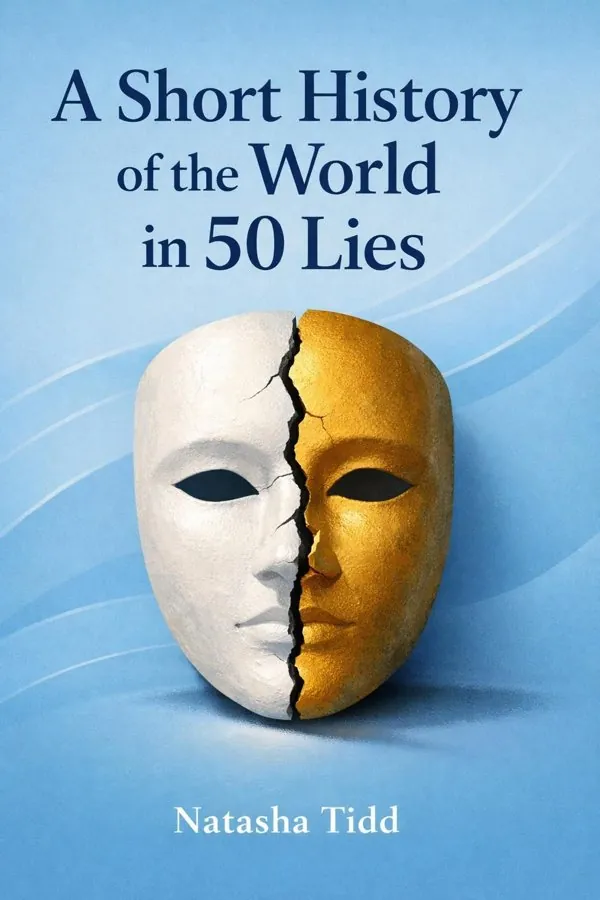
A Short History of the World in 50 Lies: Summary & Key Insights
by Natasha Tidd
 10 min9 chaptersAudio available
Key Takeaways from A Short History of the World in 50 Lies
Civilization did not begin with pure truth; it began with persuasive stories.
Faith can inspire compassion, meaning, and social cohesion, but history shows that religious storytelling has also been used to manipulate.
Empires rarely describe themselves as exploitative.
Nations are held together not only by borders and laws, but by shared stories about who "we" are.
People rarely believe falsehoods simply because they are uninformed.
What Is A Short History of the World in 50 Lies About?
A Short History of the World in 50 Lies by Natasha Tidd is a biographies book spanning 4 pages. What if many of the stories we take for granted about civilization were shaped not by truth, but by persuasion, myth, and strategic deception? In A Short History of the World in 50 Lies, historian Natasha Tidd examines how falsehood has influenced human history across empires, religions, politics, science, war, and media. Rather than treating lies as rare exceptions, she shows that they have often been central tools of power—used to justify authority, rally populations, erase inconvenient facts, and create identities that feel permanent even when they are carefully constructed. The book matters because it connects past manipulations to the information crises of the present. Tidd makes clear that misinformation did not begin with social media; it has accompanied humanity from royal courts and sacred texts to newspapers, radio broadcasts, and digital platforms. Her approach is engaging and accessible, combining sharp historical storytelling with a broader argument about why people believe what they believe. As a historian focused on hidden narratives and the social impact of misinformation, Tidd is especially well placed to reveal how lies travel, why they endure, and what they cost. This is a lively, unsettling guide to the fictions that helped shape the world.
This FizzRead summary covers all 9 key chapters of A Short History of the World in 50 Lies in approximately 10 minutes, distilling the most important ideas, arguments, and takeaways from Natasha Tidd's work. Also available as an audio summary and Key Quotes Podcast.
A Short History of the World in 50 Lies
What if many of the stories we take for granted about civilization were shaped not by truth, but by persuasion, myth, and strategic deception? In A Short History of the World in 50 Lies, historian Natasha Tidd examines how falsehood has influenced human history across empires, religions, politics, science, war, and media. Rather than treating lies as rare exceptions, she shows that they have often been central tools of power—used to justify authority, rally populations, erase inconvenient facts, and create identities that feel permanent even when they are carefully constructed.
The book matters because it connects past manipulations to the information crises of the present. Tidd makes clear that misinformation did not begin with social media; it has accompanied humanity from royal courts and sacred texts to newspapers, radio broadcasts, and digital platforms. Her approach is engaging and accessible, combining sharp historical storytelling with a broader argument about why people believe what they believe. As a historian focused on hidden narratives and the social impact of misinformation, Tidd is especially well placed to reveal how lies travel, why they endure, and what they cost. This is a lively, unsettling guide to the fictions that helped shape the world.
Who Should Read A Short History of the World in 50 Lies?
This book is perfect for anyone interested in biographies and looking to gain actionable insights in a short read. Whether you're a student, professional, or lifelong learner, the key ideas from A Short History of the World in 50 Lies by Natasha Tidd will help you think differently.
- ✓Readers who enjoy biographies and want practical takeaways
- ✓Professionals looking to apply new ideas to their work and life
- ✓Anyone who wants the core insights of A Short History of the World in 50 Lies in just 10 minutes
Want the full summary?
Get instant access to this book summary and 100K+ more with Fizz Moment.
Get Free SummaryAvailable on App Store • Free to download
Key Chapters
Civilization did not begin with pure truth; it began with persuasive stories. One of Natasha Tidd’s most striking insights is that in the ancient world, deception was often woven into the machinery of survival, rulership, and social control. Early kings, priests, and state-builders understood that legitimacy was fragile. Armies could conquer territory, but stories made conquest feel natural, ordained, and permanent. Claims of divine ancestry, exaggerated military victories, and carefully staged rituals helped rulers transform force into authority.
In many early societies, these deceptions were not always treated as moral failures. They were strategic acts. A ruler who convinced people that the gods had chosen him could reduce rebellion. A city that mythologized its founding could unify competing groups under one identity. Even monumental inscriptions often presented selective versions of events, highlighting triumph while burying defeat. Historical memory was shaped as much by propaganda as by fact.
This matters today because modern institutions still rely on narratives of origin, mission, and destiny. Companies polish their founding myths. Nations celebrate simplified histories. Leaders still understand that people rarely follow raw data; they follow emotionally satisfying stories. The ancient pattern remains familiar: control the narrative, and you influence behavior.
A practical way to apply this insight is to question stories that seem too neat, heroic, or inevitable. When an institution claims timeless greatness, ask what has been omitted, who benefits from the tale, and which voices were excluded. The actionable takeaway is simple: whenever power presents itself as natural or sacred, look closely at the story doing the legitimizing.
Faith can inspire compassion, meaning, and social cohesion, but history shows that religious storytelling has also been used to manipulate. Tidd explores how spiritual authority has often depended on controlling narratives about miracles, origins, enemies, and divine approval. Some of these stories served communal purposes, offering moral structure or hope in uncertain times. Others justified hierarchy, exclusion, conquest, and violence. The crucial point is not that religion is false, but that religious institutions have repeatedly used selective truth and outright invention to consolidate influence.
Sacred claims carry unusual force because they are often treated as beyond debate. When leaders frame political goals as divine will, disagreement becomes heresy rather than discussion. Across history, forged documents, embellished relic traditions, invented genealogies, and mythologized martyrdoms have all helped strengthen institutions and discipline populations. In many cases, believers were not simply duped; they participated in preserving stories that gave their communities identity and purpose. That is what makes these fabrications powerful: they satisfy emotional and social needs as well as institutional ones.
The lesson extends beyond formal religion. Modern ideologies can function in similar ways, creating sacred values, untouchable texts, and moral insiders and outsiders. Whenever a narrative becomes unquestionable, deception gains room to operate.
Readers can apply this insight by separating personal belief from institutional claims. Respecting spiritual traditions does not require accepting every historical assertion attached to them. Look for evidence, provenance, and motive, especially when divine language is used to justify worldly power. The actionable takeaway is to treat absolute claims with humility and curiosity: the more a story demands obedience, the more carefully it should be examined.
Empires rarely describe themselves as exploitative. They present expansion as order, civilization, protection, or destiny. Tidd shows that imperial systems have depended not only on military force and economic extraction, but also on persuasive lies that recast domination as moral duty. Colonizers claimed to bring law to chaos, enlightenment to ignorance, and progress to backward lands. These narratives did not merely excuse empire after the fact; they made empire possible by helping citizens, soldiers, and administrators believe they were participating in a righteous project.
Propaganda smoothed over brutality. Mass violence became pacification. Resource theft became development. Cultural erasure became education. Such language mattered because most people do not want to see themselves as villains. Imperial lies offered psychological comfort to those benefiting from conquest while silencing those suffering under it. Maps, schoolbooks, speeches, missionary accounts, and exhibitions all reinforced the same message: empire was natural, beneficial, and inevitable.
The patterns remain relevant. Modern powers still use humanitarian rhetoric, security claims, and development language to defend actions that may have more self-interested motives. Media framing can sanitize aggression by choosing words that hide agency and consequence. The imperial playbook survives whenever domination is renamed as assistance.
A useful application is to listen carefully to the language of intervention. Ask who gets to define terms like stability, progress, and civilization. Compare official narratives with testimony from those on the receiving end of power. The actionable takeaway is to mistrust any system that consistently portrays its own expansion as generosity; noble language often deserves a hard look at material interests beneath it.
Nations are held together not only by borders and laws, but by shared stories about who "we" are. Tidd argues that these stories are often built on selective memory. Founding moments are polished into moral parables. Defeats become heroic sacrifices. Internal conflicts are minimized in favor of unity. Atrocities are reframed, denied, or pushed to the margins. The result is not simply historical error, but a usable past—a version of history designed to produce loyalty, pride, and continuity.
These myths are powerful because identity is emotional before it is analytical. People want to belong to something honorable. National narratives answer that desire by simplifying the messy record of history into stories with clear heroes, villains, and lessons. School curricula, monuments, commemorations, and political speeches repeat the same themes until they feel like common sense. Once absorbed, these myths shape what citizens see as possible or permissible in the present.
The danger is that a nation unable to confront its own distortions becomes vulnerable to manipulation. Leaders can reactivate old myths during crises, invoking glorious pasts or invented grievances to justify exclusion, censorship, or aggression. Healthy patriotism requires honesty, not mythic purity.
A practical example is how communities debate statues, holidays, or textbook standards. These fights are not just about the past; they are about which version of belonging will guide the future. The actionable takeaway is to seek fuller history rather than comforting history. Ask what your nation celebrates, what it avoids, and how those choices shape civic behavior today.
People rarely believe falsehoods simply because they are uninformed. Tidd emphasizes that political lies succeed when they meet emotional needs: fear, hope, resentment, pride, or the desire for certainty. A misleading claim that explains hardship, identifies an enemy, or promises restoration can feel more satisfying than a complicated truth. This is why propaganda often outperforms careful analysis. It offers not just information, but emotional relief.
Throughout history, politicians have understood this deeply. Conspiracy theories mobilize because they transform confusion into clarity. Scapegoating works because it gives suffering a target. Grand promises gain traction because they replace gradual reform with dramatic rescue. In each case, the lie is not random. It is tailored to the psychological landscape of its audience.
This insight helps explain why fact-checking alone often fails. Correcting information is necessary, but it does not automatically address the identity or emotion sustaining belief. If a false story helps someone feel safe, righteous, or included, evidence may be experienced as a threat. Effective resistance to deception therefore requires empathy as well as skepticism.
In practical terms, this means paying attention to your own reactions before sharing or endorsing a claim. Does it flatter your side? Confirm your fears? Offer a suspiciously simple explanation? Those are warning signs. It also means engaging others by understanding what a belief is doing for them, not just whether it is true. The actionable takeaway is to pause whenever a political message feels instantly satisfying; emotional ease is often where manipulation enters.
Every new communication technology arrives with promises of greater access to truth, and nearly every one becomes a vehicle for new forms of deception. Tidd places the digital age in a long historical line that includes rumor networks, royal proclamations, pamphlets, newspapers, radio, photography, and television. The tools change, but the pattern remains: technologies that spread information quickly also spread manipulation faster, farther, and more persuasively.
What changes with each media shift is scale, speed, and believability. Print enabled mass ideological campaigns. Photography created the illusion that seeing was proof, even when images were staged or cropped. Radio gave propaganda an intimate voice. Television rewarded spectacle. Social media combines all of these while adding algorithmic amplification, targeted messaging, and endless repetition. The modern challenge is not just false content but environments designed to reward engagement over accuracy.
This historical perspective is useful because it prevents fatalism. Today’s misinformation crisis is serious, but it is not entirely new. Humans have always had to navigate manipulated media. The difference is that we now encounter more of it, more often, with less friction before sharing.
A practical response is to build deliberate habits: verify before reposting, trace sensational claims to original sources, diversify where you get news, and be suspicious of content engineered to provoke immediate outrage. Institutions can help through media literacy and transparency, but individual discipline still matters. The actionable takeaway is to treat speed as a risk factor; the faster a claim spreads and the stronger it makes you feel, the more carefully you should slow down and inspect it.
The past does not reach us untouched. One of Tidd’s most important contributions is reminding readers that history is filtered through archives created by people with power, literacy, and institutional backing. That means many so-called historical truths reflect not the whole past, but the surviving version of it. Conquerors preserve their triumphs. Governments classify their embarrassments. Elites commission flattering accounts. Entire communities can disappear from the record except through hostile descriptions written by others.
This does not mean history is impossible. It means history requires interpretation, comparison, and humility. A single document may reveal as much about the author’s motives as about the event it describes. Silence in the record can also be meaningful. If laborers, women, enslaved people, or colonized populations appear only faintly, that absence may reflect systematic exclusion rather than lack of historical importance.
For readers, this insight transforms how to approach any historical narrative. Instead of asking only, "What happened?" ask, "Who got to record it?" and "Whose account became official?" This method is useful beyond academic history. In workplaces, families, and public life, the first documented version of events often comes from those with the most authority, not necessarily the most accuracy.
A practical application is to seek multiple sources, especially when studying contentious events. Memoirs, letters, oral histories, material culture, and marginalized scholarship can all complicate dominant narratives. The actionable takeaway is to read records as constructed evidence, not neutral windows. If a story comes from the winners, assume it may be incomplete and keep looking.
Some lies begin as temporary tools and end up structuring entire societies. Tidd highlights how falsehoods can outgrow the people who invented them. A fabricated claim introduced to solve one short-term problem—winning support, discrediting a rival, protecting an institution—may become embedded in education, law, ritual, or collective memory. Once a lie becomes useful to enough people, it no longer needs its original author to survive.
This endurance comes from repetition and reward. If a myth justifies status, income, or belonging, there is little incentive to abandon it. Later generations may inherit the lie sincerely, believing they are defending tradition rather than perpetuating distortion. That is why dismantling longstanding falsehoods often feels threatening. It is not just facts that are challenged, but identities and advantages built upon them.
Examples appear across history: racial pseudoscience that rationalized exploitation, invented traditions that gave modern institutions ancient prestige, or wartime myths that shaped national memory for decades. Even when evidence accumulates against them, such lies can persist because they organize social life. Truth alone does not erase systems that benefit from fiction.
Understanding this helps readers stay patient and strategic. Correcting a falsehood may require changing incentives, institutions, and public rituals—not just publishing better information. In everyday life, it also encourages reflection on family stories, workplace assumptions, and inherited beliefs that have become "true" through repetition rather than evidence. The actionable takeaway is to ask not only whether a claim is false, but what social work it performs; the more useful a lie is, the harder it will be to dislodge.
A history of deception can easily lead to despair. If lies are everywhere, why trust anything? Tidd’s deeper message resists that conclusion. The answer to manipulation is not total cynicism, but disciplined skepticism. Cynicism assumes everyone lies and nothing matters. Skepticism asks better questions, weighs evidence, and remains open to revision. That distinction is essential. People who believe nothing are often as vulnerable as people who believe everything, because they can be drawn toward whichever narrative feels most powerful in the moment.
Tidd’s survey of historical lies ultimately argues for intellectual responsibility. We cannot outsource judgment to authorities, traditions, or algorithms, but neither can we live without standards of credibility. Truth-seeking is imperfect, collective, and ongoing. It depends on comparison, transparency, context, and the willingness to admit error. These habits are not glamorous, yet they are the best defense against repeated manipulation.
This idea has immediate practical value. In a workplace, it means checking the evidence behind confident claims. In civic life, it means supporting institutions that investigate, archive, and verify. In personal life, it means distinguishing between healthy doubt and performative disbelief. The goal is not to become permanently suspicious of everyone, but to become more conscious of how belief is formed.
An effective routine might include asking four questions of any strong claim: What is the source? What is the evidence? Who benefits if I believe this? What would change my mind? The actionable takeaway is to practice active, not passive, truthfulness: build habits that make you harder to deceive without becoming incapable of trust.
All Chapters in A Short History of the World in 50 Lies
About the Author
Natasha Tidd is a historian and writer whose work focuses on social history, public memory, and the hidden narratives behind major world events. She is especially interested in the ways misinformation, mythmaking, and selective storytelling shape how societies understand the past. Known for her accessible style, Tidd translates complex historical debates into engaging narratives for general readers without losing analytical depth. Her writing often explores the intersection of power and belief, showing how official histories are constructed, challenged, and revised over time. In A Short History of the World in 50 Lies, she draws on that expertise to trace deception across centuries, connecting ancient propaganda and religious fabrication to imperial ideology, national myth, and modern misinformation. Her work invites readers to approach history with curiosity, skepticism, and a sharper awareness of how narratives influence the present.
Get This Summary in Your Preferred Format
Read or listen to the A Short History of the World in 50 Lies summary by Natasha Tidd anytime, anywhere. FizzRead offers multiple formats so you can learn on your terms — all free.
Available formats: App · Audio · PDF · EPUB — All included free with FizzRead
Download A Short History of the World in 50 Lies PDF and EPUB Summary
Key Quotes from A Short History of the World in 50 Lies
“Civilization did not begin with pure truth; it began with persuasive stories.”
“Faith can inspire compassion, meaning, and social cohesion, but history shows that religious storytelling has also been used to manipulate.”
“Empires rarely describe themselves as exploitative.”
“Nations are held together not only by borders and laws, but by shared stories about who "we" are.”
“People rarely believe falsehoods simply because they are uninformed.”
Frequently Asked Questions about A Short History of the World in 50 Lies
A Short History of the World in 50 Lies by Natasha Tidd is a biographies book that explores key ideas across 9 chapters. What if many of the stories we take for granted about civilization were shaped not by truth, but by persuasion, myth, and strategic deception? In A Short History of the World in 50 Lies, historian Natasha Tidd examines how falsehood has influenced human history across empires, religions, politics, science, war, and media. Rather than treating lies as rare exceptions, she shows that they have often been central tools of power—used to justify authority, rally populations, erase inconvenient facts, and create identities that feel permanent even when they are carefully constructed. The book matters because it connects past manipulations to the information crises of the present. Tidd makes clear that misinformation did not begin with social media; it has accompanied humanity from royal courts and sacred texts to newspapers, radio broadcasts, and digital platforms. Her approach is engaging and accessible, combining sharp historical storytelling with a broader argument about why people believe what they believe. As a historian focused on hidden narratives and the social impact of misinformation, Tidd is especially well placed to reveal how lies travel, why they endure, and what they cost. This is a lively, unsettling guide to the fictions that helped shape the world.
You Might Also Like
An American Marriage
Tayari Jones
10 min
Benjamin Franklin: An American Life
Walter Isaacson
10 min
I Know Why The Caged Bird Sings
Maya Angelou
10 min
Long Walk to Freedom
Nelson Mandela
10 min
Persepolis
Marjane Satrapi
10 min
Surely You're Joking, Mr. Feynman!
Richard P. Feynman
10 minBrowse by Category
Ready to read A Short History of the World in 50 Lies?
Get the full summary and 100K+ more books with Fizz Moment.