
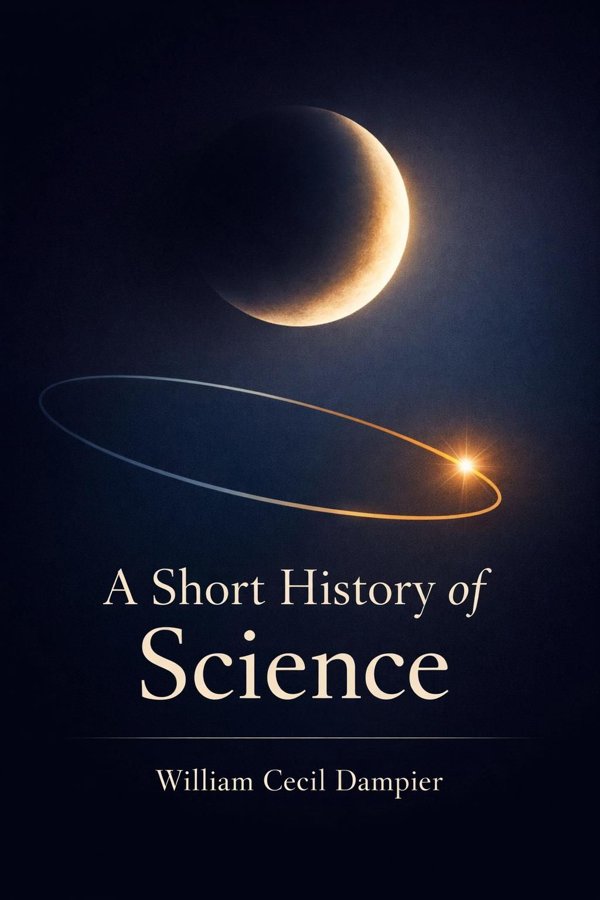
A Short History of Science: Summary & Key Insights
 10 min12 chaptersAudio available
What Is A Short History of Science About?
A Short History of Science by William Cecil Dampier is a popular_sci book spanning 12 pages. This book provides a concise overview of the development of scientific thought and discovery from ancient times to the early twentieth century. Dampier traces the evolution of key ideas in physics, chemistry, biology, and astronomy, showing how they shaped modern science. Written in accessible language, it serves as both an introduction and a historical reflection on the progress of human understanding.
This FizzRead summary covers all 12 key chapters of A Short History of Science in approximately 10 minutes, distilling the most important ideas, arguments, and takeaways from William Cecil Dampier's work. Also available as an audio summary and Key Quotes Podcast.
A Short History of Science
This book provides a concise overview of the development of scientific thought and discovery from ancient times to the early twentieth century. Dampier traces the evolution of key ideas in physics, chemistry, biology, and astronomy, showing how they shaped modern science. Written in accessible language, it serves as both an introduction and a historical reflection on the progress of human understanding.
Who Should Read A Short History of Science?
This book is perfect for anyone interested in popular_sci and looking to gain actionable insights in a short read. Whether you're a student, professional, or lifelong learner, the key ideas from A Short History of Science by William Cecil Dampier will help you think differently.
- ✓Readers who enjoy popular_sci and want practical takeaways
- ✓Professionals looking to apply new ideas to their work and life
- ✓Anyone who wants the core insights of A Short History of Science in just 10 minutes
Want the full summary?
Get instant access to this book summary and 100K+ more with Fizz Moment.
Get Free SummaryAvailable on App Store • Free to download
Key Chapters
The story of science begins long before the Greeks, in the lands where written history itself was born—Mesopotamia and Egypt. These early civilizations were not yet scientific in a modern sense, but their concerns with measurement, prediction, and order became the seeds from which science would grow. The Egyptians observed the regular flooding of the Nile and learned to read the heavens to mark time; the Mesopotamians charted planetary movements to construct calendars and predict eclipses. Though they interpreted these events in religious terms, their empirical methods revealed an instinct for regularity and cause.
It was in Greece where these practical traditions met philosophical speculation. Greek thinkers asked why the world behaved as it did, seeking principles underlying experience. Thales looked for a fundamental substance; Pythagoras found deep meaning in number; Democritus imagined atoms—a bold conceptual leap centuries ahead of verification. These were not isolated musings but part of a growing conviction that nature could be reasoned about rather than merely worshiped.
Greek science created what we may call natural philosophy—a synthesis of observation and logic. It gave birth to the idea that nature possesses order accessible to human reason. This intellectual shift was momentous: it separated rational inquiry from myth and asserted that knowledge could be cumulative, built upon what came before. Science became, from this moment, a conversation extending across generations.
No account of early science can omit Aristotle, whose system of classification and logical reasoning dominated thought for two thousand years. He sought to understand change, matter, and cause through meticulous observation and systematic deduction. To Aristotle, knowledge began with the senses but attained truth through reason—a union that would later define scientific thinking itself. Though many of his theories proved incorrect, his method was revolutionary. He formalized induction and deduction and proposed that nature operated by identifiable principles.
Archimedes, working with extraordinary mathematical clarity, extended scientific method into the realm of mechanics and hydrostatics. His approach combined precise measurement with theoretical insight—a manifestation of the quantitative spirit that would later shape modern physics. Greek philosophy also brought forth the notion of geometrical beauty as truth, an aesthetic which influenced Copernicus and Kepler centuries later.
Greek science matured through dialogue: Plato’s idealism countered Aristotle’s empiricism; the Stoics pondered a cosmos governed by divine reason. The tensions among these schools created fertile ground for intellectual progress. What the Greeks achieved was not completion but foundation—a recognition that truth demanded both thought and evidence. Their intellectual architecture became the scaffolding upon which later centuries would build.
+ 10 more chapters — available in the FizzRead app
All Chapters in A Short History of Science
About the Author
William Cecil Dampier (1867–1952) was a British scientist and historian of science. Educated at Cambridge, he contributed to zoology and physics before turning to the history and philosophy of science. His works, including 'A Short History of Science', are known for their clarity and synthesis of scientific development.
Get This Summary in Your Preferred Format
Read or listen to the A Short History of Science summary by William Cecil Dampier anytime, anywhere. FizzRead offers multiple formats so you can learn on your terms — all free.
Available formats: App · Audio · PDF · EPUB — All included free with FizzRead
Download A Short History of Science PDF and EPUB Summary
Key Quotes from A Short History of Science
“The story of science begins long before the Greeks, in the lands where written history itself was born—Mesopotamia and Egypt.”
“No account of early science can omit Aristotle, whose system of classification and logical reasoning dominated thought for two thousand years.”
Frequently Asked Questions about A Short History of Science
A Short History of Science by William Cecil Dampier is a popular_sci book that explores key ideas across 12 chapters. This book provides a concise overview of the development of scientific thought and discovery from ancient times to the early twentieth century. Dampier traces the evolution of key ideas in physics, chemistry, biology, and astronomy, showing how they shaped modern science. Written in accessible language, it serves as both an introduction and a historical reflection on the progress of human understanding.
You Might Also Like

Structures: Or Why Things Don"t Fall Down
J.E. Gordon
10 min
The Road to Wigan Pier
George Orwell
10 min
Bonk: The Curious Coupling of Science and Sex
Mary Roach
10 min
First Bite: How We Learn to Eat
Bee Wilson
10 min
In Pursuit Of The Unknown: 17 Equations That Changed The World
Ian Stewart
10 min
Napoleon's Buttons: 17 Molecules That Changed History
Penny Le Couteur and Jay Burreson
10 minFeatured In
Browse by Category
Ready to read A Short History of Science?
Get the full summary and 100K+ more books with Fizz Moment.