
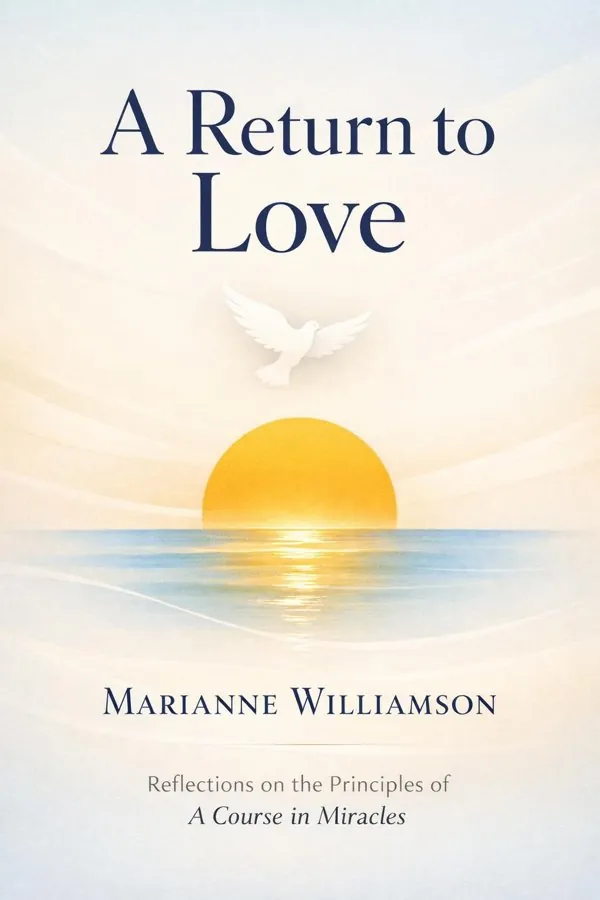
A Return to Love: Summary & Key Insights
 10 min9 chaptersAudio available
Key Takeaways from A Return to Love
Most people think a miracle must be dramatic, supernatural, or impossible to explain.
One of the book’s most powerful claims is that every action is either an expression of love or a call for love.
The ego, in Williamson’s framework, is not simply confidence or identity.
Forgiveness in A Return to Love is not presented as moral duty or passive acceptance.
Williamson sees relationships not merely as sources of comfort or disappointment, but as spiritual assignments.
What Is A Return to Love About?
A Return to Love by Marianne Williamson is a self-help book published in 1992 spanning 11 pages. A Return to Love is Marianne Williamson’s influential guide to spiritual healing, emotional transformation, and inner peace, built around the teachings of A Course in Miracles. First published in 1992, the book argues that most human suffering stems from fear, guilt, and the illusion of separation, while healing begins when we consciously choose love instead. Williamson translates the Course’s often abstract spiritual ideas into accessible reflections on relationships, work, health, money, and self-worth, showing how these principles can be lived in everyday life. What makes the book enduring is its combination of spiritual depth and practical relevance. Williamson does not present love as sentimentality or passivity, but as a disciplined inner orientation that dissolves resentment, softens the ego, and restores a sense of wholeness. Her message has resonated with millions because it speaks to ordinary struggles: conflict, insecurity, loneliness, ambition, heartbreak, and the desire for meaning. As one of the best-known interpreters of A Course in Miracles, Williamson brings credibility, warmth, and conviction to the subject. A Return to Love remains a modern classic for readers seeking a more peaceful, generous, and spiritually grounded way to live.
This FizzRead summary covers all 9 key chapters of A Return to Love in approximately 10 minutes, distilling the most important ideas, arguments, and takeaways from Marianne Williamson's work. Also available as an audio summary and Key Quotes Podcast.
A Return to Love
A Return to Love is Marianne Williamson’s influential guide to spiritual healing, emotional transformation, and inner peace, built around the teachings of A Course in Miracles. First published in 1992, the book argues that most human suffering stems from fear, guilt, and the illusion of separation, while healing begins when we consciously choose love instead. Williamson translates the Course’s often abstract spiritual ideas into accessible reflections on relationships, work, health, money, and self-worth, showing how these principles can be lived in everyday life.
What makes the book enduring is its combination of spiritual depth and practical relevance. Williamson does not present love as sentimentality or passivity, but as a disciplined inner orientation that dissolves resentment, softens the ego, and restores a sense of wholeness. Her message has resonated with millions because it speaks to ordinary struggles: conflict, insecurity, loneliness, ambition, heartbreak, and the desire for meaning. As one of the best-known interpreters of A Course in Miracles, Williamson brings credibility, warmth, and conviction to the subject. A Return to Love remains a modern classic for readers seeking a more peaceful, generous, and spiritually grounded way to live.
Who Should Read A Return to Love?
This book is perfect for anyone interested in self-help and looking to gain actionable insights in a short read. Whether you're a student, professional, or lifelong learner, the key ideas from A Return to Love by Marianne Williamson will help you think differently.
- ✓Readers who enjoy self-help and want practical takeaways
- ✓Professionals looking to apply new ideas to their work and life
- ✓Anyone who wants the core insights of A Return to Love in just 10 minutes
Want the full summary?
Get instant access to this book summary and 100K+ more with Fizz Moment.
Get Free SummaryAvailable on App Store • Free to download
Key Chapters
Most people think a miracle must be dramatic, supernatural, or impossible to explain. Williamson offers a more intimate definition: a miracle is a change in perception from fear to love. In that sense, miracles are not rare interruptions of reality; they are corrections in how we see reality. A miracle happens when resentment turns into compassion, when blame gives way to understanding, or when anxiety loosens because we remember that our deeper identity is not fragile or alone.
This idea matters because it places spiritual transformation within reach. You do not need a mystical vision to experience a miracle. If you pause during an argument and choose curiosity over attack, that is a miracle. If you stop interpreting someone’s coldness as proof that you are unworthy and instead see their behavior as an expression of pain, that too is a miracle. The outer situation may not change immediately, but your inner world does, and that shift often alters what becomes possible next.
Williamson’s point is that perception shapes experience. Fear-based thinking narrows us, making us defensive, suspicious, and reactive. Love-based perception opens us, allowing for forgiveness, creativity, and peace. In practical terms, this means that when you feel disturbed, the first question is not “How do I control this situation?” but “How can I see this differently?” The miracle begins there.
Actionable takeaway: The next time you feel upset, stop and ask, “What would love have me see here?” Write down your first honest answer and let that guide your next response.
One of the book’s most powerful claims is that every action is either an expression of love or a call for love. This reframes the way we understand conflict, cruelty, jealousy, and emotional withdrawal. Instead of treating fear as an independent force, Williamson suggests that fear is love distorted by forgetfulness. When people attack, manipulate, boast, or shut down, they are usually acting from disconnection, not strength.
This perspective can radically soften judgment without excusing harmful behavior. For example, a controlling boss may appear arrogant, but underneath may be insecurity and fear of failure. A partner who criticizes constantly may actually fear abandonment. Even your own perfectionism might be a frightened attempt to earn worth. Seeing fear as a call for love does not mean tolerating abuse or abandoning boundaries. It means refusing to interpret pain only at the surface level.
Applied practically, this teaching changes both self-talk and relationships. When you make a mistake, instead of spiraling into shame, you can recognize that harsh self-criticism is fear asking to be met with compassion. When someone is difficult, you can respond more wisely by grounding yourself rather than escalating the emotional charge. Love becomes not indulgence, but clarity.
Williamson’s larger insight is that fear cannot be defeated by force. It can only be dissolved by the presence of love, truth, and awareness. The more often you choose to interpret life this way, the less personal many hurts become and the freer you feel.
Actionable takeaway: For one day, reinterpret every upsetting behavior—yours or someone else’s—as fear or a call for love. Notice how this changes the tone of your reactions.
The ego, in Williamson’s framework, is not simply confidence or identity. It is the false self built on separation, comparison, and defensiveness. It whispers that you are alone, that you must compete to survive, and that your value depends on being superior, admired, or protected. The ego feeds on grievance because grievances reinforce the illusion that we are isolated individuals under attack.
This is why ego-driven living feels exhausting. If your worth depends on winning, being right, looking better, or never being rejected, then life becomes a constant battlefield. Small slights feel enormous. Other people’s success feels threatening. Vulnerability seems dangerous. The ego cannot rest because it is built on instability.
Williamson invites readers to recognize that the ego is not their true self. Beneath the defensive personality is a deeper identity rooted in love, connection, and spiritual wholeness. This does not erase individuality; rather, it places individuality within a larger truth. You can still pursue goals, speak honestly, and protect your boundaries, but you no longer need to make your identity out of attack or control.
A practical example is how you respond to criticism. The ego either collapses into shame or rises into counterattack. A more loving self can evaluate the feedback calmly: Is there something useful here? If yes, learn. If not, release it. The point is not to eliminate personality but to stop worshipping the frightened voice inside it.
Actionable takeaway: When you feel defensive, ask, “What identity am I trying to protect right now?” Then ask, “Who am I if I do not need to defend that image?”
Forgiveness in A Return to Love is not presented as moral duty or passive acceptance. It is a psychological and spiritual release that frees the mind from the burden of grievance. Williamson emphasizes that unforgiveness ties us to the very pain we say we want to escape. We replay injuries, re-justify resentment, and unknowingly let the past govern our present emotional life.
This kind of forgiveness does not deny hurt. It begins by acknowledging that pain is real, but it refuses to build identity around victimhood. To forgive is to surrender the demand that the past be different. It is to stop letting another person’s confusion continue living rent-free in your nervous system. Sometimes forgiveness includes reconciliation; often it does not. You can forgive someone and still choose distance, boundaries, or even permanent separation.
Williamson also turns forgiveness inward. Many people suffer less from what happened to them than from the story they tell afterward: “I should have known better,” “I ruined everything,” “I’m unlovable.” Self-forgiveness interrupts this cycle. It allows learning without self-condemnation.
Consider a friendship betrayal. Without forgiveness, you may become suspicious of everyone. With forgiveness, you grieve honestly, set wiser standards, and remain open to future connection. The wound becomes part of your story, not the ruler of it.
Forgiveness is ultimately practical because it restores energy. Mental space once consumed by bitterness becomes available for presence, creativity, and peace.
Actionable takeaway: Identify one resentment you are carrying. Write a short sentence beginning with, “I am willing to release this burden, even if I am not fully ready to forgive yet.” Repeat it daily for a week.
Williamson sees relationships not merely as sources of comfort or disappointment, but as spiritual assignments. The people closest to us expose our attachments, wounds, fears, and expectations more clearly than almost anything else. In this sense, relationships are classrooms in which we learn where we are still choosing fear over love.
Romantic relationships are especially revealing. We may look to partners to complete us, validate us, or rescue us from loneliness. When they fail to carry that impossible burden, conflict follows. Williamson encourages a different model: relationships thrive not when two incomplete people try to possess each other, but when two people bring their wholeness, honesty, and willingness to grow. Love is then less about dependency and more about shared awakening.
This applies beyond romance. Family relationships can trigger old patterns of guilt, obligation, and resentment. Friendships can reveal envy or avoidance. Workplace dynamics can uncover approval-seeking and insecurity. Each interaction becomes an opportunity to ask: Am I trying to control, punish, impress, or hide? Or am I willing to be truthful, compassionate, and responsible?
Seeing relationships this way does not make them easy, but it makes them meaningful. Instead of asking only, “How can I get what I need from this person?” you begin asking, “What is this relationship here to teach me about love?” That question changes everything.
Actionable takeaway: Choose one important relationship and list three recurring emotional patterns it brings up in you. Then identify one loving behavior you can practice the next time that pattern appears.
Many people divide life into separate compartments: spirituality belongs to prayer, while work and money belong to ambition, pressure, and survival. Williamson challenges that split. She argues that our careers and finances reflect the same inner dynamics as the rest of life. If we bring fear, scarcity, and ego into work, we create stress and competition. If we bring service, trust, and purpose, work becomes an arena for contribution.
This does not mean becoming passive or pretending practical realities do not matter. Bills must still be paid, and effort still matters. But Williamson suggests that abundance flows more naturally when our work aligns with love rather than with desperation. The central question becomes not “How do I squeeze the most out of life?” but “How can I serve through what I do?” Service-oriented work tends to create deeper trust, stronger relationships, and more meaningful success.
Her thinking about money is similarly spiritual. Money itself is neutral; what distorts it is our projection of fear onto it. Scarcity thinking says there is never enough, so we cling, hoard, compare, or panic. A more loving mindset encourages generosity, stewardship, gratitude, and confidence that value can circulate.
For example, someone in a draining job might begin by reconnecting with the human impact of their role rather than seeing it only as obligation. An entrepreneur might ask how their business can genuinely help people instead of merely chasing approval or status. Over time, this shift often changes both performance and fulfillment.
Actionable takeaway: Write a one-sentence mission for your work that focuses on service rather than self-image. Keep it visible and review it before starting each workday.
Williamson treats the body with compassion, but she does not view physical health as purely mechanical. She suggests that the body often reflects our mental and emotional condition, especially the degree of peace or conflict we carry within. Fear, repression, chronic stress, and self-attack can contribute to imbalance, while love, calm, forgiveness, and inner coherence support healing.
This idea should not be oversimplified into blame. The book does not ask readers to assume that illness is their fault or that spiritual practice replaces medical care. Rather, it invites a broader understanding of healing. True healing may involve doctors, therapy, medication, rest, nutrition, and prayer. The key is to stop treating the body as an enemy and start relating to it as a messenger and partner.
Many people use the body as a battlefield for self-worth. They criticize appearance, ignore fatigue, override emotional limits, and then wonder why they feel disconnected. Williamson’s approach encourages reverence instead of punishment. Listening to the body’s signals becomes a spiritual act: exhaustion may call for rest, tension may signal unresolved fear, compulsive habits may indicate unmet emotional needs.
Imagine someone who constantly pushes through stress until they burn out. A loving response would not be to shame themselves for weakness, but to ask what belief is driving the overexertion. Perhaps they fear they are worthy only when productive. That insight opens the door to deeper healing.
Actionable takeaway: Spend five quiet minutes each day asking your body, “What do you need from me today?” Respond with one concrete act of care.
In Williamson’s vision, spiritual practice is not an escape from daily life but a way of meeting daily life with greater wisdom. Prayer, meditation, reflection, and stillness help us step out of the ego’s noise and reconnect with a deeper center. Prayer is not merely asking for things; it is aligning our mind with love, surrendering fear, and becoming available to guidance.
This makes prayer less about control and more about relationship. Instead of demanding specific outcomes, we might pray for right perception, patience, courage, or peace. Such prayer changes the one who prays. A person who begins the day by centering themselves is less likely to be hijacked by every irritation, insecurity, or external demand.
Williamson also emphasizes willingness. You do not have to feel spiritually advanced to practice. You only need the willingness to pause and invite a different consciousness. Even a simple prayer like “Help me see this through love” can interrupt a spiral of anger or despair.
Spiritual practice becomes especially valuable during uncertainty. When facing heartbreak, job loss, illness, or conflict, the mind tends to grasp for certainty. Prayer does not always remove difficulty, but it can restore trust, making it easier to act clearly rather than react blindly.
A sustainable practice need not be elaborate. A few minutes of silence in the morning, journaling before bed, or a brief reset before difficult conversations can gradually reshape the emotional climate of a life.
Actionable takeaway: Create a two-minute daily practice: sit quietly, breathe slowly, and repeat, “I am willing to choose love instead of fear.” Do it at the same time each day for one week.
A Return to Love is not only about private serenity. Williamson argues that personal transformation and social transformation are deeply connected. A fearful world is built by fearful minds: prejudice, violence, greed, and indifference all emerge from the illusion of separation. If we want a more loving society, we cannot rely only on external reforms; we must also address the consciousness that creates destructive systems.
This does not mean social problems are solved by positive thinking alone. Rather, Williamson insists that activism without love can become self-righteous, bitter, or dehumanizing, while spirituality without social concern becomes hollow. The mature path unites inner healing with outer responsibility. As individuals become less ruled by hatred and fear, they are better able to contribute to justice, compassion, and genuine service.
This principle applies in everyday civic life. A teacher who treats students with dignity interrupts cycles of shame. A business leader who values fairness over exploitation changes workplace culture. A citizen who refuses to demonize opponents while still standing for truth helps lower collective hostility. Love here is not softness; it is moral clarity without hatred.
Williamson’s broader message is hopeful: your inner work matters beyond you. Every time you choose forgiveness over vengeance, generosity over withholding, or courage over cynicism, you participate in healing a larger field. The world is changed not only by institutions but by consciousness expressed through action.
Actionable takeaway: Identify one way your values can become visible in public life this week—through service, generosity, advocacy, or a more compassionate way of engaging with others.
All Chapters in A Return to Love
About the Author
Marianne Williamson is an American author, lecturer, and spiritual teacher widely recognized for her work in personal growth and contemporary spirituality. Born in 1952, she rose to prominence by interpreting and popularizing the teachings of A Course in Miracles for a mainstream audience. Her 1992 book A Return to Love became an international bestseller and established her as one of the most influential voices in modern spiritual self-help. Williamson’s writing focuses on love, forgiveness, inner healing, and the transformation of fear-based thinking. Beyond her books and lectures, she has also been active in charitable initiatives and public life, advocating for compassion-centered approaches to social and political issues. Her work continues to resonate with readers seeking meaning, emotional healing, and spiritual depth.
Get This Summary in Your Preferred Format
Read or listen to the A Return to Love summary by Marianne Williamson anytime, anywhere. FizzRead offers multiple formats so you can learn on your terms — all free.
Available formats: App · Audio · PDF · EPUB — All included free with FizzRead
Download A Return to Love PDF and EPUB Summary
Key Quotes from A Return to Love
“Most people think a miracle must be dramatic, supernatural, or impossible to explain.”
“One of the book’s most powerful claims is that every action is either an expression of love or a call for love.”
“The ego, in Williamson’s framework, is not simply confidence or identity.”
“Forgiveness in A Return to Love is not presented as moral duty or passive acceptance.”
“Williamson sees relationships not merely as sources of comfort or disappointment, but as spiritual assignments.”
Frequently Asked Questions about A Return to Love
A Return to Love by Marianne Williamson is a self-help book that explores key ideas across 9 chapters. A Return to Love is Marianne Williamson’s influential guide to spiritual healing, emotional transformation, and inner peace, built around the teachings of A Course in Miracles. First published in 1992, the book argues that most human suffering stems from fear, guilt, and the illusion of separation, while healing begins when we consciously choose love instead. Williamson translates the Course’s often abstract spiritual ideas into accessible reflections on relationships, work, health, money, and self-worth, showing how these principles can be lived in everyday life. What makes the book enduring is its combination of spiritual depth and practical relevance. Williamson does not present love as sentimentality or passivity, but as a disciplined inner orientation that dissolves resentment, softens the ego, and restores a sense of wholeness. Her message has resonated with millions because it speaks to ordinary struggles: conflict, insecurity, loneliness, ambition, heartbreak, and the desire for meaning. As one of the best-known interpreters of A Course in Miracles, Williamson brings credibility, warmth, and conviction to the subject. A Return to Love remains a modern classic for readers seeking a more peaceful, generous, and spiritually grounded way to live.
You Might Also Like


Featured In
Browse by Category
Ready to read A Return to Love?
Get the full summary and 100K+ more books with Fizz Moment.