
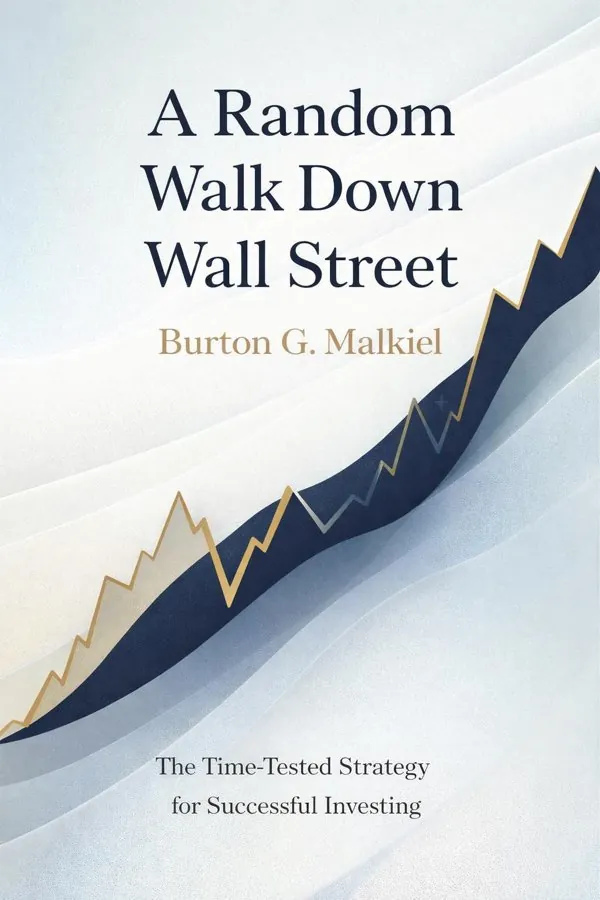
A Random Walk Down Wall Street: Summary & Key Insights
 10 min9 chaptersAudio available
Key Takeaways from A Random Walk Down Wall Street
Every generation believes its bubble is different.
If price charts truly revealed the future, Wall Street would be full of billionaires drawing trend lines.
Careful research feels like it should guarantee better returns, but Malkiel shows why even serious fundamental analysis has boundaries.
The most liberating idea in the book may also be the most unsettling: market prices already reflect a great deal of available information.
The market is not just a financial system; it is a human theater of fear, pride, envy, and overconfidence.
What Is A Random Walk Down Wall Street About?
A Random Walk Down Wall Street by Burton Malkiel is a finance book published in 1973 spanning 7 pages. What if the biggest investing advantage is not superior intelligence, secret information, or perfect timing, but the discipline to ignore noise? In A Random Walk Down Wall Street, Burton G. Malkiel makes the provocative case that most investors, including many professionals, cannot consistently beat the market. Prices, he argues, move in ways that are largely unpredictable, making elaborate forecasting systems far less useful than they appear. Instead of chasing hot stocks, market gurus, or clever charts, Malkiel urges readers to embrace a simpler path: broad diversification, low costs, and long-term patience. First published in 1973 and repeatedly updated to address new market trends, the book has become one of the most influential works in personal finance. Malkiel writes with the authority of a Princeton economist and longtime investment thinker, but his message is strikingly practical. He combines financial history, economic theory, and behavioral psychology to show why investors so often sabotage themselves. For anyone trying to build wealth without becoming a full-time market analyst, this book remains a clear, persuasive, and deeply relevant guide to rational investing.
This FizzRead summary covers all 9 key chapters of A Random Walk Down Wall Street in approximately 10 minutes, distilling the most important ideas, arguments, and takeaways from Burton Malkiel's work. Also available as an audio summary and Key Quotes Podcast.
A Random Walk Down Wall Street
What if the biggest investing advantage is not superior intelligence, secret information, or perfect timing, but the discipline to ignore noise? In A Random Walk Down Wall Street, Burton G. Malkiel makes the provocative case that most investors, including many professionals, cannot consistently beat the market. Prices, he argues, move in ways that are largely unpredictable, making elaborate forecasting systems far less useful than they appear. Instead of chasing hot stocks, market gurus, or clever charts, Malkiel urges readers to embrace a simpler path: broad diversification, low costs, and long-term patience.
First published in 1973 and repeatedly updated to address new market trends, the book has become one of the most influential works in personal finance. Malkiel writes with the authority of a Princeton economist and longtime investment thinker, but his message is strikingly practical. He combines financial history, economic theory, and behavioral psychology to show why investors so often sabotage themselves. For anyone trying to build wealth without becoming a full-time market analyst, this book remains a clear, persuasive, and deeply relevant guide to rational investing.
Who Should Read A Random Walk Down Wall Street?
This book is perfect for anyone interested in finance and looking to gain actionable insights in a short read. Whether you're a student, professional, or lifelong learner, the key ideas from A Random Walk Down Wall Street by Burton Malkiel will help you think differently.
- ✓Readers who enjoy finance and want practical takeaways
- ✓Professionals looking to apply new ideas to their work and life
- ✓Anyone who wants the core insights of A Random Walk Down Wall Street in just 10 minutes
Want the full summary?
Get instant access to this book summary and 100K+ more with Fizz Moment.
Get Free SummaryAvailable on App Store • Free to download
Key Chapters
Every generation believes its bubble is different. That is one of Burton Malkiel’s most important warnings. To understand modern investing mistakes, he begins with a tour of financial history, showing that markets have repeatedly been swept up by greed, stories, and social imitation. From Dutch tulip speculation to the South Sea Bubble and later episodes of stock market euphoria, people have consistently convinced themselves that prices could rise forever. The underlying assets change, but the emotional pattern remains the same.
Malkiel uses these episodes to demonstrate that prices can detach from reality when investors focus on excitement instead of value. In a speculative fever, buyers stop asking what an asset is worth and start asking only whether someone else will pay more tomorrow. This mindset fuels dramatic booms, but it also sets the stage for painful collapses once confidence breaks. These manias are not just historical curiosities. They reappear whenever new technologies, industries, or investment trends generate dreams of easy wealth.
You can see this pattern in internet stocks during the dot-com era, housing before the financial crisis, or any market segment where the phrase “this time is different” becomes common. Even sophisticated investors are vulnerable because bubbles are social events. It feels safer to join a crowd than to stand apart from it.
Malkiel’s deeper lesson is that successful investing requires emotional distance from market enthusiasm. When everyone is celebrating quick riches, caution becomes most valuable. Study fundamentals, question extreme narratives, and remember that excitement is not evidence.
Actionable takeaway: When an investment is soaring on hype, pause and ask whether the price is supported by realistic long-term value rather than crowd emotion.
If price charts truly revealed the future, Wall Street would be full of billionaires drawing trend lines. Malkiel challenges the promise of technical analysis, the practice of using past price patterns, trading volume, and chart formations to forecast future market moves. Technical analysts often speak confidently about support levels, resistance zones, momentum shifts, and recognizable formations such as head-and-shoulders patterns. But Malkiel argues that these patterns often look more convincing in hindsight than they are in real time.
His core point is simple: if widely known chart signals reliably predicted stock movements, investors would act on them immediately, and the opportunity would disappear. In competitive markets, useful information gets absorbed quickly into prices. That makes repeatable profits from public chart-reading methods extremely difficult. While technical analysis may sometimes appear successful over short periods, much of that success can be explained by chance, selective memory, or the tendency to highlight wins and ignore failures.
This does not mean prices move randomly from minute to minute without any influence. News, interest rates, earnings, and sentiment all matter. Malkiel’s argument is narrower and sharper: historical price data alone do not provide a dependable roadmap to future profits. Investors who rely heavily on charts may end up trading too often, paying more in taxes and fees, and reacting emotionally to noise.
In practical terms, imagine an investor constantly buying and selling based on moving averages or breakout signals. Even if a few trades work, the cumulative drag from mistakes, costs, and missed long-term compounding can outweigh any temporary advantage.
Actionable takeaway: Treat chart patterns as market entertainment, not a wealth-building system, and avoid frequent trading based solely on past price movements.
Careful research feels like it should guarantee better returns, but Malkiel shows why even serious fundamental analysis has boundaries. Fundamental analysts study financial statements, earnings growth, competitive position, management quality, and valuation metrics to estimate what a company is truly worth. This approach is more intellectually grounded than chart reading, yet Malkiel warns that it still does not offer an easy path to beating the market consistently.
Why not? Because thousands of smart investors are studying the same information. When a company’s prospects improve, prices usually adjust quickly. By the time the average investor identifies an apparently undervalued stock, much of that information may already be reflected in the price. In other words, the market is populated by professionals with powerful incentives, advanced tools, and constant access to data. Competing with them is harder than it seems.
Malkiel does not dismiss fundamental analysis as useless. It helps investors understand businesses, avoid obvious frauds, and think more clearly about risk. But he argues that many people overestimate how often they can discover mispriced securities before the broader market does. Even professional fund managers, armed with teams of analysts, frequently underperform simple index funds after fees.
Consider a retail investor who spends weeks identifying a “cheap” stock based on a low price-to-earnings ratio. That stock may be cheap for good reasons: weakening demand, regulatory pressure, or poor management. Markets are not always perfectly right, but they are usually hard to outsmart.
Malkiel’s broader message is humility. Research matters, but confidence should be tempered by the recognition that the market incorporates enormous collective intelligence.
Actionable takeaway: If you buy individual stocks, do so modestly and with humility, while keeping the core of your portfolio in diversified, low-cost funds.
The most liberating idea in the book may also be the most unsettling: market prices already reflect a great deal of available information. Malkiel’s famous “random walk” argument is tied to the efficient market hypothesis, which suggests that stock prices move in response to new information, and because new information is unpredictable, future price changes are also difficult to predict. This does not mean prices are always perfectly fair or that bubbles never occur. It means that consistently exploiting mispricings is much harder than most investors assume.
The phrase “random walk” captures the idea that short-term market movements resemble a wandering path rather than a clean, forecastable trend. Yesterday’s direction tells you little about tomorrow’s. A company can report strong earnings and still fall if expectations were even higher. A weak headline can be followed by a rally if the bad news was already priced in.
For investors, this has enormous implications. If markets are broadly efficient, then stock picking, market timing, and expert forecasting are less reliable than diversification and discipline. Rather than trying to guess which stock will outperform next year, it makes more sense to own a broad slice of the market and let economic growth work in your favor over time.
This principle explains why index funds are so powerful. They do not depend on superior prediction. They accept the market return at low cost, which often turns out to be better than the results of expensive active strategies.
Actionable takeaway: Build your strategy around the assumption that you cannot reliably forecast short-term price movements, and focus instead on broad market exposure and time in the market.
The market is not just a financial system; it is a human theater of fear, pride, envy, and overconfidence. Malkiel incorporates insights from behavioral finance to show that investors often make poor decisions not because they lack information, but because they process information irrationally. People chase winners, panic during declines, cling to losing positions, and assume they are more skilled than they really are. These biases can be more damaging than market volatility itself.
One common mistake is overconfidence. Investors remember their good calls and forget their bad ones, leading them to believe they can beat the market through skill. Another is herd behavior: when others are buying, it feels dangerous to stay out, even if prices are unreasonable. Loss aversion also plays a major role. The pain of losses feels stronger than the pleasure of gains, which can push people to sell at the worst time or avoid sensible risk altogether.
Anchoring is another trap. Investors fixate on a past stock price and treat it as meaningful even when the company’s situation has changed. Then there is recency bias, the tendency to assume that recent market trends will continue. After a long bull market, people become too optimistic. After a crash, they become too fearful.
Malkiel’s point is not that psychology occasionally matters. It matters constantly. A sound investment plan must therefore protect you from yourself. Automation, diversification, and pre-committed rules can help reduce emotion-driven mistakes.
A practical example is dollar-cost averaging into retirement accounts regardless of headlines. That simple habit prevents many impulsive decisions and turns volatility into an opportunity to buy more shares at lower prices.
Actionable takeaway: Design an investment system that minimizes emotional decision-making, such as automatic contributions, rebalancing rules, and a written long-term plan.
Sometimes the smartest strategy looks almost too simple to be true. Malkiel strongly advocates index funds because they allow investors to capture broad market returns without paying high fees for active management. Instead of trying to pick winning stocks or identify the next star fund manager, an index fund simply tracks a market benchmark such as the S&P 500 or a total stock market index. That simplicity is precisely its strength.
Active investing faces several built-in disadvantages. Managers must cover research costs, trading costs, marketing costs, and management fees. Even before those expenses, active investors as a group can only match the market, because they collectively are the market. After expenses, the average active investor must underperform. Malkiel sees this arithmetic as unavoidable. Low-cost indexing tilts the odds back toward the ordinary investor.
Index funds also reduce the risks of concentration and human error. Rather than betting on a handful of companies, you own hundreds or thousands. If one firm stumbles, the damage is limited. If innovation emerges somewhere unexpected, you still participate. This broad exposure is especially useful because the biggest long-term winners are hard to identify in advance.
For example, a young professional saving for retirement may feel tempted to chase fashionable sectors. But a low-cost total market index fund can quietly compound over decades with less stress, less guesswork, and often better outcomes. The goal is not excitement; it is dependable wealth accumulation.
Malkiel does not claim indexing is glamorous. He claims it is rational. And in investing, rationality beats drama more often than people realize.
Actionable takeaway: Make low-cost index funds the foundation of your portfolio, and judge success by long-term progress rather than short-term excitement.
Investors often obsess over which stock to buy next, but Malkiel argues that the more important decision is how to divide money across asset classes. Asset allocation means determining the right mix of stocks, bonds, cash, and sometimes real estate or other assets based on your goals, time horizon, and tolerance for risk. This allocation has a major influence on both returns and the emotional experience of investing.
Stocks generally offer higher long-term growth but come with greater short-term volatility. Bonds tend to provide more stability and income, though with lower expected returns. Cash offers safety and liquidity but loses purchasing power over time if inflation rises. The best mix depends less on market predictions than on personal circumstances. A 25-year-old saving for retirement can usually handle more stock exposure than a retiree relying on portfolio withdrawals.
Malkiel emphasizes that there is no universal ideal allocation. Instead, a suitable portfolio must reflect the investor’s stage of life and capacity to endure declines without panic. A portfolio is only effective if you can stick with it during difficult periods. That is why the “best” strategy on paper can fail in practice if it pushes you into emotional selling.
He also supports periodic rebalancing, which means restoring your target asset mix after market movements distort it. Rebalancing forces a disciplined habit of trimming assets that have become expensive and adding to those that have lagged, without relying on prediction.
For instance, a 70/30 stock-bond portfolio may drift to 80/20 after a strong stock rally. Rebalancing brings risk back in line with your original plan.
Actionable takeaway: Choose an asset allocation you can live with through market swings, and rebalance it periodically instead of reacting to headlines.
Money needed next year should not be invested like money needed in thirty years. Malkiel repeatedly stresses that investing strategy must be matched to time horizon. This principle sounds obvious, yet many costly mistakes come from ignoring it. People place short-term savings into volatile assets, panic when prices fall, or hold portfolios that are either far too risky or far too conservative for their actual goals.
A long time horizon allows investors to benefit from the compounding power of equities and to recover from market downturns. Over long periods, stocks have historically offered strong real returns, even though the path is uneven. But that advantage matters only if you can leave the money invested. If you will need funds soon for tuition, a house purchase, or emergency expenses, then preserving capital matters more than maximizing expected return.
Malkiel encourages investors to think in layers. Emergency money belongs in safe, liquid accounts. Intermediate-term goals call for more caution, perhaps with a higher share of bonds or short-term instruments. Long-term retirement money can usually bear more equity exposure. This framework reduces the temptation to sell long-term investments at bad times because near-term needs are already protected.
This idea is especially useful during market declines. If you know your retirement portfolio will not be touched for decades, a bear market becomes less threatening and more manageable. If the same money is needed in six months, volatility becomes dangerous.
The broader lesson is that risk is not just about price movement. It is about whether your portfolio matches when you need the money.
Actionable takeaway: Separate your money by goal and timeline, and invest each bucket according to when you will realistically need to use it.
Investors often search for big advantages while ignoring the small, certain losses that steadily erode wealth. Malkiel repeatedly highlights the destructive power of costs: management fees, trading commissions, taxes, bid-ask spreads, and hidden turnover expenses. These frictions may seem minor in a single year, but over decades they can consume a remarkable share of your returns.
The logic is brutal because it compounds. If one portfolio earns 8 percent before costs and another earns the same gross return but loses 1.5 percent annually to expenses, the second investor ends up dramatically poorer over time. Unlike market performance, costs are one of the few factors you can directly control. That is why Malkiel treats low-cost investing not as a detail, but as a central strategy.
Frequent trading magnifies the problem. Every trade can trigger taxes, spreads, and mistakes. An investor who constantly shifts between hot funds or reacts to market forecasts may believe they are being proactive, but they are often handing away returns. Meanwhile, a disciplined investor using low-turnover index funds keeps more of the market’s gains.
This insight also changes how you evaluate financial advice. A complex product may sound sophisticated, but if it carries high fees, sales loads, or tax inefficiency, it starts at a disadvantage. Simplicity often wins because it is cheaper.
Imagine two retirement savers making equal contributions for thirty years. The one using low-cost funds may retire with far more wealth than the one using expensive actively managed products, even if both participated in the same market.
Actionable takeaway: Audit every investment for fees, taxes, and turnover, and prefer simple, tax-efficient, low-cost vehicles whenever possible.
All Chapters in A Random Walk Down Wall Street
About the Author
Burton Gordon Malkiel is an American economist, investment writer, and professor emeritus of economics at Princeton University. He is best known for A Random Walk Down Wall Street, one of the most influential books ever written on personal investing. Malkiel helped popularize the idea that financial markets are difficult to beat consistently and that low-cost index funds offer a practical advantage for ordinary investors. Beyond academia, he has served in advisory and leadership roles in finance, giving him both theoretical and real-world credibility. His writing stands out for making complex economic ideas accessible without oversimplifying them. Through decades of updated editions and public commentary, Malkiel has remained a major voice in evidence-based investing, long-term portfolio strategy, and rational financial decision-making.
Get This Summary in Your Preferred Format
Read or listen to the A Random Walk Down Wall Street summary by Burton Malkiel anytime, anywhere. FizzRead offers multiple formats so you can learn on your terms — all free.
Available formats: App · Audio · PDF · EPUB — All included free with FizzRead
Download A Random Walk Down Wall Street PDF and EPUB Summary
Key Quotes from A Random Walk Down Wall Street
“Every generation believes its bubble is different.”
“If price charts truly revealed the future, Wall Street would be full of billionaires drawing trend lines.”
“Careful research feels like it should guarantee better returns, but Malkiel shows why even serious fundamental analysis has boundaries.”
“The most liberating idea in the book may also be the most unsettling: market prices already reflect a great deal of available information.”
“The market is not just a financial system; it is a human theater of fear, pride, envy, and overconfidence.”
Frequently Asked Questions about A Random Walk Down Wall Street
A Random Walk Down Wall Street by Burton Malkiel is a finance book that explores key ideas across 9 chapters. What if the biggest investing advantage is not superior intelligence, secret information, or perfect timing, but the discipline to ignore noise? In A Random Walk Down Wall Street, Burton G. Malkiel makes the provocative case that most investors, including many professionals, cannot consistently beat the market. Prices, he argues, move in ways that are largely unpredictable, making elaborate forecasting systems far less useful than they appear. Instead of chasing hot stocks, market gurus, or clever charts, Malkiel urges readers to embrace a simpler path: broad diversification, low costs, and long-term patience. First published in 1973 and repeatedly updated to address new market trends, the book has become one of the most influential works in personal finance. Malkiel writes with the authority of a Princeton economist and longtime investment thinker, but his message is strikingly practical. He combines financial history, economic theory, and behavioral psychology to show why investors so often sabotage themselves. For anyone trying to build wealth without becoming a full-time market analyst, this book remains a clear, persuasive, and deeply relevant guide to rational investing.
Compare A Random Walk Down Wall Street
You Might Also Like



Featured In
Browse by Category
Ready to read A Random Walk Down Wall Street?
Get the full summary and 100K+ more books with Fizz Moment.