
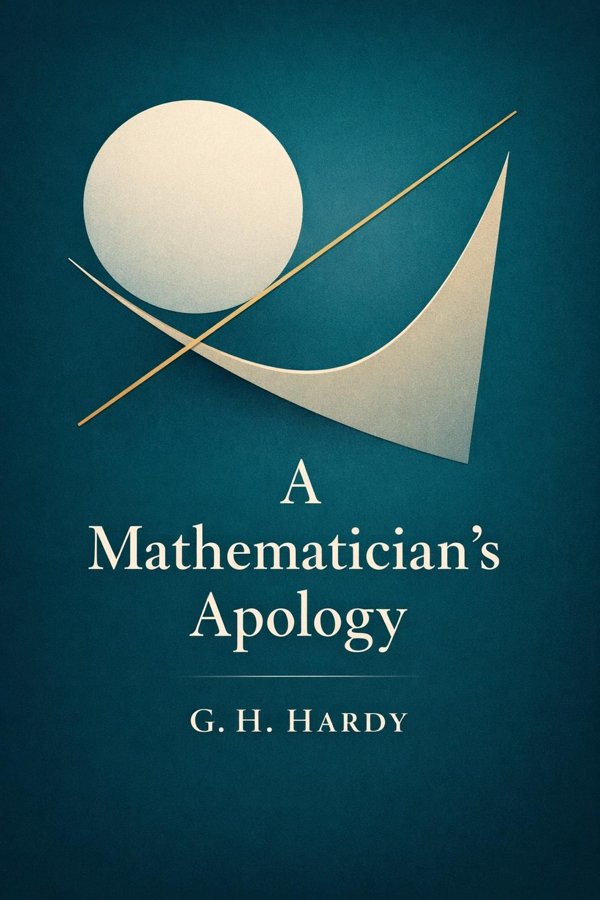
A Mathematician’s Apology: Summary & Key Insights
by G. H. Hardy
 10 min4 chaptersAudio available
What Is A Mathematician’s Apology About?
A Mathematician’s Apology by G. H. Hardy is a popular_sci book spanning 4 pages. A Mathematician’s Apology is a classic essay by the British mathematician G. H. Hardy, first published in 1940. It offers a personal reflection on the aesthetics and purpose of mathematics, defending pure mathematics as a creative art form rather than a utilitarian pursuit. Hardy discusses the beauty of mathematical thought, the motivations of mathematicians, and his own career, providing one of the most eloquent defenses of intellectual creativity in the sciences.
This FizzRead summary covers all 4 key chapters of A Mathematician’s Apology in approximately 10 minutes, distilling the most important ideas, arguments, and takeaways from G. H. Hardy's work. Also available as an audio summary and Key Quotes Podcast.
A Mathematician’s Apology
A Mathematician’s Apology is a classic essay by the British mathematician G. H. Hardy, first published in 1940. It offers a personal reflection on the aesthetics and purpose of mathematics, defending pure mathematics as a creative art form rather than a utilitarian pursuit. Hardy discusses the beauty of mathematical thought, the motivations of mathematicians, and his own career, providing one of the most eloquent defenses of intellectual creativity in the sciences.
Who Should Read A Mathematician’s Apology?
This book is perfect for anyone interested in popular_sci and looking to gain actionable insights in a short read. Whether you're a student, professional, or lifelong learner, the key ideas from A Mathematician’s Apology by G. H. Hardy will help you think differently.
- ✓Readers who enjoy popular_sci and want practical takeaways
- ✓Professionals looking to apply new ideas to their work and life
- ✓Anyone who wants the core insights of A Mathematician’s Apology in just 10 minutes
Want the full summary?
Get instant access to this book summary and 100K+ more with Fizz Moment.
Get Free SummaryAvailable on App Store • Free to download
Key Chapters
From the beginning of my career, I was confronted with a question that has plagued many mathematicians: of what use is your work? To the physicist or engineer, mathematics serves as a tool. But to those of us who are drawn to the discipline itself, mathematics transcends mere problem-solving—it is a form of creative exploration.
Applied mathematics, I have often said, is useful but ephemeral. Its relevance fades with the shifting needs of society and the progress of technology. Pure mathematics, by contrast, belongs to a different order of permanence. The truths of Euclid, the elegant symmetries of number theory—these are not contingent upon our industries or our wars. They are eternal structures of thought, as changeless as the stars. To those who see mathematics as merely a servant of the sciences, this detachment may seem arrogant or futile. But to me, it is what elevates mathematics to an art.
The practical man demands justification through use; the pure mathematician demands justification through beauty. I will have no part in defending mathematics for its applications in warfare or industry. I take pride, in fact, in its unworldliness. It is precisely because pure mathematics has no direct utility that it remains ethically untainted and intellectually free. My own work, in number theory and analysis, produced results that, I confess, were of no practical consequence. Yet I find consolation in their beauty—the perfect balance of abstraction and logic that mirrors the work of a musician composing in silence.
When I claim that mathematics is a creative art, I do not speak metaphorically. A mathematician, like a poet, must choose his words—or in our case, our symbols—with precision and taste. A beautiful proof, like a perfect sonnet, combines simplicity, inevitability, and surprise.
You may ask what beauty means in this context. For me, it lies in structure, in the clarity that accompanies inevitability. Good mathematics has an economy of expression; nothing is superfluous, each step flows from the last as naturally as melody follows rhythm. When I write or discover a proof, the satisfaction is aesthetic before it is intellectual. It feels right, much as a painter knows when a line has found its perfect place.
Mathematics possesses a permanence that art covets. A beautiful theorem does not age. The dialogues of Plato survive because their reasoning is eternal, but even beyond philosophy, mathematics stands above fashion and uncertainty. What we prove today, in purity and rigor, will still hold in centuries hence. It is this sense of timelessness that gives the mathematician his moral strength, the assurance that his work contributes to the enduring architecture of human thought.
In speaking of beauty, I do not mean ornament or decoration; I mean intellectual harmony. Consider Euclid’s proof of the infinitude of primes—it remains one of the most beautiful passages in all of thought, not because it applies to anything, but because it exemplifies perfection in reasoning. That is the kind of beauty a mathematician lives for, and it is the justification of our labor, even when the world sees in it nothing but play.
+ 2 more chapters — available in the FizzRead app
All Chapters in A Mathematician’s Apology
About the Author
Godfrey Harold Hardy (1877–1947) was an English mathematician known for his contributions to number theory and mathematical analysis. He collaborated with J. E. Littlewood and the Indian mathematician Srinivasa Ramanujan, producing influential work in analytic number theory. Hardy was also a prominent advocate for pure mathematics and an influential teacher at Cambridge University.
Get This Summary in Your Preferred Format
Read or listen to the A Mathematician’s Apology summary by G. H. Hardy anytime, anywhere. FizzRead offers multiple formats so you can learn on your terms — all free.
Available formats: App · Audio · PDF · EPUB — All included free with FizzRead
Download A Mathematician’s Apology PDF and EPUB Summary
Key Quotes from A Mathematician’s Apology
“From the beginning of my career, I was confronted with a question that has plagued many mathematicians: of what use is your work?”
“When I claim that mathematics is a creative art, I do not speak metaphorically.”
Frequently Asked Questions about A Mathematician’s Apology
A Mathematician’s Apology by G. H. Hardy is a popular_sci book that explores key ideas across 4 chapters. A Mathematician’s Apology is a classic essay by the British mathematician G. H. Hardy, first published in 1940. It offers a personal reflection on the aesthetics and purpose of mathematics, defending pure mathematics as a creative art form rather than a utilitarian pursuit. Hardy discusses the beauty of mathematical thought, the motivations of mathematicians, and his own career, providing one of the most eloquent defenses of intellectual creativity in the sciences.
You Might Also Like
Structures: Or Why Things Don"t Fall Down
J.E. Gordon
10 min
The Road to Wigan Pier
George Orwell
10 min
Bonk: The Curious Coupling of Science and Sex
Mary Roach
10 min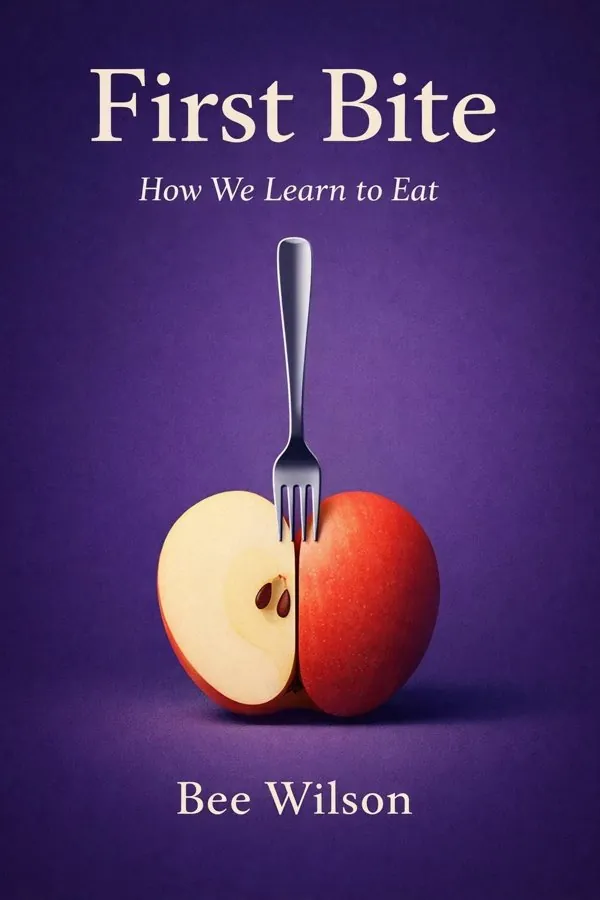
First Bite: How We Learn to Eat
Bee Wilson
10 min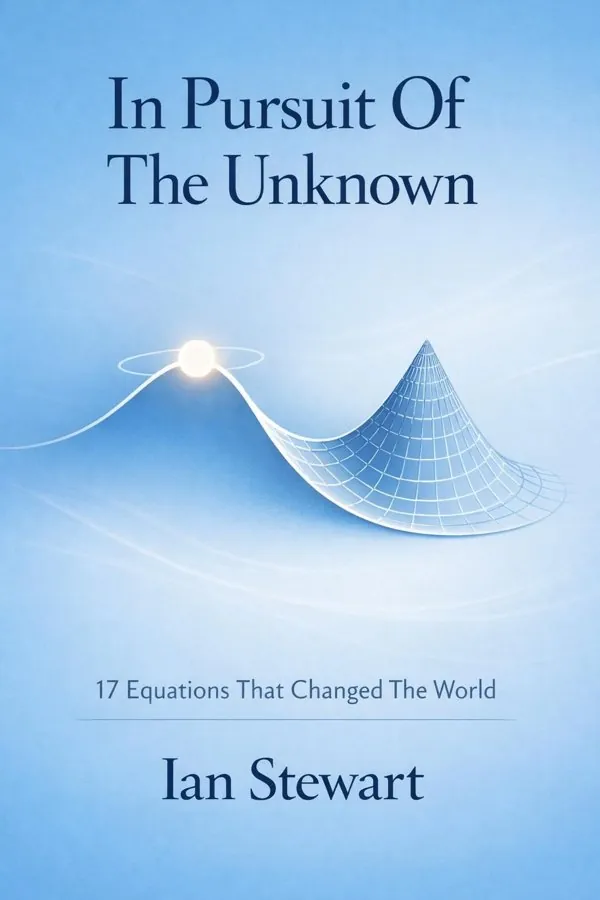
In Pursuit Of The Unknown: 17 Equations That Changed The World
Ian Stewart
10 min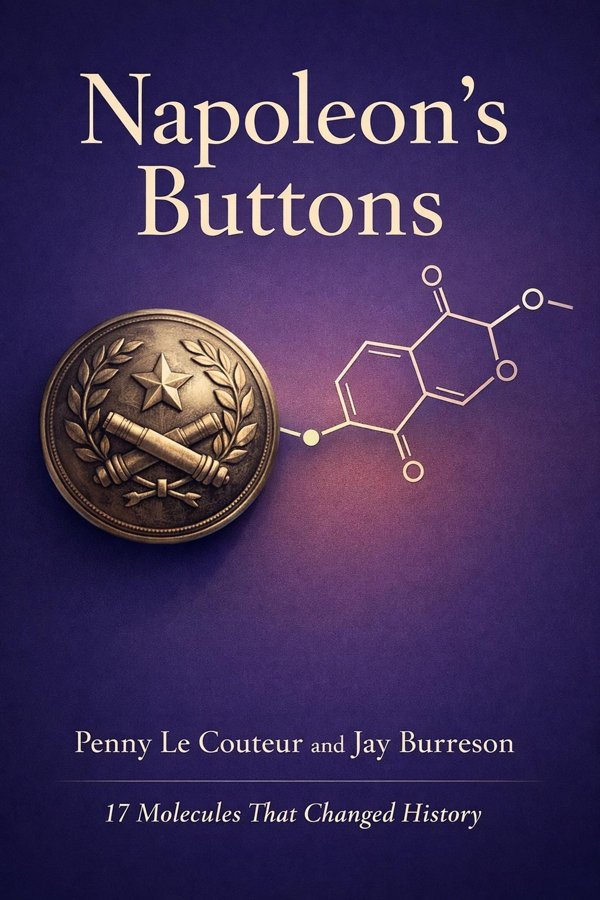
Napoleon's Buttons: 17 Molecules That Changed History
Penny Le Couteur and Jay Burreson
10 minFeatured In
Browse by Category
Ready to read A Mathematician’s Apology?
Get the full summary and 100K+ more books with Fizz Moment.