
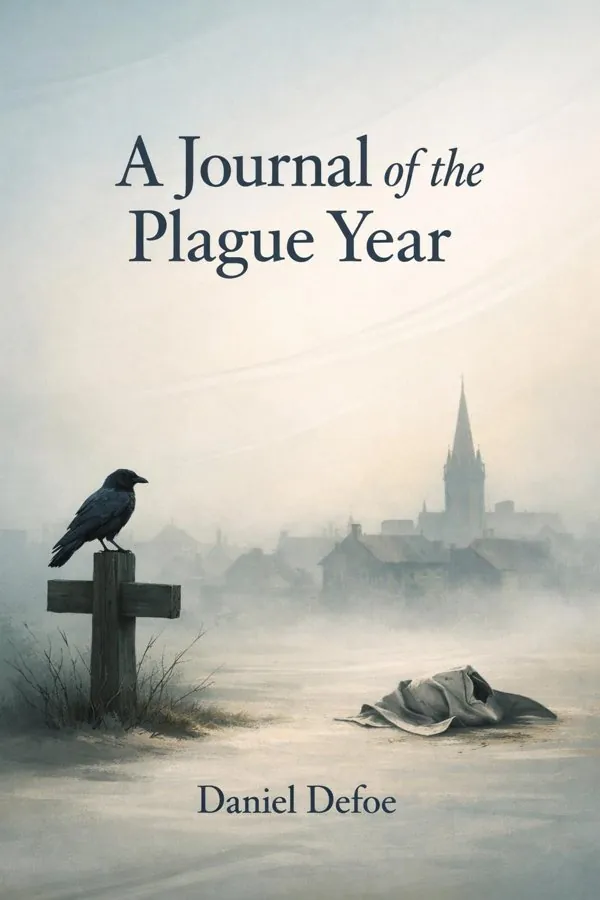
A Journal of the Plague Year: Summary & Key Insights
by Daniel Defoe
 10 min9 chaptersAudio available
Key Takeaways from A Journal of the Plague Year
Disaster rarely begins with certainty; it begins with whispers.
A plague tests not only bodies but institutions.
Fear can spread faster than disease, and Defoe shows that epidemics always have two contagions: the medical one and the emotional one.
Extreme suffering forces people to ask questions that comfort cannot answer.
Crisis does not create character from nothing; it reveals what was already there.
What Is A Journal of the Plague Year About?
A Journal of the Plague Year by Daniel Defoe is a classics book spanning 7 pages. A Journal of the Plague Year is Daniel Defoe’s haunting reconstruction of London during the Great Plague of 1665, told through the voice of a sober, observant narrator usually identified as “H.F.” First published in 1722, the book reads like eyewitness testimony, blending statistics, street scenes, moral reflection, rumor, and reportage into one of the most convincing depictions of epidemic life ever written. Defoe was only a child during the actual plague, yet his gifts as a journalist, pamphleteer, and social observer allowed him to transform historical records and oral memory into a vivid narrative of fear, denial, quarantine, grief, and survival. What makes the book endure is not only its historical value but its psychological truth. Defoe shows how people respond when ordinary life collapses: some become selfish, some generous, some irrational, some brave, and most a mixture of all four. In an age newly familiar with public health crises, misinformation, and social fragmentation, A Journal of the Plague Year feels startlingly modern. It is both a document of one city’s ordeal and a timeless study of human behavior under pressure.
This FizzRead summary covers all 9 key chapters of A Journal of the Plague Year in approximately 10 minutes, distilling the most important ideas, arguments, and takeaways from Daniel Defoe's work. Also available as an audio summary and Key Quotes Podcast.
A Journal of the Plague Year
A Journal of the Plague Year is Daniel Defoe’s haunting reconstruction of London during the Great Plague of 1665, told through the voice of a sober, observant narrator usually identified as “H.F.” First published in 1722, the book reads like eyewitness testimony, blending statistics, street scenes, moral reflection, rumor, and reportage into one of the most convincing depictions of epidemic life ever written. Defoe was only a child during the actual plague, yet his gifts as a journalist, pamphleteer, and social observer allowed him to transform historical records and oral memory into a vivid narrative of fear, denial, quarantine, grief, and survival. What makes the book endure is not only its historical value but its psychological truth. Defoe shows how people respond when ordinary life collapses: some become selfish, some generous, some irrational, some brave, and most a mixture of all four. In an age newly familiar with public health crises, misinformation, and social fragmentation, A Journal of the Plague Year feels startlingly modern. It is both a document of one city’s ordeal and a timeless study of human behavior under pressure.
Who Should Read A Journal of the Plague Year?
This book is perfect for anyone interested in classics and looking to gain actionable insights in a short read. Whether you're a student, professional, or lifelong learner, the key ideas from A Journal of the Plague Year by Daniel Defoe will help you think differently.
- ✓Readers who enjoy classics and want practical takeaways
- ✓Professionals looking to apply new ideas to their work and life
- ✓Anyone who wants the core insights of A Journal of the Plague Year in just 10 minutes
Want the full summary?
Get instant access to this book summary and 100K+ more with Fizz Moment.
Get Free SummaryAvailable on App Store • Free to download
Key Chapters
Disaster rarely begins with certainty; it begins with whispers. Defoe opens his account by showing how plague entered London first as rumor—reports from Holland, stray deaths in outlying parishes, uneasy talk among merchants and householders. At this early stage, uncertainty becomes its own danger. People hesitate to believe what they fear, and denial offers temporary comfort. The city’s first response is not panic but doubt, and Defoe reveals how societies often misread the opening moments of a crisis because the evidence is incomplete, inconvenient, or easy to dismiss.
The early deaths in St. Giles are especially important because they show how a catastrophe can gather force before the public admits it exists. The Bills of Mortality become a fragile instrument of truth, tracking deaths parish by parish, but even these figures can be manipulated, misunderstood, or delayed. Some deaths are attributed to “spotted fever” or other causes, masking the scale of the danger. The result is a deadly lag between reality and recognition.
Defoe’s insight remains practical today. Whether the threat is disease, financial collapse, environmental damage, or political unrest, people tend to wait for overwhelming proof instead of responding to credible warning signs. He teaches readers to pay attention not only to official declarations but also to patterns, anomalies, and weak signals.
A practical application is simple: when risk begins to emerge, do not ask only, “Has this been fully confirmed?” Ask also, “What would prudence require if this were true?” Early caution is often wiser than late certainty. The actionable takeaway: learn to respect credible warnings before crisis becomes undeniable.
A plague tests not only bodies but institutions. One of Defoe’s central concerns is how public authorities try to govern when ordinary mechanisms of order are overwhelmed. Magistrates, aldermen, parish officials, watchmen, nurses, and clerks all become part of the machinery of emergency response. The city publishes the Bills of Mortality, closes infected houses, appoints examiners to inspect the sick, and issues regulations intended to contain movement and reduce transmission. These efforts reflect a serious attempt to impose structure on chaos.
Yet Defoe is too clear-eyed to portray authority as either wholly competent or wholly useless. Quarantining families in their homes may slow contagion, but it also traps the healthy with the sick and can drive desperate people to escape secretly. Watchmen posted at doors may enforce rules, but they can also provoke fear, bribery, and resentment. Public policy in the book is therefore a field of painful trade-offs. Measures that are rational at the level of the city may feel cruel at the level of the household.
What makes this section powerful is Defoe’s understanding that trust is as important as policy. Citizens need information they can believe, procedures they can understand, and leaders who appear both firm and humane. Without trust, every rule invites evasion.
The lesson extends beyond seventeenth-century London. In any crisis, the best institutions combine data, clarity, and adaptability. Good governance means communicating honestly, adjusting as evidence changes, and recognizing how policies affect real people.
The actionable takeaway: evaluate institutions not only by their intentions but by whether they balance public safety, transparency, and compassion under pressure.
Fear can spread faster than disease, and Defoe shows that epidemics always have two contagions: the medical one and the emotional one. As plague expands from parish to parish, London becomes a city of multiplying anxieties. Streets empty, trade contracts, neighbors avoid one another, and every cough, smell, or rumor acquires ominous significance. People begin to read danger into every interaction. The sick fear abandonment; the healthy fear contact; everyone fears invisibly carrying death.
Defoe carefully tracks how panic changes behavior. Some flee to the countryside if they can afford it, often carrying infection with them. Others barricade themselves indoors. Some obsess over mortality tables and gossip, while others avoid all news because they cannot bear the dread. Charlatans flourish by selling cures, prophecies, and protective tokens. The atmosphere becomes one in which rational caution and irrational frenzy are hard to separate.
A striking strength of the book is that Defoe never mocks fear. He understands that panic is not simply weakness; it is often the mind’s attempt to cope with unpredictable danger. But he also shows how unmanaged fear worsens a crisis. Panic distorts judgment, fuels bad decisions, and opens the door to exploitation.
Modern readers can apply this insight to any information-saturated emergency. During a crisis, people need habits that reduce emotional contagion: verify claims, limit exposure to rumor, rely on credible sources, and distinguish vigilance from obsession. Communities also need empathy, because frightened people do not become calmer through ridicule.
The actionable takeaway: in a crisis, manage your information diet as carefully as you manage physical risk, because panic thrives where uncertainty goes unexamined.
Extreme suffering forces people to ask questions that comfort cannot answer. Throughout A Journal of the Plague Year, Defoe presents the plague not only as a public health disaster but as a spiritual trial. The city becomes a place where sermons, prayers, repentance, dread, and resignation mingle with the daily spectacle of death. Some interpret the epidemic as divine judgment; others cling to providence as their only source of hope. Faith, in Defoe’s account, is not abstract doctrine but a practical framework for enduring terror.
The book does not offer easy religious certainty. Instead, it shows a range of responses. Some become more devout, believing the crisis calls them to humility and moral seriousness. Others are shaken by the apparent randomness of death. Why does one household perish while another is spared? Why do the pious die alongside the reckless? Defoe leaves room for mystery, and that restraint gives the narrative depth.
Importantly, faith in the book is tied to conduct. Prayer without responsibility is not enough. Defoe admires those who combine spiritual seriousness with practical action: caring for the sick, accepting hardship, fulfilling duty, and refusing to surrender entirely to despair. In this way, religion becomes not merely interpretation but discipline.
For modern readers, whether religious or not, the broader lesson concerns meaning under pressure. People endure catastrophe better when they can place suffering within a moral or existential frame larger than immediate fear. Reflection, ritual, conscience, and service all help stabilize the self.
The actionable takeaway: when crisis strips away normal routines, intentionally cultivate practices—spiritual, ethical, or reflective—that help you remain purposeful rather than merely reactive.
Crisis does not create character from nothing; it reveals what was already there. One of Defoe’s most enduring achievements is his portrait of human behavior under mortal pressure. In plague-stricken London, people become more visibly themselves. Some act with courage and charity, risking exposure to assist neighbors, nurses, or relatives. Others become deceitful, selfish, or opportunistic, abandoning obligations or profiting from distress. Many oscillate between generosity and fear, proving that ordinary morality becomes unstable when survival is at stake.
Defoe refuses simplistic judgment. He understands that desperate circumstances blur the line between prudence and selfishness. A person who avoids a sick household may be heartless—or responsibly protecting a family. A servant who flees may be disloyal—or terrified beyond endurance. The book’s realism comes from this moral complexity. People are not heroes or villains in a neat arrangement; they are frail, inconsistent, and often improvising under unbearable strain.
At the same time, Defoe highlights the importance of social trust. Epidemics expose how dependent we are on one another: on gravediggers, physicians, clergymen, officials, laborers, and neighbors. Even when society seems to be disintegrating, it still runs on countless acts of duty performed by frightened individuals.
This idea remains highly practical. During emergencies, the health of a community depends less on grand rhetoric than on everyday reliability: showing up, telling the truth, following protocols, and helping without dramatics.
The actionable takeaway: do not wait for crisis to decide what kind of person you are. Build habits of honesty, courage, and service in ordinary times, because emergencies expose practiced character, not imagined virtue.
An epidemic is never only a medical event; it is a stress test for the entire social order. Defoe captures how the plague disrupts London’s economic life with relentless force. Shops close, shipping slows, markets thin out, labor is interrupted, and households lose income just as need becomes more urgent. The poor suffer most because they cannot retreat safely, stock supplies, or stop working without starving. Disease exposes the unequal distribution of both risk and resilience.
Defoe is especially attentive to the civic consequences of economic strain. Tradesmen are ruined, apprentices displaced, servants dismissed, and entire networks of exchange weakened. Charity becomes more necessary precisely when resources are scarcer. The wealthy can often flee; the working population remains, facing contagion and financial collapse at once. In this sense, the plague magnifies existing social fractures rather than creating them from scratch.
The book also illustrates an important principle of resilience: cities depend on invisible systems of interdependence. Food must still be delivered, the dead buried, the sick observed, streets monitored, and records kept. When enough people stop functioning in these roles, civic life begins to fray. Defoe makes readers see that social order is not automatic; it is maintained by coordinated labor that becomes most visible when endangered.
Today, this insight applies to pandemics, natural disasters, and supply chain shocks. Preparing for crisis means more than protecting health narrowly defined. It means supporting workers, safeguarding essential services, and building systems that can withstand disruption.
The actionable takeaway: treat economic resilience and public health as inseparable, because communities break down fastest when illness and livelihood collapse together.
Statistics can clarify a crisis, but they can also conceal its human weight. Defoe’s narrative is remarkable for its use of data—especially the Bills of Mortality—alongside vivid street-level observation. He counts deaths, tracks parish patterns, and notes fluctuations over time, giving the account a documentary authority unusual for its era. Yet he never lets numbers become the whole story. Behind each total lies a household, a body, a fear, a decision.
This tension between abstraction and immediacy is one of the book’s most modern features. Defoe knows that people need numbers to understand scale, trends, and urgency. Without records, rumor governs perception. But he also knows that data alone can anesthetize moral attention. A rising death count may become strangely impersonal unless it is connected to actual lived experience.
The narrator therefore moves between tables and testimony, between pattern and anecdote. He records broad developments, then pauses over a single scene: a deserted street, a family shut up, a cry in the night, a burial cart. This method teaches readers how to think responsibly during catastrophe. One must neither drown in individual horror nor hide inside abstraction.
The application is obvious in modern life, where dashboards, graphs, and feeds dominate public understanding. Good judgment requires combining quantitative literacy with humane imagination. Ask what the numbers mean in practical terms, who may be missing from them, and what forms of suffering they cannot measure.
The actionable takeaway: use data to sharpen perception, not replace it; the wisest response to crisis joins numerical understanding with close attention to real human experience.
A city under plague becomes more than a setting; it becomes a map of human vulnerability. In Defoe’s hands, London is not merely a backdrop of streets, alleys, churches, and parishes. It is an organism whose circulation, crowding, inequalities, and habits shape the course of the epidemic. Different neighborhoods experience different intensities of suffering, and movement through the city becomes morally charged. To walk, to trade, to visit, to flee, to remain—each action carries consequences for others.
Defoe’s close attention to urban space reveals how physical environments influence social behavior. Narrow lanes, dense housing, and busy markets facilitate transmission. Parish boundaries matter administratively, but disease ignores them. Meanwhile, wealthier residents often have more mobility, while poorer inhabitants are fixed in place. The city thus reflects a moral geography in which privilege affects exposure, choice, and survival.
What gives this theme lasting power is Defoe’s sense that shared space creates shared obligation. Urban life is built on proximity, and proximity demands responsibility. People cannot pretend to be isolated individuals when their decisions affect strangers as well as kin. The plague makes this interdependence impossible to ignore.
This idea remains highly relevant for modern readers living in dense, connected societies. Public transportation, apartment living, workplaces, and global travel all make health and behavior collective matters. Urban resilience depends on designing spaces and norms that protect the vulnerable rather than treating them as afterthoughts.
The actionable takeaway: see the places you inhabit—city, neighborhood, workplace—as networks of shared risk and shared duty, and act with awareness that your choices always travel beyond yourself.
The end of a catastrophe is rarely as clear as its worst moments. Defoe’s account of the plague’s decline is marked by relief, caution, and lingering grief. As death totals begin to fall, ordinary life hesitantly returns. Shops reopen, movement increases, and hope revives. Yet the city that emerges is not the same city that entered the crisis. Too many have died, too many households have been shattered, and too many habits of fear remain embedded in memory.
Defoe understands that aftermath is a moral phase, not simply a statistical one. Survivors must decide what to remember, what to rebuild, and what lessons to preserve. There is always a temptation to forget quickly—to celebrate recovery without examining what the disaster revealed. But the narrator insists that memory is a civic duty. To record the plague year is to resist the erasure that often follows survival.
This is one reason the book still matters so much. It is not only about how people suffer, but about how societies narrate suffering afterward. If memory becomes selective, comforting myths replace difficult truths: who was neglected, which policies failed, who benefited, who endured the greatest losses. Honest remembrance is necessary for wiser preparation.
For modern readers, the lesson applies after any collective crisis. Debriefing, documenting, and learning are part of recovery. Communities that memorialize responsibly are better equipped to respond again.
The actionable takeaway: when a crisis passes, do not rush only to resume normal life; take time to record what happened, examine what was learned, and carry those lessons into the future.
All Chapters in A Journal of the Plague Year
About the Author
Daniel Defoe (c.1660–1731) was an English writer, journalist, merchant, and political commentator whose work helped shape the modern novel. Born in London, he lived through a period of intense political, religious, and economic upheaval, experiences that informed his sharp interest in trade, social order, and individual survival. Defoe wrote prolifically on subjects ranging from politics and economics to crime and morality, often combining factual detail with vivid storytelling. He is best known for Robinson Crusoe, Moll Flanders, and A Journal of the Plague Year, works admired for their realism and psychological insight. Though he did not witness the Great Plague as an adult, his skill as an observer and compiler of public life allowed him to recreate it with extraordinary authority. His writing remains influential for its immediacy, narrative force, and moral seriousness.
Get This Summary in Your Preferred Format
Read or listen to the A Journal of the Plague Year summary by Daniel Defoe anytime, anywhere. FizzRead offers multiple formats so you can learn on your terms — all free.
Available formats: App · Audio · PDF · EPUB — All included free with FizzRead
Download A Journal of the Plague Year PDF and EPUB Summary
Key Quotes from A Journal of the Plague Year
“Disaster rarely begins with certainty; it begins with whispers.”
“A plague tests not only bodies but institutions.”
“Fear can spread faster than disease, and Defoe shows that epidemics always have two contagions: the medical one and the emotional one.”
“Extreme suffering forces people to ask questions that comfort cannot answer.”
“Crisis does not create character from nothing; it reveals what was already there.”
Frequently Asked Questions about A Journal of the Plague Year
A Journal of the Plague Year by Daniel Defoe is a classics book that explores key ideas across 9 chapters. A Journal of the Plague Year is Daniel Defoe’s haunting reconstruction of London during the Great Plague of 1665, told through the voice of a sober, observant narrator usually identified as “H.F.” First published in 1722, the book reads like eyewitness testimony, blending statistics, street scenes, moral reflection, rumor, and reportage into one of the most convincing depictions of epidemic life ever written. Defoe was only a child during the actual plague, yet his gifts as a journalist, pamphleteer, and social observer allowed him to transform historical records and oral memory into a vivid narrative of fear, denial, quarantine, grief, and survival. What makes the book endure is not only its historical value but its psychological truth. Defoe shows how people respond when ordinary life collapses: some become selfish, some generous, some irrational, some brave, and most a mixture of all four. In an age newly familiar with public health crises, misinformation, and social fragmentation, A Journal of the Plague Year feels startlingly modern. It is both a document of one city’s ordeal and a timeless study of human behavior under pressure.
More by Daniel Defoe
You Might Also Like

Featured In
Browse by Category
Ready to read A Journal of the Plague Year?
Get the full summary and 100K+ more books with Fizz Moment.