
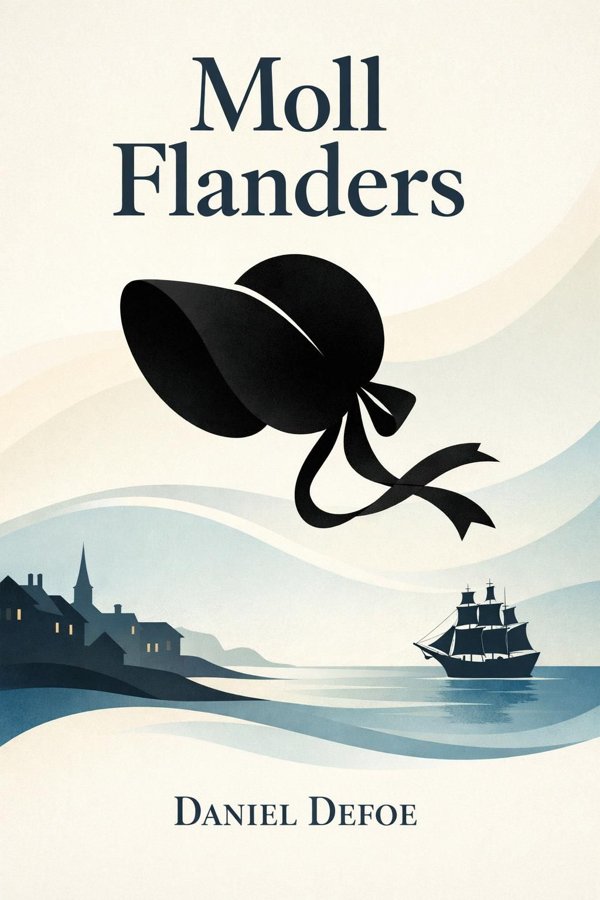
Moll Flanders: Summary & Key Insights
by Daniel Defoe
 10 min9 chaptersAudio available
Key Takeaways from Moll Flanders
A person’s beginning does not determine the shape of their desire, but it powerfully shapes the strategies they use to survive.
In a world where women lack property, marriage becomes less a romance than a marketplace.
When survival depends on perception, identity becomes something one must manufacture.
Moral judgment is easiest when we ignore the constraints under which people act.
Crime in Moll Flanders is not portrayed as glamorous rebellion, but as a learned profession born from desperation, habit, and opportunity.
What Is Moll Flanders About?
Moll Flanders by Daniel Defoe is a classics book spanning 4 pages. Daniel Defoe’s Moll Flanders is one of the earliest and most unsettling English novels: a life story told by a woman born in Newgate Prison who refuses to accept the station society assigns her. Over decades, Moll moves through service, seduction, marriage, abandonment, theft, transportation, and repentance, reinventing herself whenever necessity demands it. What makes the novel so gripping is not only its dramatic plot, but the sharp intelligence with which Defoe examines money, class, gender, and morality. Moll is neither a simple villain nor a straightforward heroine. She is ambitious, resourceful, compromised, and deeply human. Through her, Defoe reveals a society where survival often depends less on virtue than on calculation, appearance, and luck. First published in 1722, the novel still feels strikingly modern in its interest in self-fashioning, economic pressure, and the blurred line between respectability and fraud. Defoe, a journalist and master observer of commercial life, brings rare authority to this world. Moll Flanders matters because it asks a timeless question: what becomes of morality when survival itself is at stake?
This FizzRead summary covers all 9 key chapters of Moll Flanders in approximately 10 minutes, distilling the most important ideas, arguments, and takeaways from Daniel Defoe's work. Also available as an audio summary and Key Quotes Podcast.
Moll Flanders
Daniel Defoe’s Moll Flanders is one of the earliest and most unsettling English novels: a life story told by a woman born in Newgate Prison who refuses to accept the station society assigns her. Over decades, Moll moves through service, seduction, marriage, abandonment, theft, transportation, and repentance, reinventing herself whenever necessity demands it. What makes the novel so gripping is not only its dramatic plot, but the sharp intelligence with which Defoe examines money, class, gender, and morality. Moll is neither a simple villain nor a straightforward heroine. She is ambitious, resourceful, compromised, and deeply human. Through her, Defoe reveals a society where survival often depends less on virtue than on calculation, appearance, and luck. First published in 1722, the novel still feels strikingly modern in its interest in self-fashioning, economic pressure, and the blurred line between respectability and fraud. Defoe, a journalist and master observer of commercial life, brings rare authority to this world. Moll Flanders matters because it asks a timeless question: what becomes of morality when survival itself is at stake?
Who Should Read Moll Flanders?
This book is perfect for anyone interested in classics and looking to gain actionable insights in a short read. Whether you're a student, professional, or lifelong learner, the key ideas from Moll Flanders by Daniel Defoe will help you think differently.
- ✓Readers who enjoy classics and want practical takeaways
- ✓Professionals looking to apply new ideas to their work and life
- ✓Anyone who wants the core insights of Moll Flanders in just 10 minutes
Want the full summary?
Get instant access to this book summary and 100K+ more with Fizz Moment.
Get Free SummaryAvailable on App Store • Free to download
Key Chapters
A person’s beginning does not determine the shape of their desire, but it powerfully shapes the strategies they use to survive. Moll Flanders begins life under the darkest possible sign: she is born in Newgate Prison to a mother convicted of theft. From the outset, her identity is marked by stigma, instability, and the threat of social exclusion. Yet Defoe’s great insight is that Moll does not internalize defeat. Instead, she develops a fierce commitment to becoming a “gentlewoman,” a goal that captures her longing for safety, status, and independence all at once.
As a child raised first in poverty and later in foster care and service, Moll quickly learns that class is less a matter of moral worth than of performance, education, and financial security. She absorbs the manners and aspirations of her social betters, and this becomes one of her defining strengths. Her intelligence lies not in formal learning alone, but in social reading: she understands what people value, what they fear, and how appearances can open doors.
The early chapters show how vulnerable children adapt to unstable environments. Moll learns to charm, to observe, and to calculate. In modern terms, her story resembles the experience of anyone forced to build a life without inherited security—those who must learn the codes of institutions, workplaces, or social classes not designed for them. Her resilience is admirable, but it also comes at a cost: survival teaches her flexibility before it teaches her trust.
Defoe invites readers to see that ambition in the poor is often judged harshly, while the privileges of the wealthy are treated as natural. Moll’s rise begins not with opportunity, but with necessity.
Actionable takeaway: Examine the “starting conditions” behind people’s choices before judging their character too quickly.
In a world where women lack property, marriage becomes less a romance than a marketplace. One of the most revealing aspects of Moll Flanders is its unsentimental treatment of courtship. Moll’s marriages and love affairs are repeatedly shaped by money, inheritance, reputation, and concealment. She wants affection, certainly, but she needs security more. Defoe shows that in eighteenth-century England, a woman without fortune could rarely afford the luxury of pure sentiment.
After early disappointments, Moll learns to treat marriage as a negotiation. She presents herself advantageously, reads the financial signals of potential husbands, and adapts her identity to fit the expectations of each situation. Men do the same. They exaggerate wealth, hide debt, pursue beauty as capital, and treat marriage as acquisition. The result is a social world built on mutual performance. Even sincere attraction is entangled with calculation.
This does not make Moll uniquely deceitful; it makes her a sharp participant in an already deceptive system. Defoe’s realism lies in showing that economic dependence corrupts intimacy. A woman must often flatter, maneuver, and disguise because the law and custom give her few direct ways to secure herself. Readers today can see parallels in any environment where financial insecurity distorts personal relationships—whether in dating shaped by status anxiety, family expectations around income, or career choices driven by dependence rather than conviction.
The marriages in the novel are therefore not mere plot episodes. They reveal how institutions can pressure people into half-truths and moral compromise. Moll becomes adept at reading opportunity because the alternative is helplessness. Her choices are often troubling, but they are also legible responses to structural inequality.
Actionable takeaway: Whenever relationships are shaped by unequal power or financial pressure, ask what hidden incentives may be distorting honesty and freedom.
When survival depends on perception, identity becomes something one must manufacture. Throughout Moll Flanders, the heroine repeatedly changes roles: servant, gentlewoman, widow, wife, mistress, debtor, thief, penitent, colonist. These shifts are not simply signs of hypocrisy. They are evidence that in Defoe’s world, social identity is unstable and often theatrical. Moll survives because she understands that people respond not to essence, but to presentation.
This theme makes the novel feel strikingly modern. Moll curates impressions the way a contemporary person might manage a résumé, online profile, or professional persona. She emphasizes what is useful, suppresses what is dangerous, and tailors her story to the audience before her. In doing so, she reveals an uncomfortable truth: society often rewards successful self-invention while condemning only the people who are caught at it.
Yet Defoe does not portray reinvention as liberating in a simple sense. Each new identity solves one problem while creating another. Moll gains access, but loses continuity. She protects herself, but must live with secrecy. She acquires flexibility, but not peace. The self becomes fragmented under pressure. Her life suggests that constant adaptation can erode moral clarity, because one begins to value expedience over truth.
There is also a broader social critique here. If class and respectability can be imitated so effectively, then they are less solid than society pretends. Manners, clothing, speech, and confidence can all be learned. What appears “natural” in the upper ranks may simply be habitual performance backed by money.
Actionable takeaway: Be intentional about the roles you perform in life, and regularly ask whether your adaptations are helping you grow or slowly separating you from your core values.
Moral judgment is easiest when we ignore the constraints under which people act. Moll Flanders forces readers to confront how poverty and gender narrow the field of respectable choices. As a woman without lasting protection, inheritance, or stable employment, Moll lives in a society where economic dependence is built into the system. Respectability is demanded of her, but the means of preserving it are often denied to her.
Defoe is especially sharp in showing the fragility of female security. A widow without money can quickly fall into desperation. Beauty fades. Suitors deceive. Servant work offers little independence. Pregnancy outside marriage threatens ruin. The law offers few protections, and social stigma is merciless. Moll’s pursuit of financial stability can therefore appear grasping, but it is also rational. She knows that without resources, she is one illness, betrayal, or bad match away from collapse.
This does not excuse every decision she makes, but it changes how we interpret them. Defoe asks us to see that individual vice often emerges from structural vulnerability. Modern readers can apply this insight widely. People facing housing insecurity, exploitative labor, or unequal caregiving burdens often make imperfect decisions under pressure. Condemnation may feel morally satisfying, but understanding the underlying constraints is more useful and more humane.
The novel also exposes the double standard around female sexuality. Men move more freely through scandal; women bear the heavier consequences. Moll must constantly convert charm into survival while trying not to be destroyed by the very judgments that make such conversion necessary. Her life is an argument against simplistic morality.
Actionable takeaway: Before criticizing someone’s choices, consider what options were realistically available to them and how power shaped the decision.
Crime in Moll Flanders is not portrayed as glamorous rebellion, but as a learned profession born from desperation, habit, and opportunity. After repeated losses, betrayals, and financial collapses, Moll enters the criminal world with the same practical intelligence she once applied to courtship and social advancement. She becomes a thief not because she lacks discipline, but because her abilities can no longer find secure expression within respectable society.
Defoe’s treatment of criminality is psychologically astute. Moll does not transform overnight into a monster. She hesitates, rationalizes, improves her technique, and grows accustomed to what once horrified her. This gradual moral erosion is one of the novel’s most powerful lessons. Wrongdoing often becomes possible through repetition, normalization, and small acts of self-justification. A person tells herself that she has no choice, that others are worse, that one more deception will solve everything. Soon a temporary measure becomes an identity.
Newgate Prison then returns as both literal destination and symbolic reckoning. Moll is brought back to the place where her life began, as if the cycle of her existence has closed. The prison exposes the harsh machinery of justice in Defoe’s England: public shame, arbitrary mercy, and punishment aimed as much at spectacle as reform. Yet Newgate also strips away illusion. Moll must finally face not just legal consequences, but the accumulated weight of choices she has long postponed confronting.
This part of the novel remains deeply relevant. Many systems still criminalize poverty while doing little to address its causes. Individuals drift into fraud, theft, or illegal economies through incremental necessity and social abandonment.
Actionable takeaway: Watch for the small rationalizations that make larger ethical compromises feel normal before they harden into a pattern.
The hardest question in Moll Flanders is not whether the heroine sins, but whether she truly repents. Near the end of the novel, especially in prison, Moll expresses remorse and turns toward religion. Yet Defoe deliberately leaves room for ambiguity. Is her repentance a profound spiritual awakening, a practical response to fear, or some unstable mixture of both? That uncertainty is one reason the book continues to provoke readers.
Defoe understands that self-knowledge is rarely pure. Human beings often discover moral truth through crisis, but even then their motives remain mixed. Moll may be sincerely frightened for her soul and sincerely eager to avoid execution at the same time. She may regret her crimes while still valuing the cunning that helped her survive. Rather than offering a neat conversion narrative, the novel presents repentance as a messy, human process in which conscience, fear, memory, and self-interest all interact.
This complexity is useful beyond literature. In everyday life, people rarely change for a single reason. A failing executive apologizes after public exposure, a friend reforms after losing trust, a family member reflects only after illness or loss. We are often tempted to dismiss all imperfect repentance as false. Defoe suggests a subtler view: mixed motives do not automatically cancel genuine change, but they do require scrutiny.
The novel also implies that confession is easier than transformation. Moll can narrate her life and condemn it, but the reader must still ask whether she has fully shed the habits of calculation that defined her. Moral renewal requires more than regret; it demands a reordered life.
Actionable takeaway: When evaluating change in yourself or others, look less at declared feelings and more at whether choices, habits, and priorities truly begin to shift.
Sometimes society offers redemption only by removing a person from the world that shaped them. After her imprisonment, Moll escapes the worst possible fate through transportation to the American colonies. This movement from England to Virginia is more than a plot resolution. It reflects a historical system in which exile served as punishment, labor supply, and social reset. Defoe uses it to explore whether a damaged life can be rebuilt through relocation and renewed industry.
In the colonies, Moll gains a chance to begin again with a degree of prosperity and domestic stability that eluded her in England. Yet the novel does not suggest that geography alone redeems the soul. What changes is not merely place, but context. Removed from the frantic marketplace of urban survival, Moll can direct her energy into productive life rather than deception. This implies that moral reform often requires changed conditions, not just changed intentions.
There is a modern lesson here. People trying to recover from destructive patterns often need more than willpower. They may need new communities, altered routines, financial stability, and physical distance from environments that reinforce old behaviors. A second chance becomes believable when the surrounding structure also shifts.
At the same time, Defoe complicates any easy celebration of colonial renewal. Prosperity in the New World is tied to empire, displacement, and systems of exploitation the novel only partly acknowledges. Readers can therefore appreciate the theme of second beginnings while remaining alert to the historical realities underneath it.
Actionable takeaway: If you want lasting change, do not rely on inner resolve alone; redesign the environment, routines, and relationships that keep pulling you back into old patterns.
Long before the modern novel fully took shape, Moll Flanders understood that the individual life could be a battlefield of economics, desire, memory, and self-invention. One reason the book remains so influential is that it anticipates the concerns of later fiction: unreliable narration, social mobility, psychological complexity, and the tension between authenticity and performance.
Moll tells her own story in a voice that is candid, persuasive, evasive, and self-justifying by turns. This makes her one of literature’s earliest compelling narrators of experience rather than a mere moral example. We do not simply watch her from outside; we inhabit her reasoning. That narrative closeness changes how fiction works. It asks readers to interpret, to doubt, and to wrestle with competing truths inside a single life.
The novel is also modern in its focus on the self as a project. Moll is constantly assembling a life out of fragments—money, memory, costume, opportunity, persuasion. She is entrepreneurial even in moral disaster. Defoe captures the emerging modern subject: restless, adaptable, commercially minded, and never entirely secure.
For today’s readers, this makes the novel more than a period curiosity. It is an early anatomy of the pressures that still define contemporary life: branding, hustle, precarious labor, romantic calculation, and the dream of reinvention. To read Moll Flanders is to see how old these supposedly modern anxieties really are.
Actionable takeaway: Read classic works not as relics, but as early maps of problems we still face—especially when they reveal the origins of our own habits of ambition and self-construction.
All Chapters in Moll Flanders
About the Author
Daniel Defoe (c.1660–1731) was an English writer, journalist, trader, and political pamphleteer whose work helped shape the rise of the modern novel. Born in London, he lived through commercial expansion, political turmoil, financial speculation, and social change, experiences that deeply influenced his fiction. Before becoming famous as a novelist, Defoe wrote extensively on politics, religion, economics, and crime, developing a prose style noted for its immediacy and realism. He is best known for Robinson Crusoe, Moll Flanders, A Journal of the Plague Year, and Roxana. Defoe’s fiction often focuses on survival, self-invention, moral ambiguity, and the pressures of money in everyday life. His ability to blend documentary detail with narrative energy made him one of the most important and enduring voices in early English prose fiction.
Get This Summary in Your Preferred Format
Read or listen to the Moll Flanders summary by Daniel Defoe anytime, anywhere. FizzRead offers multiple formats so you can learn on your terms — all free.
Available formats: App · Audio · PDF · EPUB — All included free with FizzRead
Download Moll Flanders PDF and EPUB Summary
Key Quotes from Moll Flanders
“A person’s beginning does not determine the shape of their desire, but it powerfully shapes the strategies they use to survive.”
“In a world where women lack property, marriage becomes less a romance than a marketplace.”
“When survival depends on perception, identity becomes something one must manufacture.”
“Moral judgment is easiest when we ignore the constraints under which people act.”
“Crime in Moll Flanders is not portrayed as glamorous rebellion, but as a learned profession born from desperation, habit, and opportunity.”
Frequently Asked Questions about Moll Flanders
Moll Flanders by Daniel Defoe is a classics book that explores key ideas across 9 chapters. Daniel Defoe’s Moll Flanders is one of the earliest and most unsettling English novels: a life story told by a woman born in Newgate Prison who refuses to accept the station society assigns her. Over decades, Moll moves through service, seduction, marriage, abandonment, theft, transportation, and repentance, reinventing herself whenever necessity demands it. What makes the novel so gripping is not only its dramatic plot, but the sharp intelligence with which Defoe examines money, class, gender, and morality. Moll is neither a simple villain nor a straightforward heroine. She is ambitious, resourceful, compromised, and deeply human. Through her, Defoe reveals a society where survival often depends less on virtue than on calculation, appearance, and luck. First published in 1722, the novel still feels strikingly modern in its interest in self-fashioning, economic pressure, and the blurred line between respectability and fraud. Defoe, a journalist and master observer of commercial life, brings rare authority to this world. Moll Flanders matters because it asks a timeless question: what becomes of morality when survival itself is at stake?
More by Daniel Defoe

You Might Also Like




Browse by Category
Ready to read Moll Flanders?
Get the full summary and 100K+ more books with Fizz Moment.