
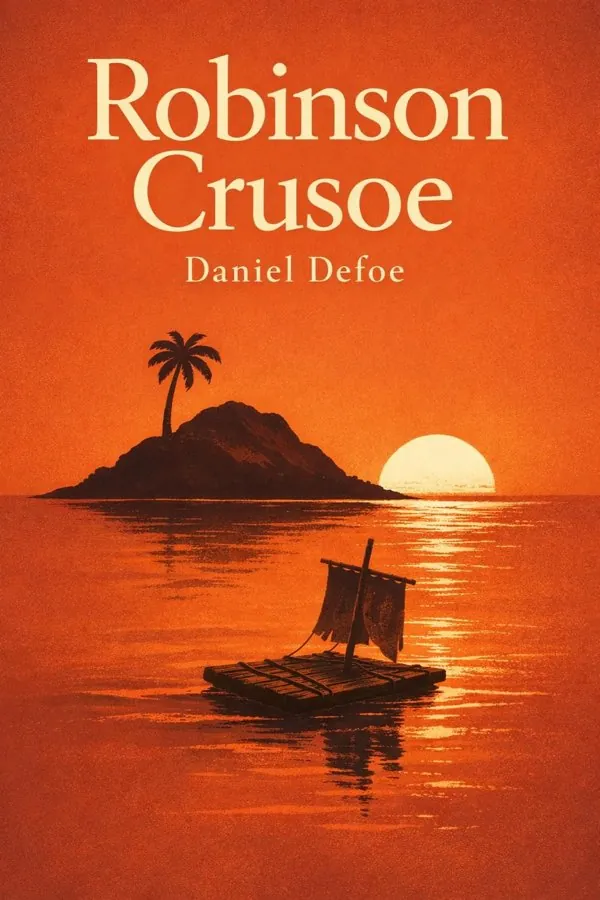
Robinson Crusoe: Summary & Key Insights
by Daniel Defoe
 10 min4 chaptersAudio available
What Is Robinson Crusoe About?
Robinson Crusoe by Daniel Defoe is a classics book spanning 4 pages. The novel tells the story of Robinson Crusoe, a man who becomes shipwrecked on a deserted island and must learn to survive alone for many years. Through ingenuity, faith, and perseverance, Crusoe builds a life for himself, reflecting on civilization, isolation, and human resilience.
This FizzRead summary covers all 4 key chapters of Robinson Crusoe in approximately 10 minutes, distilling the most important ideas, arguments, and takeaways from Daniel Defoe's work. Also available as an audio summary and Key Quotes Podcast.
Robinson Crusoe
The novel tells the story of Robinson Crusoe, a man who becomes shipwrecked on a deserted island and must learn to survive alone for many years. Through ingenuity, faith, and perseverance, Crusoe builds a life for himself, reflecting on civilization, isolation, and human resilience.
Who Should Read Robinson Crusoe?
This book is perfect for anyone interested in classics and looking to gain actionable insights in a short read. Whether you're a student, professional, or lifelong learner, the key ideas from Robinson Crusoe by Daniel Defoe will help you think differently.
- ✓Readers who enjoy classics and want practical takeaways
- ✓Professionals looking to apply new ideas to their work and life
- ✓Anyone who wants the core insights of Robinson Crusoe in just 10 minutes
Want the full summary?
Get instant access to this book summary and 100K+ more with Fizz Moment.
Get Free SummaryAvailable on App Store • Free to download
Key Chapters
I was not content with the quiet estate my parents wished for me. My father, a sensible man, urged me to remain at home and live moderately, but I was captivated by stories of ships, foreign lands, and fortunes made upon the waves. Against all prudence, I embarked upon voyages that quickly taught me the price of defiance. My first journey ended in a storm so fierce I vowed to never tempt fate again—but folly is a master that often returns. I sailed once more, only to be captured by Moorish pirates and made a slave in Sallee. Two years I served before I escaped, aided by a kind Moorish boy, and eventually reached Brazil, where I began to cultivate a plantation. For a few years it seemed my fortune might mend.
Yet my appetite for adventure had not died. When a trading expedition sought to bring slaves from Africa, I joined it, unaware that I was stepping into the greatest trial of my life. A terrible tempest struck, shattering our ship upon a hidden sandbank near a deserted island. When I awoke, the sea had swallowed my companions. Alone, soaked and starving, I realized I stood at the edge of the world, dispossessed of all but life.
It was then that the true reckoning began. There was no one to blame, no escape, no society to mirror myself against—only me, the wilderness, and the silent, omnipresent question of God’s purpose. The first days were consumed by terror and disbelief, yet instinct compelled me to act. I learned to salvage what I could from the wreck: tools, arms, powder, and provisions. Each retrieval was a battle with the tide and with death itself. As I ferried crates of food and wood to the shore, I began to sense a rhythm, as if Providence were granting me both the punishment and the means to endure it.
Once I realized my survival depended solely on myself, my hands became restless tools of invention. I explored the island and built my habitation upon a rocky height, fortifying it with stakes and a wall of earth. Each task, no matter how small, grew into a measure of sanity. Without work, despair would have devoured me. I taught myself to fashion furniture, to make pottery, and even to tame goats for milk and meat. Seeds salvaged from the ship’s stores became my first harvest—barley and rice, fragile proofs that life could be coaxed from solitude.
But material survival alone could not sustain the heart. I kept a journal, counting the days since my arrival, and soon realized that my greatest need was to impose order upon chaos. Through writing, I discovered not only a record of my existence but a testament of gratitude. I saw how fortune had spared me from death, how the wreck had yielded me supplies enough to live in comfort. Slowly, discontent gave way to reflection. I began to read the Bible I had saved, and its words grew into a dialogue with Providence. I saw my disobedience as sin and my deliverance as mercy. The island, once a prison, became a temple.
Time ceased to have meaning. The seasons marked my labors and my solitude, and I saw myself transformed from a hapless castaway into a self-sufficient man—farmer, carpenter, herdsman, and philosopher. In mastering my environment, I rediscovered the dignity of human labor. Civilization, I came to understand, is not bound to place or company but to the habits of the soul. Even in silence, a man who works, prays, and gives thanks is not forsaken.
+ 2 more chapters — available in the FizzRead app
All Chapters in Robinson Crusoe
About the Author
Daniel Defoe (c. 1660–1731) was an English writer, journalist, and pamphleteer, best known for his novel 'Robinson Crusoe'. He is considered one of the founders of the English novel and wrote extensively on politics, economics, and society.
Get This Summary in Your Preferred Format
Read or listen to the Robinson Crusoe summary by Daniel Defoe anytime, anywhere. FizzRead offers multiple formats so you can learn on your terms — all free.
Available formats: App · Audio · PDF · EPUB — All included free with FizzRead
Download Robinson Crusoe PDF and EPUB Summary
Key Quotes from Robinson Crusoe
“I was not content with the quiet estate my parents wished for me.”
“Once I realized my survival depended solely on myself, my hands became restless tools of invention.”
Frequently Asked Questions about Robinson Crusoe
Robinson Crusoe by Daniel Defoe is a classics book that explores key ideas across 4 chapters. The novel tells the story of Robinson Crusoe, a man who becomes shipwrecked on a deserted island and must learn to survive alone for many years. Through ingenuity, faith, and perseverance, Crusoe builds a life for himself, reflecting on civilization, isolation, and human resilience.
More by Daniel Defoe
You Might Also Like

Browse by Category
Ready to read Robinson Crusoe?
Get the full summary and 100K+ more books with Fizz Moment.