
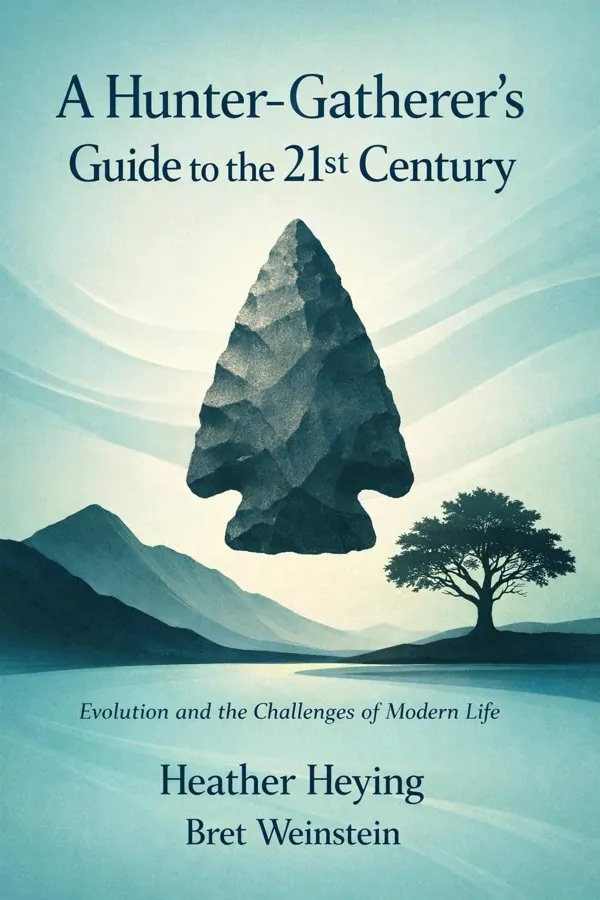
A Hunter-Gatherer's Guide to the 21st Century: Evolution and the Challenges of Modern Life: Summary & Key Insights
by Heather Heying, Bret Weinstein
 10 min11 chaptersAudio available
What Is A Hunter-Gatherer's Guide to the 21st Century: Evolution and the Challenges of Modern Life About?
A Hunter-Gatherer's Guide to the 21st Century: Evolution and the Challenges of Modern Life by Heather Heying, Bret Weinstein is a popular_sci book spanning 11 pages. A provocative exploration of the tension between our evolutionary history and the modern world, this book examines how ancient human instincts and biology interact with contemporary challenges such as diet, medicine, education, and social structures. The authors, evolutionary biologists Heather Heying and Bret Weinstein, propose that understanding our evolutionary past can help us navigate the complexities of modern life more effectively.
This FizzRead summary covers all 11 key chapters of A Hunter-Gatherer's Guide to the 21st Century: Evolution and the Challenges of Modern Life in approximately 10 minutes, distilling the most important ideas, arguments, and takeaways from Heather Heying, Bret Weinstein's work. Also available as an audio summary and Key Quotes Podcast.
A Hunter-Gatherer's Guide to the 21st Century: Evolution and the Challenges of Modern Life
A provocative exploration of the tension between our evolutionary history and the modern world, this book examines how ancient human instincts and biology interact with contemporary challenges such as diet, medicine, education, and social structures. The authors, evolutionary biologists Heather Heying and Bret Weinstein, propose that understanding our evolutionary past can help us navigate the complexities of modern life more effectively.
Who Should Read A Hunter-Gatherer's Guide to the 21st Century: Evolution and the Challenges of Modern Life?
This book is perfect for anyone interested in popular_sci and looking to gain actionable insights in a short read. Whether you're a student, professional, or lifelong learner, the key ideas from A Hunter-Gatherer's Guide to the 21st Century: Evolution and the Challenges of Modern Life by Heather Heying, Bret Weinstein will help you think differently.
- ✓Readers who enjoy popular_sci and want practical takeaways
- ✓Professionals looking to apply new ideas to their work and life
- ✓Anyone who wants the core insights of A Hunter-Gatherer's Guide to the 21st Century: Evolution and the Challenges of Modern Life in just 10 minutes
Want the full summary?
Get instant access to this book summary and 100K+ more with Fizz Moment.
Get Free SummaryAvailable on App Store • Free to download
Key Chapters
At the heart of everything lies evolution—the engine that shaped every human trait we carry today. To understand modern dysfunction, we must begin by recognizing that our biology is the product of countless generations adapting to specific environments. Evolution doesn’t strive for perfection; it improvises solutions that work well enough under particular conditions. When those conditions change faster than biology can adapt, we experience mismatch.
Natural selection, the process that refines traits through survival and reproduction, crafted us for lives of movement, intermittent hunger, cooperation, and direct connection to our ecosystems. Yet modern life has altered nearly every variable: food is abundant but artificial, physical activity optional, social relationships digital, and sleep divorced from natural cycles. It’s this tempo change—this evolutionary lag—that drives much of our confusion and ill health.
We call this phenomenon the evolutionary mismatch. It’s not inherently catastrophic but deeply consequential. Consider insulin resistance: once an adaptive trait, enabling the body to cope with periods of famine, it becomes maladaptive in a world of constant caloric excess. The same logic applies psychologically. Our craving for social validation, once vital in small groups, becomes pathological when exploited by global social media systems that flood us with comparison.
Recognizing that mismatch underpins modern problems reframes how science, medicine, and even self-help should operate. Instead of asking “What’s wrong with me?” we should ask, “What in my environment no longer fits my evolutionary design?” Our bodies are not malfunctioning; they are faithfully performing according to older instructions.
This perspective also redefines progress. Technology and institutions should evolve alongside our biology, not against it. True innovation strengthens human adaptation, rather than undermining it. When we honor the deep wisdom written into our genes, we gain not a map backward, but a compass forward—one capable of guiding us through the accelerating turbulence of modern change.
+ 9 more chapters — available in the FizzRead app
All Chapters in A Hunter-Gatherer's Guide to the 21st Century: Evolution and the Challenges of Modern Life
About the Authors
Heather Heying and Bret Weinstein are evolutionary biologists and former professors at Evergreen State College. They are known for their work on evolutionary theory, human behavior, and cultural analysis, as well as for their public commentary on science and society.
Get This Summary in Your Preferred Format
Read or listen to the A Hunter-Gatherer's Guide to the 21st Century: Evolution and the Challenges of Modern Life summary by Heather Heying, Bret Weinstein anytime, anywhere. FizzRead offers multiple formats so you can learn on your terms — all free.
Available formats: App · Audio · PDF · EPUB — All included free with FizzRead
Download A Hunter-Gatherer's Guide to the 21st Century: Evolution and the Challenges of Modern Life PDF and EPUB Summary
Key Quotes from A Hunter-Gatherer's Guide to the 21st Century: Evolution and the Challenges of Modern Life
“At the heart of everything lies evolution—the engine that shaped every human trait we carry today.”
“Human relationships are the soil from which our species arose.”
Frequently Asked Questions about A Hunter-Gatherer's Guide to the 21st Century: Evolution and the Challenges of Modern Life
A Hunter-Gatherer's Guide to the 21st Century: Evolution and the Challenges of Modern Life by Heather Heying, Bret Weinstein is a popular_sci book that explores key ideas across 11 chapters. A provocative exploration of the tension between our evolutionary history and the modern world, this book examines how ancient human instincts and biology interact with contemporary challenges such as diet, medicine, education, and social structures. The authors, evolutionary biologists Heather Heying and Bret Weinstein, propose that understanding our evolutionary past can help us navigate the complexities of modern life more effectively.
You Might Also Like

Structures: Or Why Things Don"t Fall Down
J.E. Gordon
10 min
The Road to Wigan Pier
George Orwell
10 min
Bonk: The Curious Coupling of Science and Sex
Mary Roach
10 min
First Bite: How We Learn to Eat
Bee Wilson
10 min
In Pursuit Of The Unknown: 17 Equations That Changed The World
Ian Stewart
10 min
Napoleon's Buttons: 17 Molecules That Changed History
Penny Le Couteur and Jay Burreson
10 minFeatured In
Browse by Category
Ready to read A Hunter-Gatherer's Guide to the 21st Century: Evolution and the Challenges of Modern Life?
Get the full summary and 100K+ more books with Fizz Moment.