
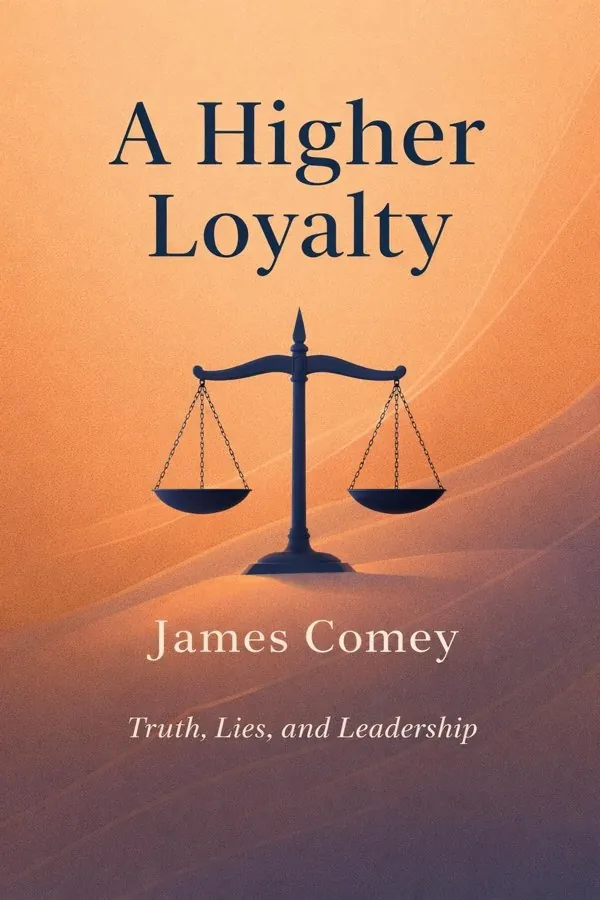
A Higher Loyalty: Truth, Lies, and Leadership: Summary & Key Insights
by James Comey
 10 min10 chaptersAudio available
What Is A Higher Loyalty: Truth, Lies, and Leadership About?
A Higher Loyalty: Truth, Lies, and Leadership by James Comey is a leadership book spanning 10 pages. In this memoir, former FBI Director James Comey reflects on his career in law enforcement and public service, exploring ethical leadership and the challenges of truth in politics. He recounts key moments from his tenure at the FBI, including his interactions with U.S. presidents and his decision-making during pivotal investigations, offering insights into integrity and moral courage in government.
This FizzRead summary covers all 10 key chapters of A Higher Loyalty: Truth, Lies, and Leadership in approximately 10 minutes, distilling the most important ideas, arguments, and takeaways from James Comey's work. Also available as an audio summary and Key Quotes Podcast.
A Higher Loyalty: Truth, Lies, and Leadership
In this memoir, former FBI Director James Comey reflects on his career in law enforcement and public service, exploring ethical leadership and the challenges of truth in politics. He recounts key moments from his tenure at the FBI, including his interactions with U.S. presidents and his decision-making during pivotal investigations, offering insights into integrity and moral courage in government.
Who Should Read A Higher Loyalty: Truth, Lies, and Leadership?
This book is perfect for anyone interested in leadership and looking to gain actionable insights in a short read. Whether you're a student, professional, or lifelong learner, the key ideas from A Higher Loyalty: Truth, Lies, and Leadership by James Comey will help you think differently.
- ✓Readers who enjoy leadership and want practical takeaways
- ✓Professionals looking to apply new ideas to their work and life
- ✓Anyone who wants the core insights of A Higher Loyalty: Truth, Lies, and Leadership in just 10 minutes
Want the full summary?
Get instant access to this book summary and 100K+ more with Fizz Moment.
Get Free SummaryAvailable on App Store • Free to download
Key Chapters
My story begins long before the Bureau, long before the high-stakes meetings in Washington conference rooms. It starts with a boy in Yonkers, New York, grappling with fear and conscience. When I was sixteen, an intruder invaded our home and held my younger brother and me at gunpoint. The fear was indescribable, but the experience imprinted something deeper: the need to stand up—to confront evil rather than shrink from it. That night, when we escaped into the cold, I understood how courage emerges not from fearlessness, but from facing fear for the sake of others.
Those early experiences, coupled with the moral clarity of my parents, defined what justice meant to me. Justice was not abstract; it was personal. My father taught me that reputation is the residue of character—the enduring mark of how you treat others when no one is watching. I carried that truth into adulthood, through the rough edges of adolescence and into the disciplined pursuit of law. Moral integrity, I learned, is less a trait than a practice—an act repeated every day in small choices that collectively become one’s soul.
At William and Mary and later in law school, I came to see how historical figures like Reinhold Niebuhr wrestled with the paradoxes of moral leadership: the notion that one must act with both humility and conviction, knowing that justice often requires uncomfortable compromise but never dishonesty. This balance between idealism and realism became central to my understanding of leadership—a principle that would be tested again and again throughout my career.
When I entered the U.S. Attorney’s Office in Manhattan, I quickly discovered that ethical judgment isn’t forged in classrooms—it unfolds in the quiet tension between power and responsibility. As a young prosecutor, I handled cases involving organized crime and financial fraud, where truth was never straightforward and loyalties were easily corrupted. What I learned was that justice depends not only on evidence, but on the integrity of those who interpret it.
In those years I saw both the beauty and brutality of the law. I saw victims demand fairness and defendants reveal the human cost of failure. I learned to approach leadership with empathy—to see people, not just cases. Ethical decision-making, I came to realize, means understanding what’s at stake for everyone involved. It’s not about the simple distinction between right and wrong, but about choosing a course that preserves both truth and humanity.
Working among brilliant and relentless colleagues taught me that leadership is defined by the courage to stay independent under pressure. In the U.S. Attorney’s Office, independence was our shield against corruption. We could serve justice only if we served no master but the law itself. That lesson would resurface later on a hospital floor in Washington, where independence and loyalty were put to their ultimate test.
+ 8 more chapters — available in the FizzRead app
All Chapters in A Higher Loyalty: Truth, Lies, and Leadership
About the Author
James Brien Comey Jr. is an American lawyer who served as the seventh Director of the Federal Bureau of Investigation from 2013 to 2017. Before his FBI tenure, he held senior positions in the U.S. Department of Justice and worked in corporate law. His writings and public speeches often focus on ethics, leadership, and justice.
Get This Summary in Your Preferred Format
Read or listen to the A Higher Loyalty: Truth, Lies, and Leadership summary by James Comey anytime, anywhere. FizzRead offers multiple formats so you can learn on your terms — all free.
Available formats: App · Audio · PDF · EPUB — All included free with FizzRead
Download A Higher Loyalty: Truth, Lies, and Leadership PDF and EPUB Summary
Key Quotes from A Higher Loyalty: Truth, Lies, and Leadership
“My story begins long before the Bureau, long before the high-stakes meetings in Washington conference rooms.”
Frequently Asked Questions about A Higher Loyalty: Truth, Lies, and Leadership
A Higher Loyalty: Truth, Lies, and Leadership by James Comey is a leadership book that explores key ideas across 10 chapters. In this memoir, former FBI Director James Comey reflects on his career in law enforcement and public service, exploring ethical leadership and the challenges of truth in politics. He recounts key moments from his tenure at the FBI, including his interactions with U.S. presidents and his decision-making during pivotal investigations, offering insights into integrity and moral courage in government.
More by James Comey
You Might Also Like

Extreme Ownership
Jocko Willink
10 min
Dare to Lead
Brene Brown
10 min
Leaders Eat Last
Simon Sinek
10 min
The 21 Irrefutable Laws of Leadership
John Maxwell
10 min
Start With Why
Simon Sinek
10 min
How to Lead When You're Not in Charge
Clay Scroggins
10 minFeatured In
Browse by Category
Ready to read A Higher Loyalty: Truth, Lies, and Leadership?
Get the full summary and 100K+ more books with Fizz Moment.