
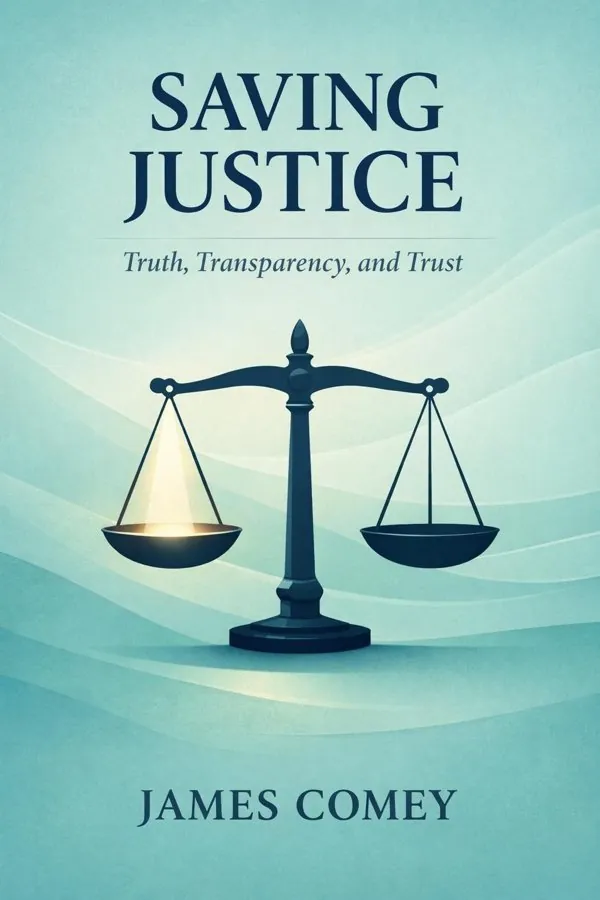
Saving Justice: Truth, Transparency, and Trust: Summary & Key Insights
by James Comey
 10 min8 chaptersAudio available
What Is Saving Justice: Truth, Transparency, and Trust About?
Saving Justice: Truth, Transparency, and Trust by James Comey is a leadership book spanning 8 pages. In this book, former FBI Director James Comey explores the principles of justice, truth, and transparency through his experiences in law enforcement and public service. He reflects on the challenges of maintaining integrity and trust in institutions, offering insights into leadership and ethical decision-making in times of political and social turmoil.
This FizzRead summary covers all 8 key chapters of Saving Justice: Truth, Transparency, and Trust in approximately 10 minutes, distilling the most important ideas, arguments, and takeaways from James Comey's work. Also available as an audio summary and Key Quotes Podcast.
Saving Justice: Truth, Transparency, and Trust
In this book, former FBI Director James Comey explores the principles of justice, truth, and transparency through his experiences in law enforcement and public service. He reflects on the challenges of maintaining integrity and trust in institutions, offering insights into leadership and ethical decision-making in times of political and social turmoil.
Who Should Read Saving Justice: Truth, Transparency, and Trust?
This book is perfect for anyone interested in leadership and looking to gain actionable insights in a short read. Whether you're a student, professional, or lifelong learner, the key ideas from Saving Justice: Truth, Transparency, and Trust by James Comey will help you think differently.
- ✓Readers who enjoy leadership and want practical takeaways
- ✓Professionals looking to apply new ideas to their work and life
- ✓Anyone who wants the core insights of Saving Justice: Truth, Transparency, and Trust in just 10 minutes
Want the full summary?
Get instant access to this book summary and 100K+ more with Fizz Moment.
Get Free SummaryAvailable on App Store • Free to download
Key Chapters
Justice exists not in abstract theories but within living institutions. When I joined the Justice Department years ago, I discovered that justice requires constant vigilance. It isn’t guaranteed by laws alone—it’s upheld by people who choose fairness even when the outcome complicates their political or personal interests. In the United States, our institutions rely heavily on public trust. The Department of Justice and the FBI must be seen not as tools of power but as guardians of impartial truth. Yet that image is fragile, and we have repeatedly seen how easily politics can corrode perception.
As I reflect on my career, the central lesson has been that law enforcement’s purpose is not to serve any political agenda but to ensure that truth guides all action. Justice demands independence, courage, and humility. It’s not enough to enforce the law; one must understand that every decision carries moral resonance. I learned early that when prosecutors or agents forget their role as instruments of fairness, they risk becoming instruments of power—and that is when justice begins to die.
In our democratic system, law enforcement must not only be right but appear right. Transparency and restraint are essential. Justice must always be seen as fair, even by those it disappoints. This is especially challenging in volatile times, but it is precisely then that the integrity of institutions becomes most vital. Our nation’s faith in justice rests on leaders who have the courage to make difficult choices, guided not by interests but by principles.
When I look back to my early days at the Department of Justice, I see not a lofty institution but a community of people faced daily with the temptation to bend. The temptation may come subtly—a request to delay a case, a suggestion to keep quiet for convenience’s sake, or the subtle pressure to look away when truth threatens comfort. Ethical leadership is born in those small moments. If you fail to stand firm, the cracks widen and the entire structure becomes unstable.
During my time as a prosecutor, I learned that integrity isn’t an ornament—it’s a discipline. Every decision carries weight beyond its immediate consequence. I often remind myself that justice is built case by case, decision by decision, truth by truth. I learned that leadership in government means embracing transparency even when it exposes your vulnerability. It means holding yourself accountable before others do. Ethical leadership is never about appearing virtuous; it’s about being virtuous when no one is watching.
These lessons shaped how I later led the FBI. Ethical leadership is about alignment—making sure that what we do reflects what we believe. And that alignment requires courage. In times of controversy, leaders must become beacons, not mirrors. They must project values rather than reflect politics. I discovered that building trust demands not perfection but authenticity—the honest acknowledgment of mistakes, and the determination to learn from them.
+ 6 more chapters — available in the FizzRead app
All Chapters in Saving Justice: Truth, Transparency, and Trust
About the Author
James B. Comey Jr. served as the seventh Director of the Federal Bureau of Investigation from 2013 to 2017. Before his tenure at the FBI, he held senior positions in the U.S. Department of Justice and worked in corporate law. He is known for his writings and public commentary on ethics, justice, and leadership.
Get This Summary in Your Preferred Format
Read or listen to the Saving Justice: Truth, Transparency, and Trust summary by James Comey anytime, anywhere. FizzRead offers multiple formats so you can learn on your terms — all free.
Available formats: App · Audio · PDF · EPUB — All included free with FizzRead
Download Saving Justice: Truth, Transparency, and Trust PDF and EPUB Summary
Key Quotes from Saving Justice: Truth, Transparency, and Trust
“Justice exists not in abstract theories but within living institutions.”
“When I look back to my early days at the Department of Justice, I see not a lofty institution but a community of people faced daily with the temptation to bend.”
Frequently Asked Questions about Saving Justice: Truth, Transparency, and Trust
Saving Justice: Truth, Transparency, and Trust by James Comey is a leadership book that explores key ideas across 8 chapters. In this book, former FBI Director James Comey explores the principles of justice, truth, and transparency through his experiences in law enforcement and public service. He reflects on the challenges of maintaining integrity and trust in institutions, offering insights into leadership and ethical decision-making in times of political and social turmoil.
More by James Comey
You Might Also Like

Extreme Ownership
Jocko Willink
10 min
Dare to Lead
Brene Brown
10 min
Leaders Eat Last
Simon Sinek
10 min
The 21 Irrefutable Laws of Leadership
John Maxwell
10 min
Start With Why
Simon Sinek
10 min
How to Lead When You're Not in Charge
Clay Scroggins
10 minBrowse by Category
Ready to read Saving Justice: Truth, Transparency, and Trust?
Get the full summary and 100K+ more books with Fizz Moment.