
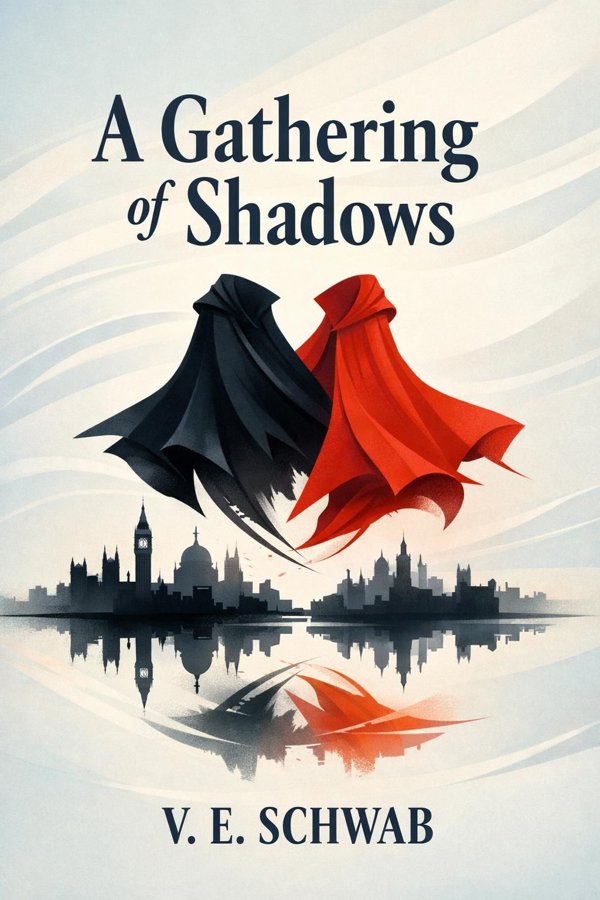
A Gathering of Shadows: Summary & Key Insights
by V. E. Schwab
 10 min9 chaptersAudio available
Key Takeaways from A Gathering of Shadows
Sometimes saving the world does not make a person freer—it makes everyone afraid of what they can do next.
Identity, in Schwab’s world, belongs to the people bold enough to seize it.
Public spectacle often hides private desperation, and the Element Games are one of the novel’s smartest examples of this truth.
In A Gathering of Shadows, magic is never just decoration; it behaves like a moral climate.
One of the novel’s most unsettling ideas is that separation does not guarantee safety.
What Is A Gathering of Shadows About?
A Gathering of Shadows by V. E. Schwab is a scifi_fantasy book spanning 5 pages. In A Gathering of Shadows, V. E. Schwab turns a thrilling fantasy adventure into something deeper: a story about what power costs after the battle seems won. Set across parallel Londons—each shaped by a different relationship to magic—the novel follows Kell, one of the last Antari magicians, as he struggles with guilt, surveillance, and the loss of freedom after saving the worlds from disaster. At the same time, Delilah Bard refuses every limit placed upon her, chasing magic, mastery, and self-invention with reckless determination. Their paths converge amid political tension, rising magical instability, and the dazzling spectacle of the Element Games, a tournament that entertains even as danger gathers in the background. What makes this sequel matter is its refusal to treat victory as an ending. Schwab explores trauma, identity, ambition, and loyalty with the same confidence she brings to world-building and pacing. Known for morally layered characters and elegant fantasy systems, Schwab proves here that a series can expand not only in scale, but in emotional intelligence. This is a fantasy novel about masks, consequences, and the unsettling truth that darkness rarely stays contained.
This FizzRead summary covers all 9 key chapters of A Gathering of Shadows in approximately 10 minutes, distilling the most important ideas, arguments, and takeaways from V. E. Schwab's work. Also available as an audio summary and Key Quotes Podcast.
A Gathering of Shadows
In A Gathering of Shadows, V. E. Schwab turns a thrilling fantasy adventure into something deeper: a story about what power costs after the battle seems won. Set across parallel Londons—each shaped by a different relationship to magic—the novel follows Kell, one of the last Antari magicians, as he struggles with guilt, surveillance, and the loss of freedom after saving the worlds from disaster. At the same time, Delilah Bard refuses every limit placed upon her, chasing magic, mastery, and self-invention with reckless determination. Their paths converge amid political tension, rising magical instability, and the dazzling spectacle of the Element Games, a tournament that entertains even as danger gathers in the background. What makes this sequel matter is its refusal to treat victory as an ending. Schwab explores trauma, identity, ambition, and loyalty with the same confidence she brings to world-building and pacing. Known for morally layered characters and elegant fantasy systems, Schwab proves here that a series can expand not only in scale, but in emotional intelligence. This is a fantasy novel about masks, consequences, and the unsettling truth that darkness rarely stays contained.
Who Should Read A Gathering of Shadows?
This book is perfect for anyone interested in scifi_fantasy and looking to gain actionable insights in a short read. Whether you're a student, professional, or lifelong learner, the key ideas from A Gathering of Shadows by V. E. Schwab will help you think differently.
- ✓Readers who enjoy scifi_fantasy and want practical takeaways
- ✓Professionals looking to apply new ideas to their work and life
- ✓Anyone who wants the core insights of A Gathering of Shadows in just 10 minutes
Want the full summary?
Get instant access to this book summary and 100K+ more with Fizz Moment.
Get Free SummaryAvailable on App Store • Free to download
Key Chapters
Sometimes saving the world does not make a person freer—it makes everyone afraid of what they can do next. That is the paradox at the center of Kell’s arc in A Gathering of Shadows. After the catastrophe of the first book, Kell is celebrated in theory but controlled in practice. In Red London, he is watched more closely, restricted by royal anxiety, and treated less like a beloved member of the royal family and more like a volatile force that must be managed. His guilt over the destruction he has witnessed only tightens those chains. He carries trauma inwardly while the palace imposes confinement outwardly.
This tension matters because Kell’s struggle is not simply political; it is deeply personal. He is a traveler between worlds, a man defined by movement, curiosity, and agency. To deny him freedom is to deny his sense of self. Schwab uses this conflict to explore a universal experience: the way responsibility can become captivity. People who are capable, gifted, or relied upon are often praised while quietly losing autonomy. A family caretaker, a high-performing employee, or a natural leader may recognize the same pattern—being needed can slowly become being owned.
Kell’s emotional state also reveals how trauma distorts identity. He is not only restricted by others; he begins to police himself. He hesitates, withdraws, and questions whether his judgment can be trusted. Schwab shows that healing is difficult when fear becomes part of the social order around you.
The practical insight is clear: after a crisis, restoring trust matters as much as restoring order. Whether in leadership, family life, or personal recovery, control is not the same thing as care. Actionable takeaway: notice where guilt or external expectations are shrinking your life, and identify one boundary or conversation that helps you reclaim agency without abandoning responsibility.
Identity, in Schwab’s world, belongs to the people bold enough to seize it. Delilah Bard enters A Gathering of Shadows as a character driven by hunger—hunger for freedom, danger, skill, and above all magic. She has escaped the narrow future Grey London offered her and reinvented herself aboard the Night Spire, building a life among thieves and sailors. Yet what makes Lila compelling is that reinvention never satisfies her for long. She does not merely want a better role; she rejects the idea that any role should define her.
Her obsession with magic is central to this. Magic represents possibility, and possibility means self-authorship. Lila’s talents, especially her surprising connection to power, force her to confront questions she usually outruns: Who is she becoming? Is she driven by courage, greed, loneliness, or all three? Schwab does not sanitize her ambition. Lila is charismatic, reckless, selfish, generous, and brave in uneven measure. That complexity makes her growth believable. She is not on a tidy journey toward virtue. She is learning how to direct her appetite instead of being consumed by it.
There is a practical resonance here for anyone building a life outside expectation. Lila embodies the exhilaration and danger of refusing prescribed identities. Career changes, creative risks, relocation, or reinvention after loss all carry the same double edge: freedom opens new doors, but it also removes excuses. Once you choose your own path, you must own its consequences.
Schwab suggests that true self-creation requires discipline, not just desire. Talent without training is instability. Independence without reflection can become isolation. Actionable takeaway: if you are trying to redefine yourself, pair your ambition with one concrete practice—study, mentorship, or routine—that turns raw longing into real capability.
Public spectacle often hides private desperation, and the Element Games are one of the novel’s smartest examples of this truth. On the surface, the Games are a lavish magical tournament in Red London, full of pageantry, masks, elemental battles, and national pride. They offer release, entertainment, and wonder. But beneath the dazzling surface, the Games reveal how identity is often performed, how power is staged for public consumption, and how competition can conceal vulnerability.
For Kell, the tournament offers a rare chance to breathe outside courtly confinement, even if only briefly. For Lila, it becomes an irresistible proving ground, a place to test whether her sense of exceptionalism can survive contact with equally gifted opponents. For the crowd, the Games transform danger into beauty. Schwab uses this event to ask a larger question: when people cheer for strength, what are they really celebrating—mastery, illusion, or the story they want to believe about themselves?
The masks worn during the competition deepen this theme. Characters in the novel regularly hide, disguise, or reinvent themselves. The tournament literalizes that process. In real life, people do the same thing in workplaces, on social media, in families, and in friendships. They present versions of themselves calibrated for approval, safety, or influence. Performance is not always deception; sometimes it is survival. But Schwab reminds us that if the mask hardens into identity, a person can lose sight of what remains underneath.
The Element Games also show that rivalry can be clarifying. Competition reveals habits, fears, and hidden strengths. A writer in a workshop, an athlete in a trial, or a professional presenting under pressure learns quickly what technique holds and what collapses.
Actionable takeaway: treat every arena of performance—whether public speaking, interviewing, or creative competition—as a mirror. Ask not only how you appeared, but what the pressure revealed about your real strengths and where you still need training.
In A Gathering of Shadows, magic is never just decoration; it behaves like a moral climate. Schwab’s parallel Londons are distinguished by their relationship to magic, and that relationship shapes culture, politics, and psychology. Red London thrives in a living exchange with magic. Grey London has almost none. White London, though less central in this installment, represents domination and imbalance. The worlds are not simply settings. They are arguments about what happens when power is respected, ignored, hoarded, or abused.
This idea gives the novel unusual depth. Magic here functions as both ability and environment. It is intimate enough to move through a body, yet vast enough to define a civilization. Characters do not just use power; they are changed by the kind of world power creates around them. The result is a fantasy story that feels relevant beyond its genre. The same principle applies in ordinary life: the systems people live in shape what seems normal, possible, and ethical. A workplace culture, a family dynamic, or a political climate can nourish generosity or reward fear.
Schwab also uses magic to reveal emotional truth. When power surges beyond control, it often corresponds to inner fracture—grief, desire, rage, obsession. This is one reason the novel’s action scenes feel meaningful rather than ornamental. They externalize hidden conflict. A magical contest is also an emotional one. A dangerous object is also a symbol of temptation. A fracture between worlds is also a fracture within people.
Readers can apply this insight by paying closer attention to the environments that shape their own behavior. If a system rewards secrecy, competition, or emotional suppression, individuals will adapt accordingly, often without noticing.
Actionable takeaway: examine one environment you belong to—work, school, family, or community—and ask what kind of “magic” it encourages. Then decide one way to reinforce what is healthy or resist what is corrosive.
One of the novel’s most unsettling ideas is that separation does not guarantee safety. The four Londons may exist as parallel worlds, but they are not truly insulated from one another. The barriers between them can hold, weaken, or break, and A Gathering of Shadows builds tension from the recognition that imbalance in one place can ripple outward. What appears contained is often merely delayed.
Schwab uses this fraying balance to expand the trilogy’s stakes. The threat is not only a villain with obvious intentions; it is the slow return of corruption, the persistence of forces thought buried, and the dangerous illusion that peace is permanent. This is what makes the novel feel mature. It understands that disasters rarely arrive out of nowhere. They gather in neglected corners, in unresolved grief, in hidden artifacts, in political complacency, and in people who mistake silence for stability.
This concept applies beyond fantasy. In personal life, ignored tensions do not disappear because they are inconvenient. In institutions, unresolved ethical problems rarely stay isolated. In relationships, avoiding difficult truths may preserve comfort temporarily while weakening trust over time. Schwab frames interconnectedness as both beautiful and dangerous: connection makes loyalty and love possible, but it also means damage spreads.
The book therefore asks readers to think about vigilance differently. Being alert is not the same as living in fear. It means recognizing that maintenance matters. Healthy systems—whether magical realms, friendships, or organizations—require attention before crisis hits.
Kell and Lila, in different ways, are drawn toward this realization. Their individual desires cannot remain purely individual because the world is linked. Choices travel.
Actionable takeaway: identify one area of your life that seems stable only because you have stopped looking closely at it. Address a small unresolved issue now—through repair, conversation, or planning—before it becomes a larger breach.
Victory is often narrated as closure, but Schwab insists that survival has its own aftermath. A Gathering of Shadows is powerful partly because it refuses to treat the end of one conflict as emotional completion. Kell, Rhy, and others continue living under the shadow of what they endured. Fear lingers, trust shifts, and ordinary life feels altered. The palace may still stand, but no one within it is untouched.
This is especially visible in the bond between Kell and Rhy, forged and transformed by blood magic and sacrifice. Their connection is intimate, lifesaving, and burdensome all at once. What should be a symbol of love also becomes a reminder of pain, dependence, and obligation. Schwab understands that trauma often complicates the very relationships that sustain people. Gratitude can coexist with resentment. Loyalty can coexist with suffocation.
The novel’s emotional honesty lies in this refusal to simplify recovery. People do not emerge from crisis as purified heroes. They become more frightened, more guarded, more reckless, or more desperate for joy. Some seek control. Some seek escape. Some pretend they are unchanged. This makes the characters feel human even in a world of magic.
The practical relevance is immediate. Many readers know what it is like to function after an intense event while still carrying its emotional residue. Returning to work, family obligations, or public performance does not erase internal disruption. Schwab suggests that healing requires acknowledgment, not just endurance.
The novel also quietly argues that compassion should include patience with uneven recovery. Progress may look inconsistent. Someone may appear capable while still struggling.
Actionable takeaway: if you are moving on from a difficult period, stop measuring your recovery only by outward performance. Build in one deliberate form of processing—honest conversation, journaling, therapy, or rest—so survival can gradually become healing rather than just continued endurance.
The most dangerous choices in A Gathering of Shadows are rarely between obvious good and evil. More often, they arise when loyalty collides with freedom, or when desire interferes with duty. Schwab excels at this kind of moral pressure. Her characters are not defined by fixed virtue but by what they protect, what they risk, and what they cannot quite give up.
Kell is torn between devotion to the Maresh family and his need for autonomy. Lila is pulled between attachment and self-interest, exhilarated by connection but resistant to dependence. Alucard Emery, with his elegance and secrets, complicates the emotional landscape further, particularly in relation to Rhy. Each major relationship is shaped by competing needs: to belong and to remain free, to trust and to remain defended, to love and to avoid being wounded.
This tension is why the novel feels emotionally rich. Power in Schwab’s world is not only magical force; it is also influence, leverage, intimacy, and knowledge. To care about someone is to gain a kind of power over them, and to grant care is to become vulnerable. The story repeatedly asks whether love can survive honesty, whether duty can survive resentment, and whether self-protection eventually becomes its own prison.
These questions have practical force. In workplaces, families, friendships, and romances, many conflicts are not about malice but misaligned obligations. A person can act from love and still create harm. A person can seek independence and still leave damage behind. Recognizing that complexity makes better decisions possible.
Actionable takeaway: when facing a difficult choice, name the two loyalties in conflict rather than pretending there is only one right answer. Clarity about competing values—freedom, security, love, ambition, duty—helps you choose more honestly and take responsibility for the tradeoff.
One reason A Gathering of Shadows builds suspense so effectively is that danger rarely arrives wearing a simple face. It appears through elegance, ceremony, wit, seduction, and beauty. Schwab understands that people lower their guard around what dazzles them. Whether in magical objects, public festivals, or charismatic individuals, the story repeatedly warns that attraction and threat often travel together.
This is not merely a gothic flourish. It is a sharp observation about human judgment. People are drawn to confidence, spectacle, and mystery. They trust what feels pleasurable or impressive. In the novel, that instinct becomes risky because dark forces exploit fascination. The beautiful can become addictive; the entertaining can become distracting; the extraordinary can make ordinary caution feel small-minded.
Lila, especially, is vulnerable to this dynamic because she is attracted to rarity and danger. Kell, too, is susceptible in different ways, particularly when emotion clouds discernment. Schwab never argues that wonder is foolish. In fact, wonder is one of the great pleasures of the book. But she insists that enchantment without discernment can become a trap.
The idea translates easily to modern life. People encounter polished narratives constantly—online personas, ambitious promises, intense relationships, glamorous opportunities. Surface appeal can obscure poor motives, hidden costs, or unstable foundations. That does not mean suspicion should replace curiosity. It means curiosity should be paired with attention.
One of the novel’s strengths is that it keeps both truths alive: beauty matters, and beauty can mislead. Magic remains marvelous even when it becomes dangerous.
Actionable takeaway: when something or someone feels irresistibly compelling, pause before committing. Ask what evidence supports your excitement, what risks you might be minimizing, and whether the attraction is grounded in substance or simply in the thrill of the extraordinary.
By the end of A Gathering of Shadows, Schwab pushes beyond mere endurance toward a harder idea: surviving darkness does not automatically create renewal. Renewal demands decisions. Characters must choose what kind of people they will become after fear, power, and loss have exposed them. This is why the novel works so well as a middle volume in a trilogy. It does not offer final resolution, but it does force transformation.
Kell cannot remain the obedient version of himself that others prefer. Lila cannot keep mistaking motion for growth. Rhy, Alucard, and the larger world around them must also contend with truths that can no longer be postponed. The story’s darker turns make one lesson unavoidable: a person cannot simply return to an earlier, safer identity once reality has changed. Renewal is not restoration of innocence; it is a conscious rebuilding with fuller knowledge.
This makes the novel surprisingly hopeful. Its hope is not naive optimism but earned resilience. Schwab suggests that collapse can reveal what was weak, false, or unfinished. That revelation is painful, but it creates the possibility of a more intentional future. In real life, this pattern appears after illness, grief, failure, betrayal, or major transition. The old structure breaks. Then comes the harder question: what now?
The book’s answer is that courage is not only dramatic action. It is also choosing honesty over denial, growth over performance, and responsibility over passivity. Renewal begins when characters stop waiting for external permission to change.
Actionable takeaway: after any disruption in your life, do not ask only how to get back to normal. Ask what needs to be rebuilt differently. Choose one intentional change—a habit, boundary, commitment, or truth-telling conversation—that turns survival into meaningful renewal.
All Chapters in A Gathering of Shadows
About the Author
V. E. Schwab is an American author celebrated for fantasy and speculative fiction that combines inventive concepts with emotional intensity. She writes for both adult and young adult audiences and is best known for the Shades of Magic trilogy, the Villains series beginning with Vicious, and the internationally acclaimed novel The Invisible Life of Addie LaRue. Schwab’s work often explores power, identity, memory, violence, and the cost of desire, all through vivid world-building and morally complex characters. She has earned a wide global readership thanks to her elegant prose, sharp pacing, and ability to make fantastical settings feel psychologically real. Whether writing about parallel worlds, extraordinary abilities, or immortal bargains, Schwab consistently returns to one central question: what does it mean to remain human in the presence of power?
Get This Summary in Your Preferred Format
Read or listen to the A Gathering of Shadows summary by V. E. Schwab anytime, anywhere. FizzRead offers multiple formats so you can learn on your terms — all free.
Available formats: App · Audio · PDF · EPUB — All included free with FizzRead
Download A Gathering of Shadows PDF and EPUB Summary
Key Quotes from A Gathering of Shadows
“Sometimes saving the world does not make a person freer—it makes everyone afraid of what they can do next.”
“Identity, in Schwab’s world, belongs to the people bold enough to seize it.”
“Public spectacle often hides private desperation, and the Element Games are one of the novel’s smartest examples of this truth.”
“In A Gathering of Shadows, magic is never just decoration; it behaves like a moral climate.”
“One of the novel’s most unsettling ideas is that separation does not guarantee safety.”
Frequently Asked Questions about A Gathering of Shadows
A Gathering of Shadows by V. E. Schwab is a scifi_fantasy book that explores key ideas across 9 chapters. In A Gathering of Shadows, V. E. Schwab turns a thrilling fantasy adventure into something deeper: a story about what power costs after the battle seems won. Set across parallel Londons—each shaped by a different relationship to magic—the novel follows Kell, one of the last Antari magicians, as he struggles with guilt, surveillance, and the loss of freedom after saving the worlds from disaster. At the same time, Delilah Bard refuses every limit placed upon her, chasing magic, mastery, and self-invention with reckless determination. Their paths converge amid political tension, rising magical instability, and the dazzling spectacle of the Element Games, a tournament that entertains even as danger gathers in the background. What makes this sequel matter is its refusal to treat victory as an ending. Schwab explores trauma, identity, ambition, and loyalty with the same confidence she brings to world-building and pacing. Known for morally layered characters and elegant fantasy systems, Schwab proves here that a series can expand not only in scale, but in emotional intelligence. This is a fantasy novel about masks, consequences, and the unsettling truth that darkness rarely stays contained.
You Might Also Like
Red Rising
Pierce Brown
10 min
Stranger in a Strange Land
Robert A. Heinlein
10 min
AI Valley
Chen Qiufan
10 min
Bloodchild
Octavia E. Butler
10 min
Do Androids Dream of Electric Sheep?
Philip K. Dick
10 min
Jujutsu Kaisen, Vol. 24
Gege Akutami
10 minBrowse by Category
Ready to read A Gathering of Shadows?
Get the full summary and 100K+ more books with Fizz Moment.