
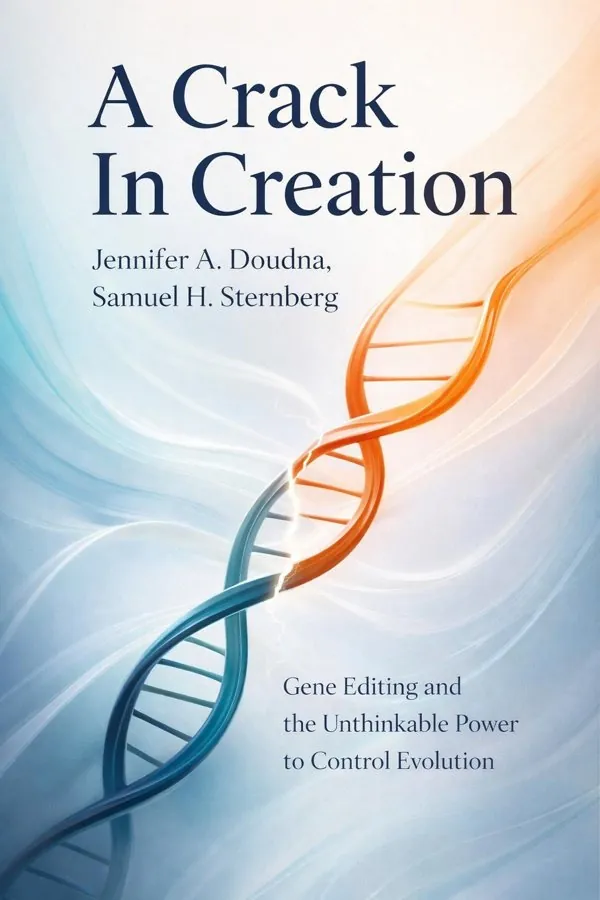
A Crack In Creation: Gene Editing and the Unthinkable Power to Control Evolution: Summary & Key Insights
by Jennifer A. Doudna, Samuel H. Sternberg
 10 min9 chaptersAudio available
What Is A Crack In Creation: Gene Editing and the Unthinkable Power to Control Evolution About?
A Crack In Creation: Gene Editing and the Unthinkable Power to Control Evolution by Jennifer A. Doudna, Samuel H. Sternberg is a life_science book spanning 9 pages. A Crack in Creation explores the revolutionary discovery of CRISPR-Cas9, a gene-editing technology that allows scientists to rewrite the genetic code with unprecedented precision. Written by Jennifer Doudna, one of the inventors of CRISPR, and Samuel Sternberg, the book delves into the science behind gene editing, its potential to cure diseases, and the profound ethical questions it raises about controlling evolution itself.
This FizzRead summary covers all 9 key chapters of A Crack In Creation: Gene Editing and the Unthinkable Power to Control Evolution in approximately 10 minutes, distilling the most important ideas, arguments, and takeaways from Jennifer A. Doudna, Samuel H. Sternberg's work. Also available as an audio summary and Key Quotes Podcast.
A Crack In Creation: Gene Editing and the Unthinkable Power to Control Evolution
A Crack in Creation explores the revolutionary discovery of CRISPR-Cas9, a gene-editing technology that allows scientists to rewrite the genetic code with unprecedented precision. Written by Jennifer Doudna, one of the inventors of CRISPR, and Samuel Sternberg, the book delves into the science behind gene editing, its potential to cure diseases, and the profound ethical questions it raises about controlling evolution itself.
Who Should Read A Crack In Creation: Gene Editing and the Unthinkable Power to Control Evolution?
This book is perfect for anyone interested in life_science and looking to gain actionable insights in a short read. Whether you're a student, professional, or lifelong learner, the key ideas from A Crack In Creation: Gene Editing and the Unthinkable Power to Control Evolution by Jennifer A. Doudna, Samuel H. Sternberg will help you think differently.
- ✓Readers who enjoy life_science and want practical takeaways
- ✓Professionals looking to apply new ideas to their work and life
- ✓Anyone who wants the core insights of A Crack In Creation: Gene Editing and the Unthinkable Power to Control Evolution in just 10 minutes
Want the full summary?
Get instant access to this book summary and 100K+ more with Fizz Moment.
Get Free SummaryAvailable on App Store • Free to download
Key Chapters
My scientific path began with RNA. At the time, we didn’t fully understand all the roles this molecule played in living systems. We knew it wasn’t just a messenger between DNA and proteins—it could also act as a catalyst, a tool capable of executing commands. I was captivated by its flexibility; RNA seemed to bridge the gap between genetics and chemistry. Through studying RNA interference, we learned how cells could regulate their own genes and defend themselves from errors and viruses. This glimpse into nature’s internal wisdom inspired my curiosity.
That curiosity eventually led me into the microscopic world of bacteria. While many colleagues focused on complex multicellular organisms, I was drawn to these simple forms of life and their strangely efficient defense systems. That fascination became the starting point of CRISPR. In science, small curiosities often open the largest doors: a question that seems tangential may uncover the core mechanisms of evolution itself. When my team began investigating how bacteria identify and remember viral invaders, we didn’t know we were chasing what nature had already perfected—a built-in form of genetic editing.
While studying bacterial genomes, we noticed curious repeating sequences—regular patterns interspersed with unique spacers. At first, no one could explain their purpose. Then we discovered that the spacer fragments matched viral DNA, relics from past infections. The realization was astounding: bacteria were archiving snippets of viral code as a memory, ready to launch a targeted counterattack during future invasions. This was CRISPR, an ancient and remarkably intelligent immune system.
As research deepened, I saw that CRISPR was more than a biological oddity—it was a programmable molecular machine capable of recognizing and cutting DNA at specific sites. In that instant, it felt as if we’d found not just nature’s defense mechanism, but a key to rewriting life’s code itself. Scientific breakthroughs often arise from coincidence joined with persistence: countless failed experiments and minute observations finally aligning to reveal a new world. The discovery of CRISPR represented a revolution in understanding—proof that life stores memories not only to preserve them, but to rewrite them.
+ 7 more chapters — available in the FizzRead app
All Chapters in A Crack In Creation: Gene Editing and the Unthinkable Power to Control Evolution
About the Authors
Jennifer A. Doudna is an American biochemist and professor at the University of California, Berkeley, known for her pioneering work on CRISPR gene editing. Samuel H. Sternberg is a biochemist and assistant professor at Columbia University, specializing in RNA biology and genome engineering.
Get This Summary in Your Preferred Format
Read or listen to the A Crack In Creation: Gene Editing and the Unthinkable Power to Control Evolution summary by Jennifer A. Doudna, Samuel H. Sternberg anytime, anywhere. FizzRead offers multiple formats so you can learn on your terms — all free.
Available formats: App · Audio · PDF · EPUB — All included free with FizzRead
Download A Crack In Creation: Gene Editing and the Unthinkable Power to Control Evolution PDF and EPUB Summary
Key Quotes from A Crack In Creation: Gene Editing and the Unthinkable Power to Control Evolution
“At the time, we didn’t fully understand all the roles this molecule played in living systems.”
“While studying bacterial genomes, we noticed curious repeating sequences—regular patterns interspersed with unique spacers.”
Frequently Asked Questions about A Crack In Creation: Gene Editing and the Unthinkable Power to Control Evolution
A Crack In Creation: Gene Editing and the Unthinkable Power to Control Evolution by Jennifer A. Doudna, Samuel H. Sternberg is a life_science book that explores key ideas across 9 chapters. A Crack in Creation explores the revolutionary discovery of CRISPR-Cas9, a gene-editing technology that allows scientists to rewrite the genetic code with unprecedented precision. Written by Jennifer Doudna, one of the inventors of CRISPR, and Samuel Sternberg, the book delves into the science behind gene editing, its potential to cure diseases, and the profound ethical questions it raises about controlling evolution itself.
You Might Also Like
The Selfish Gene
Richard Dawkins
10 min
Awakenings
Oliver Sacks
10 min
Parasite Rex: Inside the Bizarre World of Nature's Most Dangerous Creatures
Carl Zimmer
10 min
The Atlas of Life on Earth
Various
10 min
The Book of Humans: The Story of How We Became Us
Adam Rutherford
10 min
The Horse
Wendy Williams
10 minFeatured In
Browse by Category
Ready to read A Crack In Creation: Gene Editing and the Unthinkable Power to Control Evolution?
Get the full summary and 100K+ more books with Fizz Moment.