
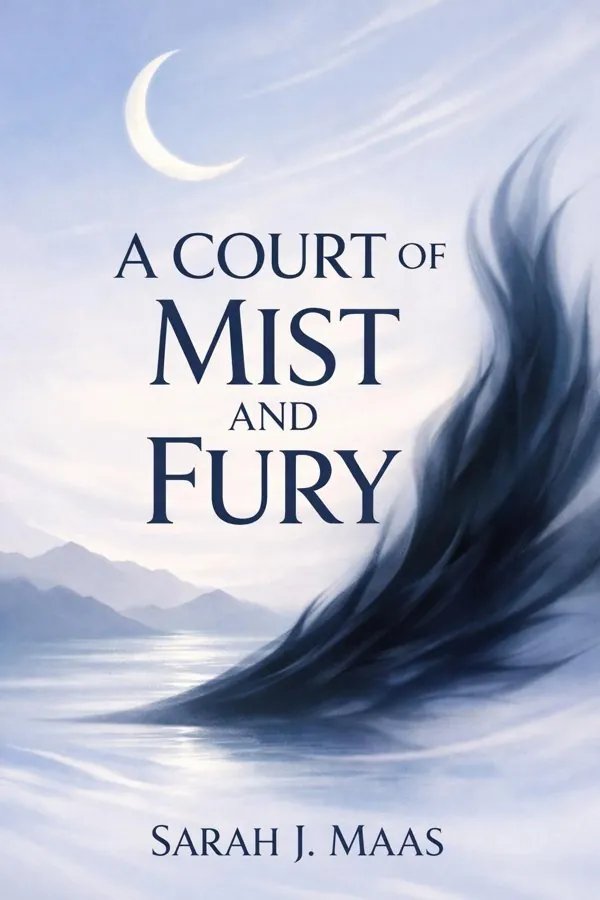
A Court of Mist and Fury: Summary & Key Insights
 10 min8 chaptersAudio available
Key Takeaways from A Court of Mist and Fury
Surviving a nightmare does not mean you immediately know how to live again.
What first looks like an unwanted obligation can become the doorway to transformation.
People do not heal in places where their pain must stay invisible.
One of the novel’s central questions is what power is for.
The most dangerous people are not always who they seem, and the most misunderstood people often hide the noblest intentions.
What Is A Court of Mist and Fury About?
A Court of Mist and Fury by Sarah J. Maas is a bestsellers book spanning 4 pages. A Court of Mist and Fury is the sweeping second installment in Sarah J. Maas’s internationally bestselling A Court of Thorns and Roses series, and it transforms what first appeared to be a romantic fantasy into something deeper, darker, and more emotionally ambitious. The novel follows Feyre after her brutal survival Under the Mountain, where victory came at the cost of innocence, peace, and a stable sense of self. Back in the Spring Court, she is supposed to be safe. Instead, she is unraveling. As political tensions rise across Prythian and a dangerous alliance threatens every court, Feyre is drawn toward the Night Court and its mysterious High Lord, Rhysand, where she begins to confront buried trauma, immense new powers, and a radically different idea of love and freedom. What makes this book matter is not only its lush world-building or high-stakes fantasy plot, but its sharp attention to healing, agency, and identity. Sarah J. Maas, celebrated for crafting emotionally charged fantasy with strong heroines and intricate court politics, delivers a story about survival after survival—about learning that rescue means little unless it leads to self-possession.
This FizzRead summary covers all 8 key chapters of A Court of Mist and Fury in approximately 10 minutes, distilling the most important ideas, arguments, and takeaways from Sarah J. Maas's work. Also available as an audio summary and Key Quotes Podcast.
A Court of Mist and Fury
A Court of Mist and Fury is the sweeping second installment in Sarah J. Maas’s internationally bestselling A Court of Thorns and Roses series, and it transforms what first appeared to be a romantic fantasy into something deeper, darker, and more emotionally ambitious. The novel follows Feyre after her brutal survival Under the Mountain, where victory came at the cost of innocence, peace, and a stable sense of self. Back in the Spring Court, she is supposed to be safe. Instead, she is unraveling. As political tensions rise across Prythian and a dangerous alliance threatens every court, Feyre is drawn toward the Night Court and its mysterious High Lord, Rhysand, where she begins to confront buried trauma, immense new powers, and a radically different idea of love and freedom. What makes this book matter is not only its lush world-building or high-stakes fantasy plot, but its sharp attention to healing, agency, and identity. Sarah J. Maas, celebrated for crafting emotionally charged fantasy with strong heroines and intricate court politics, delivers a story about survival after survival—about learning that rescue means little unless it leads to self-possession.
Who Should Read A Court of Mist and Fury?
This book is perfect for anyone interested in bestsellers and looking to gain actionable insights in a short read. Whether you're a student, professional, or lifelong learner, the key ideas from A Court of Mist and Fury by Sarah J. Maas will help you think differently.
- ✓Readers who enjoy bestsellers and want practical takeaways
- ✓Professionals looking to apply new ideas to their work and life
- ✓Anyone who wants the core insights of A Court of Mist and Fury in just 10 minutes
Want the full summary?
Get instant access to this book summary and 100K+ more with Fizz Moment.
Get Free SummaryAvailable on App Store • Free to download
Key Chapters
Surviving a nightmare does not mean you immediately know how to live again. That truth defines Feyre’s return to the Spring Court after the horrors Under the Mountain. Outwardly, she has won: Amarantha is dead, her loved ones are free, and she is about to marry Tamlin. Inwardly, however, she is starving, vomiting from nightmares, and drowning in memories she cannot voice. The safety she expected feels empty because no one around her is willing or able to name what she has endured. Instead of recovery, she is offered silence, ceremony, and the demand to appear healed.
This section of the novel matters because it rejects the fantasy convention that victory ends suffering. Maas shows trauma as ongoing, private, and often invisible. Feyre’s pain is intensified by the Spring Court’s beauty, because the contrast makes her isolation sharper. Tamlin’s protectiveness, which once seemed romantic, begins to feel suffocating when it leaves no room for her grief, anger, or agency. The people around Feyre want the symbol of her, not the wounded person she has become.
In real life, this idea applies to anyone who has gone through crisis, burnout, grief, or abuse. Recovery rarely looks triumphant. It may look like numbness, irritability, avoidance, or feeling disconnected from a life that should feel normal again. One practical lesson here is that healing requires acknowledgment. Pretending things are fine often deepens the wound.
Actionable takeaway: when facing the aftermath of a painful experience, stop measuring yourself by how quickly you “move on.” Name what hurts, notice where your environment silences you, and seek spaces where your full truth can exist.
What first looks like an unwanted obligation can become the doorway to transformation. Feyre’s bargain with Rhysand—one week every month in the Night Court—begins as a reminder of humiliation and debt. She distrusts him, resents the claim he has on her time, and assumes his motives are dangerous. Yet when Rhysand arrives to collect on the bargain, he interrupts a life that is slowly crushing her. The call to the Night Court does not simply move Feyre to a different location; it introduces a different moral and emotional framework.
In the Night Court, especially Velaris, Feyre encounters contrast. Where the Spring Court is full of beauty but rigid control, Rhysand’s world is shadowed, complex, and unexpectedly honest. She is not treated as a decorative future bride. She is trained, questioned, challenged, and invited to make choices. The bargain becomes symbolically important because it shifts from chain to threshold. Maas uses this transition to show that freedom sometimes arrives through the very thing we resist.
This idea has practical power beyond fantasy. Many people cling to familiar circumstances because they seem safe, even when those circumstances are diminishing them. A difficult job change, therapy appointment, honest conversation, or unexpected relationship may initially feel invasive. Over time, however, it may reveal a better version of life. Growth often begins with discomfort and suspicion rather than immediate relief.
A useful example is leaving a role or routine that defines you but no longer supports you. The first step can feel like betrayal of who you used to be. Yet a broader world may only become visible after that break.
Actionable takeaway: when a change feels unsettling, ask not only “Why is this happening to me?” but also “What new possibility might this open?”
People do not heal in places where their pain must stay invisible. One of the novel’s strongest emotional insights is the contrast between being managed and being truly seen. At the Spring Court, Feyre’s distress is something to be contained. At the Night Court, her suffering is acknowledged without being turned into weakness. Rhysand, Mor, Cassian, Azriel, and Amren do not demand perfection from her. They make room for her brokenness while still expecting her strength.
This distinction is crucial. Healing is not simply about tenderness; it is also about recognition. Feyre begins to recover when others stop insisting she perform happiness and instead allow her to tell the truth. Even small gestures matter: eating with others, training despite failure, painting again, and being invited into friendship without conditions. Maas suggests that trauma shrinks when it is shared in trustworthy company. Isolation feeds shame; witness weakens it.
The book also shows that support does not mean overprotection. Feyre is not healed by being hidden away. She is healed, gradually, through participation in life. She works, learns, fights, jokes, and belongs. This offers a practical lesson for anyone supporting a struggling friend, partner, or family member. Trying to erase discomfort or micromanage someone’s recovery can become another form of control. What often helps more is listening, believing, and making space for agency.
In everyday terms, this might mean replacing “You should be over this by now” with “I believe what this feels like for you.” It may mean encouraging someone to seek therapy, community, or meaningful routine rather than simply rest in isolation.
Actionable takeaway: if you are healing, seek people who can witness your pain without minimizing it. If you are supporting someone else, offer presence and respect before advice.
One of the novel’s central questions is what power is for. Feyre emerges from her resurrection with the magic of all seven High Lords inside her, making her formidable in ways she does not yet understand. But Maas is less interested in power as spectacle than in power as self-determination. Feyre’s struggle is not only to control her abilities; it is to reclaim the right to decide what her life will be.
This is why the contrast between Tamlin and Rhysand matters so deeply. Tamlin believes love is proven through protection, even if protection requires confinement. Rhysand, despite his own secrets and manipulations, repeatedly pushes Feyre toward knowledge, training, and informed choice. He withholds some truths, but the direction of his care is fundamentally different: he wants her stronger, not smaller. The book argues that real love and real leadership do not demand helplessness from others.
This idea applies widely. In relationships, workplaces, and families, control is often disguised as care. Someone may say they are protecting you while making decisions for you, limiting your movement, or discouraging your growth. By contrast, healthy power-sharing equips people. It informs them, trusts them, and expands their capacity.
A practical example is mentorship. A controlling mentor keeps you dependent and insecure. A good mentor teaches skills, shares context, and wants you to outgrow your need for constant guidance. The same principle works in romance and friendship.
Feyre’s arc reminds readers that personal power is not selfish. It is essential. Without choice, affection becomes possession.
Actionable takeaway: examine the relationships in your life and ask a simple question: does this connection make me more capable of being myself, or less?
The most dangerous people are not always who they seem, and the most misunderstood people often hide the noblest intentions. A Court of Mist and Fury thrives on reversals of perception, especially through Rhysand and the Night Court. Publicly, Rhys is known as cruel, decadent, and morally suspect. Yet as Feyre learns more, she discovers that his darkest mask was partly a survival strategy—one that protected Velaris, his people, and his long game against greater threats. At the same time, characters and institutions that appear lovely or honorable are revealed to be fragile, self-serving, or oppressive.
This theme of masks operates politically and personally. On the political level, the looming threat of Hybern forces every court into performance, secrecy, and strategic deception. On the emotional level, Feyre herself wears masks: dutiful fiancée, survivor, dutiful guest, future spy. Maas shows that concealment can be corrupt, but it can also be necessary in hostile worlds. The key question is not whether someone hides something, but why.
That question has clear real-world relevance. People cultivate personas at work, online, in families, and in public life. Some masks are manipulative. Others are protective adaptations to unsafe environments. Good judgment requires patience, context, and a willingness to revise first impressions. A charming exterior may hide coercion, while a difficult personality may conceal loyalty or sacrifice.
The practical lesson is to evaluate patterns over presentation. Who acts with integrity when no one benefits from seeing it? Who becomes smaller or crueler when threatened? Look for consistency, not image.
Actionable takeaway: challenge your first assumptions about people and systems. Ask what function a mask serves before deciding whether it signals danger, defense, or both.
Romance in this novel is not simply about chemistry; it is about the ethics of love. Maas takes the traditional fantasy promise of rescue and asks whether devotion can become damaging when it is rooted in fear and control. Feyre’s relationship with Tamlin deteriorates not because affection never existed, but because trauma changes what each of them needs and because Tamlin’s response is to tighten his grip. He tries to keep Feyre safe by restricting her world, dismissing her instincts, and making decisions on her behalf. What once felt like shelter becomes imprisonment.
By contrast, Feyre’s bond with Rhysand develops through consent, conversation, challenge, and shared vulnerability. The emotional power of their relationship comes from how often choice is emphasized. He invites rather than compels. He sees her rage, hunger, talent, and ambition as parts of her to be honored, not suppressed. In that sense, the novel offers a compelling redefinition of romance: love is not proven by possession or sacrifice alone, but by the creation of freedom.
This theme is useful beyond fiction because many people are taught to confuse intensity with health. Grand gestures, jealousy, overprotection, and dependence can be romanticized even when they erode autonomy. A stronger model of love asks different questions: Can you speak honestly? Can you grow? Are your boundaries respected? Do you feel more alive or less?
A practical application is to evaluate not only how deeply someone feels for you, but how their love behaves under stress. Do they trust you or contain you? Do they encourage your independence or fear it?
Actionable takeaway: measure love by the freedom, dignity, and honesty it allows—not merely by its intensity.
Sometimes we become ourselves not in the place we were promised, but in the community that chooses us fully. One of the most beloved elements of A Court of Mist and Fury is Feyre’s gradual integration into Rhysand’s inner circle. Mor, Cassian, Azriel, and Amren are not flawless caretakers or instant best friends. They are sharp, damaged, loyal, and distinct. What makes them transformative is the culture they create around Feyre: one of belonging without erasure.
Found family matters in the novel because it repairs what trauma fractures. Abuse and grief often isolate people, convincing them they are burdens, outsiders, or broken beyond repair. The Night Court’s inner circle counters that message. Feyre is not merely tolerated as Rhysand’s guest; she is invited to contribute, to train, to joke, to fail, and to matter. Her identity expands because she is no longer reduced to survivor, bride, or symbol. She becomes an artist, strategist, friend, fighter, and political actor.
This resonates strongly in real life. Many readers know the difference between environments where they are judged according to roles and environments where they are known more completely. Found family can appear as close friends, colleagues, teammates, creative communities, or support groups. It does not replace every original bond, but it can become the site of profound renewal.
Practically, this theme encourages intentional community-building. Healing rarely happens in isolation. Seek spaces where contribution is welcomed, humor survives hardship, and mutual loyalty is more than a slogan.
Actionable takeaway: invest in relationships that let you be both vulnerable and useful. The right community does not just comfort you; it helps you remember who you are becoming.
Transformation becomes complete when identity turns into purpose. By the latter part of the novel, Feyre is no longer merely reacting to events. She begins to understand Hybern’s threat, the strategic vulnerabilities of the courts, and her own capacity to influence what comes next. This culminates in one of the book’s most important shifts: Feyre accepts that survival and romance are not the end of her journey. She must become politically aware, strategically capable, and willing to act.
Her emerging role as spy captures this evolution perfectly. Spying requires more than bravery. It requires observation, self-control, emotional intelligence, and the ability to wear masks without losing one’s core. Feyre’s artistic eye, sensitivity to power, and newly awakened magic all become assets. Maas reframes femininity and strength here: intuition, empathy, beauty, and performance are not weaknesses but tools when used consciously.
This idea has broad application. Many people reach a point where personal healing must expand into participation in a larger mission. Once you understand systems that harm, the next question becomes how you will respond. You may not become a literal spy, but you may become more strategic at work, more engaged in your community, more alert to manipulation, or more committed to protecting others.
A practical example is learning to read group dynamics. Who holds influence? What is spoken openly, and what is only implied? Which values are real, and which are for show? These skills help in leadership, negotiation, and self-protection.
Actionable takeaway: do not stop at personal recovery. Turn what you have learned from pain into discernment, skill, and purposeful action in the wider world.
All Chapters in A Court of Mist and Fury
About the Author
Sarah J. Maas is an American bestselling author celebrated for her fantasy novels, especially the Throne of Glass, A Court of Thorns and Roses, and Crescent City series. Known for combining immersive world-building with emotionally intense character arcs, Maas has become one of the defining voices in modern fantasy romance. She began writing at a young age and gained early attention for Throne of Glass before expanding into globally successful multibook universes. Her fiction often features resilient heroines, layered political conflicts, and themes of power, trauma, loyalty, and transformation. Born in New York City, Maas has built an international readership through stories that blend epic stakes with intimate emotional journeys, making her work especially popular among readers of romantasy and character-driven fantasy.
Get This Summary in Your Preferred Format
Read or listen to the A Court of Mist and Fury summary by Sarah J. Maas anytime, anywhere. FizzRead offers multiple formats so you can learn on your terms — all free.
Available formats: App · Audio · PDF · EPUB — All included free with FizzRead
Download A Court of Mist and Fury PDF and EPUB Summary
Key Quotes from A Court of Mist and Fury
“Surviving a nightmare does not mean you immediately know how to live again.”
“What first looks like an unwanted obligation can become the doorway to transformation.”
“People do not heal in places where their pain must stay invisible.”
“One of the novel’s central questions is what power is for.”
“The most dangerous people are not always who they seem, and the most misunderstood people often hide the noblest intentions.”
Frequently Asked Questions about A Court of Mist and Fury
A Court of Mist and Fury by Sarah J. Maas is a bestsellers book that explores key ideas across 8 chapters. A Court of Mist and Fury is the sweeping second installment in Sarah J. Maas’s internationally bestselling A Court of Thorns and Roses series, and it transforms what first appeared to be a romantic fantasy into something deeper, darker, and more emotionally ambitious. The novel follows Feyre after her brutal survival Under the Mountain, where victory came at the cost of innocence, peace, and a stable sense of self. Back in the Spring Court, she is supposed to be safe. Instead, she is unraveling. As political tensions rise across Prythian and a dangerous alliance threatens every court, Feyre is drawn toward the Night Court and its mysterious High Lord, Rhysand, where she begins to confront buried trauma, immense new powers, and a radically different idea of love and freedom. What makes this book matter is not only its lush world-building or high-stakes fantasy plot, but its sharp attention to healing, agency, and identity. Sarah J. Maas, celebrated for crafting emotionally charged fantasy with strong heroines and intricate court politics, delivers a story about survival after survival—about learning that rescue means little unless it leads to self-possession.
More by Sarah J. Maas




You Might Also Like

The Godfather
Mario Puzo
10 min
The Handmaid's Tale
Margaret Atwood
10 min
The Hunger Games
Suzanne Collins
10 min
The Nightingale
Kristin Hannah
10 min
The Seven Husbands of Evelyn Hugo
Taylor Jenkins Reid
10 min
Backwater Justice
Fern Michaels
10 minBrowse by Category
Ready to read A Court of Mist and Fury?
Get the full summary and 100K+ more books with Fizz Moment.