
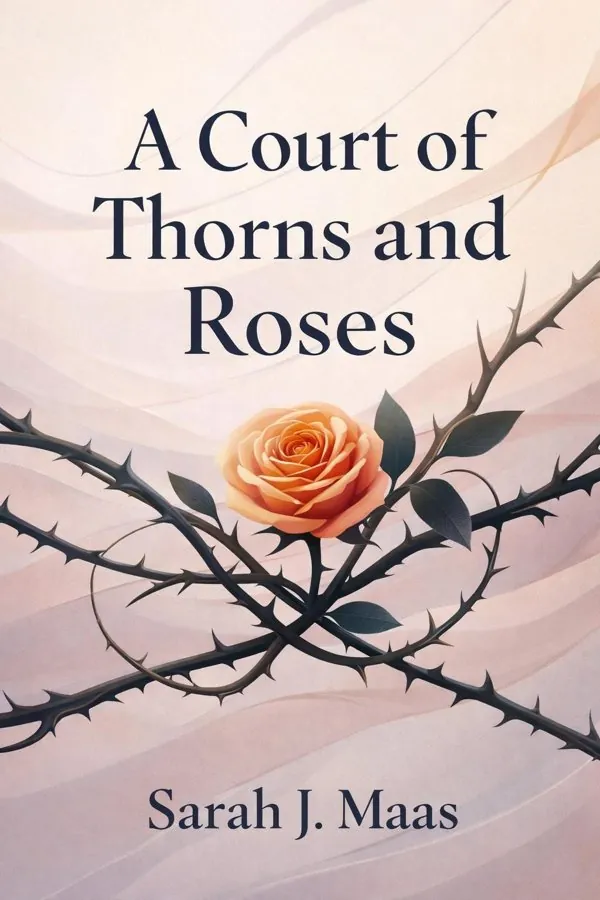
A Court of Thorns and Roses: Summary & Key Insights
 10 min9 chaptersAudio available
Key Takeaways from A Court of Thorns and Roses
Survival decisions often reveal who we are long before destiny does.
Love within a family is not always gentle, fair, or easy to carry.
Beauty can be seductive precisely because it hides what is broken.
The stories we inherit often shape our fears more strongly than direct experience.
Love becomes meaningful when it demands vulnerability rather than fantasy.
What Is A Court of Thorns and Roses About?
A Court of Thorns and Roses by Sarah J. Maas is a fantasy book published in 2015 spanning 5 pages. A Court of Thorns and Roses by Sarah J. Maas is a fantasy novel that blends fairy-tale atmosphere, dangerous romance, and a coming-of-age journey into one immersive story. The book follows Feyre Archeron, a young mortal woman who kills a wolf while hunting in the woods and is soon taken across the wall into Prythian, a land ruled by powerful faeries. What begins as punishment becomes an awakening, as Feyre discovers beauty, terror, political tension, and a curse that threatens an entire court. As she grows closer to Tamlin, the enigmatic High Lord of the Spring Court, she is forced to confront not only the brutal realities of the fae world, but also her own assumptions about strength, love, and sacrifice. The novel matters because it transforms familiar Beauty and the Beast motifs into something darker, more emotional, and more expansive, laying the foundation for one of modern fantasy’s most popular series. Sarah J. Maas is especially skilled at building emotionally charged worlds, creating heroines under pressure, and weaving romance into high-stakes fantasy with memorable intensity.
This FizzRead summary covers all 9 key chapters of A Court of Thorns and Roses in approximately 10 minutes, distilling the most important ideas, arguments, and takeaways from Sarah J. Maas's work. Also available as an audio summary and Key Quotes Podcast.
A Court of Thorns and Roses
A Court of Thorns and Roses by Sarah J. Maas is a fantasy novel that blends fairy-tale atmosphere, dangerous romance, and a coming-of-age journey into one immersive story. The book follows Feyre Archeron, a young mortal woman who kills a wolf while hunting in the woods and is soon taken across the wall into Prythian, a land ruled by powerful faeries. What begins as punishment becomes an awakening, as Feyre discovers beauty, terror, political tension, and a curse that threatens an entire court. As she grows closer to Tamlin, the enigmatic High Lord of the Spring Court, she is forced to confront not only the brutal realities of the fae world, but also her own assumptions about strength, love, and sacrifice. The novel matters because it transforms familiar Beauty and the Beast motifs into something darker, more emotional, and more expansive, laying the foundation for one of modern fantasy’s most popular series. Sarah J. Maas is especially skilled at building emotionally charged worlds, creating heroines under pressure, and weaving romance into high-stakes fantasy with memorable intensity.
Who Should Read A Court of Thorns and Roses?
This book is perfect for anyone interested in fantasy and looking to gain actionable insights in a short read. Whether you're a student, professional, or lifelong learner, the key ideas from A Court of Thorns and Roses by Sarah J. Maas will help you think differently.
- ✓Readers who enjoy fantasy and want practical takeaways
- ✓Professionals looking to apply new ideas to their work and life
- ✓Anyone who wants the core insights of A Court of Thorns and Roses in just 10 minutes
Want the full summary?
Get instant access to this book summary and 100K+ more with Fizz Moment.
Get Free SummaryAvailable on App Store • Free to download
Key Chapters
Survival decisions often reveal who we are long before destiny does. At the start of A Court of Thorns and Roses, Feyre Archeron is not searching for adventure, love, or magic. She is simply trying to keep her family alive through a brutal winter. In that frozen forest, every movement matters, and when she kills a massive wolf for food and its valuable pelt, she believes she is making a practical choice. Yet the novel immediately shows how one desperate act can open the door to an entirely different life. The wolf is not what it seems, and Feyre’s choice pulls her from poverty and human suffering into the deadly politics of the faerie world.
This opening matters because it establishes Feyre as a heroine shaped by necessity rather than fantasy. She is not special because she has secret powers or noble birthright. She is compelling because she has learned endurance, restraint, and courage under pressure. Maas uses this moment to remind readers that life-changing turning points rarely announce themselves. They often arrive disguised as ordinary responsibilities, moral compromises, or instinctive decisions made in hard times.
In everyday life, this idea applies whenever small choices create large consequences: taking a difficult job, ending a harmful relationship, speaking up at the right moment, or stepping into the unknown because remaining still is no longer possible. What seems like a survival move can become the beginning of transformation.
Actionable takeaway: Pay closer attention to the choices you make under pressure, because they often reveal your values and may shape the course of your future more than your carefully made plans.
Love within a family is not always gentle, fair, or easy to carry. Before Feyre ever crosses into Prythian, her life is defined by deprivation. Her family has fallen from wealth into poverty, and she bears most of the responsibility for keeping them fed. Her father is physically diminished and emotionally passive, while her sisters, Nesta and Elain, respond to hardship in opposite ways: one with sharp-edged bitterness, the other with softness and retreat. These dynamics create a home that is not nurturing so much as dependent on Feyre’s labor.
What makes this section of the novel powerful is that Maas does not romanticize sacrifice. Feyre loves her family, but that love is tangled with resentment, exhaustion, and loneliness. She provides because she must, not because she is endlessly patient. This gives the story emotional realism. Feyre’s early hardship teaches her self-reliance, but it also leaves her starved for care, dignity, and the possibility of being seen as more than useful.
Readers can connect this to real-life situations where responsibility falls unevenly. In many families, one person becomes the fixer, provider, or emotional anchor. Over time, this role can create strength, but it can also distort self-worth until a person believes they matter only when they are needed. Feyre’s journey begins with this imbalance and gradually challenges it.
The lesson here is that endurance is admirable, but it should not become your only identity. Supporting others should not erase your own needs, growth, or future.
Actionable takeaway: Reflect on whether your sense of worth comes only from what you provide to others, and if so, begin reclaiming space for your own desires, limits, and well-being.
Beauty can be seductive precisely because it hides what is broken. When Feyre is taken to the Spring Court by Tamlin, she enters a world that seems impossibly lush compared to the hunger and bleakness she has known. The court is full of flowering gardens, grand manor houses, magical rituals, and a sense of abundance that feels almost dreamlike. For Feyre, the Spring Court initially represents relief: food, safety, and a life untouched by the grinding desperation of the human world.
But Maas carefully builds this place as more than a fantasy refuge. The splendor of the Spring Court is shadowed by unease. Masks cannot be removed. Certain subjects are avoided. Laughter exists, but it carries strain beneath it. Tamlin and Lucien are both constrained by forces they cannot fully discuss. This creates one of the novel’s central tensions: the most enchanting environments can also be the most deceptive. A paradise may still be a prison if truth is withheld and fear governs behavior.
This idea has broad relevance beyond fantasy. People often idealize jobs, relationships, communities, or lifestyles from the outside, assuming beauty equals safety and elegance equals honesty. Yet appearances can conceal instability, emotional distance, or structural problems. Feyre’s time in the Spring Court teaches her, and the reader, to look beyond pleasure and ask what hidden costs support it.
The Spring Court also becomes the setting where Feyre begins to recover parts of herself. Through painting, observation, and new relationships, she starts imagining an identity beyond mere survival.
Actionable takeaway: When something looks perfect, pause and ask what remains unspoken, because true security depends not on beauty alone but on honesty, trust, and freedom.
The stories we inherit often shape our fears more strongly than direct experience. Feyre grows up in a human world taught to distrust and demonize faeries. The wall separating mortals from Prythian is not just a physical barrier; it is a psychological one built from old conflict, rumor, and inherited hatred. By entering the faerie lands, Feyre is forced to confront how much of what she believed was incomplete, exaggerated, or politically useful.
This does not mean the fae are harmless. Maas avoids a simplistic reversal in which humans are ignorant and faeries are secretly kind. Instead, the novel presents a more challenging truth: prejudice thrives when people reduce complex groups into single stories. Some faeries are cruel, others honorable, many both dangerous and sympathetic. Feyre’s growth depends on learning to observe individuals rather than cling to inherited assumptions.
This theme is one of the book’s most practical and enduring strengths. In real life, people absorb narratives about social groups, professions, nations, classes, or communities before they ever meet members of them. Those narratives may contain partial truths, but when left unchallenged they become barriers to judgment, empathy, and wise action. Feyre does not survive because she becomes naive. She survives because she learns discernment.
The novel suggests that maturity requires holding two truths at once: a group may be capable of harm, and still not fit the stereotypes used to define it. Understanding becomes more powerful than reflexive fear.
Actionable takeaway: Examine one assumption you have inherited about a person or group, and replace secondhand judgment with direct observation, deeper questions, and a willingness to revise your view.
Love becomes meaningful when it demands vulnerability rather than fantasy. As Feyre grows closer to Tamlin, the emotional center of the novel shifts from captivity and suspicion toward intimacy, trust, and unspoken longing. Yet their connection develops under the pressure of a curse hanging over the Spring Court. Tamlin’s people are trapped, time is running out, and what might look like a romantic bond is complicated by political and magical consequences. This raises an important question: when love is entangled with duty, danger, and desperation, how do you know what is real?
Maas uses the curse not only as plot machinery but as emotional pressure. It exposes the limits of silence, pride, and avoidance. Tamlin’s inability to say certain things, combined with Feyre’s uncertainty about her own feelings, turns love into something painful and urgent. The novel argues that love is not proven by attraction alone. It is tested by honesty, sacrifice, and the willingness to act when fear makes inaction tempting.
This idea translates easily to real life. Relationships often falter not because affection is absent, but because communication is incomplete, timing is mishandled, or people hope love will survive without courageous expression. Waiting too long, assuming the other person knows, or hiding behind roles and defenses can cost more than rejection ever would.
The emotional lesson of the novel is that love cannot remain passive if the stakes are high. It must become a choice, not merely a feeling.
Actionable takeaway: If something important remains unsaid in one of your close relationships, speak with clarity and sincerity before fear, pride, or delay turns silence into regret.
What we create often reveals the parts of us that hardship tries to erase. One of the quieter but most meaningful threads in A Court of Thorns and Roses is Feyre’s relationship with painting. Before the events of the novel, poverty leaves her little room to pursue beauty for its own sake. Yet her artistic imagination remains alive, shaping how she observes color, texture, light, and emotional atmosphere. In the Spring Court, where basic survival is no longer her only concern, this dormant part of herself begins to reemerge.
Art in the novel is not treated as decoration. It is a form of perception, memory, and identity. Feyre often understands spaces and feelings visually before she can express them directly. That matters because trauma and deprivation frequently narrow a person’s sense of self to function alone. When life becomes only about endurance, creativity can feel indulgent. Maas counters this idea by showing that creative expression is one of the ways a person remains inwardly alive.
This theme resonates beyond fantasy. Many people postpone their creative interests until life becomes easier, more stable, or more efficient. But waiting indefinitely can lead to emotional numbness. Creativity does not need to become a career to be essential. Painting, writing, music, design, gardening, or any form of making can restore agency and perspective.
Feyre’s art symbolizes her return to personhood. She is not only a provider, prisoner, or object of desire. She is someone with an inner world worth preserving.
Actionable takeaway: Reclaim one creative practice, however small, that helps you feel fully yourself rather than merely productive, and treat it as nourishment rather than a luxury.
Character is most visible when comfort disappears and no one can save you. The novel’s most dramatic transformation occurs when Feyre goes Under the Mountain to confront Amarantha, the tyrannical force who holds Tamlin and much of Prythian in fear. Here the atmosphere shifts sharply from enchantment and romance to brutality, humiliation, and deadly spectacle. Feyre is no longer navigating mystery from within relative safety. She is entering a system built to break hope, where every choice carries immense physical and emotional risk.
The trials Feyre faces are not just action sequences. They reveal what kind of courage the novel values. She is not the strongest person in the room, nor the most powerful. Often she is frightened, injured, uncertain, and outmatched. Yet she continues. Maas frames heroism not as fearlessness, but as persistence in the presence of fear. Feyre survives through resolve, intelligence, endurance, and the willingness to suffer for others.
This is one of the book’s strongest practical messages. In life, many people assume courage means confidence or certainty. More often, courage looks like showing up to hard conversations, enduring treatment or recovery, protecting someone vulnerable, or continuing after humiliation or failure. The important thing is not feeling invincible. It is deciding that what matters is greater than immediate comfort.
Under the Mountain also strips away illusion. Feyre sees the violence of power clearly and learns what love costs when tested publicly and painfully.
Actionable takeaway: When facing something intimidating, stop waiting to feel unafraid and instead define the value or person you are protecting, then let that purpose carry you forward.
We become ourselves not through comfort, but through the choices we make when comfort is no longer possible. By the end of A Court of Thorns and Roses, Feyre is no longer the same person who entered the forest with a bow and a single goal: survive the winter. Her journey through the Spring Court, the curse, and Under the Mountain transforms her emotionally, morally, and physically. But Maas is careful to show that true transformation is not something that simply happens to her. It is forged through repeated choices.
Feyre chooses to care, to return, to endure, and to act when inaction would protect her. Those choices come with tremendous cost. The novel refuses the easy fantasy that growth is painless or neatly rewarding. Instead, it suggests that becoming stronger often means losing innocence, relinquishing old certainties, and accepting that love and sacrifice are deeply connected.
This is why the book resonates so strongly with readers. Beneath the magic and romance lies a familiar human pattern: life forces change on us, but identity is shaped by how we respond. Pain can harden a person into bitterness, or deepen them into courage and compassion. Feyre’s arc illustrates the latter, even though the process is harrowing.
For readers, the practical application is clear. Major transformation rarely begins when we feel ready. It begins when values demand action before certainty arrives.
Actionable takeaway: In moments of upheaval, focus less on preserving who you used to be and more on choosing the kind of person you want to become through your response.
All Chapters in A Court of Thorns and Roses
About the Author
Sarah J. Maas is an American bestselling fantasy author celebrated for her emotionally intense storytelling, expansive magical worlds, and memorable female protagonists. She rose to prominence with her Throne of Glass series and went on to achieve even greater global success with A Court of Thorns and Roses and Crescent City. Her books often combine romance, political intrigue, danger, and transformation, appealing to readers who enjoy both epic fantasy and character-driven drama. Maas is known for creating immersive settings, high emotional stakes, and series that build devoted fan communities. With millions of copies sold worldwide and translations across numerous languages, she has become one of the defining voices in contemporary fantasy fiction, especially in the romantic fantasy space.
Get This Summary in Your Preferred Format
Read or listen to the A Court of Thorns and Roses summary by Sarah J. Maas anytime, anywhere. FizzRead offers multiple formats so you can learn on your terms — all free.
Available formats: App · Audio · PDF · EPUB — All included free with FizzRead
Download A Court of Thorns and Roses PDF and EPUB Summary
Key Quotes from A Court of Thorns and Roses
“Survival decisions often reveal who we are long before destiny does.”
“Love within a family is not always gentle, fair, or easy to carry.”
“Beauty can be seductive precisely because it hides what is broken.”
“The stories we inherit often shape our fears more strongly than direct experience.”
“Love becomes meaningful when it demands vulnerability rather than fantasy.”
Frequently Asked Questions about A Court of Thorns and Roses
A Court of Thorns and Roses by Sarah J. Maas is a fantasy book that explores key ideas across 9 chapters. A Court of Thorns and Roses by Sarah J. Maas is a fantasy novel that blends fairy-tale atmosphere, dangerous romance, and a coming-of-age journey into one immersive story. The book follows Feyre Archeron, a young mortal woman who kills a wolf while hunting in the woods and is soon taken across the wall into Prythian, a land ruled by powerful faeries. What begins as punishment becomes an awakening, as Feyre discovers beauty, terror, political tension, and a curse that threatens an entire court. As she grows closer to Tamlin, the enigmatic High Lord of the Spring Court, she is forced to confront not only the brutal realities of the fae world, but also her own assumptions about strength, love, and sacrifice. The novel matters because it transforms familiar Beauty and the Beast motifs into something darker, more emotional, and more expansive, laying the foundation for one of modern fantasy’s most popular series. Sarah J. Maas is especially skilled at building emotionally charged worlds, creating heroines under pressure, and weaving romance into high-stakes fantasy with memorable intensity.
More by Sarah J. Maas

You Might Also Like


Featured In
Browse by Category
Ready to read A Court of Thorns and Roses?
Get the full summary and 100K+ more books with Fizz Moment.