
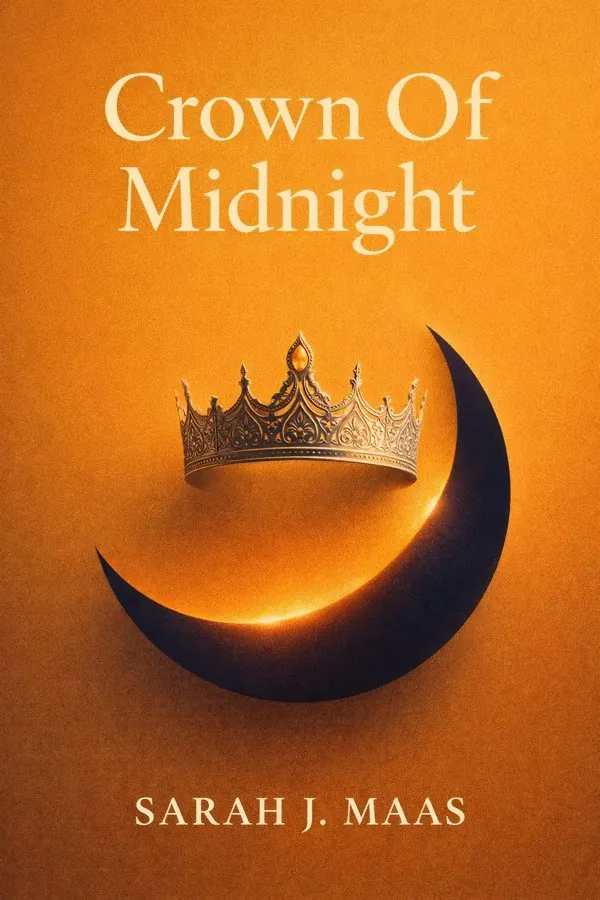
Crown Of Midnight: Summary & Key Insights
 10 min8 chaptersAudio available
Key Takeaways from Crown Of Midnight
One of the most gripping ideas in Crown Of Midnight is that power is never neutral; it always asks something from the person who holds it.
A central insight of Crown Of Midnight is that identity can be buried, manipulated, and denied, but not fully destroyed.
Crown Of Midnight argues that love is not merely romantic attraction or emotional comfort; it is a force that reveals character under pressure.
One of the clearest political messages in Crown Of Midnight is that tyranny survives not only through direct violence but also through engineered isolation.
A haunting insight in Crown Of Midnight is that courage is often born not from confidence, but from grief.
What Is Crown Of Midnight About?
Crown Of Midnight by Sarah J. Maas is a bestsellers book. Crown Of Midnight by Sarah J. Maas is a turning-point fantasy novel that deepens the emotional and political stakes of the Throne of Glass series. At its center is Celaena Sardothien, a feared assassin who has won the brutal contest to become the King of Adarlan’s Champion. But victory brings no peace. Bound to a tyrannical ruler, surrounded by secrets, and torn between duty, survival, and conscience, Celaena must decide who she truly is and what she is willing to fight for. What begins as a story of royal intrigue and covert violence expands into something far richer: a tale of grief, identity, forbidden loyalty, and awakening power. The novel matters because it transforms a compelling fantasy adventure into a layered coming-of-age story about resisting oppression and reclaiming one’s destiny. Sarah J. Maas, one of the most influential voices in modern fantasy, is known for combining fast-paced plotting with emotionally charged character arcs and expansive world-building. In Crown Of Midnight, she delivers a darker, sharper, and more revealing chapter that raises the stakes for every character involved.
This FizzRead summary covers all 8 key chapters of Crown Of Midnight in approximately 10 minutes, distilling the most important ideas, arguments, and takeaways from Sarah J. Maas's work. Also available as an audio summary and Key Quotes Podcast.
Crown Of Midnight
Crown Of Midnight by Sarah J. Maas is a turning-point fantasy novel that deepens the emotional and political stakes of the Throne of Glass series. At its center is Celaena Sardothien, a feared assassin who has won the brutal contest to become the King of Adarlan’s Champion. But victory brings no peace. Bound to a tyrannical ruler, surrounded by secrets, and torn between duty, survival, and conscience, Celaena must decide who she truly is and what she is willing to fight for. What begins as a story of royal intrigue and covert violence expands into something far richer: a tale of grief, identity, forbidden loyalty, and awakening power. The novel matters because it transforms a compelling fantasy adventure into a layered coming-of-age story about resisting oppression and reclaiming one’s destiny. Sarah J. Maas, one of the most influential voices in modern fantasy, is known for combining fast-paced plotting with emotionally charged character arcs and expansive world-building. In Crown Of Midnight, she delivers a darker, sharper, and more revealing chapter that raises the stakes for every character involved.
Who Should Read Crown Of Midnight?
This book is perfect for anyone interested in bestsellers and looking to gain actionable insights in a short read. Whether you're a student, professional, or lifelong learner, the key ideas from Crown Of Midnight by Sarah J. Maas will help you think differently.
- ✓Readers who enjoy bestsellers and want practical takeaways
- ✓Professionals looking to apply new ideas to their work and life
- ✓Anyone who wants the core insights of Crown Of Midnight in just 10 minutes
Want the full summary?
Get instant access to this book summary and 100K+ more with Fizz Moment.
Get Free SummaryAvailable on App Store • Free to download
Key Chapters
One of the most gripping ideas in Crown Of Midnight is that power is never neutral; it always asks something from the person who holds it. Celaena may appear to have risen from slave to royal champion, but her new status is not freedom. It is a gilded cage. She has access, authority, and protection, yet every advantage comes tied to the king’s violence. Her role forces her to confront a brutal question: if your survival depends on serving evil, how much of yourself can you keep intact?
This tension gives the novel much of its emotional force. Celaena is not simply carrying out missions; she is making moral calculations under pressure. She begins to understand that obedience can become complicity, and that avoiding a choice is often a choice in itself. In a kingdom shaped by fear, even silence strengthens the oppressor. That is why her internal conflict matters so much. She is not deciding only whom to kill or spare. She is deciding what kind of person she will become.
This idea applies well beyond fantasy. In everyday life, people often accept systems, workplaces, or relationships that reward compliance while punishing conscience. A promotion may require silence about wrongdoing. Social belonging may depend on going along with what feels wrong. Crown Of Midnight shows how seductive compromised power can be and how costly it becomes over time.
The book suggests that integrity is not preserved through good intentions alone. It requires action, often risky action. Celaena’s struggle reminds readers to examine where their own comfort may depend on ignoring harm.
Actionable takeaway: Identify one area in your life where convenience may be outweighing conscience, and decide on one concrete step that aligns your actions more closely with your values.
A central insight of Crown Of Midnight is that identity can be buried, manipulated, and denied, but not fully destroyed. Celaena has lived under labels imposed by others: assassin, prisoner, champion, weapon. Each title narrows her humanity and turns her into something useful to stronger powers. Yet beneath those assigned roles, a deeper self remains alive, pressing toward recognition. The novel’s emotional and political revelations gain their force from this slow unmasking.
What makes this idea powerful is that identity in the book is not treated as a simple matter of self-expression. It is tied to memory, grief, ancestry, loyalty, and truth. Celaena’s journey shows that when people are forced to perform a role for survival, they may lose access to parts of themselves without losing them forever. Recovery can be painful because it requires facing what was suppressed, stolen, or feared.
Many readers connect with this theme because real life often works the same way. People become what circumstances demand: the dependable one, the tough one, the invisible one, the successful one. Over time, performance can feel like personality. Crown Of Midnight asks what happens when that mask begins to crack. The answer is unsettling but hopeful: truth is disruptive, yet it is also liberating.
The novel encourages readers to see identity not as a fixed image but as a reclaimed inheritance. Celaena’s growing awareness changes how she views her past and what she owes the future. Knowing who she is does not simplify her life; it raises the stakes of every choice.
Actionable takeaway: Reflect on one label you have accepted from others and ask whether it still reflects your true self, or merely the version of you that learned how to survive.
Crown Of Midnight argues that love is not merely romantic attraction or emotional comfort; it is a force that reveals character under pressure. In the novel, affection and loyalty develop in spaces shaped by surveillance, danger, and hidden motives. That setting matters. When trust is costly, every act of tenderness becomes meaningful. Love is no longer abstract. It becomes a choice to see, protect, and risk oneself for another person.
Celaena’s relationships are among the book’s greatest strengths because they are never simple. Romance, friendship, and political alliance overlap in complicated ways. Characters care for one another, but they also keep secrets, make mistakes, and carry conflicting loyalties. This gives emotional realism to the story. Love is shown not as purity, but as vulnerability in a world that punishes it.
The book also explores how love can sharpen moral awakening. Celaena cannot remain emotionally detached once she lets herself care. Connection makes suffering personal. It pushes her beyond self-preservation and into responsibility. In this way, love becomes transformative. It does not weaken her. It deepens her courage and makes indifference impossible.
This idea has practical relevance because many people treat vulnerability as a threat to strength. Crown Of Midnight presents the opposite possibility: caring deeply may expose pain, but it also clarifies what matters. Relationships often reveal whether our values are real or merely convenient.
The novel further reminds readers that secrecy can test love in two directions. Hidden truths can protect others, but they can also erode trust. Strong relationships require not just feeling, but honesty at the right moment.
Actionable takeaway: Consider one important relationship in your life and ask whether fear, pride, or secrecy is preventing deeper trust; then choose one truthful conversation that could strengthen that bond.
One of the clearest political messages in Crown Of Midnight is that tyranny survives not only through direct violence but also through engineered isolation. The king’s rule is oppressive because it teaches people to mistrust, obey, and endure alone. Individuals are easier to control when they feel cut off from one another, uncertain about the truth, and convinced resistance is futile. The novel’s atmosphere of secrecy and dread reflects exactly how authoritarian systems maintain power.
Celaena’s world is filled with hidden corridors, concealed agendas, and dangerous silences. Yet beneath those silences, resistance still exists. Characters begin to matter politically the moment they stop functioning as isolated survivors and start acting as connected moral agents. Trust becomes revolutionary. Shared knowledge becomes dangerous to the regime. Even private compassion carries public consequences.
This idea resonates outside fiction because oppressive dynamics appear in many forms: abusive relationships, dysfunctional workplaces, corrupt institutions, and political systems that encourage fear over solidarity. In each case, control depends on fragmentation. People are less likely to object when they believe they are alone in their concern or powerless to change anything.
Crown Of Midnight demonstrates that breaking isolation does not require instant rebellion or grand speeches. It often begins with smaller acts: telling the truth to one trusted person, refusing to participate in a lie, preserving memory, or helping someone targeted by power. These gestures may seem limited, but they create the conditions for larger change.
The novel’s tension comes from how dangerous connection can be in a monitored world. Yet it insists that fear loses some of its power the moment it is no longer carried in solitude.
Actionable takeaway: When facing a difficult or unjust situation, resist the instinct to withdraw completely; identify one trustworthy ally and begin building clarity and support together.
A haunting insight in Crown Of Midnight is that courage is often born not from confidence, but from grief. Loss strips away illusions. It reveals what cannot be recovered and forces characters to decide whether pain will harden them, break them, or awaken them. Celaena’s emotional journey is shaped by mourning, and the novel treats grief not as a pause in the story, but as a force that redirects it.
What makes this theme especially powerful is that grief in the book is layered. It includes personal loss, lost innocence, lost homeland, lost trust, and lost possibility. This broadens the novel’s emotional scope. Characters are not grieving only people. They are grieving versions of the future that have been stolen from them. That kind of sorrow can lead to numbness, but it can also produce fierce clarity.
The novel suggests that grief changes courage by making avoidance impossible. Before loss, a person may tolerate injustice, postpone hard choices, or hope someone else will intervene. After loss, the cost of inaction becomes undeniable. Celaena’s pain pushes her toward truth, confrontation, and transformation. Her grief does not make her gentler or simpler. It makes her more honest about the stakes.
Readers can apply this idea in real life by recognizing that grief often reshapes priorities. After major disappointment or loss, many people reassess how they spend time, whom they trust, and what they are willing to endure. Pain can become a harsh teacher, but also a clarifying one.
Crown Of Midnight does not romanticize suffering. Instead, it shows that what we do after heartbreak matters deeply. Grief can isolate, but it can also sharpen purpose.
Actionable takeaway: If you are moving through a loss, ask what truth that pain has revealed about what matters most, and let that truth guide one brave next step.
Few novels illustrate the double edge of secrecy as effectively as Crown Of Midnight. Secrets in this story are not mere plot devices; they are emotional weapons, political tools, and survival strategies. Characters conceal identities, motives, histories, and intentions for reasons that are sometimes noble and sometimes destructive. The result is a world where hidden truths preserve life in one moment and shatter trust in the next.
This complexity is what makes the theme compelling. Secrecy is often treated in fiction as obviously wrong or obviously necessary, but Maas presents a more difficult reality. In dangerous systems, transparency can be fatal. Yet concealment has costs. The longer truth is delayed, the more relationships strain under incomplete knowledge and mistaken assumptions. Characters begin acting based on fragments, and those fragments alter destinies.
Celaena’s journey is shaped by this paradox. She must decide when a secret is a shield and when it has become a prison. That distinction matters in ordinary life too. People hide parts of themselves to stay safe, avoid conflict, protect others, or preserve control. Sometimes that instinct is wise. Sometimes it prevents intimacy, accountability, or healing.
The novel invites readers to ask better questions about what is hidden. Not simply, “Is this secret justified?” but also, “Who is being protected, who is being harmed, and what happens if the truth waits too long?” That framework is useful in families, friendships, workplaces, and leadership.
Crown Of Midnight shows that truth is not automatically liberating in the short term. It can destabilize everything. But false stability built on secrecy usually collapses eventually.
Actionable takeaway: Think about one secret you are keeping and evaluate whether it is serving genuine protection or merely postponing a necessary truth; then plan the safest, most honest way forward.
An important challenge at the heart of Crown Of Midnight is the idea that true strength is measured not only by force, precision, or endurance, but by the capacity for mercy. Celaena is famous for lethal skill. Others fear her because she can kill efficiently and survive almost anything. Yet the novel steadily complicates that image by asking whether restraint may require greater strength than aggression.
This theme matters because Celaena lives in a world that rewards brutality and admires dominance. In such a setting, mercy can look like weakness. But the story reveals that choosing not to kill, protecting the vulnerable, or refusing cruelty often demands more courage than violence does. Mercy carries consequences. It creates uncertainty, invites risk, and requires faith in values beyond immediate advantage.
The book does not suggest that force is never necessary. Rather, it distinguishes between power used mechanically and power governed by conscience. Celaena’s evolution depends on learning that being dangerous and being honorable are not the same. Her decisions become more meaningful as she begins to weigh lives not just tactically, but morally.
This concept applies broadly. In professional life, leadership is often mistaken for harshness. In personal conflict, people may equate winning with strength. Crown Of Midnight offers a more mature definition: real strength includes self-command, discernment, and the willingness to protect rather than dominate.
Mercy in the novel is not softness detached from reality. It is disciplined humanity in a dehumanizing world. That is why it feels radical. It preserves the possibility that a person shaped by violence can still choose a different code.
Actionable takeaway: The next time you have the power to punish, dismiss, or overpower someone, pause and ask whether a measured act of mercy would better reflect the person you want to become.
Crown Of Midnight makes a compelling case that destiny is not simply discovered; it is forged through painful decisions. Fantasy often treats fate as a hidden truth waiting to be revealed, but this novel adds a sharper dimension. Identity and destiny matter, yes, but they become real only when characters choose in alignment with them. Revelation alone changes nothing. Action gives destiny substance.
Celaena faces repeated moments where every available path carries loss. This is crucial to the novel’s depth. Her future is not shaped by easy heroic gestures, but by decisions made under uncertainty, grief, love, and pressure. These choices define her more than any title bestowed upon her. The story suggests that a person becomes who they are through what they protect, what they resist, and what they are willing to sacrifice.
This idea is valuable because many readers wait for clarity before acting. They hope identity will feel complete first, then choice will become obvious. Crown Of Midnight presents a more realistic sequence. Often, we understand ourselves by acting with courage before certainty arrives. We choose, and then the meaning of the choice unfolds.
In real life, this might look like leaving a harmful environment, telling an uncomfortable truth, defending someone vulnerable, or refusing a role that contradicts your values. These decisions rarely come with guarantees. Yet they shape character and direction in lasting ways.
The novel’s intensity comes partly from the fact that destiny is costly. It asks more of Celaena with every truth she learns. But that cost is also what makes her transformation convincing. Greatness is not inherited without struggle; it is claimed through choice.
Actionable takeaway: Stop waiting for perfect certainty about your next major step and instead ask which available choice most closely reflects your deepest values, then move toward it with intention.
All Chapters in Crown Of Midnight
About the Author
Sarah J. Maas is a globally bestselling fantasy author known for creating immersive worlds, emotionally intense character arcs, and highly addictive series. She rose to prominence with the Throne of Glass novels, which introduced readers to a sweeping fantasy universe centered on power, identity, and resistance. She later expanded her readership even further with the A Court of Thorns and Roses and Crescent City series. Maas is especially admired for blending romance, political intrigue, magical conflict, and coming-of-age transformation in ways that appeal to both young adult and adult fantasy readers. Her books have sold millions of copies worldwide and have been translated into numerous languages. Crown Of Midnight showcases her talent for deepening a series by raising both the emotional stakes and the mythic scale of the story.
Get This Summary in Your Preferred Format
Read or listen to the Crown Of Midnight summary by Sarah J. Maas anytime, anywhere. FizzRead offers multiple formats so you can learn on your terms — all free.
Available formats: App · Audio · PDF · EPUB — All included free with FizzRead
Download Crown Of Midnight PDF and EPUB Summary
Key Quotes from Crown Of Midnight
“One of the most gripping ideas in Crown Of Midnight is that power is never neutral; it always asks something from the person who holds it.”
“A central insight of Crown Of Midnight is that identity can be buried, manipulated, and denied, but not fully destroyed.”
“Crown Of Midnight argues that love is not merely romantic attraction or emotional comfort; it is a force that reveals character under pressure.”
“One of the clearest political messages in Crown Of Midnight is that tyranny survives not only through direct violence but also through engineered isolation.”
“A haunting insight in Crown Of Midnight is that courage is often born not from confidence, but from grief.”
Frequently Asked Questions about Crown Of Midnight
Crown Of Midnight by Sarah J. Maas is a bestsellers book that explores key ideas across 8 chapters. Crown Of Midnight by Sarah J. Maas is a turning-point fantasy novel that deepens the emotional and political stakes of the Throne of Glass series. At its center is Celaena Sardothien, a feared assassin who has won the brutal contest to become the King of Adarlan’s Champion. But victory brings no peace. Bound to a tyrannical ruler, surrounded by secrets, and torn between duty, survival, and conscience, Celaena must decide who she truly is and what she is willing to fight for. What begins as a story of royal intrigue and covert violence expands into something far richer: a tale of grief, identity, forbidden loyalty, and awakening power. The novel matters because it transforms a compelling fantasy adventure into a layered coming-of-age story about resisting oppression and reclaiming one’s destiny. Sarah J. Maas, one of the most influential voices in modern fantasy, is known for combining fast-paced plotting with emotionally charged character arcs and expansive world-building. In Crown Of Midnight, she delivers a darker, sharper, and more revealing chapter that raises the stakes for every character involved.
More by Sarah J. Maas
You Might Also Like
The Godfather
Mario Puzo
10 min
The Handmaid's Tale
Margaret Atwood
10 min
The Hunger Games
Suzanne Collins
10 min
The Nightingale
Kristin Hannah
10 min
The Seven Husbands of Evelyn Hugo
Taylor Jenkins Reid
10 min
Backwater Justice
Fern Michaels
10 minBrowse by Category
Ready to read Crown Of Midnight?
Get the full summary and 100K+ more books with Fizz Moment.