
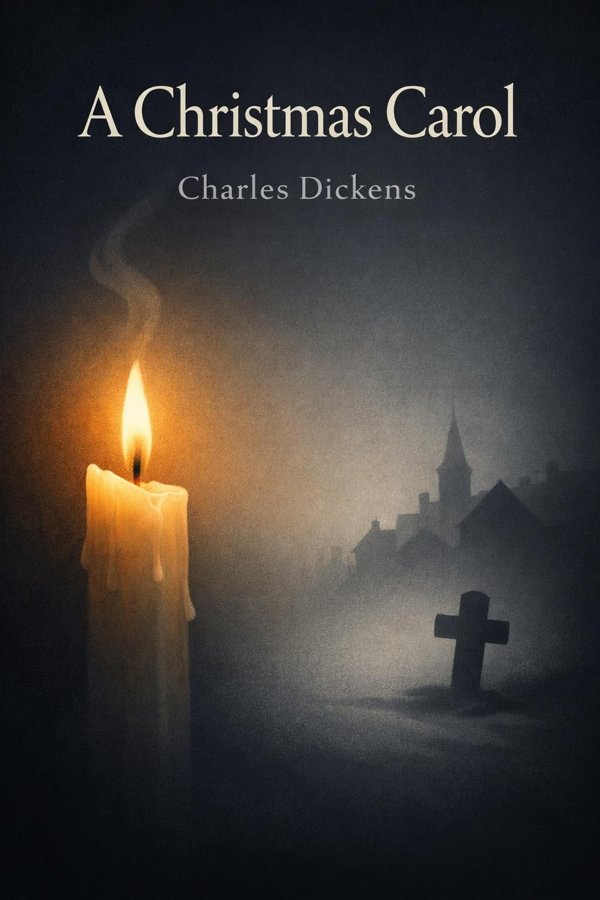
A Christmas Carol: Summary & Key Insights
 10 min5 chaptersAudio available
What Is A Christmas Carol About?
A Christmas Carol by Charles Dickens is a classics book spanning 5 pages. A Christmas Carol is a novella by Charles Dickens first published in 1843. It tells the story of Ebenezer Scrooge, a miserly old man who is visited by the ghosts of Christmas Past, Present, and Yet to Come. Through these supernatural encounters, Scrooge undergoes a profound transformation, learning compassion and the true spirit of Christmas.
This FizzRead summary covers all 5 key chapters of A Christmas Carol in approximately 10 minutes, distilling the most important ideas, arguments, and takeaways from Charles Dickens's work. Also available as an audio summary and Key Quotes Podcast.
A Christmas Carol
A Christmas Carol is a novella by Charles Dickens first published in 1843. It tells the story of Ebenezer Scrooge, a miserly old man who is visited by the ghosts of Christmas Past, Present, and Yet to Come. Through these supernatural encounters, Scrooge undergoes a profound transformation, learning compassion and the true spirit of Christmas.
Who Should Read A Christmas Carol?
This book is perfect for anyone interested in classics and looking to gain actionable insights in a short read. Whether you're a student, professional, or lifelong learner, the key ideas from A Christmas Carol by Charles Dickens will help you think differently.
- ✓Readers who enjoy classics and want practical takeaways
- ✓Professionals looking to apply new ideas to their work and life
- ✓Anyone who wants the core insights of A Christmas Carol in just 10 minutes
Want the full summary?
Get instant access to this book summary and 100K+ more with Fizz Moment.
Get Free SummaryAvailable on App Store • Free to download
Key Chapters
When the story begins, Jacob Marley has been dead these seven years. Yet even in death, I would not allow him rest, for the purpose of the supernatural in this tale is to confront moral indifference with undeniable truth. His spectral form, bound in chains forged link by link through years of selfish business, appears before Scrooge on Christmas Eve. Marley is the first voice of conscience breaking through the crust of avarice. With grating remorse he confesses what Scrooge has yet to understand—that the pursuit of profit without compassion is to fashion one’s own fetters.
Scrooge, terrified but skeptical, insists that such hauntings are tricks of the senses. In that stubborn refusal lies the very essence of his spiritual blindness. Still, even as fear trembles through his bones, a seed has been planted. Marley’s warning—that Scrooge will share his fate unless he changes—establishes the story’s moral architecture. The past, the present, and the future will come to judge the life of a man who has valued coin above kin.
Through Marley’s confession, I wished to show how regret endures beyond the grave. The ghost’s purpose is not vengeance but mercy—to offer Scrooge a chance at salvation. Every rattle of chain, every tremor of his hollow voice, serves as an echo of neglect—the cries of the poor, the forgotten, the dismissed. The apparition is grotesque yet pitiful, a mirror in death of what greed makes of the living. When he departs, it is not only Scrooge’s house that is left trembling—it is the reader’s heart, reminded that time’s generosity is limited, and the hour of reckoning cannot be deferred forever.
Into the quiet of the night comes the first spirit, radiant like the tender light of dawn—neither child nor old man, a being whose very form suggests memory’s fragile glow. The Ghost of Christmas Past guides Scrooge through the corridors of his own life, where time itself becomes the great moral teacher. We start with a schoolroom, draughty and deserted, where a lonely boy remains forgotten while others rejoice with their families. That child is Scrooge himself. I wanted this moment to pierce even the reader’s pride—a reminder that even the hardest heart had once beat faster with hope and longing.
As the journey progresses, we arrive at a merrier scene—Mr. Fezziwig’s warehouse, a place where generosity transforms commerce into community. Fezziwig’s celebration, full of dancing and laughter, stands in radiant contrast to Scrooge’s current coldness. Here was an employer who understood that kindness breeds loyalty and joy unites a household. Scrooge’s spirit falters, for he knows he has betrayed this lesson. The recollection of Belle, his one-time fiancée, completes the wound. When she releases him, seeing that he loves gold more than her, the last of his youthful warmth drains away. Through these scenes, I hoped to illustrate that greed does not descend suddenly—it accumulates over years of small surrenders, the slow dying of tenderness and imagination.
At the end of this visitation, Scrooge is shaken but still resists. In attempting to extinguish the spirit’s light with a cap, he enacts the very folly he has lived by: to suppress truth because it pains him. Yet memory, once awakened, cannot be unlearned. The past has whispered that he was not always lost, and that knowledge will haunt and guide him yet.
+ 3 more chapters — available in the FizzRead app
All Chapters in A Christmas Carol
About the Author
Charles Dickens (1812–1870) was an English novelist and social critic, widely regarded as one of the greatest writers of the Victorian era. His works, including Oliver Twist, Great Expectations, and A Tale of Two Cities, are known for their vivid characters, social commentary, and enduring influence on English literature.
Get This Summary in Your Preferred Format
Read or listen to the A Christmas Carol summary by Charles Dickens anytime, anywhere. FizzRead offers multiple formats so you can learn on your terms — all free.
Available formats: App · Audio · PDF · EPUB — All included free with FizzRead
Download A Christmas Carol PDF and EPUB Summary
Key Quotes from A Christmas Carol
“When the story begins, Jacob Marley has been dead these seven years.”
“Into the quiet of the night comes the first spirit, radiant like the tender light of dawn—neither child nor old man, a being whose very form suggests memory’s fragile glow.”
Frequently Asked Questions about A Christmas Carol
A Christmas Carol by Charles Dickens is a classics book that explores key ideas across 5 chapters. A Christmas Carol is a novella by Charles Dickens first published in 1843. It tells the story of Ebenezer Scrooge, a miserly old man who is visited by the ghosts of Christmas Past, Present, and Yet to Come. Through these supernatural encounters, Scrooge undergoes a profound transformation, learning compassion and the true spirit of Christmas.
More by Charles Dickens
You Might Also Like

Featured In
Browse by Category
Ready to read A Christmas Carol?
Get the full summary and 100K+ more books with Fizz Moment.