
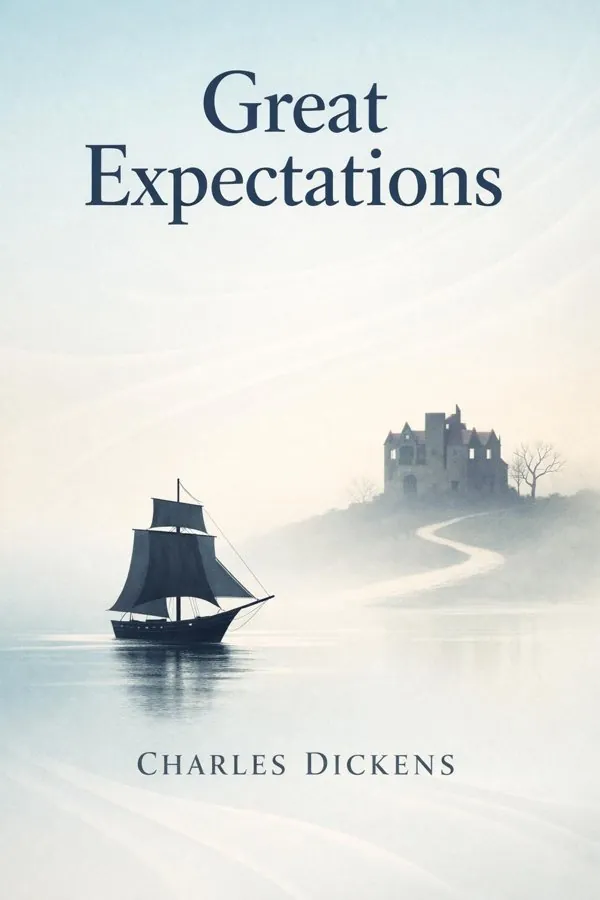
Great Expectations: Summary & Key Insights
 10 min9 chaptersAudio available
Key Takeaways from Great Expectations
A single frightening encounter can quietly shape an entire life.
We often begin wanting love and end up wanting status instead.
Rising in the world can be admirable, but not when it begins with rejecting yourself.
Many people imagine money will clarify their future, but Dickens shows that sudden elevation often creates deeper confusion.
Becoming polished is not the same as becoming wise.
What Is Great Expectations About?
Great Expectations by Charles Dickens is a classics book spanning 9 pages. Great Expectations is Charles Dickens’s masterful coming-of-age novel about desire, shame, self-invention, and the painful gap between who we are and who we wish to become. It follows Pip, an orphan raised in humble circumstances on the Kent marshes, as a series of mysterious events carries him from childhood poverty toward the glittering promise of gentlemanly status in London. Along the way, Pip falls under the spell of the cold but captivating Estella, the wounded grandeur of Miss Havisham, and the unsettling loyalty of the convict Magwitch. What begins as a story of personal ambition gradually becomes a moral reckoning about class, gratitude, love, and the hidden costs of social aspiration. The novel matters because Dickens turns a deeply personal narrative into a sharp portrait of Victorian society, exposing how wealth and status can distort character while kindness and loyalty often come from unexpected places. Few writers rival Dickens in his ability to create unforgettable characters and pair suspense with social insight. Great Expectations remains enduring not just because of its plot, but because it asks a timeless question: what do we lose when we mistake appearance for worth?
This FizzRead summary covers all 9 key chapters of Great Expectations in approximately 10 minutes, distilling the most important ideas, arguments, and takeaways from Charles Dickens's work. Also available as an audio summary and Key Quotes Podcast.
Great Expectations
Great Expectations is Charles Dickens’s masterful coming-of-age novel about desire, shame, self-invention, and the painful gap between who we are and who we wish to become. It follows Pip, an orphan raised in humble circumstances on the Kent marshes, as a series of mysterious events carries him from childhood poverty toward the glittering promise of gentlemanly status in London. Along the way, Pip falls under the spell of the cold but captivating Estella, the wounded grandeur of Miss Havisham, and the unsettling loyalty of the convict Magwitch. What begins as a story of personal ambition gradually becomes a moral reckoning about class, gratitude, love, and the hidden costs of social aspiration.
The novel matters because Dickens turns a deeply personal narrative into a sharp portrait of Victorian society, exposing how wealth and status can distort character while kindness and loyalty often come from unexpected places. Few writers rival Dickens in his ability to create unforgettable characters and pair suspense with social insight. Great Expectations remains enduring not just because of its plot, but because it asks a timeless question: what do we lose when we mistake appearance for worth?
Who Should Read Great Expectations?
This book is perfect for anyone interested in classics and looking to gain actionable insights in a short read. Whether you're a student, professional, or lifelong learner, the key ideas from Great Expectations by Charles Dickens will help you think differently.
- ✓Readers who enjoy classics and want practical takeaways
- ✓Professionals looking to apply new ideas to their work and life
- ✓Anyone who wants the core insights of Great Expectations in just 10 minutes
Want the full summary?
Get instant access to this book summary and 100K+ more with Fizz Moment.
Get Free SummaryAvailable on App Store • Free to download
Key Chapters
A single frightening encounter can quietly shape an entire life. Dickens opens Great Expectations on the stark Kent marshes, where young Pip, an orphan living with his abusive sister and her gentle husband Joe Gargery, meets the escaped convict Abel Magwitch in a churchyard. The scene is terrifying: Pip is small, vulnerable, and already emotionally neglected. Yet this moment is not important only because it launches the plot. It reveals the central tension of the novel: how fear and compassion can exist together in the same heart.
Magwitch threatens Pip into stealing food and a file, and Pip obeys out of terror. But Dickens makes the episode morally richer than a simple crime. Pip is not only afraid; he also pities the convict. He notices Magwitch’s suffering, hunger, and desperation. That early act of aid, though coerced, becomes the seed of a lifelong moral consequence. Dickens suggests that our first ethical choices often arise in confusion, not clarity. We rarely act under perfect conditions.
In practical terms, Pip’s childhood teaches us how early environments shape self-worth. Constant criticism from Mrs. Joe leaves him eager for approval and vulnerable to shame. Many people carry similar emotional patterns into adulthood, seeking status or validation to heal childhood wounds. Dickens shows how these wounds do not disappear simply because circumstances improve.
The takeaway is simple: examine the fears and humiliations that shaped your early self. If you understand them, you are less likely to let them unconsciously govern your ambitions, loyalties, and sense of worth.
We often begin wanting love and end up wanting status instead. Pip’s visits to Satis House mark the moment his life is emotionally and socially transformed. There he meets Miss Havisham, the wealthy recluse frozen in time after being abandoned on her wedding day, and Estella, the beautiful girl she has raised to be proud, cold, and emotionally punishing. In that decaying mansion, Pip encounters a world that is both glamorous and rotten. It dazzles him even as it deforms him.
Estella mocks Pip’s coarse hands, thick boots, and common background. These comments wound him deeply. Before Satis House, Pip’s life with Joe, though modest, contained affection and honesty. Afterward, he begins to feel ashamed of everything that once sustained him. Dickens brilliantly captures a universal psychological experience: the moment when we internalize someone else’s contempt and start viewing ourselves through hostile eyes.
Miss Havisham encourages this distortion. She allows Pip to believe he may someday rise for Estella, turning his hopes into a cruel emotional experiment. The house itself symbolizes this trap. It appears aristocratic but is actually stagnant, dusty, and consumed by old injury. Dickens’s point is clear: class glamour can enchant us even when it rests on decay.
In modern life, Satis House survives in elite institutions, social media fantasies, prestige cultures, and exclusive circles that teach people to confuse refinement with value. The danger is not appreciating excellence; it is believing that dignity belongs only to the socially elevated.
Actionable takeaway: notice where admiration turns into self-contempt. If a person or environment makes you feel inherently lesser, step back and ask whether you are seeing reality or simply absorbing a hierarchy that diminishes your humanity.
Rising in the world can be admirable, but not when it begins with rejecting yourself. After his experiences at Satis House, Pip becomes increasingly dissatisfied with his origins. Though Joe offers steady affection and the blacksmith’s forge provides an honest livelihood, Pip comes to see apprenticeship as a mark of inferiority. His discontent is not rooted in a true calling or developed talent. It springs from shame.
This distinction matters. Dickens does not condemn ambition itself. He condemns ambition based on social self-loathing. Pip wants to become a gentleman largely because he believes it will make him worthy of Estella and free him from the embarrassment of being common. He starts to undervalue Joe, Biddy, and the moral solidity of the life available to him. In doing so, he trades gratitude for fantasy.
This part of the novel speaks powerfully to anyone tempted to reinvent themselves by disowning their background. Education, advancement, and social mobility can be healthy. But when those pursuits depend on despising one’s family, origins, or earlier self, they become corrosive. Pip’s inner conflict shows how easy it is to turn aspiration into a form of emotional exile.
A practical example is the person who enters a more elite professional world and begins hiding their accent, family history, or old friendships to seem more acceptable. Success achieved this way often brings anxiety rather than confidence, because it rests on concealment.
The takeaway: pursue growth, but ask what fuels it. If your ambition is animated by curiosity, discipline, and service, it can strengthen you. If it is powered by shame, it will likely estrange you from the people and values that matter most.
Many people imagine money will clarify their future, but Dickens shows that sudden elevation often creates deeper confusion. Pip’s life changes dramatically when the lawyer Jaggers informs him that he has received "great expectations" from an anonymous benefactor and is to be transformed into a gentleman in London. Pip immediately assumes Miss Havisham is behind the gift and that Estella is therefore still the hidden prize toward which his life is moving. This assumption reveals how easily we shape facts to fit our desires.
The inheritance is not simply financial. It gives Pip a new social script. He adopts clothes, manners, habits, and ambitions appropriate to gentlemanly status, yet he has little inner foundation for this new identity. London becomes a place where appearances are cultivated, expenses multiply, and Pip learns to perform rather than understand himself. Dickens is especially sharp in showing how external advancement can outpace moral development.
The false story Pip tells himself about his benefactor is crucial. He believes his rise must have a noble, elegant source because he wants to believe his destiny is tied to Estella and high society. In reality, life is less flattering and more morally demanding. Dickens reminds us that what we inherit, earn, or are given matters less than how honestly we interpret it.
Today, similar distortions occur when promotions, prestige, or new wealth make people feel they must become someone else overnight. They begin spending, speaking, and relating in ways that impress others but disconnect them from reality.
Actionable takeaway: whenever your circumstances improve, pause before rewriting your identity around status. Ask not just what you can now afford or access, but what values should continue to anchor you as your external position changes.
Becoming polished is not the same as becoming wise. In London, Pip receives the education and social exposure he once craved. He befriends Herbert Pocket, learns gentlemanly habits, and moves through a world of clubs, dinners, debts, and cultivated manners. Yet Dickens steadily reveals that this version of refinement is often theatrical. Pip becomes more sophisticated in appearance while drifting morally from the people who truly love him.
One of the novel’s deepest ironies is that Joe, the uneducated blacksmith, embodies more generosity, humility, and emotional intelligence than many of the so-called gentlemen Pip admires. Pip, meanwhile, grows embarrassed by Joe’s simplicity when Joe visits London. It is one of the most painful episodes in the novel because it exposes how far Pip has moved from gratitude. He is not evil; he is morally asleep.
Dickens also links social performance with financial irresponsibility. Pip and Herbert accumulate debts as part of maintaining a gentleman’s lifestyle, suggesting that status often depends on illusion and unsustainable habits. This feels strikingly modern. People still go into emotional and financial debt trying to uphold identities they think others will respect.
The practical lesson is that environments built around appearances can quietly train us to neglect substance. We start optimizing for impression rather than integrity, networking rather than friendship, polish rather than character.
The takeaway is to measure your development by more than social fluency. Ask: Have I become kinder? More honest? More reliable? If progress makes you more ashamed of loyal people and more dependent on display, it is not true growth. It is merely successful performance.
The truth that saves us often arrives in a form we least want to face. The great turning point of Great Expectations comes when Magwitch reappears in London and reveals that he, not Miss Havisham, is Pip’s secret benefactor. The shock is devastating. Pip had imagined his rise as the elegant design of upper-class patronage, perhaps even as a path to Estella. Instead, the money comes from the convict he once helped as a child, a man hardened by suffering and exile who made his fortune in Australia and devoted it to Pip out of gratitude and love.
Pip’s first response is horror. He recoils not because Magwitch has wronged him, but because the revelation humiliates his class fantasies. Dickens forces both Pip and the reader to confront a difficult truth: moral worth and social respectability do not align neatly. The criminal has acted with profound loyalty; the refined world Pip admired is morally compromised.
This revelation changes the novel from a story of aspiration into one of ethical awakening. Pip slowly comes to see Magwitch not as a contaminating source of shame but as a human being worthy of care. That shift is the beginning of his maturity. Compassion becomes more important than status.
In modern terms, this is the moment when a person realizes that the people who truly invested in them may not be the prestigious ones they wanted credit from. Real support often comes from unfashionable places and asks for gratitude rather than vanity.
Actionable takeaway: reexamine the sources of your opportunities. If pride makes you dismiss the people who helped you because they do not fit your ideal image, you may be rejecting the very relationships that can restore your moral clarity.
Unhealed pain rarely stays private; it becomes a pattern passed on to others. Miss Havisham, abandoned on her wedding day, turns her life into a shrine to betrayal. She stops the clocks, wears her decaying wedding dress, and raises Estella to break men’s hearts as revenge against a world that hurt her. Dickens does not present her merely as grotesque or theatrical. He shows how trauma can become identity when grief is never transformed.
Estella is both powerful and tragic. She appears cold, elegant, and emotionally invulnerable, but she has been shaped to wound and to remain untouched by tenderness. Pip loves not the possibility of mutual intimacy, but an idealized image that repeatedly harms him. Dickens’s insight is sharp: people often mistake emotional distance for superiority, especially when beauty and status are involved.
Miss Havisham eventually recognizes the damage she has caused. Her remorse is one of the novel’s most moving developments because it demonstrates that self-awareness can arrive late but still matter. Estella’s later suffering, especially in marriage, suggests that those trained to deny feeling often pay dearly for that training.
The broader application is clear. Families, institutions, and communities can transmit unresolved bitterness across generations. Children may inherit not only wealth or manners, but emotional scripts: distrust, manipulation, pride, or numbness.
The takeaway: do not romanticize woundedness when it becomes cruelty. If you have been hurt, ask what habits of defense you are normalizing and what those habits may teach others. Healing begins when pain stops being treated as a justification for harming the next person.
Character is revealed most clearly when social advantage disappears. After Magwitch’s return, Pip’s life becomes dangerous and morally demanding. Rather than expose him, Pip gradually commits himself to protecting Magwitch from capture, despite the risk to his own position. With Herbert’s help, he plans Magwitch’s escape. In this period, Pip finally begins acting not as an aspiring gentleman, but as an honorable man.
This distinction lies at the heart of Dickens’s novel. Gentility, in the social sense, is linked to breeding, wealth, manners, and leisure. But true gentility, in the moral sense, is made visible through loyalty, courage, compassion, and responsibility. Pip learns this not through lectures but through suffering. His care for Magwitch, especially as the older man is injured, arrested, and dying, marks the full reversal of Pip’s earlier shame.
Joe’s role in this section is equally important. When Pip falls ill after financial and emotional collapse, Joe comes to London, nurses him tenderly, settles his debts, and leaves without demanding recognition. This quiet goodness outshines all aristocratic performance in the book. Dickens makes an unmistakable argument: nobility of heart can flourish in a forge and be absent in a drawing room.
In everyday life, we often confuse polished communication, elite credentials, or cultural sophistication with trustworthiness. Dickens warns against that mistake. The people with the least social glamour may show the greatest fidelity when crisis arrives.
Actionable takeaway: redefine your standards for admiration. Instead of being most impressed by success or style, pay closer attention to who stays, who serves, who tells the truth, and who helps when helping is inconvenient.
The deepest transformation in Great Expectations is not Pip’s rise, but his return to moral reality. After Magwitch’s death, Pip loses the expectations that once governed his life. Yet this apparent ruin becomes liberation. The illusions have burned away: Miss Havisham cannot give him destiny, Estella cannot complete him, and wealth cannot erase the damage of shame. What remains is the possibility of becoming honest.
Pip’s redemption unfolds through humility. He recognizes the ways he has wronged Joe and Biddy, especially through ingratitude and snobbery. His desire to seek forgiveness shows a new maturity. He no longer wants to be admired; he wants to be reconciled. That is one reason the novel feels emotionally satisfying even amid sorrow. Dickens suggests that moral repair matters more than romantic fulfillment.
The ending, in its revised form, leaves readers with a tempered hope in Pip’s final meeting with Estella. She, too, has been changed by suffering. The future is not presented as a fairy tale but as a quiet opening beyond pride and illusion. Dickens refuses easy triumph. Instead, he offers something better: the possibility that suffering, honestly faced, can deepen rather than destroy us.
This is perhaps the novel’s most practical wisdom. Many people cling to failed fantasies because giving them up feels like defeat. But Dickens shows that when false expectations collapse, they create space for truer relationships and a more stable self-understanding.
The takeaway: when life strips away your idealized future, do not assume all is lost. Ask what kind of person you can still become through humility, gratitude, and repaired relationships. That question leads closer to redemption than ambition ever could.
All Chapters in Great Expectations
About the Author
Charles Dickens (1812–1870) was an English novelist, journalist, and social critic whose work helped define Victorian literature. Born in Portsmouth, he experienced financial instability in childhood, including the imprisonment of his father for debt, a hardship that deeply shaped his fiction. Dickens became famous for serialized novels that combined vivid characterization, dramatic plotting, humor, and sharp commentary on poverty, class, and institutional injustice. His most celebrated works include Oliver Twist, David Copperfield, Bleak House, A Tale of Two Cities, and A Christmas Carol. He had an extraordinary ability to create memorable figures while exposing the moral failings of society. Great Expectations, one of his later masterpieces, shows his psychological subtlety at full strength, blending social critique with a deeply personal story of ambition, shame, and redemption.
Get This Summary in Your Preferred Format
Read or listen to the Great Expectations summary by Charles Dickens anytime, anywhere. FizzRead offers multiple formats so you can learn on your terms — all free.
Available formats: App · Audio · PDF · EPUB — All included free with FizzRead
Download Great Expectations PDF and EPUB Summary
Key Quotes from Great Expectations
“A single frightening encounter can quietly shape an entire life.”
“We often begin wanting love and end up wanting status instead.”
“Rising in the world can be admirable, but not when it begins with rejecting yourself.”
“Many people imagine money will clarify their future, but Dickens shows that sudden elevation often creates deeper confusion.”
“Becoming polished is not the same as becoming wise.”
Frequently Asked Questions about Great Expectations
Great Expectations by Charles Dickens is a classics book that explores key ideas across 9 chapters. Great Expectations is Charles Dickens’s masterful coming-of-age novel about desire, shame, self-invention, and the painful gap between who we are and who we wish to become. It follows Pip, an orphan raised in humble circumstances on the Kent marshes, as a series of mysterious events carries him from childhood poverty toward the glittering promise of gentlemanly status in London. Along the way, Pip falls under the spell of the cold but captivating Estella, the wounded grandeur of Miss Havisham, and the unsettling loyalty of the convict Magwitch. What begins as a story of personal ambition gradually becomes a moral reckoning about class, gratitude, love, and the hidden costs of social aspiration. The novel matters because Dickens turns a deeply personal narrative into a sharp portrait of Victorian society, exposing how wealth and status can distort character while kindness and loyalty often come from unexpected places. Few writers rival Dickens in his ability to create unforgettable characters and pair suspense with social insight. Great Expectations remains enduring not just because of its plot, but because it asks a timeless question: what do we lose when we mistake appearance for worth?
More by Charles Dickens
You Might Also Like




Browse by Category
Ready to read Great Expectations?
Get the full summary and 100K+ more books with Fizz Moment.