
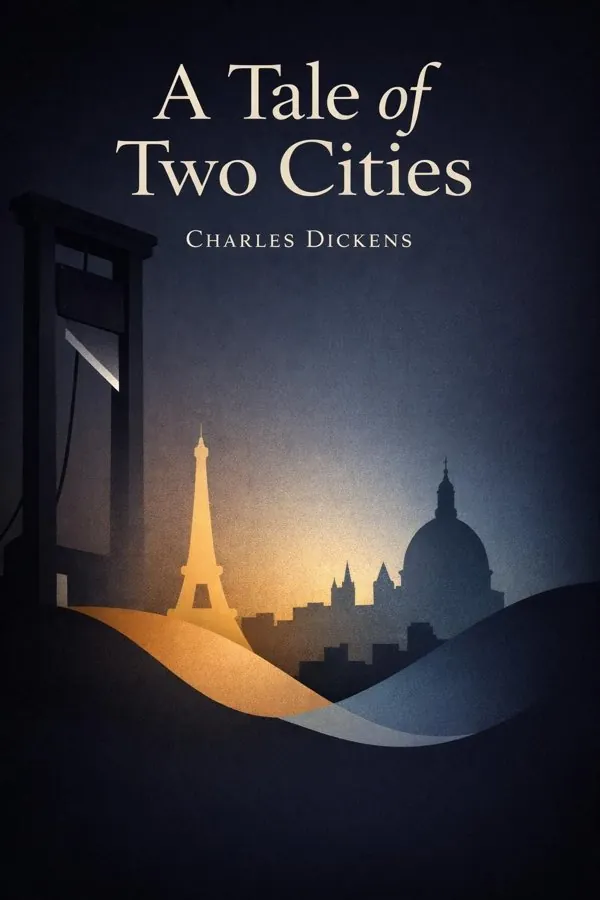
A Tale of Two Cities: Summary & Key Insights
 10 min4 chaptersAudio available
What Is A Tale of Two Cities About?
A Tale of Two Cities by Charles Dickens is a classics book spanning 4 pages. A Tale of Two Cities is a historical novel set in London and Paris before and during the French Revolution. It follows the intertwined lives of Charles Darnay, a French nobleman who renounces his title, and Sydney Carton, a disillusioned English lawyer, as both fall in love with Lucie Manette. The story explores themes of sacrifice, redemption, and resurrection amid revolutionary chaos and violence.
This FizzRead summary covers all 4 key chapters of A Tale of Two Cities in approximately 10 minutes, distilling the most important ideas, arguments, and takeaways from Charles Dickens's work. Also available as an audio summary and Key Quotes Podcast.
A Tale of Two Cities
A Tale of Two Cities is a historical novel set in London and Paris before and during the French Revolution. It follows the intertwined lives of Charles Darnay, a French nobleman who renounces his title, and Sydney Carton, a disillusioned English lawyer, as both fall in love with Lucie Manette. The story explores themes of sacrifice, redemption, and resurrection amid revolutionary chaos and violence.
Who Should Read A Tale of Two Cities?
This book is perfect for anyone interested in classics and looking to gain actionable insights in a short read. Whether you're a student, professional, or lifelong learner, the key ideas from A Tale of Two Cities by Charles Dickens will help you think differently.
- ✓Readers who enjoy classics and want practical takeaways
- ✓Professionals looking to apply new ideas to their work and life
- ✓Anyone who wants the core insights of A Tale of Two Cities in just 10 minutes
Want the full summary?
Get instant access to this book summary and 100K+ more with Fizz Moment.
Get Free SummaryAvailable on App Store • Free to download
Key Chapters
The story opens in 1775, and with it, I sought to grasp an entire world in contrast—the best and worst of times, wisdom and foolishness, light and darkness. England enjoys a deceptive calm, blind to the struggles that would soon shake Europe; France, meanwhile, burns beneath the weight of aristocratic cruelty and social inequality.
Into this ancient tension steps Jarvis Lorry, a faithful employee of Tellson’s Bank, who undertakes a mission that bridges the two cities and the two moral worlds they represent. His journey to France is not one of finance, but of compassion—to reunite Dr. Alexandre Manette with his daughter Lucie after eighteen years of wrongful imprisonment in the Bastille. The meeting between father and daughter becomes the novel’s first act of resurrection. I wanted readers to feel the pain and miracle of renewal when Lucie gently calls her broken father back from madness. Imprisonment has turned him into a ghost of a man, endlessly making shoes—a ritual of trauma and survival. Yet Lucie’s presence, her quiet endurance, begins to awaken fragments of his former self.
This first act lays the spiritual foundation of the book. Against the vast machinery of injustice, personal love becomes the force of salvation. The world may convulse in violence, but one heart’s gentleness can still call another back to life. That interplay between desolation and rebirth, private goodness and public cruelty, forms the pattern that continues to the end of the tale.
Charles Darnay enters the story as the image of moral courage—a French aristocrat who rejects his family’s privilege to live humbly as a teacher in England. Yet even in that renunciation, he cannot escape the sins of his lineage. The shadow of the Evrémonde name follows him across the Channel, and in a London courtroom, he stands accused of treason against the Crown. It is here that Sydney Carton, the most complex soul in the novel, reveals himself.
Carton—brilliant, disillusioned, and self-destructive—is Darnay’s physical double, yet his moral opposite. In a cruel twist of irony, his resemblance becomes Darnay’s salvation: through clever reasoning, Carton helps secure the Frenchman’s acquittal. But the incident leaves Carton staring into a living reflection of what he might have been—a man of integrity, beloved, and worthy of life. From that moment forward, his torment deepens, and Lucie Manette becomes the silent compass toward which his broken heart turns.
Lucie’s compassion draws both men: Darnay in legitimate love and marriage, Carton in silent devotion. Through her, each discovers what it means to be renewed. For Darnay, her love creates a home of peace; for Carton, whose life has been squandered on cynicism and drink, it sparks an awakening. He comes to believe that love’s truest expression is not possession but sacrifice. His famous line, uttered at the end, is no mere flourish—it is the culmination of a life finally reclaimed for virtue.
In juxtaposing Darnay and Carton, I sought to reveal the dual nature of humanity: the same face can house both ruin and salvation, depending only on the will of the heart. Their bond with Lucie crystallizes the book’s central moral—that redemption is always possible, even for those who have failed themselves.
+ 2 more chapters — available in the FizzRead app
All Chapters in A Tale of Two Cities
About the Author
Charles Dickens (1812–1870) was an English novelist regarded as one of the greatest writers of the Victorian era. His works, including Oliver Twist, Great Expectations, and David Copperfield, vividly portray social injustices and everyday life in 19th-century England.
Get This Summary in Your Preferred Format
Read or listen to the A Tale of Two Cities summary by Charles Dickens anytime, anywhere. FizzRead offers multiple formats so you can learn on your terms — all free.
Available formats: App · Audio · PDF · EPUB — All included free with FizzRead
Download A Tale of Two Cities PDF and EPUB Summary
Key Quotes from A Tale of Two Cities
“The story opens in 1775, and with it, I sought to grasp an entire world in contrast—the best and worst of times, wisdom and foolishness, light and darkness.”
“Charles Darnay enters the story as the image of moral courage—a French aristocrat who rejects his family’s privilege to live humbly as a teacher in England.”
Frequently Asked Questions about A Tale of Two Cities
A Tale of Two Cities by Charles Dickens is a classics book that explores key ideas across 4 chapters. A Tale of Two Cities is a historical novel set in London and Paris before and during the French Revolution. It follows the intertwined lives of Charles Darnay, a French nobleman who renounces his title, and Sydney Carton, a disillusioned English lawyer, as both fall in love with Lucie Manette. The story explores themes of sacrifice, redemption, and resurrection amid revolutionary chaos and violence.
More by Charles Dickens

You Might Also Like





Browse by Category
Ready to read A Tale of Two Cities?
Get the full summary and 100K+ more books with Fizz Moment.