
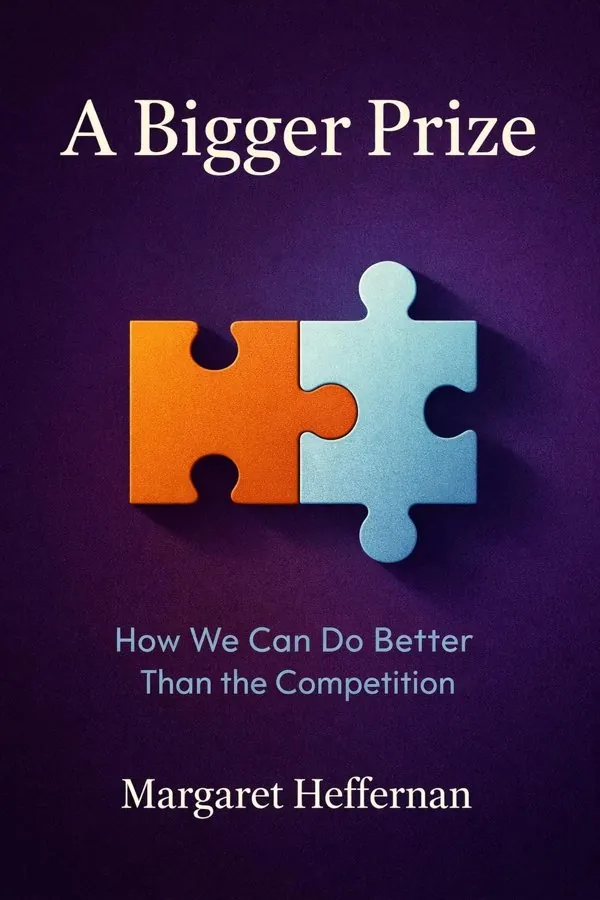
A Bigger Prize: How We Can Do Better Than the Competition: Summary & Key Insights
 10 min11 chaptersAudio available
What Is A Bigger Prize: How We Can Do Better Than the Competition About?
A Bigger Prize: How We Can Do Better Than the Competition by Margaret Heffernan is a leadership book spanning 11 pages. In 'A Bigger Prize', Margaret Heffernan explores how the obsession with competition undermines creativity, collaboration, and long-term success. Drawing on research from psychology, economics, and organizational behavior, she argues that cooperation and trust yield better outcomes for individuals, companies, and societies. The book challenges the myth that competition is the only path to excellence and offers examples of how collective intelligence and shared purpose can lead to more sustainable progress.
This FizzRead summary covers all 11 key chapters of A Bigger Prize: How We Can Do Better Than the Competition in approximately 10 minutes, distilling the most important ideas, arguments, and takeaways from Margaret Heffernan's work. Also available as an audio summary and Key Quotes Podcast.
A Bigger Prize: How We Can Do Better Than the Competition
In 'A Bigger Prize', Margaret Heffernan explores how the obsession with competition undermines creativity, collaboration, and long-term success. Drawing on research from psychology, economics, and organizational behavior, she argues that cooperation and trust yield better outcomes for individuals, companies, and societies. The book challenges the myth that competition is the only path to excellence and offers examples of how collective intelligence and shared purpose can lead to more sustainable progress.
Who Should Read A Bigger Prize: How We Can Do Better Than the Competition?
This book is perfect for anyone interested in leadership and looking to gain actionable insights in a short read. Whether you're a student, professional, or lifelong learner, the key ideas from A Bigger Prize: How We Can Do Better Than the Competition by Margaret Heffernan will help you think differently.
- ✓Readers who enjoy leadership and want practical takeaways
- ✓Professionals looking to apply new ideas to their work and life
- ✓Anyone who wants the core insights of A Bigger Prize: How We Can Do Better Than the Competition in just 10 minutes
Want the full summary?
Get instant access to this book summary and 100K+ more with Fizz Moment.
Get Free SummaryAvailable on App Store • Free to download
Key Chapters
To understand why competition became so deeply ingrained in our psyche, we must trace its roots. The modern obsession with rivalry didn’t materialize overnight. It’s the product of centuries of economic and cultural conditioning. Much of it stems from the triumph of free-market ideology: Adam Smith’s vision of self-interest harnessed for public good was transformed, over time, into a moral justification for relentless comparison. Schools adopted rankings, sports valorized victory at any cost, and corporations built hierarchies that rewarded lone stars over collective brilliance. We began to equate competition with virtue itself.
What this history reveals is that our modern systems don’t just use competition as a tool—they rely on it as a worldview. But as I came to see, the more competition is normalized, the less space we give to collaboration. The classroom becomes a battlefield for grades rather than ideas. The workplace turns into a stage for self-promotion instead of experimentation. Even nations internalize the logic of rivalry, viewing cooperation as compromise rather than progress. Recognizing this cultural inheritance is the first step to questioning it—and to imagining alternatives that do not demand perpetual conflict as the price of success.
Competition doesn’t just shape our systems—it shapes our minds. Psychological research shows that rivalry triggers stress responses similar to threat detection. Our focus narrows, empathy diminishes, and creativity declines. In competitive settings, people tend to take fewer risks, fearing that failure will disqualify them from future rewards. Meanwhile, cooperation releases oxytocin, the hormone that deepens trust and social bonding. The science, in short, confirms what many of us intuitively feel: competition can energize us briefly, but it rarely sustains us.
I recall interviews with athletes and executives who confessed that winning felt hollow, not because victory wasn’t pleasurable, but because it came at the expense of connection. They were driven by metrics, not meaning. And when competition is constant, it breeds conformity; we do what the system rewards, not what we believe matters. This is how innovation withers. By seeing others as threats, we lose the capacity to see them as partners.
+ 9 more chapters — available in the FizzRead app
All Chapters in A Bigger Prize: How We Can Do Better Than the Competition
About the Author
Margaret Heffernan is an entrepreneur, CEO, and author known for her work on business leadership and organizational culture. She has led several media companies and written extensively on collaboration, innovation, and the human aspects of management. Her TED Talks have been viewed millions of times worldwide.
Get This Summary in Your Preferred Format
Read or listen to the A Bigger Prize: How We Can Do Better Than the Competition summary by Margaret Heffernan anytime, anywhere. FizzRead offers multiple formats so you can learn on your terms — all free.
Available formats: App · Audio · PDF · EPUB — All included free with FizzRead
Download A Bigger Prize: How We Can Do Better Than the Competition PDF and EPUB Summary
Key Quotes from A Bigger Prize: How We Can Do Better Than the Competition
“To understand why competition became so deeply ingrained in our psyche, we must trace its roots.”
“Competition doesn’t just shape our systems—it shapes our minds.”
Frequently Asked Questions about A Bigger Prize: How We Can Do Better Than the Competition
A Bigger Prize: How We Can Do Better Than the Competition by Margaret Heffernan is a leadership book that explores key ideas across 11 chapters. In 'A Bigger Prize', Margaret Heffernan explores how the obsession with competition undermines creativity, collaboration, and long-term success. Drawing on research from psychology, economics, and organizational behavior, she argues that cooperation and trust yield better outcomes for individuals, companies, and societies. The book challenges the myth that competition is the only path to excellence and offers examples of how collective intelligence and shared purpose can lead to more sustainable progress.
More by Margaret Heffernan

You Might Also Like

Extreme Ownership
Jocko Willink
10 min
Dare to Lead
Brene Brown
10 min
Leaders Eat Last
Simon Sinek
10 min
The 21 Irrefutable Laws of Leadership
John Maxwell
10 min
Start With Why
Simon Sinek
10 min
How to Lead When You're Not in Charge
Clay Scroggins
10 minFeatured In
Browse by Category
Ready to read A Bigger Prize: How We Can Do Better Than the Competition?
Get the full summary and 100K+ more books with Fizz Moment.