
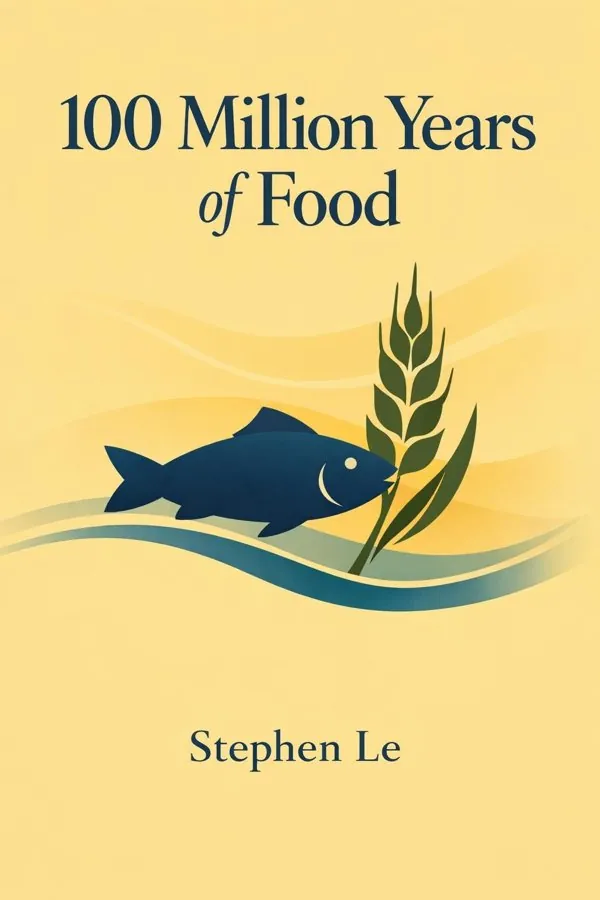
100 Million Years of Food: What Our Ancestors Ate and Why It Matters Today: Summary & Key Insights
by Stephen Le
 10 min5 chaptersAudio available
What Is 100 Million Years of Food: What Our Ancestors Ate and Why It Matters Today About?
100 Million Years of Food: What Our Ancestors Ate and Why It Matters Today by Stephen Le is a life_science book spanning 5 pages. In this engaging exploration of human evolution and diet, biological anthropologist Stephen Le traces how our eating habits have evolved over millions of years and how modern food choices affect our health. Drawing on fieldwork across Asia, Africa, and the Americas, Le examines the interplay between genetics, culture, and environment in shaping what we eat and why. The book argues that understanding ancestral diets can help us make better nutritional decisions in the modern world.
This FizzRead summary covers all 5 key chapters of 100 Million Years of Food: What Our Ancestors Ate and Why It Matters Today in approximately 10 minutes, distilling the most important ideas, arguments, and takeaways from Stephen Le's work. Also available as an audio summary and Key Quotes Podcast.
100 Million Years of Food: What Our Ancestors Ate and Why It Matters Today
In this engaging exploration of human evolution and diet, biological anthropologist Stephen Le traces how our eating habits have evolved over millions of years and how modern food choices affect our health. Drawing on fieldwork across Asia, Africa, and the Americas, Le examines the interplay between genetics, culture, and environment in shaping what we eat and why. The book argues that understanding ancestral diets can help us make better nutritional decisions in the modern world.
Who Should Read 100 Million Years of Food: What Our Ancestors Ate and Why It Matters Today?
This book is perfect for anyone interested in life_science and looking to gain actionable insights in a short read. Whether you're a student, professional, or lifelong learner, the key ideas from 100 Million Years of Food: What Our Ancestors Ate and Why It Matters Today by Stephen Le will help you think differently.
- ✓Readers who enjoy life_science and want practical takeaways
- ✓Professionals looking to apply new ideas to their work and life
- ✓Anyone who wants the core insights of 100 Million Years of Food: What Our Ancestors Ate and Why It Matters Today in just 10 minutes
Want the full summary?
Get instant access to this book summary and 100K+ more with Fizz Moment.
Get Free SummaryAvailable on App Store • Free to download
Key Chapters
When I look into the fossil record, I see the story of our appetites written in bone and tooth. Early hominins began primarily as gatherers—creatures that spent most of their energy searching for roots, tubers, fruits, and leaves. Our ancestors’ teeth, shaped for grinding, and their long digestive tracts tell us that plants were our first teachers in nutrition. But as landscapes dried and forests gave way to open savannas, our species faced a new challenge: how to survive in a world where plant foods were scarce for much of the year.
The introduction of meat into the human diet wasn’t just a matter of taste—it was a revolution. Hunting, scavenging, and later cooking animal flesh supplied dense calories and essential fatty acids that allowed our brains to grow. When you hold a piece of meat, you’re holding a fragment of evolutionary history—the substance that fueled the growth of Homo erectus and eventually Homo sapiens. Our intelligence, our tools, and even our social cooperation were sharpened by the pursuit of food that could flee. But this shift also anchored our species in a new ecological niche: omnivores, reliant on flexibility and innovation.
As we began to cook, our digestive systems shrank because fire did some of the work for us. Cooking made food safer, more digestible, and calorie-rich, allowing us to spend less time chewing and more time thinking, creating, and communicating. Around prehistoric hearths, language, kinship, and culture were kindled along with the flames. Food and thought evolved together, and that partnership still defines what it means to be human.
Ten thousand years ago, the world changed once more. In multiple regions—Mesopotamia, China, Mesoamerica—humans began to cultivate plants and domesticate animals. Agriculture marked our first large-scale experiment in controlling nature, and it transformed our diets in both good and bad ways. Suddenly, food could be produced in abundance and stored, liberating us from constant foraging. Populations grew, villages swelled, and civilizations took root.
But the bounty came at a cost. The early farmers’ bones, found by archaeologists, tell a sobering tale: shorter stature, more dental cavities, and signs of nutritional anemia. By relying heavily on a narrow set of grains—wheat, rice, maize—we traded diversity for stability. Our ancestors’ genomes had been shaped by a vast variety of wild foods; now, specialization began to extract a biological toll. Epidemics and infections thrived in the new dense settlements, and our diets, once rich in micronutrients, became monotonous. The agricultural revolution was therefore not purely a victory but an uneasy compromise between progress and health.
Still, the shift toward agriculture sowed the seeds for everything that followed: religion, writing, and urban life. It also marked the beginning of the food systems that dominate our world today. As I traveled through rural Asia and Africa, I saw farmers still living with the echoes of that ancient transition: cycles of planting and harvest that tie people to land, weather, and tradition. To understand modern eating, we have to appreciate that we are all heirs to the farmer’s dilemma—balancing abundance with variety, survival with nourishment.
+ 3 more chapters — available in the FizzRead app
All Chapters in 100 Million Years of Food: What Our Ancestors Ate and Why It Matters Today
About the Author
Stephen Le is a biological anthropologist and researcher whose work focuses on human evolution, diet, and health. He has conducted field research in several countries and is known for his accessible writing that connects scientific insights with everyday life.
Get This Summary in Your Preferred Format
Read or listen to the 100 Million Years of Food: What Our Ancestors Ate and Why It Matters Today summary by Stephen Le anytime, anywhere. FizzRead offers multiple formats so you can learn on your terms — all free.
Available formats: App · Audio · PDF · EPUB — All included free with FizzRead
Download 100 Million Years of Food: What Our Ancestors Ate and Why It Matters Today PDF and EPUB Summary
Key Quotes from 100 Million Years of Food: What Our Ancestors Ate and Why It Matters Today
“When I look into the fossil record, I see the story of our appetites written in bone and tooth.”
“Ten thousand years ago, the world changed once more.”
Frequently Asked Questions about 100 Million Years of Food: What Our Ancestors Ate and Why It Matters Today
100 Million Years of Food: What Our Ancestors Ate and Why It Matters Today by Stephen Le is a life_science book that explores key ideas across 5 chapters. In this engaging exploration of human evolution and diet, biological anthropologist Stephen Le traces how our eating habits have evolved over millions of years and how modern food choices affect our health. Drawing on fieldwork across Asia, Africa, and the Americas, Le examines the interplay between genetics, culture, and environment in shaping what we eat and why. The book argues that understanding ancestral diets can help us make better nutritional decisions in the modern world.
You Might Also Like
The Selfish Gene
Richard Dawkins
10 min
Awakenings
Oliver Sacks
10 min
Parasite Rex: Inside the Bizarre World of Nature's Most Dangerous Creatures
Carl Zimmer
10 min
The Atlas of Life on Earth
Various
10 min
The Book of Humans: The Story of How We Became Us
Adam Rutherford
10 min
The Horse
Wendy Williams
10 minFeatured In
Browse by Category
Ready to read 100 Million Years of Food: What Our Ancestors Ate and Why It Matters Today?
Get the full summary and 100K+ more books with Fizz Moment.