
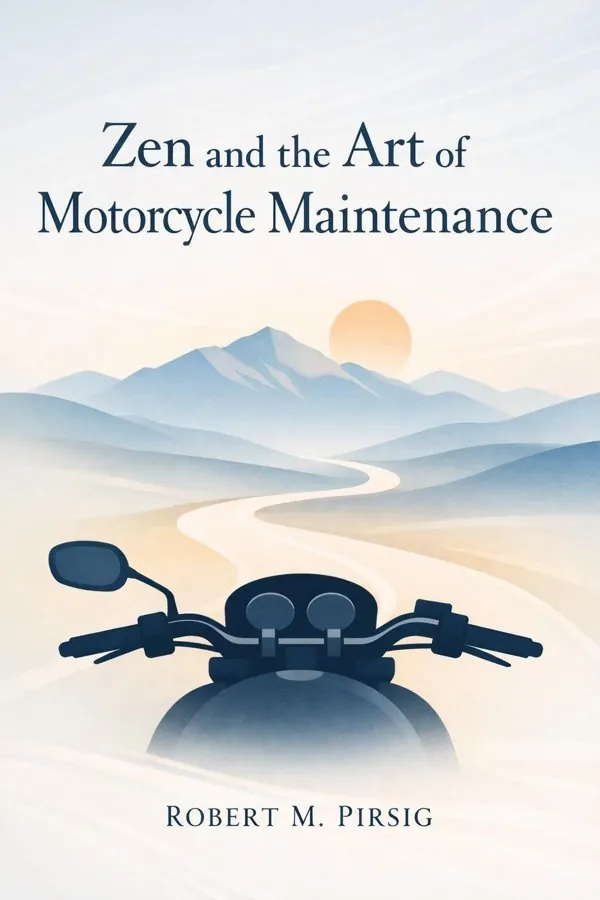
Zen and the Art of Motorcycle Maintenance: An Inquiry into Values: Summary & Key Insights
 10 min9 chaptersAudio available
Key Takeaways from Zen and the Art of Motorcycle Maintenance: An Inquiry into Values
A journey across physical terrain can reveal the shape of an inner life more clearly than any formal confession.
Some of the most important things in life are recognized before they are explained.
Many conflicts in modern life arise because people mistake different ways of seeing for incompatible truths.
The way we care for ordinary tools often reveals the way we care for life itself.
Intellectual honesty can be liberating, but pursued without balance it can also become destructive.
What Is Zen and the Art of Motorcycle Maintenance: An Inquiry into Values About?
Zen and the Art of Motorcycle Maintenance: An Inquiry into Values by Robert M. Pirsig is a western_phil book spanning 5 pages. Robert M. Pirsig’s Zen and the Art of Motorcycle Maintenance is one of the most unusual and influential philosophical books of the modern era. Framed as a motorcycle trip from Minnesota to California taken by a father and his son, Chris, the book gradually becomes a profound investigation into how we live, think, work, and assign value to experience. What begins as a travel narrative unfolds into an inquiry into “Quality,” a concept Pirsig treats as more fundamental than the usual split between reason and feeling, science and art, technology and spirituality. The result is part memoir, part philosophical quest, and part cultural diagnosis. The book matters because it addresses a problem that still defines contemporary life: why so many people feel divided between efficient, technical systems and the search for meaning. Pirsig writes with unusual authority because his argument is not abstract speculation alone; it emerges from lived experience, intellectual struggle, and personal crisis. Drawing on philosophy, motorcycle maintenance, education, and everyday perception, he offers a way to reconcile precision with care and intellect with presence. This is a demanding but deeply rewarding book for readers seeking a more integrated life.
This FizzRead summary covers all 9 key chapters of Zen and the Art of Motorcycle Maintenance: An Inquiry into Values in approximately 10 minutes, distilling the most important ideas, arguments, and takeaways from Robert M. Pirsig's work. Also available as an audio summary and Key Quotes Podcast.
Zen and the Art of Motorcycle Maintenance: An Inquiry into Values
Robert M. Pirsig’s Zen and the Art of Motorcycle Maintenance is one of the most unusual and influential philosophical books of the modern era. Framed as a motorcycle trip from Minnesota to California taken by a father and his son, Chris, the book gradually becomes a profound investigation into how we live, think, work, and assign value to experience. What begins as a travel narrative unfolds into an inquiry into “Quality,” a concept Pirsig treats as more fundamental than the usual split between reason and feeling, science and art, technology and spirituality. The result is part memoir, part philosophical quest, and part cultural diagnosis.
The book matters because it addresses a problem that still defines contemporary life: why so many people feel divided between efficient, technical systems and the search for meaning. Pirsig writes with unusual authority because his argument is not abstract speculation alone; it emerges from lived experience, intellectual struggle, and personal crisis. Drawing on philosophy, motorcycle maintenance, education, and everyday perception, he offers a way to reconcile precision with care and intellect with presence. This is a demanding but deeply rewarding book for readers seeking a more integrated life.
Who Should Read Zen and the Art of Motorcycle Maintenance: An Inquiry into Values?
This book is perfect for anyone interested in western_phil and looking to gain actionable insights in a short read. Whether you're a student, professional, or lifelong learner, the key ideas from Zen and the Art of Motorcycle Maintenance: An Inquiry into Values by Robert M. Pirsig will help you think differently.
- ✓Readers who enjoy western_phil and want practical takeaways
- ✓Professionals looking to apply new ideas to their work and life
- ✓Anyone who wants the core insights of Zen and the Art of Motorcycle Maintenance: An Inquiry into Values in just 10 minutes
Want the full summary?
Get instant access to this book summary and 100K+ more with Fizz Moment.
Get Free SummaryAvailable on App Store • Free to download
Key Chapters
A journey across physical terrain can reveal the shape of an inner life more clearly than any formal confession. In Zen and the Art of Motorcycle Maintenance, the motorcycle trip from Minnesota to California is not merely a backdrop; it is the structure through which Pirsig examines thought, memory, relationships, and value. Traveling with his son Chris and their friends John and Sylvia Sutherland, the narrator notices how the road invites attention. Weather, engine sounds, roadside conversations, fatigue, and changing scenery all become opportunities for reflection.
The trip also introduces one of the book’s key tensions. John and Sylvia prefer the romance of riding: the feel of the open road, the freedom, the atmosphere. The narrator, by contrast, also cares about the machine itself. He wants to understand how the motorcycle works, because maintenance is part of responsible engagement with reality. This contrast is not a simple personality difference; it previews the larger philosophical division between immediate experience and analytical understanding.
The road narrative matters because it keeps philosophy grounded. Questions about value are not raised in a classroom but while adjusting a machine, enduring heat, navigating discomfort, and caring for a child. Pirsig suggests that our deepest ideas are tested in ordinary life, not protected from it. Even the changing landscapes of the American West mirror shifting states of mind: calm, tension, uncertainty, wonder, and unease.
In practical terms, the journey reminds us that how we travel through life matters as much as where we are headed. A commute, a work project, or a family obligation can become either dead routine or a site of attention and discovery. The actionable takeaway: treat everyday processes as meaningful paths of inquiry, and use ordinary moments to observe how you think, what you value, and where you are divided within yourself.
Some of the most important things in life are recognized before they are explained. Pirsig’s central philosophical question is deceptively simple: What is Quality? We all use the term with confidence. We say a book has quality, a repair job lacks quality, a teacher offers quality instruction. Yet when asked to define it precisely, language begins to fail. For Pirsig, this failure is not proof that Quality is meaningless; it is evidence that Quality may come before conceptual categories.
Pirsig’s earlier self, Phaedrus, becomes obsessed with this question because it exposes a weakness in conventional philosophy. If we say Quality is purely subjective, we reduce it to private preference. If we say it is purely objective, we treat value as if it were just another measurable property. But lived experience suggests something richer. Before we classify an event as useful, beautiful, correct, or moral, we often have an immediate sense that something is better or worse, fitting or unfitting, alive or dead.
This inquiry has practical force. In education, for instance, teachers often rely on grades and rubrics, but students still know when a class truly matters. In professional work, metrics can track output, yet they cannot fully capture care, coherence, or excellence. In relationships, we may struggle to explain why one conversation feels genuine and another hollow.
Pirsig’s insight is that Quality functions as a direct encounter with value prior to rigid intellectual division. It is not easy to define because it is the source from which many definitions arise. This does not eliminate analysis; it gives analysis a deeper foundation. The actionable takeaway: when making decisions, do not rely only on rules or only on feelings. Notice your immediate sense of what has vitality, coherence, and rightness, then examine it carefully rather than dismissing it.
Many conflicts in modern life arise because people mistake different ways of seeing for incompatible truths. Pirsig captures this divide through two modes of understanding: the classical and the romantic. The romantic mode focuses on immediate appearance, feeling, intuition, and surface experience. It values the beauty of a sunset, the thrill of riding, the atmosphere of the moment. The classical mode looks beneath appearance to underlying structure, form, method, and mechanics. It values how an engine works, how an argument holds together, how a system can be understood.
Pirsig does not present these as enemies in themselves. The problem begins when one side dismisses the other. John and Sylvia resist motorcycle maintenance because they associate technology with coldness and alienation. The narrator sees this as a mistake. A well-maintained machine is not opposed to beauty; understanding it can deepen appreciation. Likewise, someone immersed only in technical analysis can become detached from lived immediacy and lose touch with the human meaning of what they know.
This distinction applies everywhere. In art, some people respond to emotional impact while others care about composition and technique. In business, one manager may focus on culture and morale while another prioritizes systems and process. In personal growth, some people trust inspiration while others rely on disciplined habits. Each perspective reveals something real, but neither is sufficient alone.
Pirsig’s larger point is that wisdom requires integration. We need the romantic openness that lets life feel vivid, and the classical discipline that allows us to engage reality responsibly. To reject one side is to shrink the world. The actionable takeaway: identify which mode you default to, then deliberately practice the other. If you are highly analytical, make room for presence and aesthetic attention; if you are highly intuitive, learn the structures that sustain what you love.
The way we care for ordinary tools often reveals the way we care for life itself. Motorcycle maintenance in Pirsig’s book is not mainly about machinery; it is a moral and philosophical exercise in attention, patience, and responsibility. To maintain a motorcycle well, one must observe carefully, avoid panic, understand relationships between parts, and resist the temptation of careless shortcuts. These habits are not confined to the garage. They shape character.
Pirsig argues against the common belief that technology is inherently dehumanizing. Alienation comes less from the machine itself than from the attitude we bring to it. When people approach technology resentfully or mechanically, they become separated from their own work. But when they bring care and understanding, even a technical task can become satisfying and meaningful. This is one of the book’s most enduring contributions: it reframes maintenance as a way of being present rather than a tedious interruption to “real life.”
The practical examples are easy to recognize. A cook who sharpens knives and organizes a kitchen works with more calm and competence. A programmer who understands the structure of a system avoids future chaos. A homeowner who notices a small leak early prevents major damage. In each case, maintenance is not glamorous, but it preserves quality and reduces suffering.
Pirsig also introduces the idea of “gumption,” the inner energy needed to solve problems. Maintenance often stalls because of frustration, ego, distraction, or discouragement. Learning to protect gumption is essential in both technical and personal life.
The actionable takeaway: choose one neglected area of your life, tool, or routine and maintain it with full attention this week. Treat upkeep not as drudgery but as a disciplined expression of respect for reality.
Intellectual honesty can be liberating, but pursued without balance it can also become destructive. One of the book’s most haunting dimensions is the story of Phaedrus, the narrator’s former self, whose relentless philosophical inquiry ultimately led to mental breakdown and electroshock therapy. Phaedrus is brilliant, intense, uncompromising, and unable to rest until he reaches the roots of meaning. His obsession with Quality grows out of dissatisfaction with shallow academic assumptions, especially in the teaching of rhetoric and philosophy.
Pirsig uses Phaedrus to dramatize the danger of seeking certainty at any cost. Phaedrus is not wrong to question inherited categories, but he becomes consumed by the search. His identity narrows around the problem. Relationships strain, ordinary functioning deteriorates, and thought loses proportion. The result is not a triumphant discovery but psychic collapse. This gives the book emotional gravity: philosophy here is not a game but an existential force.
At the same time, Pirsig does not simply reject intense inquiry. Phaedrus’s quest exposes real weaknesses in the culture around him: rote education, empty abstractions, and the false separation of reason from value. His breakdown does not invalidate his questions; it shows the human cost of pursuing them without enough grounding, tenderness, or limits.
This insight applies far beyond philosophy. Ambitious professionals can become consumed by productivity. Activists can burn out trying to solve systemic injustice alone. Students can tie self-worth to intellectual performance. In each case, the pursuit of truth or excellence becomes dangerous when it erases the person pursuing it.
The actionable takeaway: take your deepest questions seriously, but build practices that keep you human while pursuing them—rest, friendship, humility, and a willingness to step back when obsession begins replacing wisdom.
Often the biggest obstacle to solving a problem is not the problem itself but the state of mind we bring to it. Pirsig’s discussion of “gumption traps” is one of the book’s most practical and memorable ideas. Gumption is the combination of enthusiasm, confidence, patience, and mental energy that keeps us engaged. When gumption is high, challenges feel workable. When it is low, even minor setbacks feel unbearable.
Pirsig identifies different kinds of traps. Some are external setbacks, such as faulty tools, poor instructions, or confusing conditions. Others are internal, including ego, anxiety, boredom, hurry, and the inability to tolerate uncertainty. For example, a person fixing a machine may become so eager for a quick result that they skip basic steps and create bigger problems. Or they may become attached to appearing competent, making them resistant to admitting they do not understand what is wrong.
This framework extends well beyond maintenance. Writers encounter gumption traps when perfectionism stops momentum. Managers encounter them when stress leads to rushed decisions. Parents encounter them when fatigue turns solvable conflicts into emotional standoffs. Students encounter them when fear of failure makes them avoid the very tasks that would help them improve.
Pirsig’s wisdom is to slow down, observe the trap, and restore inner quality before forcing external solutions. Sometimes the best next step is not more effort but a pause, a reframe, or a return to basics. Good work is not just a matter of knowledge; it depends on protecting the conditions under which clear thought is possible.
The actionable takeaway: when you feel stuck, ask not only “What is wrong with the task?” but also “What is happening to my gumption?” Then reset by resting, simplifying, checking assumptions, and proceeding with deliberate calm.
A system can function efficiently and still fail at its most important purpose. Pirsig’s critique of education is one of the book’s sharpest themes. Through Phaedrus’s experiences as a teacher of rhetoric, he argues that schools often train students to perform academically without helping them confront the deeper question of value. Students may learn rules of composition, standards of argument, and formulas for success, yet remain uncertain about what makes work genuinely good.
This concern emerges vividly when Phaedrus encounters students paralyzed by writing assignments. Their difficulty is not always a lack of technical skill but a lack of meaningful orientation. They do not know what deserves attention or how to recognize significance. In response, Pirsig shifts emphasis away from rigid abstraction and toward direct engagement with specific experience. Instead of asking students to write generally about a broad topic, he encourages them to start with something concrete and immediate. Quality appears not through vague performance but through careful attention.
The institutional criticism goes wider. Bureaucracies often rely on measurable outputs because they are easy to standardize, but overreliance on metrics can hollow out excellence. A school can optimize test scores while weakening curiosity. A company can maximize short-term efficiency while damaging craftsmanship. A hospital can improve reporting while diminishing patient care. When institutions lose sight of value, they become technically competent but spiritually empty.
Pirsig’s point is not anti-intellectual and not anti-institutional. He wants forms, standards, and methods to remain connected to lived quality. Systems should support good judgment, not replace it.
The actionable takeaway: in any learning or work environment, ask what the formal system is measuring—and what it may be overlooking. Then create room for direct attention, concrete experience, and standards of excellence that cannot be reduced to numbers alone.
We are not always as unified as we imagine, and confronting that fact can be both painful and illuminating. As the journey progresses, the narrator increasingly faces the presence of Phaedrus, the former self he both is and is not. The book’s emotional power comes partly from this unstable relationship to memory and identity. Phaedrus represents a past intellect and personality that was shattered by illness and treatment, leaving behind a man who remembers enough to be haunted but not enough to feel whole.
This divided self mirrors the philosophical divisions in the book. Just as modern culture splits subject from object and art from science, the narrator experiences a split within his own being. The conflict is not merely theoretical; it affects his relationship with Chris, his sense of continuity, and his fear of what returning knowledge might bring. The deeper he explores Quality, the more he approaches the person who nearly destroyed himself pursuing it.
Pirsig’s treatment of identity is significant because it resists simplistic notions of self-discovery. Knowing oneself is not always a smooth process of clarification. Sometimes it involves grief, discontinuity, shame, and the recognition that parts of us have been denied or fragmented. Yet the book also suggests that healing requires some kind of encounter with what has been excluded.
This theme has practical relevance for anyone carrying a split between outer function and inner truth. A professional self may hide emotional depletion. A family role may suppress intellectual longing. A competent persona may cover unresolved pain. Integration begins when we stop pretending the split does not exist.
The actionable takeaway: pay attention to the parts of your history or personality you avoid. Instead of forcing a neat story, allow honest reflection, conversation, or journaling to reveal what remains unresolved and what form of integration is now possible.
The boldest move in the book is the suggestion that value is not an afterthought added to reality but a fundamental feature of it. Pirsig’s inquiry gradually points toward what later becomes known as the Metaphysics of Quality. Rather than beginning with a rigid split between subject and object—mind and world, observer and observed—he proposes that Quality is more basic. Our experience of better and worse, fit and misfit, excellence and failure is not merely a personal reaction layered onto neutral facts. It is part of how reality presents itself.
This idea matters because the subject-object framework has shaped much of modern thinking. It has brought enormous analytical power, but it also leaves us stranded when we try to account for meaning, morality, beauty, or craftsmanship. If facts are one thing and values another, then life easily fractures into technical control on one side and private feeling on the other. Pirsig aims to heal that fracture by making value primary.
In practice, this means that a well-made sentence, a carefully repaired engine, a generous act, and a coherent theory are not valuable by accident. They participate in patterns of quality that can be recognized, cultivated, and discussed, even if they are not reducible to simple formulas. This does not solve every philosophical problem, but it gives us a richer way to think about excellence and moral seriousness.
Readers need not master formal metaphysics to benefit from the insight. The central lesson is that value is woven into experience more deeply than modern habits of thought often admit.
The actionable takeaway: stop treating value as merely subjective preference. In your work and choices, ask not only what is efficient or acceptable, but what has genuine quality—coherence, care, depth, and life-enhancing force.
All Chapters in Zen and the Art of Motorcycle Maintenance: An Inquiry into Values
About the Author
Robert M. Pirsig (1928–2017) was an American writer and philosophical novelist whose work explored the relationship between rationality, value, technology, and human experience. He studied philosophy at the University of Minnesota and later at the University of Chicago, developing a lifelong interest in questions of knowledge, quality, and meaning. Pirsig became internationally known with the publication of Zen and the Art of Motorcycle Maintenance in 1974, a book that blended autobiography, travel narrative, and philosophy in a highly original form. Its success established him as a distinctive public intellectual, despite his relatively small body of published work. He later expanded his ideas in Lila: An Inquiry into Morals. Pirsig remains influential for readers interested in craftsmanship, education, metaphysics, and the search for a more integrated way of living.
Get This Summary in Your Preferred Format
Read or listen to the Zen and the Art of Motorcycle Maintenance: An Inquiry into Values summary by Robert M. Pirsig anytime, anywhere. FizzRead offers multiple formats so you can learn on your terms — all free.
Available formats: App · Audio · PDF · EPUB — All included free with FizzRead
Download Zen and the Art of Motorcycle Maintenance: An Inquiry into Values PDF and EPUB Summary
Key Quotes from Zen and the Art of Motorcycle Maintenance: An Inquiry into Values
“A journey across physical terrain can reveal the shape of an inner life more clearly than any formal confession.”
“Some of the most important things in life are recognized before they are explained.”
“Many conflicts in modern life arise because people mistake different ways of seeing for incompatible truths.”
“The way we care for ordinary tools often reveals the way we care for life itself.”
“Intellectual honesty can be liberating, but pursued without balance it can also become destructive.”
Frequently Asked Questions about Zen and the Art of Motorcycle Maintenance: An Inquiry into Values
Zen and the Art of Motorcycle Maintenance: An Inquiry into Values by Robert M. Pirsig is a western_phil book that explores key ideas across 9 chapters. Robert M. Pirsig’s Zen and the Art of Motorcycle Maintenance is one of the most unusual and influential philosophical books of the modern era. Framed as a motorcycle trip from Minnesota to California taken by a father and his son, Chris, the book gradually becomes a profound investigation into how we live, think, work, and assign value to experience. What begins as a travel narrative unfolds into an inquiry into “Quality,” a concept Pirsig treats as more fundamental than the usual split between reason and feeling, science and art, technology and spirituality. The result is part memoir, part philosophical quest, and part cultural diagnosis. The book matters because it addresses a problem that still defines contemporary life: why so many people feel divided between efficient, technical systems and the search for meaning. Pirsig writes with unusual authority because his argument is not abstract speculation alone; it emerges from lived experience, intellectual struggle, and personal crisis. Drawing on philosophy, motorcycle maintenance, education, and everyday perception, he offers a way to reconcile precision with care and intellect with presence. This is a demanding but deeply rewarding book for readers seeking a more integrated life.
You Might Also Like
A Little History of Philosophy
Nigel Warburton
10 min
Areopagitica
John Milton
10 min
How To Think Like A Philosopher: Essential Principles For Clear Thinking
Peter Cave
10 min
Language, Truth and Logic
A. J. Ayer
10 min
The Age of Reason
Thomas Paine
10 min
The Essays
Michel De Montaigne
10 minBrowse by Category
Ready to read Zen and the Art of Motorcycle Maintenance: An Inquiry into Values?
Get the full summary and 100K+ more books with Fizz Moment.