
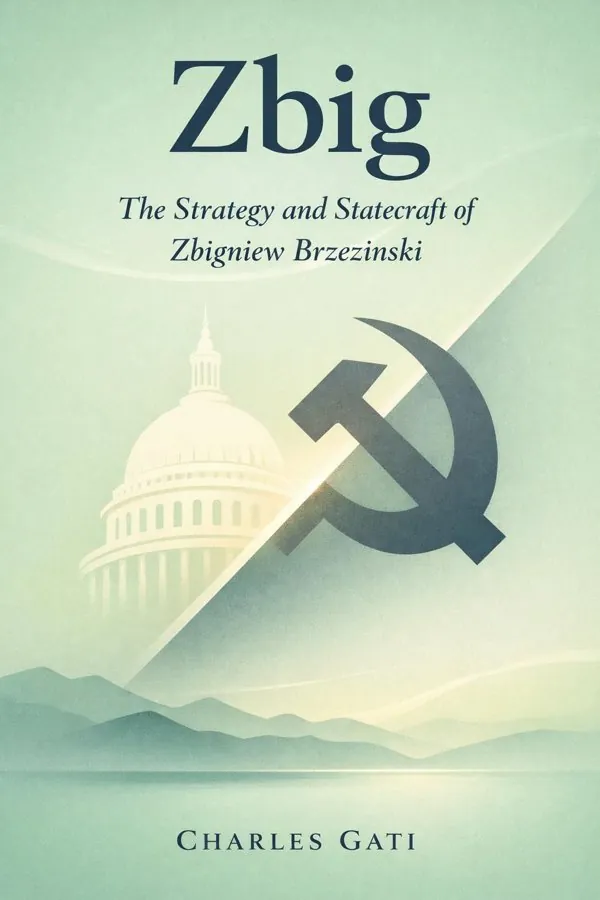
Zbig: The Strategy and Statecraft of Zbigniew Brzezinski: Summary & Key Insights
by Charles Gati
 10 min9 chaptersAudio available
What Is Zbig: The Strategy and Statecraft of Zbigniew Brzezinski About?
Zbig: The Strategy and Statecraft of Zbigniew Brzezinski by Charles Gati is a politics book spanning 9 pages. This book offers an in-depth analysis of Zbigniew Brzezinski’s strategic thinking and diplomatic influence, exploring his role as National Security Advisor and his impact on U.S. foreign policy during the Cold War. Drawing on interviews and archival materials, it provides a comprehensive portrait of Brzezinski’s intellectual legacy and his approach to global affairs.
This FizzRead summary covers all 9 key chapters of Zbig: The Strategy and Statecraft of Zbigniew Brzezinski in approximately 10 minutes, distilling the most important ideas, arguments, and takeaways from Charles Gati's work. Also available as an audio summary and Key Quotes Podcast.
Zbig: The Strategy and Statecraft of Zbigniew Brzezinski
This book offers an in-depth analysis of Zbigniew Brzezinski’s strategic thinking and diplomatic influence, exploring his role as National Security Advisor and his impact on U.S. foreign policy during the Cold War. Drawing on interviews and archival materials, it provides a comprehensive portrait of Brzezinski’s intellectual legacy and his approach to global affairs.
Who Should Read Zbig: The Strategy and Statecraft of Zbigniew Brzezinski?
This book is perfect for anyone interested in politics and looking to gain actionable insights in a short read. Whether you're a student, professional, or lifelong learner, the key ideas from Zbig: The Strategy and Statecraft of Zbigniew Brzezinski by Charles Gati will help you think differently.
- ✓Readers who enjoy politics and want practical takeaways
- ✓Professionals looking to apply new ideas to their work and life
- ✓Anyone who wants the core insights of Zbig: The Strategy and Statecraft of Zbigniew Brzezinski in just 10 minutes
Want the full summary?
Get instant access to this book summary and 100K+ more with Fizz Moment.
Get Free SummaryAvailable on App Store • Free to download
Key Chapters
Brzezinski’s intellectual foundation was formed in the aftermath of tyranny. Having fled wartime Europe, he arrived in North America not just as a refugee but as a seeker of order—a scholar determined to interpret the forces that had destroyed his homeland. At Harvard, his doctoral research on Soviet totalitarianism explored the ideological rigidity and bureaucratic mechanisms that sustained the Communist system. He argued that totalitarian regimes were not immutable; they could decay under the pressures of technological modernization and social mobility. This diagnosis would later underpin his view that the Soviet Union was ultimately vulnerable to internal transformation.
As a professor at Columbia University, Brzezinski applied the emerging tools of modernization theory to the study of political development. He posited that modernity was more than industrial progress—it was the crucible of pluralism and choice, and authoritarian systems would struggle to contain these forces. These scholarly insights soon carried political weight. His writings resonated beyond the academy, positioning him as a key interpreter of Communist evolution at a time when policymakers were searching for intellectual frameworks to guide U.S. strategy.
But Brzezinski was never content with detached analysis. Academia, for him, was a laboratory for power. He lectured with a sharpness that reflected his belief in the unity of thought and action. His grasp of comparative politics and his Eastern European origins gave his work a distinctive edge: it was both analytical and existential. He saw the Cold War not as an abstract contest but as a moral struggle, one that demanded clarity about both the mechanisms of control and the possibilities of change.
To comprehend Brzezinski’s strategic outlook, one must situate it in the mid-twentieth century’s crucible of anxiety and rivalry. The postwar balance of power was defined by nuclear deterrence, ideological polarization, and the fragile architecture of alliances. The illusion of stability masked underlying volatility.
Brzezinski’s early writings reflected this tension. He rejected the notion, popular among some contemporaries, that coexistence with the Soviet Union meant acceptance of its permanence. He viewed the Cold War as a historical phase—a competition of systems in which the West’s adaptability gave it the long-term advantage. The Soviet model, he argued, was brittle beneath its surface uniformity.
By the 1960s, his intellectual compass pointed toward engagement with change inside the Communist bloc. He saw signs of differentiation—Poland’s reformist currents, Yugoslavia’s deviation, Czechoslovakia’s intellectual ferment—as evidence of softening monolithism. To be effective, American strategy would need to exploit these fissures rather than retreat into static deterrence. Thus emerged his central conviction: strategy should not merely contain an adversary but catalyze its transformation.
This insight set him apart from many in the realist school. While sharing realism’s respect for power, Brzezinski infused it with a dynamic, almost dialectical sense of historical movement. He foresaw a world in which ideology would wane before modernization, and where the ultimate contest would be for global legitimacy rather than territory.
+ 7 more chapters — available in the FizzRead app
All Chapters in Zbig: The Strategy and Statecraft of Zbigniew Brzezinski
About the Author
Charles Gati is a Hungarian-born American political scientist and historian specializing in U.S.-East European relations. He has taught at Johns Hopkins University and written extensively on Cold War diplomacy and Eastern European politics.
Get This Summary in Your Preferred Format
Read or listen to the Zbig: The Strategy and Statecraft of Zbigniew Brzezinski summary by Charles Gati anytime, anywhere. FizzRead offers multiple formats so you can learn on your terms — all free.
Available formats: App · Audio · PDF · EPUB — All included free with FizzRead
Download Zbig: The Strategy and Statecraft of Zbigniew Brzezinski PDF and EPUB Summary
Key Quotes from Zbig: The Strategy and Statecraft of Zbigniew Brzezinski
“Brzezinski’s intellectual foundation was formed in the aftermath of tyranny.”
“To comprehend Brzezinski’s strategic outlook, one must situate it in the mid-twentieth century’s crucible of anxiety and rivalry.”
Frequently Asked Questions about Zbig: The Strategy and Statecraft of Zbigniew Brzezinski
Zbig: The Strategy and Statecraft of Zbigniew Brzezinski by Charles Gati is a politics book that explores key ideas across 9 chapters. This book offers an in-depth analysis of Zbigniew Brzezinski’s strategic thinking and diplomatic influence, exploring his role as National Security Advisor and his impact on U.S. foreign policy during the Cold War. Drawing on interviews and archival materials, it provides a comprehensive portrait of Brzezinski’s intellectual legacy and his approach to global affairs.
You Might Also Like
Antifa: The Anti-Fascist Handbook
Mark Bray
10 min
Attack from Within: How Disinformation Is Sabotaging America
Barbara McQuade
10 min
Coercion, Capital, and European States, AD 990–1992
Charles Tilly
10 min
Digital Democracy: Concepts, Methodologies, Tools, and Applications
Various Authors
10 min
Fascism
Stanley G. Payne
10 min
Fire And Fury: Inside The Trump White House
Michael Wolff
10 minBrowse by Category
Ready to read Zbig: The Strategy and Statecraft of Zbigniew Brzezinski?
Get the full summary and 100K+ more books with Fizz Moment.