
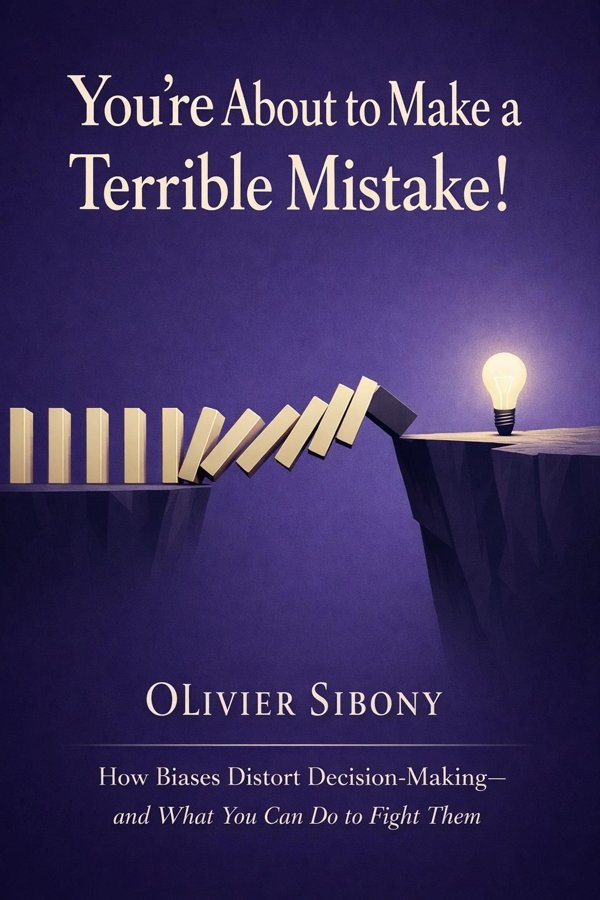
You're About to Make a Terrible Mistake!: How Biases Distort Decision-Making—and What You Can Do to Fight Them: Summary & Key Insights
 10 min10 chaptersAudio available
What Is You're About to Make a Terrible Mistake!: How Biases Distort Decision-Making—and What You Can Do to Fight Them About?
You're About to Make a Terrible Mistake!: How Biases Distort Decision-Making—and What You Can Do to Fight Them by Olivier Sibony is a mindset book spanning 10 pages. In this insightful book, Olivier Sibony explores how cognitive biases systematically distort our decision-making processes in business and everyday life. Drawing on behavioral science and real-world examples, he explains why even experienced leaders fall prey to predictable errors and offers practical frameworks to improve judgment and strategic thinking.
This FizzRead summary covers all 10 key chapters of You're About to Make a Terrible Mistake!: How Biases Distort Decision-Making—and What You Can Do to Fight Them in approximately 10 minutes, distilling the most important ideas, arguments, and takeaways from Olivier Sibony's work. Also available as an audio summary and Key Quotes Podcast.
You're About to Make a Terrible Mistake!: How Biases Distort Decision-Making—and What You Can Do to Fight Them
In this insightful book, Olivier Sibony explores how cognitive biases systematically distort our decision-making processes in business and everyday life. Drawing on behavioral science and real-world examples, he explains why even experienced leaders fall prey to predictable errors and offers practical frameworks to improve judgment and strategic thinking.
Who Should Read You're About to Make a Terrible Mistake!: How Biases Distort Decision-Making—and What You Can Do to Fight Them?
This book is perfect for anyone interested in mindset and looking to gain actionable insights in a short read. Whether you're a student, professional, or lifelong learner, the key ideas from You're About to Make a Terrible Mistake!: How Biases Distort Decision-Making—and What You Can Do to Fight Them by Olivier Sibony will help you think differently.
- ✓Readers who enjoy mindset and want practical takeaways
- ✓Professionals looking to apply new ideas to their work and life
- ✓Anyone who wants the core insights of You're About to Make a Terrible Mistake!: How Biases Distort Decision-Making—and What You Can Do to Fight Them in just 10 minutes
Want the full summary?
Get instant access to this book summary and 100K+ more with Fizz Moment.
Get Free SummaryAvailable on App Store • Free to download
Key Chapters
One of the most comforting beliefs in decision-making is the idea that we are objective. We like to think we weigh evidence, evaluate options, and reach conclusions through logical reasoning. Yet, my own experience observing countless strategic teams taught me otherwise. People behave as if they seek truth, but they really seek confirmation—that subtle difference is the engine of bias.
Overconfidence sits at the heart of this illusion. When executives evaluate investment opportunities or strategic directions, they often believe their judgment is based on data, when in reality it’s anchored in prior decisions or emotional attachments. We interpret evidence that supports our existing beliefs with enthusiasm and downplay anything that contradicts them. This is *confirmation bias*, and it doesn’t discriminate—it affects the seasoned CEO as much as the young analyst. The powerful illusion of objectivity stems from our brain’s ability to rationalize after the fact. Once a choice feels right, we construct a story that makes it look rational.
Consider how easily overconfidence shapes professional forecasting. Think of the many failed predictions in finance or technology—where experts assigned probabilities of success that ignored uncertainty. Behavioral research shows we consistently underestimate complexity and overrate our own ability to predict outcomes. In organizations, this illusion becomes contagious: when leaders project confidence, their teams align with it, reinforcing the same distorted narrative. Objectivity dissolves in a haze of shared certainty.
So how do we fight this? It begins not by distrusting ourselves completely, but by acknowledging that human reasoning is inherently subjective. When you recognize that your ‘rational’ view is actually a reflection of your mental model, you start to introduce humility into your decision process. In my classes and consulting work, I encourage teams to systematically challenge their assumptions—to ask, “What would I think if I were wrong?” That question, simple as it sounds, is the first crack in the illusion of objectivity.
Biases are not random distortions; they are predictable patterns rooted in how the human mind simplifies complex reality. Behavioral science has identified hundreds, but three are particularly pervasive in organizational life: anchoring, availability, and representativeness. Each functions like a mental shortcut, saving cognitive effort but quietly leading us astray.
Anchoring occurs when we latch onto an initial piece of information—the ‘anchor’—and fail to adjust sufficiently from it. In negotiations, early price references skew all subsequent judgments. In performance reviews, the first impression of an employee colors every later evaluation. Anchoring is powerful because it tricks us into believing we are adjusting rationally when we are merely orbiting around a biased starting point.
Availability bias operates through memory and salience. We judge the probability of events by how easily examples come to mind. If a recent crisis dominates headlines, we overestimate its likelihood of recurring. Managers may allocate resources to mitigate visible risks while neglecting more serious but less vivid ones. In corporate planning, availability bias fuels short-termism—reacting to what’s fresh in memory rather than what’s statistically probable.
Representativeness, perhaps the most intuitive bias, leads us to assess situations by superficial similarity. We expect a small sample to ‘represent’ a broader truth, confusing pattern recognition with statistical validity. When a startup resembles a past success story, investors infer success; when a team looks like one that failed before, they expect trouble. The mind craves coherence, but coherence is not truth.
Across these examples, the consistent danger is simplification. The very cognitive mechanisms that make human judgment possible also create systematic error. The challenge isn’t to eradicate simplification—that’s impossible—but to recognize when it’s driving the bus. That awareness can be embedded in organizational processes: by structuring discussions, separating data gathering from evaluation, and diversifying perspectives. Understanding biases is not an academic exercise; it’s the foundation for designing decisions that are less vulnerable to predictable failure.
+ 8 more chapters — available in the FizzRead app
All Chapters in You're About to Make a Terrible Mistake!: How Biases Distort Decision-Making—and What You Can Do to Fight Them
About the Author
Olivier Sibony is a professor, author, and consultant specializing in strategic decision-making and behavioral strategy. He teaches at HEC Paris and has co-authored several influential works on cognitive bias and business strategy.
Get This Summary in Your Preferred Format
Read or listen to the You're About to Make a Terrible Mistake!: How Biases Distort Decision-Making—and What You Can Do to Fight Them summary by Olivier Sibony anytime, anywhere. FizzRead offers multiple formats so you can learn on your terms — all free.
Available formats: App · Audio · PDF · EPUB — All included free with FizzRead
Download You're About to Make a Terrible Mistake!: How Biases Distort Decision-Making—and What You Can Do to Fight Them PDF and EPUB Summary
Key Quotes from You're About to Make a Terrible Mistake!: How Biases Distort Decision-Making—and What You Can Do to Fight Them
“One of the most comforting beliefs in decision-making is the idea that we are objective.”
“Biases are not random distortions; they are predictable patterns rooted in how the human mind simplifies complex reality.”
Frequently Asked Questions about You're About to Make a Terrible Mistake!: How Biases Distort Decision-Making—and What You Can Do to Fight Them
You're About to Make a Terrible Mistake!: How Biases Distort Decision-Making—and What You Can Do to Fight Them by Olivier Sibony is a mindset book that explores key ideas across 10 chapters. In this insightful book, Olivier Sibony explores how cognitive biases systematically distort our decision-making processes in business and everyday life. Drawing on behavioral science and real-world examples, he explains why even experienced leaders fall prey to predictable errors and offers practical frameworks to improve judgment and strategic thinking.
More by Olivier Sibony
You Might Also Like


Browse by Category
Ready to read You're About to Make a Terrible Mistake!: How Biases Distort Decision-Making—and What You Can Do to Fight Them?
Get the full summary and 100K+ more books with Fizz Moment.