
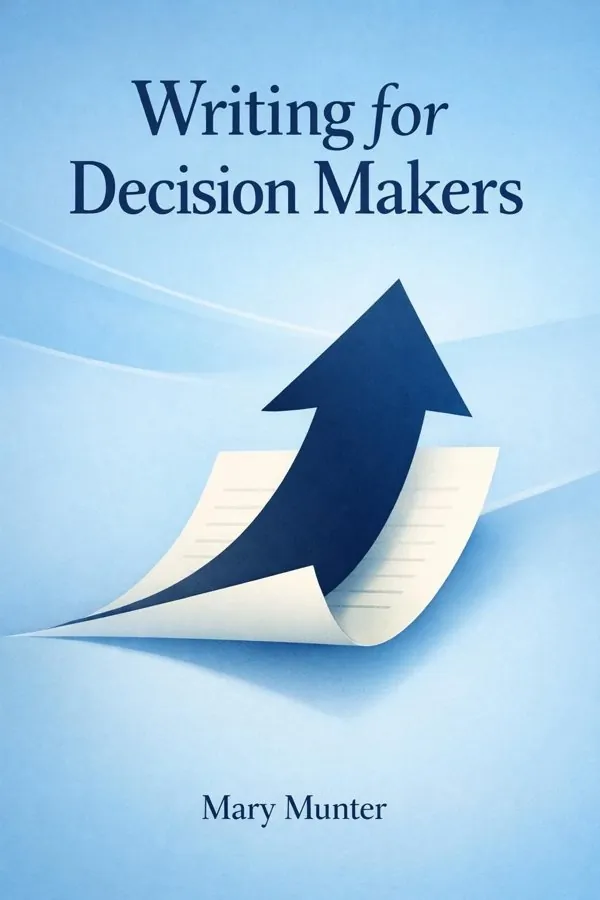
Writing for Decision Makers: Summary & Key Insights
by Mary Munter
 10 min9 chaptersAudio available
Key Takeaways from Writing for Decision Makers
The biggest mistake in business writing is assuming your audience reads the way you wrote.
A document without a clear purpose may still be polished, but it will not be persuasive.
In professional writing, extra words do not signal intelligence; they signal friction.
Many professionals organize documents in the order they completed their analysis.
One of Munter’s most valuable lessons is that business readers should not have to wait for the answer.
What Is Writing for Decision Makers About?
Writing for Decision Makers by Mary Munter is a communication book spanning 8 pages. Writing for business is never just about putting information on paper. It is about helping someone with limited time, competing priorities, and real accountability make a smart choice. In Writing for Decision Makers, Mary Munter shows that effective professional writing succeeds not because it sounds impressive, but because it makes action easier. Her focus is on the people at the top of the reading chain: executives, managers, clients, and stakeholders who scan quickly, ask practical questions, and want conclusions before details. Munter explains how to shape documents around purpose, audience, structure, and persuasion so that writing becomes a strategic management tool rather than a passive record of facts. The book is especially valuable because it bridges classroom communication principles and real business pressures. Munter, a respected professor of managerial communication at Dartmouth’s Tuck School of Business, writes with authority and practicality, offering guidance that applies to reports, proposals, executive summaries, emails, and recommendations. For anyone who wants their writing to be clearer, more persuasive, and more likely to influence decisions, this book offers a disciplined and highly usable framework.
This FizzRead summary covers all 9 key chapters of Writing for Decision Makers in approximately 10 minutes, distilling the most important ideas, arguments, and takeaways from Mary Munter's work. Also available as an audio summary and Key Quotes Podcast.
Writing for Decision Makers
Writing for business is never just about putting information on paper. It is about helping someone with limited time, competing priorities, and real accountability make a smart choice. In Writing for Decision Makers, Mary Munter shows that effective professional writing succeeds not because it sounds impressive, but because it makes action easier. Her focus is on the people at the top of the reading chain: executives, managers, clients, and stakeholders who scan quickly, ask practical questions, and want conclusions before details. Munter explains how to shape documents around purpose, audience, structure, and persuasion so that writing becomes a strategic management tool rather than a passive record of facts. The book is especially valuable because it bridges classroom communication principles and real business pressures. Munter, a respected professor of managerial communication at Dartmouth’s Tuck School of Business, writes with authority and practicality, offering guidance that applies to reports, proposals, executive summaries, emails, and recommendations. For anyone who wants their writing to be clearer, more persuasive, and more likely to influence decisions, this book offers a disciplined and highly usable framework.
Who Should Read Writing for Decision Makers?
This book is perfect for anyone interested in communication and looking to gain actionable insights in a short read. Whether you're a student, professional, or lifelong learner, the key ideas from Writing for Decision Makers by Mary Munter will help you think differently.
- ✓Readers who enjoy communication and want practical takeaways
- ✓Professionals looking to apply new ideas to their work and life
- ✓Anyone who wants the core insights of Writing for Decision Makers in just 10 minutes
Want the full summary?
Get instant access to this book summary and 100K+ more with Fizz Moment.
Get Free SummaryAvailable on App Store • Free to download
Key Chapters
The biggest mistake in business writing is assuming your audience reads the way you wrote. Decision makers rarely move line by line through a document with patient attention. They read selectively, often beginning with headings, summaries, recommendations, charts, and first sentences. Their goal is not to admire your logic step by step; it is to locate what matters, judge its relevance, and decide what to do next. Mary Munter argues that once you accept this reality, your writing becomes more strategic. Instead of building toward the point slowly, you place the point where a busy reader can find it immediately.
This audience-centered mindset changes everything. A vice president reviewing a proposal wants to know the recommendation, cost, risk, timing, and expected result before wading through technical explanation. A board member reading a briefing memo wants implications, not background for its own sake. A client deciding between vendors wants evidence tied to outcomes, not a display of how much you know. Good writing for these readers anticipates questions: What is the issue? What do you want me to approve? Why now? What evidence supports this? What are the trade-offs?
Munter’s insight is that effective documents are designed for use, not merely composed for completeness. That means employing informative headings, concise summaries, visual hierarchy, and a structure that mirrors the reader’s decision process. If your reader must work to find the point, you have shifted the burden in the wrong direction.
Actionable takeaway: Before drafting, list your decision maker’s top five likely questions and organize the document so each answer is easy to find within seconds.
A document without a clear purpose may still be polished, but it will not be persuasive. Munter insists that the strategic foundation of strong business writing is knowing exactly why you are writing and what you want the reader to think, feel, or do after reading. Many weak reports fail not because the writer lacks information, but because the writer never clarified the objective. Are you informing, recommending, requesting approval, warning of a risk, or building support for future action? Each purpose calls for a different structure, tone, and level of detail.
Purpose also protects you from dumping information onto the page. Professionals often confuse activity with communication, producing long documents full of analysis that never lead to a usable conclusion. If your purpose is to gain approval for a budget increase, your writing should center on the decision, the rationale, the financial implications, and the consequences of delay. If your purpose is to update leadership, then your goal may be clarity and alignment rather than persuasion. Munter encourages writers to state the objective in practical terms before drafting: What should happen because this document exists?
This discipline becomes especially important in collaborative environments. Teams may gather data, debate assumptions, and add sections, but unless everyone agrees on the purpose, the final document becomes a patchwork. A clear objective also helps determine what to exclude. Not every fact deserves inclusion; only the facts that serve the purpose belong.
Actionable takeaway: Write a one-sentence purpose statement before drafting, such as, “This memo seeks approval to launch the pilot in Q3 because delay will increase cost and reduce market opportunity,” and use it to test every section.
In professional writing, extra words do not signal intelligence; they signal friction. Munter emphasizes that clarity and conciseness are not cosmetic virtues but core tools of influence. Decision makers often equate clear writing with clear thinking. When a memo is dense, indirect, or cluttered with jargon, readers may assume the analysis behind it is equally confused. Clear language, by contrast, communicates command of the subject and respect for the reader’s time.
Conciseness is not about stripping away meaning. It is about removing what does not advance meaning. Writers often weaken their message with padded openings, unnecessary transitions, inflated phrases, and nominalized verbs. For example, “We are in a position to provide an evaluation of the implementation process” is weaker than “We can evaluate the rollout.” The second sentence is shorter, more direct, and easier to understand. Munter encourages plain English, active verbs, and concrete wording because they move readers toward action more efficiently.
Clarity also depends on sentence and paragraph design. Each paragraph should do one job. Each sentence should make its point without forcing the reader to decode it. Technical or complex material can still be clear if terms are defined, examples are used, and ideas are introduced in logical sequence. In business settings, concise writing helps readers absorb, remember, and act on what matters.
A practical application might be revising a status report. Instead of writing three paragraphs describing minor delays, you might say: “The project is two weeks behind schedule due to vendor delays. To recover time, we recommend narrowing phase one scope and adding one temporary contractor.” That is both concise and decision-ready.
Actionable takeaway: During revision, cut or rewrite every sentence that does not add meaning, direction, or evidence, and aim to make your main point understandable on a first read.
Many professionals organize documents in the order they completed their analysis. Munter argues that this is usually the wrong order for the reader. Decision makers care less about your journey than about the conclusion, the reasoning, and the implications. That is why effective business writing is structured around the reader’s decision needs rather than the writer’s work process. Instead of beginning with background, method, and historical context, strong documents often begin with the recommendation or key message, followed by supporting evidence and only then additional detail.
This principle is often called front-loading the answer. In an executive memo, for example, the first paragraph should typically state the issue, recommendation, and rationale. Supporting sections can then explain costs, risks, timing, alternatives, and implementation considerations. This structure reduces cognitive effort and helps readers assess whether they need to dive deeper. It also improves discussions in meetings, because participants arrive with the central conclusion already understood.
Munter’s emphasis on organization also extends to hierarchy. Clear headings, subheadings, bullets, and numbering make relationships visible. A strong heading such as “Recommendation: Consolidate Regional Vendors by Q4” does more work than a vague heading like “Procurement Considerations.” Similarly, grouping related information prevents readers from piecing together scattered points across multiple sections.
A practical example: if you are writing a proposal to adopt new software, organize the document under headings like recommendation, business case, financial impact, implementation plan, risks, and requested approval. That mirrors how a manager thinks. It is more useful than organizing around vendor research steps or technical specifications alone.
Actionable takeaway: Outline your document using the sequence in which the reader must make sense of the decision: recommendation, reasons, evidence, risks, next steps.
One of Munter’s most valuable lessons is that business readers should not have to wait for the answer. In school, writers are often trained to build suspense, present background, and arrive at a conclusion near the end. In business, that pattern wastes time and weakens influence. Decision makers want the bottom line first. If you believe a team should enter a new market, approve a capital expenditure, or postpone a launch, say so early and clearly. Then explain why.
Leading with the recommendation does not mean oversimplifying. It means respecting the realities of executive attention. A strong opening often contains three parts: the issue, the recommendation, and the primary justification. For example: “To reduce customer churn by 12 percent over the next year, we recommend launching a premium support tier in Q2. Survey data and pilot results suggest this is the most cost-effective retention strategy available.” That opening gives the reader a direction, a goal, and a reason to keep reading.
This approach is especially powerful in summaries, cover notes, and email communication. Even when a full report includes extensive analysis, the executive summary should distill the recommendation and rationale into quick, scannable form. Readers who need detail can go deeper; those who do not still leave informed. Munter’s point is that clarity at the top improves the usefulness of everything that follows.
There is also a political advantage. By stating your recommendation upfront, you frame the conversation. Instead of letting readers define the issue for themselves from fragments of information, you provide a coherent interpretation. That helps your evidence land with greater force.
Actionable takeaway: Rewrite openings so that the first paragraph states what you recommend, why it matters, and what decision or response you want from the reader.
Words carry not only information but relationship. Munter pays close attention to tone because writing to a decision maker is never socially neutral. A message can be accurate and still fail if it sounds defensive, arrogant, vague, passive, or overly informal. The right tone balances confidence with respect. It should acknowledge authority without becoming timid, and it should advocate a position without sounding pushy or manipulative.
Tone depends on context. Writing to a senior executive about strategic options requires a different level of formality than writing to a close colleague about project logistics. Yet even informal business writing benefits from discipline. A decision maker wants professionalism, control, and relevance. Overly emotional language can undermine trust; so can excessive hedging. Compare “I was just kind of thinking maybe this could possibly help” with “This option would reduce onboarding time by 20 percent and merits pilot testing.” The second sentence projects judgment and invites action.
Munter also reminds writers that format contributes to tone. Clean layout, parallel bullet points, informative headings, and readable spacing signal competence. Sloppy formatting or inconsistent style can create doubt before the reader even engages the content. Tone, then, is not only verbal; it is visual and structural.
A useful application appears in difficult communication. Suppose you must report underperformance. An effective tone is candid but solution-oriented: “Sales in the Northeast are 8 percent below target due to distributor turnover. We recommend reallocating support resources and revising incentives this quarter.” This avoids blame while preserving urgency.
Actionable takeaway: Review your draft for tone by asking, “Does this sound credible, respectful, and decisive to someone with authority?” Then adjust wording, format, and level of formality accordingly.
Decision makers are rarely persuaded by enthusiasm alone. Munter shows that persuasive business writing works when claims are supported by evidence and linked to outcomes the reader values. Too many proposals focus on what the writer wants to say instead of what the decision maker needs to justify action. The result is a document rich in features but weak on business case. Effective persuasion translates information into consequences: revenue gained, costs reduced, risks avoided, time saved, customers retained, or strategic position strengthened.
This means evidence must be selective and meaningful. Not every data point deserves equal space. The strongest support usually combines quantitative data, qualitative insight, and practical implications. A recommendation to automate part of a workflow, for instance, becomes more compelling when it includes current labor costs, error rates, implementation timeline, and benchmark results from comparable teams. Persuasion also improves when alternatives are acknowledged. Showing that you considered other options signals maturity and strengthens confidence in your recommendation.
Munter’s approach is particularly useful for proposals and executive summaries. A persuasive summary should not merely condense the report; it should sharpen the case for action. It should tell the reader what is recommended, why it makes sense, what benefits it offers, and what next step is required. By focusing on benefits from the reader’s perspective, you align your message with the criteria by which decisions are made.
For example, if pitching training software to leadership, do not lead with platform features. Lead with impact: reduced onboarding time, more consistent compliance training, and lower manager burden. That speaks the language of decisions.
Actionable takeaway: For every major claim in your document, add the evidence behind it and explicitly state the business benefit or consequence that matters to the reader.
First drafts reflect thought in motion; final drafts should reflect thought refined. Munter treats revision not as cleanup but as a strategic stage where business writing becomes useful to decision makers. Many writers stop revising once grammar and spelling look acceptable, but professional effectiveness depends on much more: structure, emphasis, coherence, brevity, and readability. A document may be technically correct and still fail because the key message is buried, the logic is weak, or the requested action is unclear.
Revision begins with large questions before small ones. Is the purpose obvious? Does the opening present the main point? Is the organization built around the reader’s needs? Are the strongest arguments given prominence? Only after those issues are resolved should the writer focus on sentence-level editing. Munter’s framework encourages writers to separate drafting from revising so they can assess the document more objectively.
Editing also includes ethical responsibility. Accuracy, fair representation of evidence, proper attribution of sources, and honest acknowledgment of uncertainty are essential in managerial communication. Manipulative omission or selective framing may produce short-term approval, but it damages credibility and decision quality. Good business writing helps decision makers act wisely, not merely agree quickly.
A practical revision method is to test a document with a realistic reader. Ask a colleague to read only the headings and opening sentences. If they cannot tell you the recommendation and logic, the document likely needs restructuring. Another test is to identify every action implied by the draft and see whether one clear request stands out.
Actionable takeaway: Revise in layers: first for purpose and structure, then for evidence and emphasis, then for clarity and correctness, making sure the final document supports sound decision making.
One reason Munter’s book remains useful is that its principles travel well across formats. Whether you are writing a formal report, a one-page brief, an executive summary, a recommendation memo, or even a high-stakes email, the same fundamentals apply: know the reader, define the purpose, lead with the point, organize for quick understanding, support claims with evidence, and revise for clarity. The medium changes, but the discipline of decision-focused communication does not.
Consider how this works in different settings. In a long report, the recommendation may appear in the executive summary and opening section, with appendices carrying technical detail. In an email to a senior leader, the first sentence may need to contain the request: “I’m seeking approval to extend the vendor contract by six months while procurement completes the RFP process.” In a presentation handout, headings and bullet structure may carry most of the persuasive burden. The writer’s job is always to reduce the effort required for a reader to understand and act.
This adaptability matters because modern professionals communicate across channels constantly. A proposal may become a slide deck, then a follow-up memo, then an implementation update. If the core writing principles are weak, inconsistency and confusion spread. If the principles are strong, the message remains coherent across forms.
Munter’s broader lesson is that writing is a managerial capability, not a narrow language skill. People who can communicate recommendations clearly often gain influence because they help organizations think better and move faster. Their documents do not merely record decisions; they shape them.
Actionable takeaway: Build a reusable writing checklist for all professional documents, including audience, objective, main message, evidence, structure, tone, and requested action.
All Chapters in Writing for Decision Makers
About the Author
Mary Munter is a leading authority on managerial communication and is widely known for teaching business professionals how to write and present with greater clarity and impact. Associated with the Tuck School of Business at Dartmouth College, she has built a strong reputation for translating communication theory into practical guidance for managers, executives, and students. Her work focuses on business writing, presentation strategy, audience analysis, and persuasive communication in organizational settings. Munter’s books and teaching have influenced generations of professionals who need to communicate upward, across teams, and in high-stakes decision environments. What makes her especially valuable as an author is her ability to connect elegant communication principles with the real demands of business life, where readers are busy, decisions are consequential, and clear writing can directly shape outcomes.
Get This Summary in Your Preferred Format
Read or listen to the Writing for Decision Makers summary by Mary Munter anytime, anywhere. FizzRead offers multiple formats so you can learn on your terms — all free.
Available formats: App · Audio · PDF · EPUB — All included free with FizzRead
Download Writing for Decision Makers PDF and EPUB Summary
Key Quotes from Writing for Decision Makers
“The biggest mistake in business writing is assuming your audience reads the way you wrote.”
“A document without a clear purpose may still be polished, but it will not be persuasive.”
“In professional writing, extra words do not signal intelligence; they signal friction.”
“Many professionals organize documents in the order they completed their analysis.”
“One of Munter’s most valuable lessons is that business readers should not have to wait for the answer.”
Frequently Asked Questions about Writing for Decision Makers
Writing for Decision Makers by Mary Munter is a communication book that explores key ideas across 9 chapters. Writing for business is never just about putting information on paper. It is about helping someone with limited time, competing priorities, and real accountability make a smart choice. In Writing for Decision Makers, Mary Munter shows that effective professional writing succeeds not because it sounds impressive, but because it makes action easier. Her focus is on the people at the top of the reading chain: executives, managers, clients, and stakeholders who scan quickly, ask practical questions, and want conclusions before details. Munter explains how to shape documents around purpose, audience, structure, and persuasion so that writing becomes a strategic management tool rather than a passive record of facts. The book is especially valuable because it bridges classroom communication principles and real business pressures. Munter, a respected professor of managerial communication at Dartmouth’s Tuck School of Business, writes with authority and practicality, offering guidance that applies to reports, proposals, executive summaries, emails, and recommendations. For anyone who wants their writing to be clearer, more persuasive, and more likely to influence decisions, this book offers a disciplined and highly usable framework.
You Might Also Like

Magic Words: The Science and Secrets Behind Seven Words That Motivate, Engage, and Influence
Tim David
10 min
Talking Across The Divide: How to Communicate with People You Disagree with and Maybe Even Change the World
Justin Lee
10 min
The Exceptional Presenter: A Proven Formula to Open Up! and Own the Room
Timothy J. Koegel
10 min
4 Essential Keys to Effective Communication in Love, Life, Work--Anywhere!: Including the 12-Day Communication Challenge!
Bento C. Leal III
10 min
Active Listening Techniques: 30 Practical Tools to Hone Your Communication Skills
Nisha Gupta
10 min
Bargaining for Advantage: Negotiation Strategies for Reasonable People
G. Richard Shell
10 minBrowse by Category
Ready to read Writing for Decision Makers?
Get the full summary and 100K+ more books with Fizz Moment.