
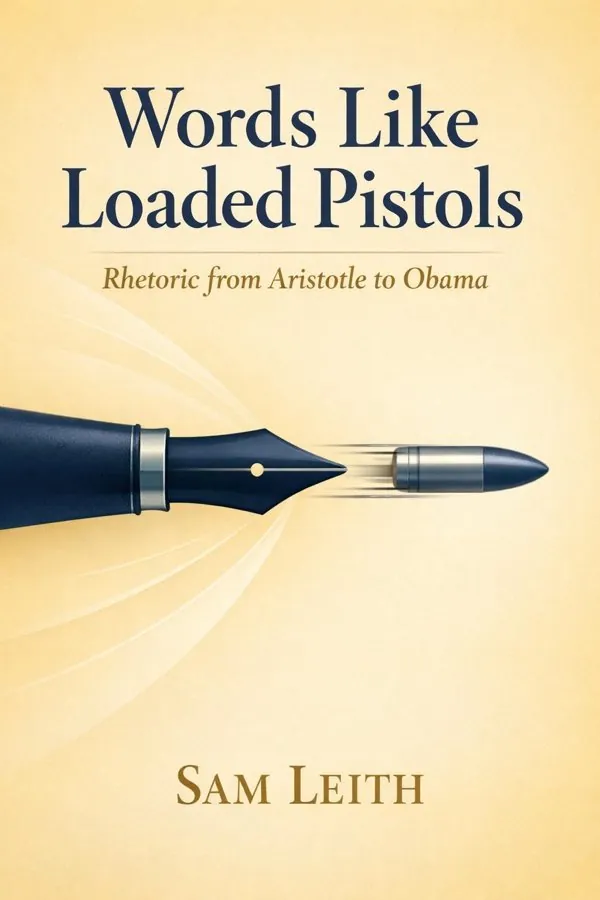
Words Like Loaded Pistols: Rhetoric from Aristotle to Obama: Summary & Key Insights
by Sam Leith
 10 min9 chaptersAudio available
Key Takeaways from Words Like Loaded Pistols: Rhetoric from Aristotle to Obama
In politics, law, ethics, and civic life, we rarely deal in mathematical certainty.
Ideas become powerful when they leave the classroom and enter the forum.
Great traditions survive not by staying pure but by adapting.
Modern people like to imagine that progress moved us from rhetoric to reason, as if the Enlightenment cured humanity of persuasion.
Campaign technology may change, but the mechanics of persuasion remain surprisingly old.
What Is Words Like Loaded Pistols: Rhetoric from Aristotle to Obama About?
Words Like Loaded Pistols: Rhetoric from Aristotle to Obama by Sam Leith is a communication book spanning 9 pages. Persuasion shapes far more of our lives than we usually admit. It influences elections, sells products, frames moral arguments, wins court cases, sparks movements, and colors everyday conversations. In Words Like Loaded Pistols, Sam Leith offers an entertaining and intellectually rich tour through the history of rhetoric, showing how language has been used not only to decorate thought, but to direct it. Moving from ancient Greek theorists like Aristotle to Roman masters such as Cicero, and onward to Churchill, advertising, spin doctors, and Barack Obama, Leith makes rhetoric feel alive, practical, and unavoidable. What makes this book matter is its central claim: rhetoric is not merely empty flourish or manipulation. It is one of the main tools human beings use to reason together, compete for power, and make sense of public life. Leith is especially well placed to guide this journey. As a journalist, editor, and stylist with a sharp ear for language, he combines literary wit with historical range, making complex ideas accessible without flattening them. The result is a lively defense of eloquence and a warning that if we do not understand rhetoric, we are more likely to be ruled by it.
This FizzRead summary covers all 9 key chapters of Words Like Loaded Pistols: Rhetoric from Aristotle to Obama in approximately 10 minutes, distilling the most important ideas, arguments, and takeaways from Sam Leith's work. Also available as an audio summary and Key Quotes Podcast.
Words Like Loaded Pistols: Rhetoric from Aristotle to Obama
Persuasion shapes far more of our lives than we usually admit. It influences elections, sells products, frames moral arguments, wins court cases, sparks movements, and colors everyday conversations. In Words Like Loaded Pistols, Sam Leith offers an entertaining and intellectually rich tour through the history of rhetoric, showing how language has been used not only to decorate thought, but to direct it. Moving from ancient Greek theorists like Aristotle to Roman masters such as Cicero, and onward to Churchill, advertising, spin doctors, and Barack Obama, Leith makes rhetoric feel alive, practical, and unavoidable.
What makes this book matter is its central claim: rhetoric is not merely empty flourish or manipulation. It is one of the main tools human beings use to reason together, compete for power, and make sense of public life. Leith is especially well placed to guide this journey. As a journalist, editor, and stylist with a sharp ear for language, he combines literary wit with historical range, making complex ideas accessible without flattening them. The result is a lively defense of eloquence and a warning that if we do not understand rhetoric, we are more likely to be ruled by it.
Who Should Read Words Like Loaded Pistols: Rhetoric from Aristotle to Obama?
This book is perfect for anyone interested in communication and looking to gain actionable insights in a short read. Whether you're a student, professional, or lifelong learner, the key ideas from Words Like Loaded Pistols: Rhetoric from Aristotle to Obama by Sam Leith will help you think differently.
- ✓Readers who enjoy communication and want practical takeaways
- ✓Professionals looking to apply new ideas to their work and life
- ✓Anyone who wants the core insights of Words Like Loaded Pistols: Rhetoric from Aristotle to Obama in just 10 minutes
Want the full summary?
Get instant access to this book summary and 100K+ more with Fizz Moment.
Get Free SummaryAvailable on App Store • Free to download
Key Chapters
Most people think rhetoric begins where truth ends, but Aristotle argued almost the opposite: rhetoric matters because human beings need practical ways to argue about uncertain things. In politics, law, ethics, and civic life, we rarely deal in mathematical certainty. We deliberate, judge probabilities, appeal to values, and try to move others. Aristotle’s great achievement was to treat rhetoric not as mere verbal trickery but as a disciplined art.
He defined rhetoric as the ability to see the available means of persuasion in any given case. That single idea remains powerful because it shifts attention from ornament to strategy. For Aristotle, persuasion works through three core appeals: ethos, pathos, and logos. Ethos concerns the credibility and character of the speaker. Pathos concerns the emotions of the audience. Logos concerns reasoning, evidence, and structure. Effective persuasion usually blends all three. A doctor explaining treatment options, for example, relies on expertise and trustworthiness, uses clear evidence, and speaks with sensitivity to a patient’s fears.
Aristotle also analyzed types of speech: deliberative rhetoric for the future, judicial rhetoric for the past, and epideictic rhetoric for praise or blame in the present. This framework still helps us understand campaign speeches, courtroom arguments, eulogies, keynote talks, and even social media posts. The point is not to memorize old categories for their own sake, but to recognize that persuasion changes depending on purpose and audience.
Leith shows how Aristotle’s system gave rhetoric intellectual dignity. Once we understand this foundation, persuasive language stops looking like magic. It becomes something we can study, evaluate, and practice. The actionable takeaway: before trying to persuade anyone, ask three questions—why should they trust me, what reason am I giving them, and what emotion is shaping their decision?
Ideas become powerful when they leave the classroom and enter the forum. If the Greeks gave rhetoric its concepts, the Romans showed how those concepts could dominate public life. In Leith’s account, Roman rhetoric is not just an inheritance from Greece; it is an expansion of rhetoric into law, politics, education, and civic identity.
Cicero stands at the center of this story. Lawyer, philosopher, statesman, and unmatched orator, he treated eloquence as a civic duty. For Cicero, the ideal speaker was not a technician of words alone but a broadly educated person capable of judgment. Oratory demanded memory, timing, argument, emotional intelligence, and ethical presence. Quintilian later sharpened this ideal by describing the orator as “a good man speaking well.” Whether or not real politicians met that standard, the aspiration mattered. It linked persuasive skill to public responsibility.
Roman educators formalized rhetoric into a trainable craft. Students learned invention, arrangement, style, memory, and delivery—the five canons of rhetoric. Those canons still map remarkably well onto modern communication. Invention is finding your argument. Arrangement is ordering it. Style is choosing the right language. Memory is mastery of material. Delivery is performance. Think of a startup pitch: first identify the problem and solution, then structure the presentation, shape the tone, know the facts cold, and deliver with confidence.
Leith also emphasizes that Roman rhetoric was theatrical. Gesture, cadence, and persona mattered. A speech was not only a set of propositions but an event. This remains true today, from courtroom advocacy to TED talks. The actionable takeaway: when preparing any important message, do not stop at what you want to say. Rehearse how it will unfold, sound, and feel to the listener.
Great traditions survive not by staying pure but by adapting. One of Leith’s most useful insights is that rhetoric did not end with antiquity. It changed shape as culture, religion, education, and power changed. During the medieval and Renaissance periods, rhetoric moved through monasteries, courts, universities, pulpits, and diplomatic exchanges, proving itself flexible enough to serve very different worlds.
In the medieval era, rhetoric often aligned with preaching, scriptural interpretation, and letter writing. Public persuasion remained important, but the emphasis shifted. Religious authority and moral instruction gave rhetoric new functions. Sermons had to clarify doctrine, stir devotion, and move listeners to repentance or obedience. Formal letter writing also became a rhetorical art, especially in institutions where power depended on patronage, diplomacy, and hierarchy. Persuasion did not disappear; it became embedded in forms of communication that looked less like classical public debate and more like institutional and spiritual guidance.
The Renaissance brought a renewed enthusiasm for classical learning. Humanists returned to Greek and Roman texts not as museum pieces but as living resources. Eloquence became central to education. Style, imitation, and the study of exemplary speeches were seen as tools for shaping both thought and character. Rhetoric was once again linked to civic participation and intellectual refinement. Writers and statesmen used rhetorical training to argue, negotiate, and govern.
This period matters because it reveals a larger truth: rhetoric flourishes wherever people need to interpret authority, organize institutions, and move others through language. Even today, workplace communication, nonprofit fundraising, university administration, and religious leadership all rely on these inherited habits. The actionable takeaway: when you communicate within an institution, remember that form itself persuades—tone, ceremony, convention, and context often carry as much force as your explicit argument.
Modern people like to imagine that progress moved us from rhetoric to reason, as if the Enlightenment cured humanity of persuasion. Leith complicates that comforting story. The rise of science, empiricism, and rational inquiry certainly changed how arguments were valued, but it did not make rhetoric obsolete. Instead, rhetoric was often pushed into the shadows, where it continued to operate while pretending not to.
Enlightenment thinkers sometimes distrusted rhetoric because it seemed connected to ornament, emotional manipulation, and political demagoguery. Clear prose and logical argument became ideals. In one sense, this was a healthy corrective: evidence and precision matter. Yet the dream of communication free from rhetoric turned out to be impossible. Scientific papers still frame evidence persuasively. Philosophers still use metaphor and structure. Politicians still claim to be speaking “plain facts” while carefully crafting public emotion.
Leith’s historical sweep suggests that rhetoric declines most visibly when people become embarrassed by it, not when they stop using it. In fact, some of the most effective rhetorical moments come wrapped in the language of anti-rhetoric: “I’m just telling it like it is,” “These are only the facts,” or “No spin, just common sense.” Such statements are themselves persuasive moves. They build ethos by presenting the speaker as honest, direct, and free from artifice.
This insight is especially useful today, when technical expertise often competes with populist simplicity. The best communicators do not choose between truth and rhetoric. They combine accuracy with form, evidence with audience awareness, and clarity with human resonance. The actionable takeaway: whenever someone claims to be above rhetoric, listen more carefully, not less—ask how their style of “plain speaking” is itself shaping your response.
Campaign technology may change, but the mechanics of persuasion remain surprisingly old. Leith shows that modern political speech, from Churchill to Obama, still relies on principles recognizable to Aristotle and Cicero. What changes is the medium, the tempo, and the audience’s expectations. The core challenge remains the same: how do you make people believe, feel, and act?
Consider Churchill. His wartime speeches did not persuade through policy detail alone. They worked because of rhythm, moral framing, contrast, and the creation of collective identity. He transformed fear into endurance by making struggle sound noble and shared. Obama, by contrast, often used cadence, parallelism, and narrative inclusiveness to produce hope and moral seriousness. His speeches frequently balanced logos and pathos: policy was presented through story, and aspiration was disciplined by structure.
Leith’s point is not that great speeches are only technical performances. It is that technical features help explain why some language lands and some does not. Repetition fixes ideas in memory. Antithesis sharpens choice. Metaphor condenses complexity. Strategic pauses create emphasis. Political rhetoric also depends on kairos, the sense of timing and suitability. A line that works in a victory speech may fail in a crisis briefing.
You can see the same logic in leadership communication beyond politics. A CEO addressing layoffs, a principal responding to community concerns, or an activist speaking after a public tragedy all need more than information. They need form equal to the moment.
The actionable takeaway: study speeches you admire with a craftsman’s eye. Do not just ask what they say; ask how they pace, repeat, contrast, and frame. Then borrow one technique intentionally in your next presentation.
A rhetorical device is often treated like verbal glitter, something added after the real thinking is done. Leith helps overturn that misconception. Figures of speech are not merely decorations; they are tools for organizing attention, creating memory, guiding emotion, and making abstract ideas graspable. Used well, they help thought travel.
Take metaphor. When we say an argument is “on shaky ground” or a campaign “gained momentum,” we are not just speaking colorfully. We are importing a whole structure of meaning. Metaphor can clarify, but it can also distort by smuggling in assumptions. That is why it matters to notice whether a leader frames immigration as a “flood,” inflation as a “war,” or democracy as a “conversation.” The chosen image shapes the available response.
Repetition is another classic device. Martin Luther King Jr.’s “I have a dream” works because recurrence builds expectation and emotional force. Parallelism gives balance and authority. Antithesis creates memorable contrast, as in “ask not what your country can do for you.” Tricolon, alliteration, rhetorical questions, irony, hyperbole, and understatement all have distinct effects. In advertising, these devices make slogans sticky. In teaching, they make explanations memorable. In everyday life, they can help you frame a point so others retain it.
But Leith also implies a warning: devices become manipulative when they detach style from substance. A polished phrase can hide weak logic. The answer is not to avoid technique, but to pair it with scrutiny.
The actionable takeaway: choose one rhetorical device each time you write or speak publicly. Use it deliberately to reinforce your meaning, then test whether the message still holds up when the flourish is stripped away.
We often notice rhetoric most easily in politics, but some of its most relentless forms appear in commerce. Leith extends rhetoric beyond the podium to media and advertising, where persuasion is compressed into slogans, images, sound bites, and emotional associations. In this world, the argument is often implied rather than stated, which can make it even more powerful.
Advertising rarely says, “Here is a syllogism proving you should buy this product.” Instead, it links a product to aspiration, identity, fear, belonging, status, or relief. A fragrance becomes sophistication. A car becomes freedom. A financial service becomes security. These are rhetorical moves because they rely on ethos, pathos, and selective logos. Ethos appears in branding and authority. Pathos appears in mood, music, and desire. Logos appears in comparison charts, testimonials, or pseudo-rational claims about value.
Media rhetoric works similarly. Headlines frame events before we read the article. Television segments use imagery and sequencing to imply significance. Social media captions and thumbnails act as miniature speeches designed to trigger curiosity or outrage. The point is not only that media persuades, but that it often does so under the guise of merely presenting options or information.
This matters practically because consumers and citizens alike are immersed in persuasive environments. If you run a business, understanding rhetorical framing can help you communicate benefits more effectively and ethically. If you are a consumer, it helps you resist being nudged by associations that bypass reflection.
The actionable takeaway: when you encounter an ad, headline, or branded message, ask three questions—what feeling is it attaching to the product, what identity is it inviting me to adopt, and what assumptions is it asking me not to examine?
A troubling truth about rhetoric is that it can illuminate public life or degrade it. Leith does not romanticize persuasion. He shows that contemporary politics is saturated with spin, framing, message discipline, and strategic ambiguity. The danger is not rhetoric itself but rhetoric detached from accountability.
Modern political communication often operates in a media environment that rewards speed, conflict, and memorable phrasing. Sound bites beat nuance. Viral clips outrun careful explanation. In such conditions, rhetorical skill can become a form of defensive warfare: evade the question, reframe the issue, repeat the preferred phrase, attack the premise, and occupy the emotional high ground. None of this is new in principle, but modern media amplifies it dramatically.
Yet Leith’s broader argument remains balanced. Since politics is unavoidably rhetorical, the answer cannot be to wish persuasion away. Democratic life requires argument, symbolic leadership, emotional articulation, and public narrative. Citizens need rhetoric to advocate, organize, dissent, and imagine common purpose. The challenge is to distinguish persuasive speech that clarifies values and trade-offs from persuasive speech that clouds them.
A useful example is the difference between framing and falsifying. Every policy must be framed to become understandable. But framing becomes corrupt when it hides consequences or replaces substance with tribal signaling. Skilled listeners learn to separate emotional energy from evidentiary support.
For anyone navigating contemporary debates, this is one of the book’s most practical lessons. The actionable takeaway: when evaluating political speech, identify the frame, then ask what facts, alternatives, or costs disappear inside it. A good habit is to restate the argument in plain terms and see what remains.
The internet did not kill rhetoric; it democratized and accelerated it. In Leith’s modern frame, digital and popular culture reveal just how widely rhetorical habits now circulate. No longer confined to statesmen, lawyers, and preachers, persuasion belongs to influencers, meme makers, brand managers, activists, commenters, and ordinary users building identities one post at a time.
Online communication rewards compression, immediacy, and shareability. That means rhetorical force often comes through punch, framing, irony, and emotional charge rather than formal argument. A meme can function like epigrammatic rhetoric: brief, memorable, repeatable, and loaded with assumptions. A thread on social media can mimic classical arrangement, opening with an attention-grabbing claim, building evidence, anticipating objections, and ending with a call to action. Even emoji, image choice, and timing contribute to persuasive effect.
Digital rhetoric also blurs private and public speech. We perform for friends, strangers, employers, and algorithms at once. Ethos becomes curated identity. Pathos becomes outrage cycles, confessional intimacy, or belonging signals. Logos often gets compressed into screenshots, charts, and clipped “receipts.” The result is a communicative space where style can spread faster than truth, but where marginalized voices can also mobilize powerfully through strategic language.
Understanding this environment is now essential. Whether you are building a personal brand, advocating for a cause, teaching online, or simply trying not to be manipulated, rhetorical awareness is part of digital literacy.
The actionable takeaway: before posting, sharing, or reacting, pause to identify the rhetorical engine of the message. Is it asking for belief through evidence, identity, emotion, ridicule, or urgency? Naming the mechanism gives you back a measure of control.
All Chapters in Words Like Loaded Pistols: Rhetoric from Aristotle to Obama
About the Author
Sam Leith is a British author, journalist, editor, and cultural critic known for his sharp wit and deep interest in language, literature, and public discourse. He has written for a wide range of major publications, including The Guardian, The Times, the Financial Times, and The Spectator, where he has served as literary editor. His writing often combines intellectual range with an engaging, conversational style, making complex subjects approachable without oversimplifying them. That talent is especially evident in Words Like Loaded Pistols, where he brings together classical history, political speech, media analysis, and literary flair. Leith’s background in journalism and criticism gives him a keen ear for how language operates in public life, making him a particularly credible and entertaining guide to the enduring power of rhetoric.
Get This Summary in Your Preferred Format
Read or listen to the Words Like Loaded Pistols: Rhetoric from Aristotle to Obama summary by Sam Leith anytime, anywhere. FizzRead offers multiple formats so you can learn on your terms — all free.
Available formats: App · Audio · PDF · EPUB — All included free with FizzRead
Download Words Like Loaded Pistols: Rhetoric from Aristotle to Obama PDF and EPUB Summary
Key Quotes from Words Like Loaded Pistols: Rhetoric from Aristotle to Obama
“Most people think rhetoric begins where truth ends, but Aristotle argued almost the opposite: rhetoric matters because human beings need practical ways to argue about uncertain things.”
“Ideas become powerful when they leave the classroom and enter the forum.”
“Great traditions survive not by staying pure but by adapting.”
“Modern people like to imagine that progress moved us from rhetoric to reason, as if the Enlightenment cured humanity of persuasion.”
“Campaign technology may change, but the mechanics of persuasion remain surprisingly old.”
Frequently Asked Questions about Words Like Loaded Pistols: Rhetoric from Aristotle to Obama
Words Like Loaded Pistols: Rhetoric from Aristotle to Obama by Sam Leith is a communication book that explores key ideas across 9 chapters. Persuasion shapes far more of our lives than we usually admit. It influences elections, sells products, frames moral arguments, wins court cases, sparks movements, and colors everyday conversations. In Words Like Loaded Pistols, Sam Leith offers an entertaining and intellectually rich tour through the history of rhetoric, showing how language has been used not only to decorate thought, but to direct it. Moving from ancient Greek theorists like Aristotle to Roman masters such as Cicero, and onward to Churchill, advertising, spin doctors, and Barack Obama, Leith makes rhetoric feel alive, practical, and unavoidable. What makes this book matter is its central claim: rhetoric is not merely empty flourish or manipulation. It is one of the main tools human beings use to reason together, compete for power, and make sense of public life. Leith is especially well placed to guide this journey. As a journalist, editor, and stylist with a sharp ear for language, he combines literary wit with historical range, making complex ideas accessible without flattening them. The result is a lively defense of eloquence and a warning that if we do not understand rhetoric, we are more likely to be ruled by it.
You Might Also Like
Magic Words: The Science and Secrets Behind Seven Words That Motivate, Engage, and Influence
Tim David
10 min
Talking Across The Divide: How to Communicate with People You Disagree with and Maybe Even Change the World
Justin Lee
10 min
The Exceptional Presenter: A Proven Formula to Open Up! and Own the Room
Timothy J. Koegel
10 min
4 Essential Keys to Effective Communication in Love, Life, Work--Anywhere!: Including the 12-Day Communication Challenge!
Bento C. Leal III
10 min
Active Listening Techniques: 30 Practical Tools to Hone Your Communication Skills
Nisha Gupta
10 min
Bargaining for Advantage: Negotiation Strategies for Reasonable People
G. Richard Shell
10 minBrowse by Category
Ready to read Words Like Loaded Pistols: Rhetoric from Aristotle to Obama?
Get the full summary and 100K+ more books with Fizz Moment.