
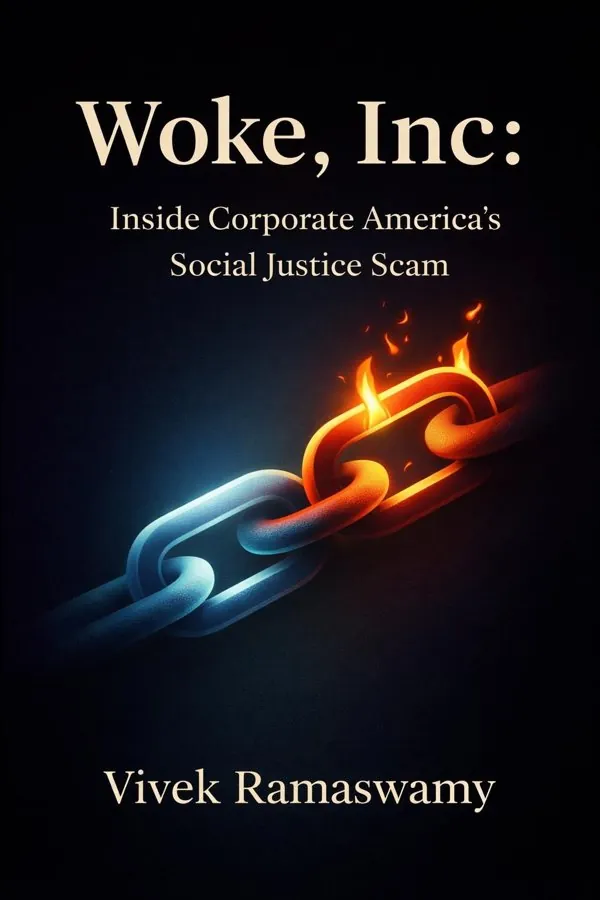
Woke, Inc.: Inside Corporate America's Social Justice Scam: Summary & Key Insights
 10 min5 chaptersAudio available
What Is Woke, Inc.: Inside Corporate America's Social Justice Scam About?
Woke, Inc.: Inside Corporate America's Social Justice Scam by Vivek Ramaswamy is a politics book spanning 5 pages. In this provocative book, entrepreneur Vivek Ramaswamy argues that corporate America has weaponized social justice language to advance its own interests. He explores how companies use progressive rhetoric to deflect scrutiny, consolidate power, and silence dissent, while eroding genuine civic debate. Drawing on his experience as a biotech founder, Ramaswamy exposes the moral and economic consequences of this trend and calls for a return to authentic capitalism and open discourse.
This FizzRead summary covers all 5 key chapters of Woke, Inc.: Inside Corporate America's Social Justice Scam in approximately 10 minutes, distilling the most important ideas, arguments, and takeaways from Vivek Ramaswamy's work. Also available as an audio summary and Key Quotes Podcast.
Woke, Inc.: Inside Corporate America's Social Justice Scam
In this provocative book, entrepreneur Vivek Ramaswamy argues that corporate America has weaponized social justice language to advance its own interests. He explores how companies use progressive rhetoric to deflect scrutiny, consolidate power, and silence dissent, while eroding genuine civic debate. Drawing on his experience as a biotech founder, Ramaswamy exposes the moral and economic consequences of this trend and calls for a return to authentic capitalism and open discourse.
Who Should Read Woke, Inc.: Inside Corporate America's Social Justice Scam?
This book is perfect for anyone interested in politics and looking to gain actionable insights in a short read. Whether you're a student, professional, or lifelong learner, the key ideas from Woke, Inc.: Inside Corporate America's Social Justice Scam by Vivek Ramaswamy will help you think differently.
- ✓Readers who enjoy politics and want practical takeaways
- ✓Professionals looking to apply new ideas to their work and life
- ✓Anyone who wants the core insights of Woke, Inc.: Inside Corporate America's Social Justice Scam in just 10 minutes
Want the full summary?
Get instant access to this book summary and 100K+ more with Fizz Moment.
Get Free SummaryAvailable on App Store • Free to download
Key Chapters
Stakeholder capitalism began as a well-intentioned idea—to broaden a company’s responsibility beyond shareholders to include employees, communities, and the environment. It sounded like progress, a moral evolution of business itself. Yet somewhere along the way, a noble concept mutated into a marketing strategy. I witnessed this transformation within boardrooms: what was supposed to be a philosophy of balance turned into a convenient mask for power.
The shift began when corporations realized that language could achieve what lobbying could not. By embracing the rhetoric of social justice, companies found they could influence regulation, attract consumer loyalty, and discourage criticism—all under the guise of activism. Stakeholder capitalism became the perfect narrative vehicle: flexible enough to sound visionary, vague enough to evade accountability. A company could claim to serve multiple stakeholders without transparently defining how those interests were measured or balanced. The result was moral opacity—a smokescreen of virtue through which enormous economic decisions were quietly made.
As a founder, I learned how seductive this model can be. Investors love a good story, and nothing sells better today than ethics. When I watched corporate peers turn value statements into press releases that doubled as advertising, I saw how quickly moral aspiration turned into transactional self-interest. This is the essence of 'Woke, Inc.': ethical language used as strategic leverage.
This chapter dissects the intellectual origins of stakeholder capitalism, tracing how its principles were co-opted from legitimate reform movements. I explore how figures like Milton Friedman, once criticized for promoting shareholder primacy, offered clarity that is now sorely missing: that capitalism functions best when moral and market incentives remain distinct. When corporations act as quasi-governments, deciding what is socially acceptable while pursuing profit, both democracy and the marketplace suffer. Real moral progress is not advanced through centralized branding but through individual conscience and transparent action.
The rise of stakeholder capitalism is therefore not the story of ethical awakening—it is the story of clever adaptation. Corporations evolved to speak in the moral register of a generation yearning for justice. Once they mastered the tone, they could guide the conversation, absorbing potential critics into their ranks. We must remember that every moral framework, when tied to money, becomes vulnerable to corruption. As long as virtue itself can be monetized, capitalism ceases to be a system of innovation and becomes a system of manipulation.
Corporate activism today is the art of appearing righteous without changing anything fundamental. Consider how quickly companies issue public statements after moments of national crisis—tweeting hashtags, donating token amounts, updating their logos with pride colors or slogans. These acts are presented as moral commitments, but often they are carefully calculated decisions made by marketing and legal teams. They serve to insulate the corporation from criticism while deepening consumer trust.
I call this dynamic 'moral cover.' It’s a strategy that transforms social causes into corporate armor. It allows companies to maintain exploitative global practices while basking in domestic approval. When a business stands behind a trending social movement, it effectively purchases moral immunity—a psychological contract with the public that says, 'We are on your side.' But this loyalty is built on illusions rather than genuine virtue.
In my years as an entrepreneur, I encountered many forms of moral cover: executives who celebrated diversity initiatives while knowingly perpetuating inequitable compensation structures; brands that denounced fossil fuels in advertisements but maintained deep energy dependencies overseas; media conglomerates that preached inclusion but silenced dissenting voices internally. Each case revealed the same underlying principle: moral gestures as public relations tools.
This chapter digs into why consumers often accept these gestures without question. Social media has made outrage and affirmation instantaneous. When a corporation adopts the language of virtue, it satisfies emotional needs that might otherwise fuel activism against it. People want to believe that the brands they support share their values. Corporations understand this human yearning and exploit it, constructing a moral narrative that sells products as symbols of virtue.
Through examples such as Nike’s endorsement of Colin Kaepernick or tech companies’ public advocacy for social causes while maintaining billion-dollar contracts with authoritarian regimes, we can see how moral posturing works. These actions create a moral equilibrium—a sense that as long as visible virtue exists on the surface, ugly truths beneath are forgiven. The irony is that moral cover fosters not progress but complacency. When activism itself becomes another marketing channel, justice loses its grounding. Real activism requires risk, sacrifice, and accountability, none of which are found in corporate press releases.
By the end of this section, I challenge the reader to scrutinize every public moral gesture and ask a simple question: Who benefits? Often, the answer reveals how moral language is used not to serve people but to serve power.
+ 3 more chapters — available in the FizzRead app
All Chapters in Woke, Inc.: Inside Corporate America's Social Justice Scam
About the Author
Vivek Ramaswamy is an American entrepreneur, author, and political figure. He founded the biopharmaceutical company Roivant Sciences and later became known for his commentary on corporate ethics, capitalism, and political culture. Ramaswamy graduated from Harvard University and Yale Law School.
Get This Summary in Your Preferred Format
Read or listen to the Woke, Inc.: Inside Corporate America's Social Justice Scam summary by Vivek Ramaswamy anytime, anywhere. FizzRead offers multiple formats so you can learn on your terms — all free.
Available formats: App · Audio · PDF · EPUB — All included free with FizzRead
Download Woke, Inc.: Inside Corporate America's Social Justice Scam PDF and EPUB Summary
Key Quotes from Woke, Inc.: Inside Corporate America's Social Justice Scam
“Stakeholder capitalism began as a well-intentioned idea—to broaden a company’s responsibility beyond shareholders to include employees, communities, and the environment.”
“Corporate activism today is the art of appearing righteous without changing anything fundamental.”
Frequently Asked Questions about Woke, Inc.: Inside Corporate America's Social Justice Scam
Woke, Inc.: Inside Corporate America's Social Justice Scam by Vivek Ramaswamy is a politics book that explores key ideas across 5 chapters. In this provocative book, entrepreneur Vivek Ramaswamy argues that corporate America has weaponized social justice language to advance its own interests. He explores how companies use progressive rhetoric to deflect scrutiny, consolidate power, and silence dissent, while eroding genuine civic debate. Drawing on his experience as a biotech founder, Ramaswamy exposes the moral and economic consequences of this trend and calls for a return to authentic capitalism and open discourse.
You Might Also Like

Antifa: The Anti-Fascist Handbook
Mark Bray
10 min
Attack from Within: How Disinformation Is Sabotaging America
Barbara McQuade
10 min
Coercion, Capital, and European States, AD 990–1992
Charles Tilly
10 min
Digital Democracy: Concepts, Methodologies, Tools, and Applications
Various Authors
10 min
Fascism
Stanley G. Payne
10 min
Fire And Fury: Inside The Trump White House
Michael Wolff
10 minBrowse by Category
Ready to read Woke, Inc.: Inside Corporate America's Social Justice Scam?
Get the full summary and 100K+ more books with Fizz Moment.