
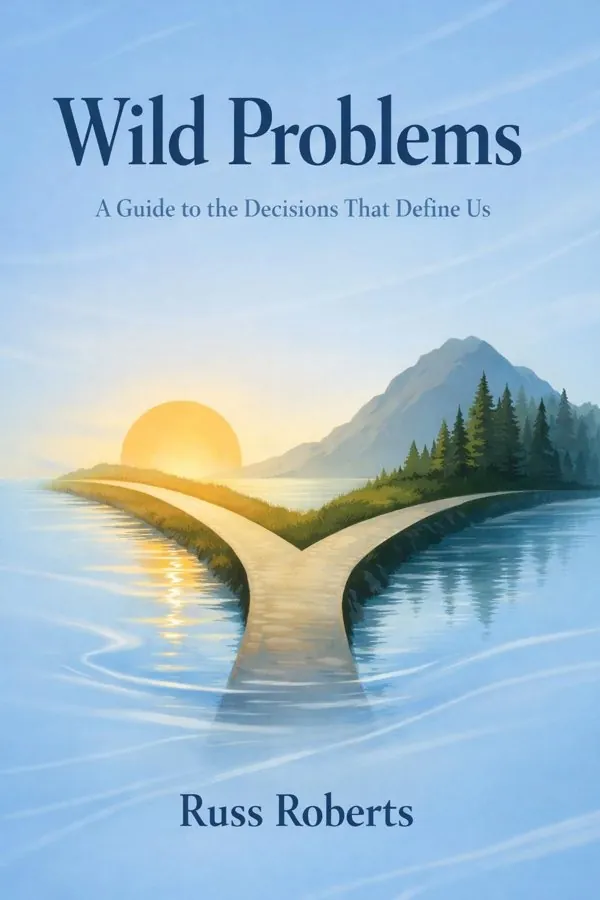
Wild Problems: A Guide to the Decisions That Define Us: Summary & Key Insights
by Russ Roberts
 10 min8 chaptersAudio available
What Is Wild Problems: A Guide to the Decisions That Define Us About?
Wild Problems: A Guide to the Decisions That Define Us by Russ Roberts is a economics book spanning 8 pages. In Wild Problems, economist Russ Roberts explores the kinds of life decisions that cannot be solved by data or rational calculation—choices such as whom to marry, whether to have children, or what career to pursue. Drawing on philosophy, literature, and economics, Roberts argues that these 'wild problems' require wisdom, imagination, and moral reflection rather than optimization. The book invites readers to embrace uncertainty and to see life as an unfolding narrative rather than a solvable equation.
This FizzRead summary covers all 8 key chapters of Wild Problems: A Guide to the Decisions That Define Us in approximately 10 minutes, distilling the most important ideas, arguments, and takeaways from Russ Roberts's work. Also available as an audio summary and Key Quotes Podcast.
Wild Problems: A Guide to the Decisions That Define Us
In Wild Problems, economist Russ Roberts explores the kinds of life decisions that cannot be solved by data or rational calculation—choices such as whom to marry, whether to have children, or what career to pursue. Drawing on philosophy, literature, and economics, Roberts argues that these 'wild problems' require wisdom, imagination, and moral reflection rather than optimization. The book invites readers to embrace uncertainty and to see life as an unfolding narrative rather than a solvable equation.
Who Should Read Wild Problems: A Guide to the Decisions That Define Us?
This book is perfect for anyone interested in economics and looking to gain actionable insights in a short read. Whether you're a student, professional, or lifelong learner, the key ideas from Wild Problems: A Guide to the Decisions That Define Us by Russ Roberts will help you think differently.
- ✓Readers who enjoy economics and want practical takeaways
- ✓Professionals looking to apply new ideas to their work and life
- ✓Anyone who wants the core insights of Wild Problems: A Guide to the Decisions That Define Us in just 10 minutes
Want the full summary?
Get instant access to this book summary and 100K+ more with Fizz Moment.
Get Free SummaryAvailable on App Store • Free to download
Key Chapters
The economist’s mind is a magnificent tool. It teaches us how to think about trade-offs, about opportunity cost, about the seen and unseen. These are powerful frameworks for deciding how to spend money or how to allocate scarce resources. But what happens when the resource at stake is not money, but your future self? What if the decision is not about efficiency but about purpose? Traditional rational choice theory whispers, calculate the expected value, gather information, and optimize. Yet, as I came to realize, information about who you will be in ten years does not exist today.
When I married or contemplated having children, I could not possibly know what it would feel like to grow older with someone or to see my child’s first smile. Data could not tell me how my own heart would transform. Economists call this ‘missing data,’ but that phrase trivializes the enormity of what’s missing. These aren’t numbers yet to be found; they are experiences that have never existed until you live them.
Thus rational choice approaches life like a mapmaker trying to measure a river that keeps changing its course. Even if the measurement is precise today, it’s obsolete tomorrow. Real rationality, I’ve come to believe, requires humility – the recognition that calculation itself has limits. In those limits lies the domain of imagination and moral judgment.
Wild problems are inescapable. They emerge whenever the question ‘What should I do?’ collides with the deeper question ‘Who do I want to be?’ They are wild because the landscape is unmapped and the territory moves with every step you take. Consider marriage. A spreadsheet might evaluate a partner’s compatibility score, but no model can capture the way love reshapes what matters to you. Parenthood offers another example: before you become a parent, you may imagine the costs in time and money; after you become one, you realize the decision has rewritten your identity entirely.
These problems are not annoyances to be resolved but mirrors that reveal what you value most. When we face them, the question is not ‘How do I win?’ but ‘What kind of person am I becoming through this choice?’ That shift in framing changes everything. Wild problems aren’t about optimization; they are about transformation.
+ 6 more chapters — available in the FizzRead app
All Chapters in Wild Problems: A Guide to the Decisions That Define Us
About the Author
Russ Roberts is an American economist, author, and host of the popular podcast EconTalk. He is known for his accessible discussions of economics, philosophy, and human behavior. Roberts has taught at George Mason University and currently serves as president of Shalem College in Jerusalem. His works often explore the intersection of economics and the human experience.
Get This Summary in Your Preferred Format
Read or listen to the Wild Problems: A Guide to the Decisions That Define Us summary by Russ Roberts anytime, anywhere. FizzRead offers multiple formats so you can learn on your terms — all free.
Available formats: App · Audio · PDF · EPUB — All included free with FizzRead
Download Wild Problems: A Guide to the Decisions That Define Us PDF and EPUB Summary
Key Quotes from Wild Problems: A Guide to the Decisions That Define Us
“The economist’s mind is a magnificent tool.”
“They emerge whenever the question ‘What should I do?”
Frequently Asked Questions about Wild Problems: A Guide to the Decisions That Define Us
Wild Problems: A Guide to the Decisions That Define Us by Russ Roberts is a economics book that explores key ideas across 8 chapters. In Wild Problems, economist Russ Roberts explores the kinds of life decisions that cannot be solved by data or rational calculation—choices such as whom to marry, whether to have children, or what career to pursue. Drawing on philosophy, literature, and economics, Roberts argues that these 'wild problems' require wisdom, imagination, and moral reflection rather than optimization. The book invites readers to embrace uncertainty and to see life as an unfolding narrative rather than a solvable equation.
More by Russ Roberts
You Might Also Like
Business Adventures
John Brooks
10 min
Nudge
Richard H. Thaler, Cass R. Sunstein
10 min
The Hitchhiker"s Guide to the Galaxy
Douglas Adams
10 minThe Muqaddimah
Ibn Khaldun
10 minThe Outsiders
William N. Thorndike
10 min
A Little History of Economics
Niall Kishtainy
10 minBrowse by Category
Ready to read Wild Problems: A Guide to the Decisions That Define Us?
Get the full summary and 100K+ more books with Fizz Moment.