
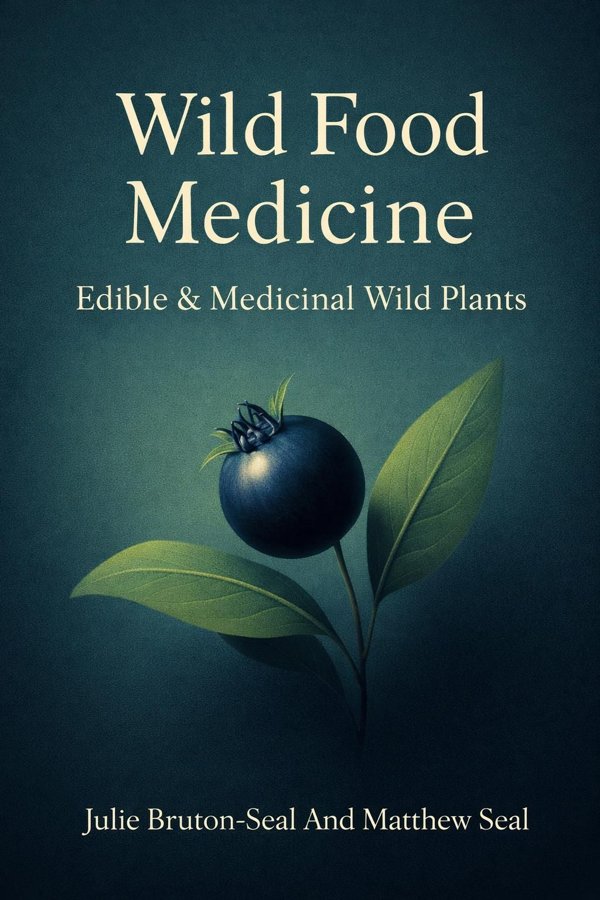
Wild Food Medicine: Edible & Medicinal Wild Plants: Summary & Key Insights
by Julie Bruton-Seal, Matthew Seal
 10 min9 chaptersAudio available
Key Takeaways from Wild Food Medicine: Edible & Medicinal Wild Plants
Every act of foraging is also an act of relationship.
The difference between medicine and poison can begin with a mistaken leaf.
To forage well is to notice time differently.
A plant’s value is not fully unlocked when it is picked; it becomes most useful through thoughtful preparation.
Medicine does not always arrive as a bitter dose; sometimes it appears as lunch.
What Is Wild Food Medicine: Edible & Medicinal Wild Plants About?
Wild Food Medicine: Edible & Medicinal Wild Plants by Julie Bruton-Seal And Matthew Seal is a life_science book spanning 11 pages. Wild Food Medicine: Edible & Medicinal Wild Plants is a practical, inspiring guide to rediscovering the healing and nourishing plants that grow all around us. Julie Bruton-Seal and Matthew Seal show that the fields, hedgerows, woods, and even urban margins many people overlook are filled with species that can be eaten, brewed, infused, or applied as everyday remedies. More than a plant manual, the book is an invitation to rebuild a direct relationship with the natural world through careful observation, seasonal awareness, and hands-on practice. What makes this book especially valuable is its balance of tradition and practicality. It draws on longstanding herbal wisdom while presenting accessible guidance on identifying plants, harvesting them responsibly, and turning them into foods, teas, oils, tinctures, and simple medicines. The authors also emphasize safety, ecological respect, and the importance of learning plants in context rather than as isolated ingredients. Julie Bruton-Seal’s experience as a practicing herbalist and Matthew Seal’s background in health publishing and natural history make them credible, grounded guides. For anyone curious about foraging, herbal medicine, or self-reliant living, this book offers both knowledge and a renewed sense of wonder.
This FizzRead summary covers all 9 key chapters of Wild Food Medicine: Edible & Medicinal Wild Plants in approximately 10 minutes, distilling the most important ideas, arguments, and takeaways from Julie Bruton-Seal And Matthew Seal's work. Also available as an audio summary and Key Quotes Podcast.
Wild Food Medicine: Edible & Medicinal Wild Plants
Wild Food Medicine: Edible & Medicinal Wild Plants is a practical, inspiring guide to rediscovering the healing and nourishing plants that grow all around us. Julie Bruton-Seal and Matthew Seal show that the fields, hedgerows, woods, and even urban margins many people overlook are filled with species that can be eaten, brewed, infused, or applied as everyday remedies. More than a plant manual, the book is an invitation to rebuild a direct relationship with the natural world through careful observation, seasonal awareness, and hands-on practice.
What makes this book especially valuable is its balance of tradition and practicality. It draws on longstanding herbal wisdom while presenting accessible guidance on identifying plants, harvesting them responsibly, and turning them into foods, teas, oils, tinctures, and simple medicines. The authors also emphasize safety, ecological respect, and the importance of learning plants in context rather than as isolated ingredients. Julie Bruton-Seal’s experience as a practicing herbalist and Matthew Seal’s background in health publishing and natural history make them credible, grounded guides. For anyone curious about foraging, herbal medicine, or self-reliant living, this book offers both knowledge and a renewed sense of wonder.
Who Should Read Wild Food Medicine: Edible & Medicinal Wild Plants?
This book is perfect for anyone interested in life_science and looking to gain actionable insights in a short read. Whether you're a student, professional, or lifelong learner, the key ideas from Wild Food Medicine: Edible & Medicinal Wild Plants by Julie Bruton-Seal And Matthew Seal will help you think differently.
- ✓Readers who enjoy life_science and want practical takeaways
- ✓Professionals looking to apply new ideas to their work and life
- ✓Anyone who wants the core insights of Wild Food Medicine: Edible & Medicinal Wild Plants in just 10 minutes
Want the full summary?
Get instant access to this book summary and 100K+ more with Fizz Moment.
Get Free SummaryAvailable on App Store • Free to download
Key Chapters
Every act of foraging is also an act of relationship. That is one of the book’s most important insights: wild plants are not free commodities waiting to be collected, but living parts of complex ecosystems. When people harvest without attention, they damage habitats, reduce food for wildlife, and weaken plant populations. When they gather with respect, they participate in a more reciprocal way of living with the land.
The authors stress that ethical and sustainable wildcrafting starts with observation. Before picking anything, you should ask basic ecological questions: Is the plant abundant here? Is this a clean environment, free from traffic pollution, pesticides, or industrial contamination? Am I taking from a healthy patch large enough to recover? You should also consider which parts are being harvested. Taking a few leaves may leave a plant thriving, while digging roots can kill it outright. In many cases, harvesting aerial parts, seeds, or fruits is less destructive than uprooting entire plants.
The book also frames restraint as a skill. Good foragers do not take every usable specimen they see. They leave enough for the plant to reproduce and enough for insects, birds, and other foragers, human or otherwise. This principle becomes especially important with slow-growing species or plants under local pressure. Ethical gathering may also mean choosing not to harvest at all.
A practical application is the “one in twenty” mindset: take only a small portion from a large stand and move on. Keep notes on where and when you harvest so you can monitor regrowth over seasons. Actionable takeaway: make abundance, habitat health, and minimal impact your three non-negotiable rules before harvesting any wild plant.
The difference between medicine and poison can begin with a mistaken leaf. Wild Food Medicine repeatedly makes clear that plant identification is the foundation of safe foraging and herbal use. Enthusiasm alone is never enough; confidence must be earned through repeated observation, careful study, and a willingness to slow down.
The authors encourage readers to identify plants using multiple features rather than relying on a single trait. Leaf shape, stem structure, flower form, growth habit, smell, habitat, and season all matter. A plant should “fit” as a whole organism in its environment. This is especially important because many edible or medicinal plants have lookalikes, some harmless and some dangerous. Umbellifers, for example, include useful species but also highly toxic ones, which means a casual guess can be risky.
The book also implies a practical method for beginners: learn a small number of common, distinctive plants extremely well before expanding your repertoire. Nettles, dandelions, plantain, and cleavers are often easier starting points than more confusing species. Compare live plants with trusted field guides, photographs from multiple growth stages, and, ideally, instruction from experienced foragers or herbalists.
Safety extends beyond identity. Even correctly identified plants may be unsuitable if gathered from contaminated ground, used in excessive quantities, or taken alongside certain medications. The book’s cautious approach reminds readers that natural does not automatically mean harmless.
A useful practice is to delay consumption until you have identified the same plant confidently several times in different conditions. Keep a field notebook with sketches, habitat notes, and seasonal changes. Actionable takeaway: never eat or medicate with a wild plant unless you can identify it with certainty from several characteristics, not just one.
To forage well is to notice time differently. Instead of seeing the year as a blur of months, the forager begins to recognize waves of emergence, flowering, fruiting, and dormancy. Wild Food Medicine presents seasonal awareness not just as a practical skill, but as a way of becoming more attentive to landscape, weather, and ecological change.
Different plants are at their best in different seasons, and the part you harvest often depends on timing. Tender spring leaves may be ideal for food when they are young and mild, while the same plant later becomes fibrous or bitter. Flowers are often gathered at full opening, fruits when ripe, seeds when dry, and roots in seasons when the plant’s energy has retreated underground, often autumn or early spring. This timing affects not only flavor but also medicinal strength.
Seasonal foraging also spreads harvest pressure. Rather than overcollecting a few famous spring greens, a knowledgeable forager learns to follow the succession of available plants throughout the year. Spring may bring nettles, cleavers, and dandelion leaves; summer offers flowers and aromatic herbs; autumn yields berries, seeds, nuts, and roots. Winter becomes a time for studying bark, evergreen species, and preserved preparations from earlier months.
The practical benefit is twofold. First, food and medicine are fresher, more potent, and more pleasurable when gathered at the right stage. Second, seasonal awareness builds intimacy with place. You begin to remember where plants emerge first, which valleys hold moisture longest, and how a dry year changes growth patterns.
An effective habit is to create your own foraging calendar, listing key species by month, habitat, and usable parts. Revisit the same sites regularly to learn their cycles. Actionable takeaway: match your harvesting to each plant’s season and life stage, because timing is one of the most important ingredients in successful foraging.
A plant’s value is not fully unlocked when it is picked; it becomes most useful through thoughtful preparation. One of the strengths of Wild Food Medicine is its emphasis on simple, home-scale methods that turn wild plants into practical foods and medicines. The book helps readers move from admiration in the field to confident use in the kitchen and home apothecary.
Different preparations suit different plant parts and purposes. Tender leaves may be eaten fresh, wilted into soups, or blended into pestos. Flowers can become teas, syrups, or infused oils. Tough roots and barks may need simmering as decoctions. Alcohol tinctures can preserve certain medicinal properties over time, while vinegars capture minerals and make useful culinary extracts. Salves, creams, and poultices transform herbs into topical remedies for skin and minor injuries.
The authors show that preparation is both practical and interpretive. You are not just following a recipe; you are choosing a method that fits the plant’s chemistry and intended effect. For example, a soothing leaf might be best as a fresh poultice for bites or irritation, while the same plant in tea form may support internal use. Drying herbs correctly, storing them away from heat and light, and labeling preparations with dates are all essential parts of maintaining quality.
For beginners, this can be empowering. You do not need industrial equipment or rare ingredients. A jar, clean oil, vinegar, honey, alcohol, a saucepan, and a few reliable methods can go a long way. The point is not perfection but informed practice.
Start by choosing one familiar plant and preparing it in two ways, such as a tea and an infused oil, then observe differences in use and shelf life. Actionable takeaway: learn a handful of core preparation techniques so that each wild plant you gather can be used safely, effectively, and with minimal waste.
Medicine does not always arrive as a bitter dose; sometimes it appears as lunch. A key contribution of the book is its refusal to separate food and healing too sharply. Many wild plants nourish and support the body at the same time, which means regular culinary use can be one of the simplest ways to benefit from them.
The authors highlight how edible wild plants can enrich ordinary meals with flavors, textures, and nutrients often missing from standardized diets. Young nettles can be cooked like spinach and added to soups, omelets, or pasta fillings. Dandelion leaves can sharpen salads with a pleasant bitterness that stimulates digestion. Wild garlic, where it grows safely and legally, can be made into pesto or folded into butter. Flowers and seeds can add color and complexity as well as subtle medicinal properties.
Using wild foods in the kitchen also encourages moderation and familiarity. A plant does not have to be consumed in large quantities to be valuable. Small, regular additions can diversify the diet and build confidence. Culinary experimentation further deepens plant knowledge. You learn which leaves are best young, which need cooking to soften fibers, which pair well with fats, and which are stronger as condiments than bulk greens.
This food-first approach may be especially appealing to readers who are cautious about herbal remedies. Eating known edible plants in familiar dishes can be a gentle entry point into the wider world of herbal practice. It also restores a lost tradition in which seasonal local plants were everyday resources, not exotic wellness products.
A practical way to begin is to add one wild ingredient per week to a meal you already know how to make, such as soup, salad, tea, or pesto. Actionable takeaway: treat safe wild plants not as occasional novelties but as small, regular ingredients that can make everyday eating both more nutritious and more connected to place.
One of the book’s quiet but powerful messages is that many common health needs can be supported with simple plant preparations. Wild Food Medicine does not promise miracle cures, nor does it suggest replacing professional medical care when needed. Instead, it offers a grounded view of herbal medicine as practical household knowledge for minor complaints, seasonal imbalances, and general wellbeing.
The plants in the book are often used for familiar concerns: soothing irritated skin, easing coughs, supporting digestion, calming inflammation, helping with minor wounds, or providing gentle nutritive support during fatigue and convalescence. The emphasis is on appropriate matching. A demulcent plant may soothe; an aromatic bitter may stimulate appetite; a mineral-rich spring herb may help replenish after winter. This pattern-based understanding is more useful than memorizing isolated claims.
The authors also bridge internal and external uses. A plant may be taken as tea for one purpose and applied as a wash, compress, or salve for another. This versatility makes wild medicine practical for home use. Just as importantly, the book frames remedy-making as observational. You notice how your body responds, which form works best, and when a condition is beyond self-care.
That caution matters. Readers are reminded, directly or indirectly, that dosage, contraindications, pregnancy, chronic illness, allergies, and drug interactions all require care. Herbal medicine is accessible, but it still demands responsibility.
A useful beginner’s practice is to build a small home kit around a few well-understood herbs for common uses: a soothing tea, a skin salve, a digestive bitter, and a wound wash. Label everything clearly and note effects. Actionable takeaway: use wild plant medicine as a thoughtful first line of support for everyday issues, while respecting limits, safety, and the need for professional help when symptoms are serious or persistent.
The plants most people ignore are often the ones most worth learning. Rather than focusing only on rare or glamorous species, Wild Food Medicine gives special importance to common wild plants that thrive in ordinary places. This is one of the book’s most democratic ideas: useful herbal knowledge does not depend on access to remote wilderness. It begins with what grows nearby.
Plants such as nettle, dandelion, plantain, chickweed, cleavers, yarrow, and elder have earned long-standing reputations because they are abundant, versatile, and relatively accessible to beginners. Their value lies not just in medicinal chemistry or nutrient content, but in repeated usefulness. A common plant that can be found, recognized, and used reliably often matters more in daily life than a rare species known only from books.
The authors treat plant profiles as gateways into wider understanding. Learning one species teaches habitat awareness, harvest timing, useful parts, and appropriate preparations. For example, plantain can illustrate the importance of fresh topical use for bites and stings; nettle can teach cooking, drying, tea-making, and mineral nourishment; elder can introduce flowers, berries, cordials, and seasonal medicine. Each plant becomes a case study in how food and remedy overlap.
This focus also supports sustainability. If readers center their practice on resilient, common plants, pressure on vulnerable species decreases. It becomes easier to forage ethically and to return often to the same trusted allies.
A practical exercise is to choose five common local plants and learn them deeply across a full year: when they emerge, which parts are useful, and how they change. Photograph them in different stages and test one safe preparation for each. Actionable takeaway: build your knowledge around abundant, familiar plants first, because mastery of the common is the surest path to confident and responsible foraging.
Herbal medicine survives because people remember, but it remains trustworthy because people keep observing. A notable strength of the book is how it values traditional plant knowledge without treating it as untouchable folklore. Instead, the authors present a living tradition: inherited uses tested by generations, refined by practice, and interpreted in light of modern understanding.
Traditional herbal knowledge offers patterns that still matter. People long before modern laboratories noticed that certain leaves soothed skin, some bitter herbs aided digestion, and some flowers had calming or cooling qualities. Such uses often emerged from long familiarity with local plants. The book honors this accumulated wisdom, including regional and household practices, while also encouraging readers to engage critically and practically.
Modern readers benefit from this balanced attitude. Scientific research can help explain why some plants act as they do, identifying compounds, nutrients, or pharmacological effects. But science does not replace direct experience. Plants are variable; place, season, preparation, and constitution all influence outcomes. The book therefore invites an integrated approach in which tradition offers guidance, science adds context, and personal observation keeps practice honest.
This integration is also cultural. Recovering wild food and medicine reconnects people with ancestral habits of self-reliance, local ecology, and seasonal living. In a world dominated by packaged products, that recovery can be deeply meaningful.
A practical way to apply this idea is to compare one plant’s traditional uses with current herbal references, then prepare and use it in a simple, safe form while tracking your observations. Notice taste, effect, and timing rather than expecting dramatic results. Actionable takeaway: treat herbal knowledge as both inherited and experiential, using tradition as a guide while grounding your confidence in careful, real-world observation.
Books can introduce wild plants, but confidence grows outdoors. Wild Food Medicine ultimately points readers toward field-based learning: walking, noticing, touching, smelling, harvesting carefully, and returning to the same places over time. Plant knowledge becomes durable when it is embodied rather than merely memorized.
Practical fieldwork teaches details that pages alone cannot fully convey. You learn how a plant stands in relation to its neighbors, what kind of soil it favors, how its scent changes when crushed, and how its leaves look in shade versus sun. You also begin to notice patterns of abundance and scarcity, human disturbance, moisture, and wildlife use. This ecological context is essential for safe identification and ethical harvesting.
The book also suggests that foraging has a social dimension. Knowledge has often been shared through families, local traditions, walks, classes, and community gatherings. Learning with others helps correct mistakes, broadens species knowledge, and reconnects people to shared landscapes. It can also deepen cultural appreciation, because plants often carry stories, customs, and recipes as much as botanical facts.
In a broader sense, fieldwork changes attention itself. It slows the pace of perception and replaces passive consumption with active relationship. Even readers who never make a tincture may find that the practice of noticing wild plants transforms how they experience familiar places.
A practical starting point is to adopt one local route, such as a park edge, hedgerow, or woodland path, and walk it weekly through the year. Bring a notebook, take photographs, and, when appropriate, go with a more experienced forager or herbalist group. Actionable takeaway: pair reading with repeated outdoor observation and shared learning, because real skill in wild food medicine grows from lived experience in actual landscapes.
All Chapters in Wild Food Medicine: Edible & Medicinal Wild Plants
About the Authors
Julie Bruton-Seal is a practicing herbalist, artist, and author whose work focuses on traditional plant medicine, natural self-care, and the everyday use of healing herbs. She is known for making herbal knowledge approachable while preserving its depth, practicality, and connection to seasonal living. Matthew Seal is a writer and editor with a background in publishing, health communication, and natural history. Together, they have collaborated on several well-regarded books about herbal remedies and wild plants, combining Julie’s clinical and botanical experience with Matthew’s clear and engaging presentation. Their writing emphasizes accessible home practice, ecological awareness, and the recovery of local, traditional knowledge. As co-authors, they are especially valued for bridging the worlds of foraging, food, and herbal medicine in a way that is both inspiring and responsibly grounded.
Get This Summary in Your Preferred Format
Read or listen to the Wild Food Medicine: Edible & Medicinal Wild Plants summary by Julie Bruton-Seal And Matthew Seal anytime, anywhere. FizzRead offers multiple formats so you can learn on your terms — all free.
Available formats: App · Audio · PDF · EPUB — All included free with FizzRead
Download Wild Food Medicine: Edible & Medicinal Wild Plants PDF and EPUB Summary
Key Quotes from Wild Food Medicine: Edible & Medicinal Wild Plants
“Every act of foraging is also an act of relationship.”
“The difference between medicine and poison can begin with a mistaken leaf.”
“To forage well is to notice time differently.”
“A plant’s value is not fully unlocked when it is picked; it becomes most useful through thoughtful preparation.”
“Medicine does not always arrive as a bitter dose; sometimes it appears as lunch.”
Frequently Asked Questions about Wild Food Medicine: Edible & Medicinal Wild Plants
Wild Food Medicine: Edible & Medicinal Wild Plants by Julie Bruton-Seal And Matthew Seal is a life_science book that explores key ideas across 9 chapters. Wild Food Medicine: Edible & Medicinal Wild Plants is a practical, inspiring guide to rediscovering the healing and nourishing plants that grow all around us. Julie Bruton-Seal and Matthew Seal show that the fields, hedgerows, woods, and even urban margins many people overlook are filled with species that can be eaten, brewed, infused, or applied as everyday remedies. More than a plant manual, the book is an invitation to rebuild a direct relationship with the natural world through careful observation, seasonal awareness, and hands-on practice. What makes this book especially valuable is its balance of tradition and practicality. It draws on longstanding herbal wisdom while presenting accessible guidance on identifying plants, harvesting them responsibly, and turning them into foods, teas, oils, tinctures, and simple medicines. The authors also emphasize safety, ecological respect, and the importance of learning plants in context rather than as isolated ingredients. Julie Bruton-Seal’s experience as a practicing herbalist and Matthew Seal’s background in health publishing and natural history make them credible, grounded guides. For anyone curious about foraging, herbal medicine, or self-reliant living, this book offers both knowledge and a renewed sense of wonder.
You Might Also Like

The Selfish Gene
Richard Dawkins
10 min
Awakenings
Oliver Sacks
10 min
Parasite Rex: Inside the Bizarre World of Nature's Most Dangerous Creatures
Carl Zimmer
10 min
The Atlas of Life on Earth
Various
10 min
The Book of Humans: The Story of How We Became Us
Adam Rutherford
10 min
The Horse
Wendy Williams
10 minBrowse by Category
Ready to read Wild Food Medicine: Edible & Medicinal Wild Plants?
Get the full summary and 100K+ more books with Fizz Moment.