
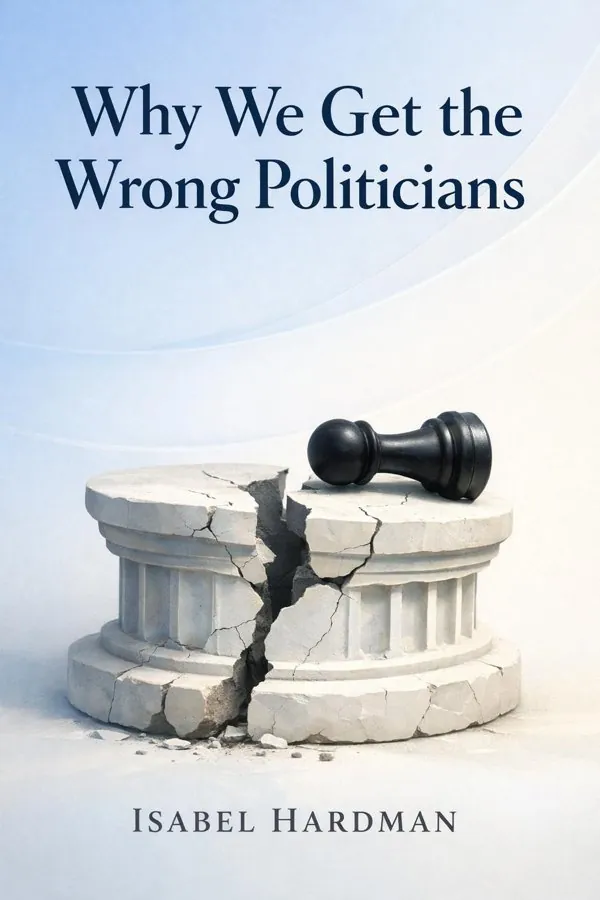
Why We Get the Wrong Politicians: Summary & Key Insights
 10 min10 chaptersAudio available
Key Takeaways from Why We Get the Wrong Politicians
A democracy can sincerely want wise representatives and still build a pipeline that selects for very different qualities.
Few jobs in modern society carry such immense responsibility and such little formal preparation as becoming a Member of Parliament.
The skills needed to win office are not always the skills needed to govern well.
Arriving in Parliament is often described as exhilarating, but Hardman makes clear that it can also be disorienting and infantilizing.
Political failure is not only about who gets elected; it is also about the environment they enter.
What Is Why We Get the Wrong Politicians About?
Why We Get the Wrong Politicians by Isabel Hardman is a politics book spanning 12 pages. Why do democratic systems so often elevate people who seem ill-suited to govern? In Why We Get the Wrong Politicians, Isabel Hardman tackles that uncomfortable question by looking beyond easy cynicism. Rather than claiming that politics is simply full of bad people, she argues that Britain’s political system often filters out the thoughtful, capable, public-spirited candidates citizens say they want, while rewarding stamina, tribal loyalty, media performance, and an unusual tolerance for personal upheaval. The result is not just disappointing politicians, but a political culture that makes good judgment harder to practice. Hardman writes with the authority of a seasoned political journalist who has spent years observing Westminster up close and speaking candidly with MPs, advisers, officials, and party insiders. Her great strength is that she combines institutional analysis with human insight. She shows how candidate selection, campaign pressures, parliamentary routines, constituency demands, and relentless public scrutiny shape political behavior long before major decisions are made. This book matters because it moves the conversation from blaming individual politicians to examining the machinery that produces them. If we want better politics, Hardman suggests, we need to rethink the system that trains, selects, exhausts, and often distorts those who enter it.
This FizzRead summary covers all 10 key chapters of Why We Get the Wrong Politicians in approximately 10 minutes, distilling the most important ideas, arguments, and takeaways from Isabel Hardman's work. Also available as an audio summary and Key Quotes Podcast.
Why We Get the Wrong Politicians
Why do democratic systems so often elevate people who seem ill-suited to govern? In Why We Get the Wrong Politicians, Isabel Hardman tackles that uncomfortable question by looking beyond easy cynicism. Rather than claiming that politics is simply full of bad people, she argues that Britain’s political system often filters out the thoughtful, capable, public-spirited candidates citizens say they want, while rewarding stamina, tribal loyalty, media performance, and an unusual tolerance for personal upheaval. The result is not just disappointing politicians, but a political culture that makes good judgment harder to practice.
Hardman writes with the authority of a seasoned political journalist who has spent years observing Westminster up close and speaking candidly with MPs, advisers, officials, and party insiders. Her great strength is that she combines institutional analysis with human insight. She shows how candidate selection, campaign pressures, parliamentary routines, constituency demands, and relentless public scrutiny shape political behavior long before major decisions are made. This book matters because it moves the conversation from blaming individual politicians to examining the machinery that produces them. If we want better politics, Hardman suggests, we need to rethink the system that trains, selects, exhausts, and often distorts those who enter it.
Who Should Read Why We Get the Wrong Politicians?
This book is perfect for anyone interested in politics and looking to gain actionable insights in a short read. Whether you're a student, professional, or lifelong learner, the key ideas from Why We Get the Wrong Politicians by Isabel Hardman will help you think differently.
- ✓Readers who enjoy politics and want practical takeaways
- ✓Professionals looking to apply new ideas to their work and life
- ✓Anyone who wants the core insights of Why We Get the Wrong Politicians in just 10 minutes
Want the full summary?
Get instant access to this book summary and 100K+ more with Fizz Moment.
Get Free SummaryAvailable on App Store • Free to download
Key Chapters
A democracy can sincerely want wise representatives and still build a pipeline that selects for very different qualities. One of Hardman’s central insights is that the route into Parliament already narrows the field in damaging ways. Becoming an MP is not primarily a matter of expertise, integrity, or practical problem-solving. It often depends on navigating party hierarchies, cultivating local associations, proving ideological loyalty, raising personal visibility, and enduring years of uncertainty. That process favors people with unusual resilience for internal competition, a high appetite for risk, and often the financial or social flexibility to spend years chasing a precarious role.
This matters because the people most qualified to improve public life may be the least willing to enter such a system. A successful doctor, engineer, teacher, business leader, or charity director may care deeply about the country but balk at abandoning a stable career for years of partisan maneuvering and insecure selection battles. Meanwhile, those who do persist learn early that advancement depends on message discipline, factional awareness, and endurance under pressure. In other words, the system trains candidates to survive politics before they ever get the chance to improve it.
A practical example is candidate selection in safe seats. The contest can be less about local competence than about party reputation, internal endorsements, and perceived ideological reliability. Even before election day, the logic of representation is displaced by the logic of political career progression.
Actionable takeaway: if voters and parties want better representatives, they should support selection processes that value real-world experience, local credibility, and evidence of judgment rather than mere party apprenticeship.
Few jobs in modern society carry such immense responsibility and such little formal preparation as becoming a Member of Parliament. Hardman highlights a striking paradox: MPs help shape laws, scrutinize ministers, handle casework, manage staff, navigate constitutional conventions, and represent thousands of constituents, yet there is no robust professional pathway that prepares them for the totality of the role. New MPs often arrive in Westminster after a bruising campaign and are expected to learn through improvisation.
This lack of preparation has serious consequences. Imagine being handed responsibility for a small office, a stream of vulnerable constituents, complex legislative material, media obligations, and party expectations all at once. Even competent people can appear ineffective when dropped into an institution with arcane rules and little structured induction. As Hardman shows, inexperience does not simply lead to personal discomfort; it affects public outcomes. Poorly supported MPs can struggle to scrutinize government effectively, prioritize urgent issues, or build sustainable working routines.
The problem is worsened by Westminster’s culture, which often prizes instinct and toughness over training. Asking for help may feel like weakness, while institutional knowledge remains scattered among party whips, veteran MPs, clerks, and staff. Compare that with professions like medicine, law, or the military, where training is treated as essential rather than optional.
In practical terms, this means better induction, mentoring, management training, and legislative education could significantly improve parliamentary performance. MPs do not need to become technocrats, but they do need support equal to the gravity of their role.
Actionable takeaway: treat political office as a profession requiring serious onboarding, continuous development, and managerial support, not as a test of who can cope with chaos.
The skills needed to win office are not always the skills needed to govern well. Hardman shows how election campaigns intensify this mismatch. Campaigning rewards message discipline, stamina, performative confidence, tribal loyalty, and a willingness to reduce complex issues into emotionally resonant slogans. Governing, by contrast, requires patience, evidence-based judgment, compromise, administrative competence, and the humility to revise one’s views. The trouble is that politicians are selected and celebrated for the first set of qualities, then criticized for lacking the second.
Campaigns also shape political habits. Candidates spend months repeating lines, suppressing nuance, and treating every interaction as potentially risky. That survival mentality can continue once they enter Parliament. A politician trained to avoid mistakes may become overly cautious in office. Someone rewarded for combative rhetoric may struggle with collaborative policy work. Hardman’s point is not that campaigning is inherently bad; it is that a permanent campaign culture changes how politics is practiced.
A practical example is media handling during an election. A candidate who offers a nuanced answer to a difficult policy question may be judged weak or indecisive, while a rival who delivers a sharp, oversimplified line appears strong. Over time, those incentives shape what parties look for in candidates and what candidates believe they must become.
This is one reason public disappointment runs so deep. Voters often want authenticity and seriousness, but campaign systems reward polish and defensiveness. The result is a political class trained to win attention before it is trained to govern responsibly.
Actionable takeaway: voters, journalists, and parties should reward candidates who can explain complexity honestly instead of punishing every sign of nuance as weakness.
Arriving in Parliament is often described as exhilarating, but Hardman makes clear that it can also be disorienting and infantilizing. New MPs enter a centuries-old institution full of rituals, procedural traps, unwritten rules, and status hierarchies. They must quickly assemble offices, hire staff, manage constituent problems, understand legislation, and integrate into party structures. In that vulnerable period, many become heavily dependent on party machines, whips, and experienced insiders who can explain how things work.
That dependency has political consequences. If your ability to function depends on the guidance of party structures, your independence may be quietly compromised from the start. MPs are elected as representatives, but many begin their careers feeling like initiates in an opaque system. Hardman suggests that this can weaken scrutiny and reinforce conformity. The institution does not merely process political talent; it socializes it.
This matters especially in moments when new MPs arrive in large waves after election landslides. Such intake groups may contain energetic, idealistic people with fresh perspectives, but their inexperience makes them easier to manage. Instead of renewing Parliament, they can be absorbed into its habits. The challenge is not their lack of ability; it is the absence of structures that help them remain effective while preserving independent judgment.
A more supportive system might include cross-party mentoring, stronger procedural education, and early training in how to challenge one’s own leadership constructively. That would reduce the sense that survival depends on obedience.
Actionable takeaway: institutions should help newcomers become capable representatives quickly without forcing them into excessive dependence on party gatekeepers.
Political failure is not only about who gets elected; it is also about the environment they enter. Hardman portrays Westminster as a workplace whose rhythms and norms often work against thoughtful decision-making. The long hours, tribal atmosphere, performative adversarialism, and constant interruption make it hard for MPs to do the deep, disciplined thinking that effective governance requires. Parliament can reward visibility over substance and theatrical confrontation over careful scrutiny.
One reason this matters is that institutions shape conduct. Even good people adapt to the norms around them. If the culture prizes being seen in the chamber, appearing on broadcast media, or displaying loyalty in party battles, then slow, serious committee work or quiet policy mastery may be undervalued. MPs are pulled in multiple directions, and the most publicly visible activities often crowd out the most democratically valuable ones.
Hardman also points to the mismatch between the idealized image of parliamentary debate and the reality of modern legislative work. The romantic picture of eloquent persuasion in the chamber obscures the fact that much policymaking depends on detailed scrutiny, administrative competence, and sustained attention. Yet the institution still carries traditions and incentives better suited to display than to problem-solving.
In everyday terms, this can mean MPs running from meeting to meeting, voting late into the evening, responding to media crises, and dealing with constituency emergencies while trying to read dense bill papers. Unsurprisingly, quality suffers.
Actionable takeaway: improving politics requires redesigning parliamentary working culture so that scrutiny, preparation, and substantive contribution are rewarded as much as public performance.
An MP is expected to be both national legislator and local problem-solver, and Hardman shows how difficult it is to do both well. Constituents increasingly turn to MPs not only for policy representation but for help with housing disputes, immigration delays, benefit problems, healthcare access, and a wide range of bureaucratic failures. This casework can be deeply meaningful, and it often reveals where the state is failing ordinary people. But it also consumes vast amounts of time and emotional energy.
The result is a structural overload. MPs are elected to make laws and scrutinize government, yet many spend large portions of their week acting as last-resort ombudsmen. That is not because they are doing the job badly; it is because the public experiences the state through breakdowns, and MPs become the human access point. Hardman’s insight is that this local service burden can distort what representation becomes. Legislators are judged on their responsiveness to individual crises even as the national policy work that could prevent those crises receives less attention.
For example, an MP may spend hours chasing a delayed welfare payment for one family while having little uninterrupted time to examine broader social security reform. Both forms of work matter, but the system rarely balances them well. Constituency expectations grow, while institutional support often lags behind.
A healthier model might involve stronger local administrative routes for citizens, better-resourced casework teams, and clearer public understanding of what MPs can realistically do.
Actionable takeaway: citizens and institutions should recognize that better local public services are not separate from better politics; they free representatives to focus on the national decisions only they can make.
One of Hardman’s most humane contributions is her refusal to treat politicians as abstractions. Behind the office are people exposed to unusual levels of instability, scrutiny, and emotional strain. The political timetable is punishing, the career path insecure, the public hostility intense, and the separation from family life often severe. Hardman argues that these pressures do not merely hurt individuals; they shape the kind of politics the system produces.
This is crucial because chronic stress changes behavior. Exhausted people make worse decisions, become more reactive, and struggle to sustain perspective. A politician under relentless pressure may default to party lines, avoid difficult conversations, or focus on short-term media survival. Those responses can look like moral failure from the outside, but they are also institutional effects. If the job is structured in a way that destabilizes mental health and family life, then the system will repel many capable people and warp the performance of those who remain.
Hardman is especially perceptive about the stigma around vulnerability in politics. Admitting strain can be portrayed as weakness in a profession obsessed with toughness. Yet the refusal to acknowledge burnout, depression, or loneliness simply entrenches dysfunction. A healthier political culture would understand that resilience is not the absence of need, but the presence of support.
In practical terms, this means better mental health provision, more predictable scheduling, stronger office management support, and a less macho understanding of political competence. Sustainable public service should not require self-destruction.
Actionable takeaway: if we want better judgment from politicians, we must support working conditions that protect mental health, family life, and the basic stability needed for sound decision-making.
Citizens often assume the media merely report political failure, but Hardman shows that public perception and media incentives also help produce it. Politicians operate in an environment where mistakes are amplified, nuance is flattened, and performance is constantly judged in real time. This encourages caution, spin, tribal signaling, and a defensive style of communication. When every statement can become a viral clip or hostile headline, politicians learn to avoid honesty that might be misread as weakness.
This dynamic fuels a vicious circle. The public grows cynical because politicians sound scripted and evasive. Politicians sound scripted and evasive because they expect cynicism and punishment. The media, meanwhile, often privilege conflict, personality, and tactical drama over institutional explanation. The result is a political conversation that makes superficiality rational. Hardman does not deny that many politicians deserve criticism; rather, she argues that the surrounding ecosystem rewards the very habits people dislike.
A practical example is the treatment of policy reversals. In healthy decision-making, changing your view after new evidence can be a sign of seriousness. In political media culture, it is often framed as weakness, betrayal, or incompetence. So politicians double down instead. That is bad for government and bad for public trust.
Breaking this pattern requires responsibility from more than one side. Politicians must communicate more honestly, but citizens and journalists must also stop demanding impossible certainty and punishing every imperfect expression.
Actionable takeaway: consume political news with an eye for incentives, and reward leaders who explain trade-offs candidly rather than those who merely perform confidence.
A political system cannot consistently recruit the best people if large parts of society face extra obstacles to entry. Hardman explores how gender, class, caring responsibilities, financial insecurity, and social background affect who can realistically pursue political office. Formal openness is not the same as real accessibility. The costs of campaigning, the uncertainty of selection, the demands of travel, the culture of confrontation, and the strains on family life all weigh unevenly on different groups.
This matters not only for fairness but for competence. When politics draws disproportionately from narrow professional and social pathways, it loses experience, perspective, and legitimacy. A Parliament dominated by those who can tolerate instability and navigate elite networks will be less representative of the people it serves. It may also be less capable of understanding how policy lands in ordinary lives. Hardman’s argument is not that identity automatically guarantees insight, but that barriers to participation deprive public life of talent it badly needs.
For instance, a parent with substantial caring duties may find evening votes and unpredictable schedules nearly impossible to manage. A highly capable candidate from a modest background may be unable to absorb the financial risk of years spent seeking selection. A woman considering public office may reasonably factor in abuse, scrutiny, and cultural hostility that male peers face differently. These are not private issues; they shape the political supply chain.
Actionable takeaway: meaningful political reform should include practical measures such as predictable hours, financial support pathways, safer working conditions, and recruitment systems designed to widen, not narrow, the pool of talent.
The most important lesson of Hardman’s book is that better politics cannot be achieved by simply hoping for better people. Individual character matters, but the system of incentives matters too. If selection rewards loyalty over judgment, if campaigning rewards simplification over honesty, if parliamentary culture rewards performance over scrutiny, and if political life drives away many capable people, then replacing one politician with another will not solve the deeper problem. Reform must address the machinery.
Hardman’s proposals point toward a politics that is more professional, humane, and open. That includes improved candidate recruitment, better induction for MPs, clearer role expectations, stronger support for mental health, more family-friendly working practices, and institutional changes that reduce dependence on party gatekeepers. It also means taking Parliament seriously as a workplace and a governing institution, not as a theatre sustained by outdated assumptions.
The practical application of this insight extends beyond Westminster. Any organization that wants better leadership must examine how it selects, trains, rewards, and supports people. Politics is simply a highly visible version of a universal truth: systems produce behavior. When outcomes disappoint us repeatedly, we should stop blaming only the people and ask what the structure is selecting for.
For readers, this reframes political frustration. Cynicism alone is sterile. Institutional curiosity is more useful. Asking how politicians are made, shaped, and constrained opens the door to reform that is realistic rather than merely emotional.
Actionable takeaway: judge political systems not only by the leaders they praise, but by the behaviors they incentivize and the kinds of people they quietly push away.
All Chapters in Why We Get the Wrong Politicians
About the Author
Isabel Hardman is a British political journalist, broadcaster, and author best known for her penetrating coverage of Westminster and UK public life. She has served as assistant editor of The Spectator and has written extensively on politics, policy, leadership, and government culture for major British publications. Hardman is also a familiar voice and face in broadcast media, appearing on BBC Radio 4, television news programs, and political discussion shows. Her reporting stands out for combining insider knowledge with clarity, wit, and empathy. Beyond day-to-day politics, she has written and spoken candidly about mental health, giving her work a distinctive sensitivity to the human pressures behind public roles. In Why We Get the Wrong Politicians, she brings together deep reporting, institutional understanding, and humane observation to explain why democratic systems so often fail to attract and support the representatives citizens actually want.
Get This Summary in Your Preferred Format
Read or listen to the Why We Get the Wrong Politicians summary by Isabel Hardman anytime, anywhere. FizzRead offers multiple formats so you can learn on your terms — all free.
Available formats: App · Audio · PDF · EPUB — All included free with FizzRead
Download Why We Get the Wrong Politicians PDF and EPUB Summary
Key Quotes from Why We Get the Wrong Politicians
“A democracy can sincerely want wise representatives and still build a pipeline that selects for very different qualities.”
“Few jobs in modern society carry such immense responsibility and such little formal preparation as becoming a Member of Parliament.”
“The skills needed to win office are not always the skills needed to govern well.”
“Arriving in Parliament is often described as exhilarating, but Hardman makes clear that it can also be disorienting and infantilizing.”
“Political failure is not only about who gets elected; it is also about the environment they enter.”
Frequently Asked Questions about Why We Get the Wrong Politicians
Why We Get the Wrong Politicians by Isabel Hardman is a politics book that explores key ideas across 10 chapters. Why do democratic systems so often elevate people who seem ill-suited to govern? In Why We Get the Wrong Politicians, Isabel Hardman tackles that uncomfortable question by looking beyond easy cynicism. Rather than claiming that politics is simply full of bad people, she argues that Britain’s political system often filters out the thoughtful, capable, public-spirited candidates citizens say they want, while rewarding stamina, tribal loyalty, media performance, and an unusual tolerance for personal upheaval. The result is not just disappointing politicians, but a political culture that makes good judgment harder to practice. Hardman writes with the authority of a seasoned political journalist who has spent years observing Westminster up close and speaking candidly with MPs, advisers, officials, and party insiders. Her great strength is that she combines institutional analysis with human insight. She shows how candidate selection, campaign pressures, parliamentary routines, constituency demands, and relentless public scrutiny shape political behavior long before major decisions are made. This book matters because it moves the conversation from blaming individual politicians to examining the machinery that produces them. If we want better politics, Hardman suggests, we need to rethink the system that trains, selects, exhausts, and often distorts those who enter it.
You Might Also Like

Antifa: The Anti-Fascist Handbook
Mark Bray
10 min
Attack from Within: How Disinformation Is Sabotaging America
Barbara McQuade
10 min
Coercion, Capital, and European States, AD 990–1992
Charles Tilly
10 min
Digital Democracy: Concepts, Methodologies, Tools, and Applications
Various Authors
10 min
Fascism
Stanley G. Payne
10 min
Fire And Fury: Inside The Trump White House
Michael Wolff
10 minBrowse by Category
Ready to read Why We Get the Wrong Politicians?
Get the full summary and 100K+ more books with Fizz Moment.