
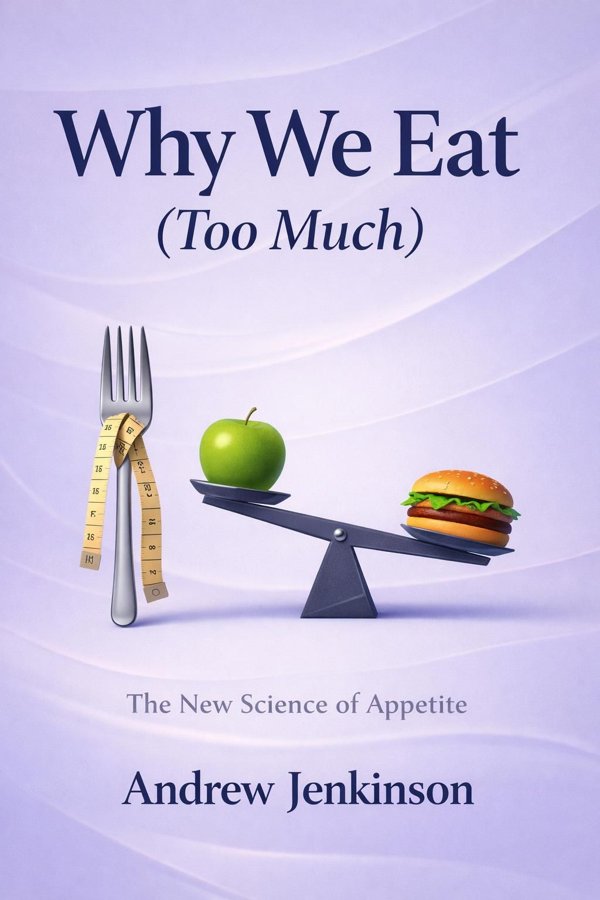
Why We Eat (Too Much): The New Science of Appetite: Summary & Key Insights
 10 min6 chaptersAudio available
What Is Why We Eat (Too Much): The New Science of Appetite About?
Why We Eat (Too Much): The New Science of Appetite by Andrew Jenkinson is a health_med book spanning 6 pages. In this Sunday Times bestseller, bariatric surgeon Andrew Jenkinson explores the science behind appetite, metabolism, and weight regulation. Drawing on clinical experience and research, he explains why dieting often fails, how the body defends its weight set point, and what truly drives overeating. The book challenges conventional wisdom about calories and willpower, offering a new understanding of obesity and sustainable health.
This FizzRead summary covers all 6 key chapters of Why We Eat (Too Much): The New Science of Appetite in approximately 10 minutes, distilling the most important ideas, arguments, and takeaways from Andrew Jenkinson's work. Also available as an audio summary and Key Quotes Podcast.
Why We Eat (Too Much): The New Science of Appetite
In this Sunday Times bestseller, bariatric surgeon Andrew Jenkinson explores the science behind appetite, metabolism, and weight regulation. Drawing on clinical experience and research, he explains why dieting often fails, how the body defends its weight set point, and what truly drives overeating. The book challenges conventional wisdom about calories and willpower, offering a new understanding of obesity and sustainable health.
Who Should Read Why We Eat (Too Much): The New Science of Appetite?
This book is perfect for anyone interested in health_med and looking to gain actionable insights in a short read. Whether you're a student, professional, or lifelong learner, the key ideas from Why We Eat (Too Much): The New Science of Appetite by Andrew Jenkinson will help you think differently.
- ✓Readers who enjoy health_med and want practical takeaways
- ✓Professionals looking to apply new ideas to their work and life
- ✓Anyone who wants the core insights of Why We Eat (Too Much): The New Science of Appetite in just 10 minutes
Want the full summary?
Get instant access to this book summary and 100K+ more with Fizz Moment.
Get Free SummaryAvailable on App Store • Free to download
Key Chapters
Every human body has a preferred weight range—a set point—that it strives to maintain. This is not mere speculation but a biological fact supported by decades of metabolic research. Through subtle feedback loops involving hormones like leptin and insulin, your brain continually monitors how much energy is stored in your fat cells. When you try to diet aggressively, your body perceives it as a threat, not a goal. It responds by slowing your metabolism and heightening your hunger cues, nudging you inexorably back toward your original weight.
I often explain it to patients using a simple analogy: your body weight is like the temperature controlled by a thermostat. You can open windows to cool a room or light a fireplace to heat it, but if the thermostat is still set at 22°C, the central system will fight to bring the temperature back there. The same rule applies to weight. If your set point is high—perhaps because of years of eating ultra-processed foods or enduring chronic stress—your body resists efforts to lower it.
Understanding set point theory liberates you from self-blame. It reveals why diets fail so frustratingly often. The problem isn’t lack of discipline; it’s that your biology is defending what it perceives as equilibrium. The true path to long-term weight change is not to starve the body but to recalibrate the thermostat itself. And that begins with understanding and addressing the factors that have pushed it upward.
The tragedy of traditional dieting lies in metabolic adaptation—the body’s evolutionary safeguard against starvation. Whenever you cut calories drastically, your metabolism shifts gears, slowing down energy expenditure to preserve fat stores. Meanwhile, appetite hormones such as ghrelin surge, amplifying hunger and obsession with food. You may succeed in losing weight initially, but within months, the heightened hunger and slow metabolism inevitably pull the weight back.
Patients often tell me that they lost weight on a diet but gained back even more later. That’s not a moral failure—it’s a predictable biological response. In fact, after repeated cycles of dieting, your body becomes even more efficient at storing fat. The lower metabolism and heightened hunger persist, creating a vicious loop.
The only sustainable way out of this cycle is to restore trust between body and metabolism. Real food—nutrient-rich, unprocessed, and balanced with adequate proteins and fats—signals to your biology that starvation is over. When that trust is restored, your metabolism recovers, and your set point can gradually readjust downward. The goal is not calorie punishment but metabolic peace.
+ 4 more chapters — available in the FizzRead app
All Chapters in Why We Eat (Too Much): The New Science of Appetite
About the Author
Andrew Jenkinson is a consultant bariatric surgeon at University College London Hospitals. He specializes in metabolic and obesity surgery and has contributed to research on the physiological mechanisms of appetite and weight regulation. His work bridges clinical practice and public education on obesity and nutrition.
Get This Summary in Your Preferred Format
Read or listen to the Why We Eat (Too Much): The New Science of Appetite summary by Andrew Jenkinson anytime, anywhere. FizzRead offers multiple formats so you can learn on your terms — all free.
Available formats: App · Audio · PDF · EPUB — All included free with FizzRead
Download Why We Eat (Too Much): The New Science of Appetite PDF and EPUB Summary
Key Quotes from Why We Eat (Too Much): The New Science of Appetite
“Every human body has a preferred weight range—a set point—that it strives to maintain.”
“The tragedy of traditional dieting lies in metabolic adaptation—the body’s evolutionary safeguard against starvation.”
Frequently Asked Questions about Why We Eat (Too Much): The New Science of Appetite
Why We Eat (Too Much): The New Science of Appetite by Andrew Jenkinson is a health_med book that explores key ideas across 6 chapters. In this Sunday Times bestseller, bariatric surgeon Andrew Jenkinson explores the science behind appetite, metabolism, and weight regulation. Drawing on clinical experience and research, he explains why dieting often fails, how the body defends its weight set point, and what truly drives overeating. The book challenges conventional wisdom about calories and willpower, offering a new understanding of obesity and sustainable health.
You Might Also Like

On Immunity
Eula Biss
10 min
The Three-Body Problem
Liu Cixin
10 min
Community Health Volunteer Toolkit: Training and Practical Activities
World Health Organization
10 min
Healing Back Pain: The Mind-Body Connection
John E. Sarno
10 min
Health Literacy for All: Practical Guides to Communicate Health Information (Compilations)
World Health Organization
10 min
The Complete Guide to Sports Supplements: An Evidence-Based Review
Anita Bean
10 minBrowse by Category
Ready to read Why We Eat (Too Much): The New Science of Appetite?
Get the full summary and 100K+ more books with Fizz Moment.