
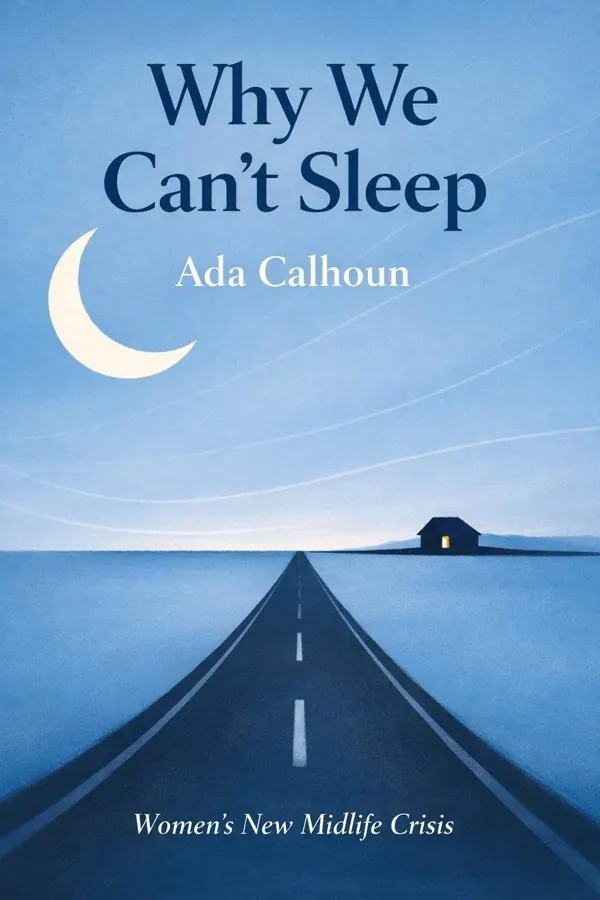
Why We Can’t Sleep: Women’s New Midlife Crisis: Summary & Key Insights
by Ada Calhoun
 10 min9 chaptersAudio available
Key Takeaways from Why We Can’t Sleep: Women’s New Midlife Crisis
A generation can be shaped as much by what it was promised as by what it actually received.
When people describe midlife distress, they often talk about emotions first.
One of the cruelest myths of modern adulthood is that balance is a personal skill rather than a structural challenge.
Midlife often exposes the hidden operating system of a relationship.
Modern parenting asks for devotion, expertise, vigilance, and emotional presence on a near-professional level.
What Is Why We Can’t Sleep: Women’s New Midlife Crisis About?
Why We Can’t Sleep: Women’s New Midlife Crisis by Ada Calhoun is a sociology book spanning 12 pages. Why We Can’t Sleep is a sharp, deeply recognizable portrait of what midlife feels like for many Generation X women: overextended, under-supported, and haunted by the sense that they did everything they were told to do and still ended up exhausted. In this blend of reportage, memoir, and cultural criticism, Ada Calhoun investigates why women in their forties and fifties are experiencing such intense anxiety, burnout, and disappointment. Her answer is not simply personal failure or poor choices. It is a collision of economic instability, impossible standards, caregiving burdens, and the broken promises of post-feminist optimism. Calhoun writes with authority because she is both a journalist and a participant in the story she tells. Drawing on interviews, historical context, and her own life, she maps how a generation raised to “have it all” instead inherited debt, insecure work, expensive housing, unequal domestic labor, and relentless pressure to stay grateful. The book matters because it names a widespread but often privatized struggle, turning private shame into public understanding and making readers feel less alone.
This FizzRead summary covers all 9 key chapters of Why We Can’t Sleep: Women’s New Midlife Crisis in approximately 10 minutes, distilling the most important ideas, arguments, and takeaways from Ada Calhoun's work. Also available as an audio summary and Key Quotes Podcast.
Why We Can’t Sleep: Women’s New Midlife Crisis
Why We Can’t Sleep is a sharp, deeply recognizable portrait of what midlife feels like for many Generation X women: overextended, under-supported, and haunted by the sense that they did everything they were told to do and still ended up exhausted. In this blend of reportage, memoir, and cultural criticism, Ada Calhoun investigates why women in their forties and fifties are experiencing such intense anxiety, burnout, and disappointment. Her answer is not simply personal failure or poor choices. It is a collision of economic instability, impossible standards, caregiving burdens, and the broken promises of post-feminist optimism. Calhoun writes with authority because she is both a journalist and a participant in the story she tells. Drawing on interviews, historical context, and her own life, she maps how a generation raised to “have it all” instead inherited debt, insecure work, expensive housing, unequal domestic labor, and relentless pressure to stay grateful. The book matters because it names a widespread but often privatized struggle, turning private shame into public understanding and making readers feel less alone.
Who Should Read Why We Can’t Sleep: Women’s New Midlife Crisis?
This book is perfect for anyone interested in sociology and looking to gain actionable insights in a short read. Whether you're a student, professional, or lifelong learner, the key ideas from Why We Can’t Sleep: Women’s New Midlife Crisis by Ada Calhoun will help you think differently.
- ✓Readers who enjoy sociology and want practical takeaways
- ✓Professionals looking to apply new ideas to their work and life
- ✓Anyone who wants the core insights of Why We Can’t Sleep: Women’s New Midlife Crisis in just 10 minutes
Want the full summary?
Get instant access to this book summary and 100K+ more with Fizz Moment.
Get Free SummaryAvailable on App Store • Free to download
Key Chapters
A generation can be shaped as much by what it was promised as by what it actually received. Calhoun argues that many Gen X women were raised on the language of second-wave feminism: be independent, get educated, build a career, delay dependence on men, and expect equality to keep expanding. The message was empowering, but it often carried a hidden assumption that the social systems around women would evolve fast enough to support those ambitions. In reality, many women entered adulthood still facing unequal pay, domestic expectations, weak family policy, and cultural pressure to excel everywhere at once.
This mismatch created a particular kind of midlife pain. Many women did not feel merely tired; they felt betrayed. They had worked hard, postponed gratification, sought self-sufficiency, and followed the script of success, only to discover that the script was incomplete. A woman might have a degree, a job, children, and a mortgage, yet still feel financially fragile, emotionally overburdened, and oddly guilty for not appreciating her life more. The problem was not that she wanted too much. It was that she was asked to carry old obligations and new ambitions without structural support.
This idea helps explain why the distress Calhoun documents feels generational rather than simply individual. It is not a handful of bad decisions repeated by many women. It is a broad social experience shaped by history, economics, and culture. Readers can apply this insight by reinterpreting their own dissatisfaction less as personal weakness and more as evidence of conflicting demands.
Actionable takeaway: Make a list of the major life promises you absorbed about work, family, money, and happiness, then compare them with your actual circumstances. Naming the gap can reduce self-blame and clarify what needs to change.
When people describe midlife distress, they often talk about emotions first. Calhoun shows that money is frequently the quieter engine underneath them. Across her interviews, financial strain appears again and again: student debt carried into middle age, high rent or mortgages, unaffordable child care, stagnant wages, divorce-related losses, eldercare costs, and the instability of freelance or contract work. Even women who seem professionally successful often live with persistent precarity.
This matters because financial insecurity amplifies every other pressure. A woman who dislikes her job may stay because she needs health insurance. A parent may remain in a stressful city because moving would disrupt school and employment. Someone caring for aging parents may not be able to reduce work hours because the budget is already stretched. Money stress also has a psychological effect: it keeps the nervous system activated. You cannot fully rest when one unexpected expense could undo months of effort.
Calhoun’s broader point is that many Gen X women came of age during economic shifts that made stable adulthood harder to achieve than the culture admitted. The old milestones remained desirable, but the cost of reaching them rose sharply. This disconnect feeds shame. Women compare themselves to ideals of competence while ignoring the economic realities that shape their choices.
A practical application is to talk about money more honestly. Private financial worry thrives in silence. Sharing concrete numbers with a partner, planner, or trusted friend can make a diffuse fear manageable. Budgeting will not solve structural inequality, but visibility matters.
Actionable takeaway: Replace vague dread with specifics. Review your fixed costs, debt, savings, and biggest stress points, then identify one pressure you can renegotiate, refinance, reduce, or plan for this month.
One of the cruelest myths of modern adulthood is that balance is a personal skill rather than a structural challenge. Calhoun shows how many women in midlife are juggling paid labor, emotional labor, domestic management, and caregiving all at once. Even when they have meaningful careers, the workday rarely ends when employment ends. There are meals to plan, forms to sign, aging parents to call, appointments to schedule, family emotions to manage, and the endless invisible tasks that keep households functioning.
This produces a distinctive kind of burnout. It is not simply overwork in the professional sense. It is the accumulation of responsibility across multiple roles, many of them socially expected and poorly recognized. A woman may appear "high functioning" while inwardly feeling fragmented, resentful, or numb. The pressure is worsened by the idea that competent women should be able to organize their way out of overload. But no color-coded calendar can fix unequal labor distribution or unrealistic expectations.
Calhoun encourages readers to see work-life imbalance as a cultural issue, not just a personal management problem. That shift matters because it opens the door to renegotiation. Examples include auditing who performs which household tasks, setting boundaries around after-hours work, outsourcing selectively when possible, and abandoning perfection in areas that do not truly matter. Small changes can restore energy, especially when they acknowledge that time and attention are finite resources.
The larger lesson is that burnout is often information. It reveals where your life is asking more of you than one person can sustainably give.
Actionable takeaway: Track every recurring task you handle in one week, including invisible mental labor. Use that list to redistribute responsibilities or deliberately drop low-value obligations.
Midlife often exposes the hidden operating system of a relationship. Calhoun explores how marriage and long-term partnership can become sites where broader gender inequalities are quietly reproduced. Even in modern, loving relationships, women often remain the default planners, rememberers, comforters, and adjusters. They may earn money, parent actively, and contribute equally or more financially, yet still carry the emotional and logistical burden of family life.
This inequality is not always dramatic enough to be easily named. That is part of the problem. A partner may be decent, involved, and supportive in visible ways, while still relying on a woman to hold the whole system in her head. Over time, this can create exhaustion and resentment. Midlife intensifies these feelings because the cumulative cost becomes harder to ignore. What was once manageable starts to feel unsustainable.
Calhoun also notes that women are often expected to make relationship compromises appear graceful. They are supposed to absorb friction, maintain harmony, and interpret dissatisfaction as a sign to work harder on communication. Yet sometimes the deeper issue is not communication style but unequal responsibility. The same pattern can affect divorced, single, and co-parenting women too, especially when they continue to shoulder disproportionate labor after separation.
Practical applications include naming invisible work explicitly, discussing fairness in terms of outcomes rather than intentions, and refusing the assumption that one person should naturally become the family project manager. Some couples benefit from treating domestic labor as a shared system with assigned ownership, not vague goodwill.
Actionable takeaway: Choose one recurring area, such as meals, school logistics, finances, or eldercare, and define complete ownership of tasks rather than "help." Clarity often reveals and reduces imbalance.
Modern parenting asks for devotion, expertise, vigilance, and emotional presence on a near-professional level. Calhoun shows how Gen X women were pulled into a parenting culture that became more intensive, expensive, and competitive than what many experienced in their own childhoods. Mothers are now expected to be highly informed, deeply involved, and constantly optimizing their children’s outcomes, while also maintaining careers and personal stability.
This expectation creates pressure from all directions. There are educational decisions, extracurricular schedules, digital safety concerns, emotional coaching, and a relentless stream of advice suggesting that every choice matters permanently. For women already carrying work and household responsibilities, parenting can begin to feel like a permanent test with no clear finish line. Even women who love being mothers may feel trapped by the standards attached to motherhood.
Calhoun’s point is not that caring deeply for children is wrong. It is that the social definition of good parenting has expanded in ways that are often incompatible with adult well-being. Mothers are encouraged to treat ordinary imperfection as risk. That mindset turns family life into a constant state of alertness. It also isolates women, because everyone appears to be coping better than they are.
A practical way to use this insight is to distinguish care from over-functioning. Not every school issue, scheduling opportunity, or enrichment activity deserves the same level of energy. Children benefit from secure attachment, not parental depletion. Families can also normalize shared responsibility and lower the temperature around achievement.
Actionable takeaway: Identify one parenting standard you are following mainly out of guilt or comparison, not values. Scale it back for two weeks and observe whether family life actually worsens or simply becomes saner.
Midlife is not only a social stage; it is a bodily one. Calhoun addresses how health changes, hormonal shifts, insomnia, anxiety, and the visible signs of aging can intensify a woman’s sense that she is losing control just when life demands the most from her. The body becomes both a source of fatigue and a target of judgment. Women are expected to keep functioning at high levels while also appearing youthful, energetic, and attractive in ways that require time, money, and emotional bandwidth.
This creates a double bind. Aging is natural, but female aging is often framed as a problem to manage privately. Menopause, sleep disruption, weight changes, and declining resilience are rarely treated with the seriousness they deserve, even though they can affect mood, concentration, and self-perception. Many women therefore interpret health struggles as evidence of personal decline rather than as normal transitions compounded by stress.
Calhoun’s insight is that health in midlife cannot be separated from culture. A woman sleeping poorly while managing work, caregiving, and financial strain is not just experiencing a medical issue. She is living in a system that leaves little room for restoration. Recognizing this encourages more compassionate choices: seeking medical support, taking symptoms seriously, adjusting routines, and resisting appearance-based shame.
Practical applications include tracking sleep and mood patterns, learning about perimenopause and menopause, setting more realistic energy expectations, and investing in health habits that support function rather than punish the body. Rest is not indulgence when the system is overloaded.
Actionable takeaway: Treat one recurring symptom, such as insomnia, irritability, fatigue, or brain fog, as worthy of real attention. Document it for two weeks and bring the pattern to a qualified healthcare professional.
One reason midlife can feel so destabilizing is that many women are surrounded by evidence of other people’s supposedly smoother lives. Calhoun examines how comparison, especially in the age of social media, magnifies dissatisfaction. A woman may be objectively managing a great deal, yet still feel behind because she sees curated images of career success, serene motherhood, stylish aging, organized homes, and financially secure families. The result is not motivation but erosion of self-trust.
Comparison is especially painful when the standards are contradictory. Women are supposed to be ambitious but not absent, youthful but authentic, self-caring but selfless, financially savvy but effortlessly generous. Because no one can fully satisfy these ideals, many women live with the sense of failing multiple tests simultaneously. The problem is not simply envy. It is the internalization of impossible benchmarks.
Calhoun invites readers to question the cultural myths beneath these comparisons. Success is often portrayed as a matter of discipline and smart choices, but that story erases luck, class, health, family support, and timing. Once readers recognize how incomplete the public version of success is, they can begin to loosen its hold. This does not eliminate ambition; it makes ambition more self-directed.
Practical steps include curating media consumption, reducing exposure to triggers, and replacing broad status comparisons with more honest questions: What do I actually want? What am I optimizing for? What costs am I no longer willing to pay for appearances? Midlife can be liberating when women stop grading themselves against fantasy lives.
Actionable takeaway: For one week, unfollow or mute accounts, newsletters, or conversations that reliably provoke inadequacy. Use the reclaimed attention to define three personal measures of a good life.
Not all midlife crises look the same, and Calhoun is careful to show why this one has a specifically Gen X flavor. Women born roughly between the mid-1960s and 1980 came of age during cultural transition. They were often raised with unusual degrees of independence, exposed to rising divorce rates, and taught to be self-sufficient. They also entered adulthood amid economic restructuring, changing labor markets, and the early normalization of hustle culture. In short, they were told to rely on themselves at the very moment institutions were becoming less reliable.
This generational identity matters because it shaped both expectations and coping styles. Many Gen X women learned not to ask for too much, not to appear needy, and not to assume help would arrive. That stoicism can become a liability in midlife. It keeps women functioning beyond sustainable limits while making it harder to seek support or admit distress. The generation’s cultural coolness masks real depletion.
Calhoun also suggests that Gen X women often occupy a squeezed position: caring for children while worrying about aging parents, trying to maintain careers in volatile industries, and comparing themselves with both boomer-era stability and millennial-era language around burnout and boundaries. They belong to a cohort that often feels overlooked, yet carries heavy responsibility.
A useful application is recognizing the generational habits that no longer serve. Self-reliance is valuable, but isolation is costly. Naming a generational pattern can make it easier to change without shame.
Actionable takeaway: Notice one place where you are defaulting to silent self-sufficiency. Ask directly for help, information, time, or relief, and treat that request as a strength rather than a failure.
A central gift of Calhoun’s book is that it converts private distress into shared reality. Many women assume their exhaustion is uniquely theirs, caused by poor choices, weak boundaries, or insufficient gratitude. But when the same themes recur across many lives, something larger is being revealed. Community does not erase structural problems, yet it can interrupt the loneliness and shame that make those problems harder to bear.
Calhoun points toward solidarity not as a sentimental ideal but as a practical survival tool. Honest friendship, peer conversation, and intergenerational dialogue can help women compare realities instead of performances. In these spaces, people trade information about careers, caregiving, health, divorce, money, and aging without pretending to have mastered everything. This exchange restores perspective. It also helps women move from self-diagnosis to social analysis, which often brings relief.
Solidarity can take many forms: a text thread where friends discuss real budgets, a support group for caregiving, a workplace conversation about boundaries, or even a book club that uses the text as a starting point for truth-telling. The aim is not to complain endlessly. It is to create enough shared language that women can advocate for change and make more deliberate choices.
Calhoun ultimately frames midlife not only as a crisis but as a threshold. Once women stop interpreting their distress as individual malfunction, they can begin redefining success, relationships, work, and care on more humane terms.
Actionable takeaway: Start one honest conversation this week with a friend, sibling, colleague, or partner about a pressure you usually downplay. Specific truth is often the first step toward practical change.
All Chapters in Why We Can’t Sleep: Women’s New Midlife Crisis
About the Author
Ada Calhoun is an American author and journalist whose work focuses on contemporary culture, gender, family, and generational identity. She has written for major publications including The New York Times, Time, and other national outlets, often combining personal experience with social reporting. Calhoun is known for her ability to turn private anxieties into broader cultural conversations, especially around the pressures of modern adulthood. In Why We Can’t Sleep, she draws on interviews, memoir, and historical analysis to examine the specific burdens facing Generation X women in midlife. Her writing is accessible, candid, and emotionally intelligent, making complex social issues feel immediate and relatable. Across her work, Calhoun has built a reputation for noticing how ordinary lives reflect larger shifts in culture, economics, and family life.
Get This Summary in Your Preferred Format
Read or listen to the Why We Can’t Sleep: Women’s New Midlife Crisis summary by Ada Calhoun anytime, anywhere. FizzRead offers multiple formats so you can learn on your terms — all free.
Available formats: App · Audio · PDF · EPUB — All included free with FizzRead
Download Why We Can’t Sleep: Women’s New Midlife Crisis PDF and EPUB Summary
Key Quotes from Why We Can’t Sleep: Women’s New Midlife Crisis
“A generation can be shaped as much by what it was promised as by what it actually received.”
“When people describe midlife distress, they often talk about emotions first.”
“One of the cruelest myths of modern adulthood is that balance is a personal skill rather than a structural challenge.”
“Midlife often exposes the hidden operating system of a relationship.”
“Modern parenting asks for devotion, expertise, vigilance, and emotional presence on a near-professional level.”
Frequently Asked Questions about Why We Can’t Sleep: Women’s New Midlife Crisis
Why We Can’t Sleep: Women’s New Midlife Crisis by Ada Calhoun is a sociology book that explores key ideas across 9 chapters. Why We Can’t Sleep is a sharp, deeply recognizable portrait of what midlife feels like for many Generation X women: overextended, under-supported, and haunted by the sense that they did everything they were told to do and still ended up exhausted. In this blend of reportage, memoir, and cultural criticism, Ada Calhoun investigates why women in their forties and fifties are experiencing such intense anxiety, burnout, and disappointment. Her answer is not simply personal failure or poor choices. It is a collision of economic instability, impossible standards, caregiving burdens, and the broken promises of post-feminist optimism. Calhoun writes with authority because she is both a journalist and a participant in the story she tells. Drawing on interviews, historical context, and her own life, she maps how a generation raised to “have it all” instead inherited debt, insecure work, expensive housing, unequal domestic labor, and relentless pressure to stay grateful. The book matters because it names a widespread but often privatized struggle, turning private shame into public understanding and making readers feel less alone.
You Might Also Like

Between the World and Me
Ta-Nehisi Coates
10 min
Half the Sky
Nicholas D. Kristof, Sheryl WuDunn
10 min
Men Explain Things To Me
Rebecca Solnit
10 min
Rational Ritual
Michael Suk-Young Chwe
10 min
The New Jim Crow
Michelle Alexander
10 min
Beyond Culture
Edward T. Hall
10 minBrowse by Category
Ready to read Why We Can’t Sleep: Women’s New Midlife Crisis?
Get the full summary and 100K+ more books with Fizz Moment.