
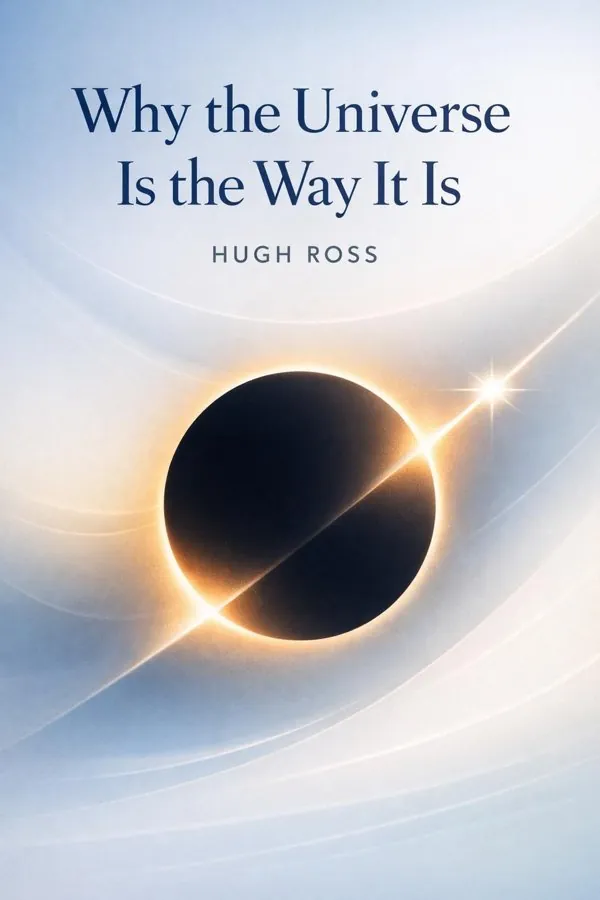
Why the Universe Is the Way It Is: Summary & Key Insights
by Hugh Ross
 10 min11 chaptersAudio available
What Is Why the Universe Is the Way It Is About?
Why the Universe Is the Way It Is by Hugh Ross is a popular_sci book spanning 11 pages. This book explores the fundamental question of why the universe exists in its current form and how its physical properties make life possible. Astrophysicist Hugh Ross examines cosmology, physics, and theology to argue that the universe’s design reflects purposeful intent. He discusses fine-tuning, cosmic constants, and the relationship between science and faith, offering a perspective that integrates scientific discovery with philosophical and spiritual meaning.
This FizzRead summary covers all 11 key chapters of Why the Universe Is the Way It Is in approximately 10 minutes, distilling the most important ideas, arguments, and takeaways from Hugh Ross's work. Also available as an audio summary and Key Quotes Podcast.
Why the Universe Is the Way It Is
This book explores the fundamental question of why the universe exists in its current form and how its physical properties make life possible. Astrophysicist Hugh Ross examines cosmology, physics, and theology to argue that the universe’s design reflects purposeful intent. He discusses fine-tuning, cosmic constants, and the relationship between science and faith, offering a perspective that integrates scientific discovery with philosophical and spiritual meaning.
Who Should Read Why the Universe Is the Way It Is?
This book is perfect for anyone interested in popular_sci and looking to gain actionable insights in a short read. Whether you're a student, professional, or lifelong learner, the key ideas from Why the Universe Is the Way It Is by Hugh Ross will help you think differently.
- ✓Readers who enjoy popular_sci and want practical takeaways
- ✓Professionals looking to apply new ideas to their work and life
- ✓Anyone who wants the core insights of Why the Universe Is the Way It Is in just 10 minutes
Want the full summary?
Get instant access to this book summary and 100K+ more with Fizz Moment.
Get Free SummaryAvailable on App Store • Free to download
Key Chapters
Long before modern telescopes, humankind wondered whether the universe had always existed or if there was a moment of beginning. As an astrophysicist, I have seen how evidence has answered that ancient question with startling clarity. Cosmology now shows that space, time, matter, and energy all originated together from a single event—the cosmic creation we call the Big Bang. This was not an explosion in preexisting space; it was the birth of space itself. Each strand of data—the cosmic microwave background, galactic redshifts, the ratio of light elements—points toward a definite, finite origin.
What does that mean? If the universe had a beginning, then it must have a cause beyond itself. A self-contained cosmos could not spontaneously arise without external input. This realization unsettles many, yet it opens the door to profound insight. The Creator I see through these equations is not bound by time but initiates it. The physics describing that instant of emergence hints at exquisite order and planning. The expansion rate had to be tuned to more than fifty decimal places for stars and galaxies to form later. That precision is not the language of chaos. It is the signature of mind.
As I walked through this evidence, I felt both intellectually satisfied and personally humbled. Science, rather than stripping away mystery, intensified it. Every photon traveling through space since the early universe carries the message that creation is not an accident—it was launched, calibrated, and sustained. This beginning lies at the foundation of every argument in the book: if the cosmos began with intelligible purpose, then its ongoing story must likewise be purposeful.
Fine-tuning is one of the most astonishing scientific revelations of our time. Imagine the universe as a cosmic orchestra where every instrument—the strengths of fundamental forces, the masses of particles, the speed of light, the cosmological constant—must play at exactly the right pitch for harmony to exist. If gravity were slightly stronger, stars would burn too rapidly, destroying planetary stability. If it were weaker, nuclear fusion would fail, leaving a sterile universe. The balance among the strong nuclear force and electromagnetic interaction ensures that carbon, oxygen, and the building blocks of biology can exist. The evidence is overwhelming: the physical constants are not arbitrary; they form a systematic ensemble conducive to life.
When I first delved into these ratios and magnitudes as a researcher, I wasn’t merely calculating numbers. I was reading hints of intent encrypted within reality itself. Fine-tuning tells me that the universe was calibrated to host observers—to sustain beings capable of asking questions and seeking relationship. Could such exactitude arise from chance? The probability complexities defy imagination; they reach values so infinitesimal that random occurrence becomes implausible. This pattern of order transforms data into dialogue: the cosmos seems to speak, "You were meant to be."
Recognizing fine-tuning reshapes how we perceive the world around us. It instills gratitude—the realization that every sunrise, every atom of oxygen is possible because the universe was designed to allow life to flourish. For me, that design reflects the character of a Creator who values both precision and beauty.
+ 9 more chapters — available in the FizzRead app
All Chapters in Why the Universe Is the Way It Is
About the Author
Hugh Ross is a Canadian astrophysicist, Christian apologist, and founder of the organization Reasons to Believe. He earned his Ph.D. in astronomy from the University of Toronto and has written extensively on the intersection of science and religion, advocating for harmony between scientific evidence and biblical faith.
Get This Summary in Your Preferred Format
Read or listen to the Why the Universe Is the Way It Is summary by Hugh Ross anytime, anywhere. FizzRead offers multiple formats so you can learn on your terms — all free.
Available formats: App · Audio · PDF · EPUB — All included free with FizzRead
Download Why the Universe Is the Way It Is PDF and EPUB Summary
Key Quotes from Why the Universe Is the Way It Is
“Long before modern telescopes, humankind wondered whether the universe had always existed or if there was a moment of beginning.”
“Fine-tuning is one of the most astonishing scientific revelations of our time.”
Frequently Asked Questions about Why the Universe Is the Way It Is
Why the Universe Is the Way It Is by Hugh Ross is a popular_sci book that explores key ideas across 11 chapters. This book explores the fundamental question of why the universe exists in its current form and how its physical properties make life possible. Astrophysicist Hugh Ross examines cosmology, physics, and theology to argue that the universe’s design reflects purposeful intent. He discusses fine-tuning, cosmic constants, and the relationship between science and faith, offering a perspective that integrates scientific discovery with philosophical and spiritual meaning.
You Might Also Like

Structures: Or Why Things Don"t Fall Down
J.E. Gordon
10 min
The Road to Wigan Pier
George Orwell
10 min
Bonk: The Curious Coupling of Science and Sex
Mary Roach
10 min
First Bite: How We Learn to Eat
Bee Wilson
10 min
In Pursuit Of The Unknown: 17 Equations That Changed The World
Ian Stewart
10 min
Napoleon's Buttons: 17 Molecules That Changed History
Penny Le Couteur and Jay Burreson
10 minBrowse by Category
Ready to read Why the Universe Is the Way It Is?
Get the full summary and 100K+ more books with Fizz Moment.