
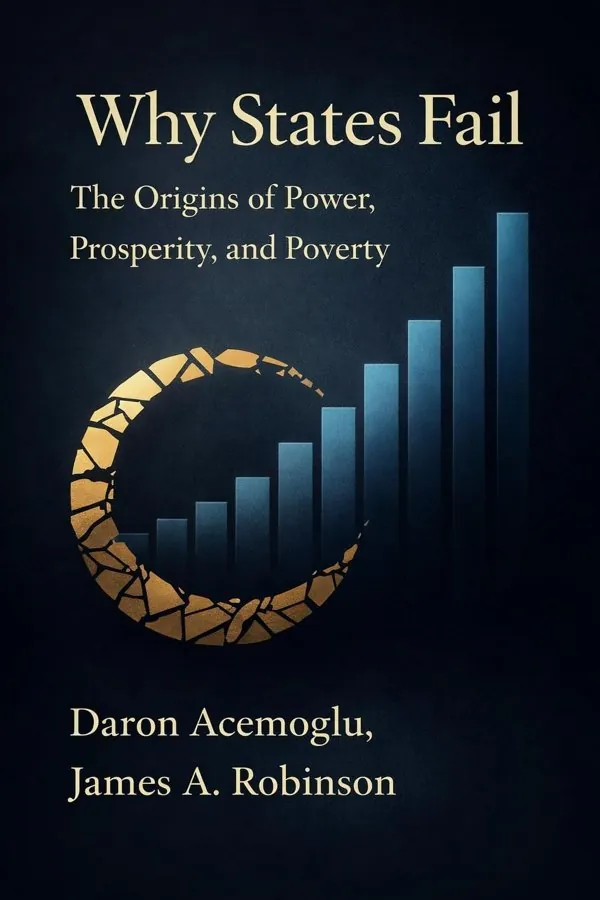
Why States Fail: The Origins of Power, Prosperity, and Poverty: Summary & Key Insights
by Daron Acemoglu, James A. Robinson
 10 min10 chaptersAudio available
Key Takeaways from Why States Fail: The Origins of Power, Prosperity, and Poverty
A nation’s future is rarely determined by luck alone; it is built into the rules that govern who gets power, who gets opportunity, and who gets rewarded.
Prosperity often looks modern, but its roots are usually historical.
Economic success is never just about economics; it is fundamentally political.
History does not move in a straight line; sometimes a shock changes everything.
Once institutions take root, they tend to reproduce themselves.
What Is Why States Fail: The Origins of Power, Prosperity, and Poverty About?
Why States Fail: The Origins of Power, Prosperity, and Poverty by Daron Acemoglu, James A. Robinson is a economics book spanning 10 pages. Why do some countries generate sustained prosperity while others remain stuck in corruption, instability, and poverty? In Why States Fail, economist Daron Acemoglu and political scientist James A. Robinson offer a bold and influential answer: the decisive factor is not geography, culture, religion, or ignorance, but institutions. Specifically, nations thrive when they build inclusive political and economic institutions that protect property rights, spread opportunity, encourage innovation, and limit concentrated power. They fail when extractive institutions allow elites to dominate society and siphon wealth from the many to the few. This book matters because it challenges many familiar explanations for global inequality and replaces them with a framework that is both historically rich and politically urgent. Drawing on examples from the Roman Empire, colonial Latin America, the Industrial Revolution, modern Africa, and divided cities like Nogales, the authors show how power structures shape long-term development. Acemoglu, one of the world’s leading economists, and Robinson, a renowned scholar of political development, combine rigorous research with vivid storytelling. The result is a powerful lens for understanding not only why nations rise and fall, but also what citizens and leaders must protect if they want durable prosperity.
This FizzRead summary covers all 10 key chapters of Why States Fail: The Origins of Power, Prosperity, and Poverty in approximately 10 minutes, distilling the most important ideas, arguments, and takeaways from Daron Acemoglu, James A. Robinson's work. Also available as an audio summary and Key Quotes Podcast.
Why States Fail: The Origins of Power, Prosperity, and Poverty
Why do some countries generate sustained prosperity while others remain stuck in corruption, instability, and poverty? In Why States Fail, economist Daron Acemoglu and political scientist James A. Robinson offer a bold and influential answer: the decisive factor is not geography, culture, religion, or ignorance, but institutions. Specifically, nations thrive when they build inclusive political and economic institutions that protect property rights, spread opportunity, encourage innovation, and limit concentrated power. They fail when extractive institutions allow elites to dominate society and siphon wealth from the many to the few.
This book matters because it challenges many familiar explanations for global inequality and replaces them with a framework that is both historically rich and politically urgent. Drawing on examples from the Roman Empire, colonial Latin America, the Industrial Revolution, modern Africa, and divided cities like Nogales, the authors show how power structures shape long-term development. Acemoglu, one of the world’s leading economists, and Robinson, a renowned scholar of political development, combine rigorous research with vivid storytelling. The result is a powerful lens for understanding not only why nations rise and fall, but also what citizens and leaders must protect if they want durable prosperity.
Who Should Read Why States Fail: The Origins of Power, Prosperity, and Poverty?
This book is perfect for anyone interested in economics and looking to gain actionable insights in a short read. Whether you're a student, professional, or lifelong learner, the key ideas from Why States Fail: The Origins of Power, Prosperity, and Poverty by Daron Acemoglu, James A. Robinson will help you think differently.
- ✓Readers who enjoy economics and want practical takeaways
- ✓Professionals looking to apply new ideas to their work and life
- ✓Anyone who wants the core insights of Why States Fail: The Origins of Power, Prosperity, and Poverty in just 10 minutes
Want the full summary?
Get instant access to this book summary and 100K+ more with Fizz Moment.
Get Free SummaryAvailable on App Store • Free to download
Key Chapters
A nation’s future is rarely determined by luck alone; it is built into the rules that govern who gets power, who gets opportunity, and who gets rewarded. Acemoglu and Robinson argue that the deepest dividing line between prosperous and poor countries is institutional. They distinguish between inclusive institutions, which broadly distribute power and economic opportunity, and extractive institutions, which concentrate power in the hands of a narrow elite and organize the economy to benefit that elite.
Inclusive economic institutions protect property rights, enforce contracts, support investment, and allow people from many backgrounds to start businesses, get educated, and improve their lives. Inclusive political institutions, in turn, create constraints on rulers, encourage pluralism, and make it harder for one group to dominate everyone else. Extractive institutions do the opposite: they enable coercion, corruption, insecurity, and favoritism. Even if they generate growth for a time, that growth tends to be narrow, unstable, and ultimately self-limiting.
The authors show that this framework helps explain why two places with similar geography can end up with radically different outcomes. It also clarifies why resource-rich countries can remain poor while resource-poor countries become wealthy. The core question is not what a nation has, but how its institutions channel incentives and power.
A practical application of this idea is to look beyond headline economic statistics. If a country has growth but weak courts, censorship, crony monopolies, and little political competition, its prosperity may be more fragile than it appears. Actionable takeaway: when evaluating a country, company, or community, focus first on whether its rules are inclusive or extractive, because incentives shape long-term results.
Prosperity often looks modern, but its roots are usually historical. One of the book’s central claims is that today’s inequality among nations can only be understood by tracing how institutions evolved over centuries. Colonialism provides some of the clearest examples. In many parts of Latin America, Spanish colonizers built systems such as encomiendas, forced labor arrangements, and concentrated land ownership. These structures were designed not to create broad prosperity, but to extract wealth and labor from indigenous populations.
In contrast, in parts of North America where settlers could not easily exploit dense native populations or mineral wealth, colonists were more likely to establish institutions with wider participation, stronger local governance, and more secure property rights. These arrangements were far from perfect and often deeply unjust, but they created conditions more favorable to inclusive development over time.
The authors’ point is not that history mechanically determines the future. Rather, historical choices create institutional tracks that are difficult to leave. Elites who benefit from extraction often build legal systems, social norms, and political arrangements that preserve their advantages. That is why countries can remain trapped long after the original conditions have changed.
This insight matters in modern policy debates. Development plans that ignore history often fail because they assume poor outcomes come only from present-day incompetence. But inherited institutions can continue shaping incentives long after colonial rule, dictatorship, or conflict formally ends.
Actionable takeaway: whenever you examine a nation’s current problems, ask what historical power arrangements created them. Sustainable reform becomes more realistic when it addresses the institutional legacy beneath today’s symptoms.
Economic success is never just about economics; it is fundamentally political. Acemoglu and Robinson insist that inclusive economic institutions usually require inclusive political institutions to sustain them. If political power is highly concentrated, elites can rewrite economic rules whenever broad-based growth threatens their control. This is why many societies experience bursts of development that later collapse into repression, stagnation, or elite capture.
Political institutions matter because they determine who makes decisions, how leaders are constrained, and whether ordinary citizens have meaningful influence. Pluralism, rule of law, and checks on authority make it harder for any one faction to suppress competition or seize wealth. Without these political safeguards, even sensible economic reforms can be reversed. A dictator may welcome growth until new entrepreneurs become politically independent; then the regime often responds by restricting media, tightening regulation selectively, or favoring loyal insiders.
The book repeatedly shows that countries fail not because leaders do not understand prosperity, but because ruling groups often fear its consequences. Innovation disrupts old hierarchies. Free markets can create rival centers of influence. Education can empower citizens to challenge authority. From the elite perspective, blocking inclusion can be rational, even if it impoverishes society as a whole.
This argument has broad application. In organizations, local governments, and even nonprofits, concentrated authority often produces similar patterns: insiders protect themselves at the cost of long-term performance. When decision-making is unaccountable, efficiency eventually gives way to favoritism.
Actionable takeaway: if you want lasting economic improvement, look beyond technical policy fixes and ask who holds power, who benefits from the status quo, and what political constraints are needed to keep opportunity open.
History does not move in a straight line; sometimes a shock changes everything. The authors use the idea of critical junctures to explain moments when major disruptions open the possibility of institutional change. Wars, technological revolutions, pandemics, state collapse, or external trade shocks can weaken old arrangements and create opportunities for new coalitions to reshape power.
But critical junctures do not guarantee progress. The same disruption can push one society toward inclusion and another toward greater extraction. What matters is the balance of political forces and the institutional foundation already in place. The Black Death, for example, transformed labor relations in parts of Europe, but its effects varied depending on local political structures. Likewise, the Atlantic trade enriched some regions and destabilized others, depending on whether elites used new wealth to broaden institutions or tighten coercion.
This helps explain why major crises sometimes produce reform and sometimes authoritarian backlash. A financial collapse may lead one country to strengthen oversight and civic accountability, while another uses the same crisis to centralize power and suppress dissent. The shock itself matters less than the institutional response to it.
For readers today, this is especially relevant. Climate pressures, geopolitical conflict, technological disruption, and democratic strain are all potential critical junctures. They can entrench privilege or expand opportunity. Citizens, leaders, and institutions are not passive observers; they help determine which path is taken.
Actionable takeaway: treat crises as moments of institutional choice. In periods of disruption, pay close attention to whether reforms increase accountability and participation or merely give more power to already dominant actors.
Once institutions take root, they tend to reproduce themselves. This is the logic of path dependence, one of the book’s most important ideas. Inclusive systems create incentives for investment, education, participation, and accountability, which reinforce one another over time. Extractive systems create fear, corruption, inequality, and concentrated power, which also reinforce one another. In both cases, the past becomes embedded in the present.
This is why countries do not easily switch tracks. Elites benefiting from extractive institutions usually have money, influence, military leverage, and control over information. They can block reforms, co-opt rivals, or make small concessions without changing the underlying structure. Meanwhile, citizens living under weak institutions often face collective action problems: even if many people want change, organizing is risky and difficult.
The concept also explains why inclusive societies can remain resilient. Once broad participation and legal protections exist, many groups have a stake in preserving them. Businesses benefit from predictable law, citizens defend voting rights, and civil society resists arbitrary rule. A healthy institutional ecosystem becomes self-supporting.
In practical terms, path dependence warns against simplistic optimism. A constitution, election, or policy package alone does not transform a nation if old patronage networks and coercive practices remain intact. At the same time, it offers hope: small institutional gains can accumulate and create new expectations that strengthen over time.
Actionable takeaway: when trying to change a failing system, focus on building reinforcing mechanisms, not isolated reforms. Durable progress comes from creating institutions that make better behavior easier, more rewarding, and harder to reverse.
Prosperity depends not only on stability, but on a society’s willingness to let new people, new technologies, and new ideas challenge established interests. Acemoglu and Robinson emphasize that inclusive institutions foster what Joseph Schumpeter called creative destruction: the process by which innovation replaces old ways of producing, organizing, and living. This process is messy and often politically threatening, but it is essential for sustained growth.
Extractive systems fear creative destruction because innovation shifts power. A new industry can weaken monopolies. A new communication tool can spread dissent. A better production method can elevate outsiders who are not loyal to the ruling elite. As a result, societies with concentrated power often underinvest in education, suppress entrepreneurship, regulate selectively, or block technologies that threaten incumbents.
The Industrial Revolution is central to the authors’ argument. Britain’s relatively pluralistic institutions created a setting in which inventors, merchants, and manufacturers could challenge existing interests more successfully than in more absolutist states. This was not because Britons were inherently more inventive, but because institutions made experimentation and disruption more feasible.
The lesson extends beyond nations. In business, organizations that protect incumbents at all costs usually become stagnant. In education, systems that reward conformity over experimentation struggle to adapt. In politics, societies that punish dissent often lose the energy that fuels long-term progress.
Actionable takeaway: if you want growth, ask whether the system truly allows disruption. Support rules that protect competition, reward innovation, and prevent powerful insiders from using regulation or political influence to freeze the future in their favor.
Countries that achieve durable prosperity usually do not rely on one miracle policy; they build a pattern of inclusion. Throughout the book, the authors point to cases where broad political participation, secure property rights, and room for innovation generated sustained growth. Britain after the Glorious Revolution is one of their most important examples. By placing greater limits on arbitrary royal power and strengthening Parliament, Britain created conditions in which merchants, inventors, and investors could operate with more confidence.
The United States, despite its many contradictions and exclusions, also benefited from institutions that were more inclusive than those in many rival societies. A relatively decentralized political structure, stronger constraints on authority, and wider economic participation helped support expansion, entrepreneurship, and technological change. The authors are not romantic about these histories; they recognize slavery, dispossession, and inequality. Their point is comparative: even imperfectly inclusive institutions can create stronger incentives for broad-based growth than overtly extractive ones.
More contemporary examples such as Botswana also matter. Botswana’s post-independence leadership avoided some of the destructive patterns common elsewhere in Africa by preserving stronger constraints on power and managing resources more inclusively. This did not solve every problem, but it demonstrated that institutional choices could alter outcomes significantly.
The practical value of success stories is that they reveal repeatable principles. Sustainable prosperity tends to emerge where power is checked, laws are more predictable, and many people can participate in economic life rather than a small clique.
Actionable takeaway: study success not as a list of policies to copy, but as a pattern of institutions to emulate: accountability, pluralism, security of rights, and openness to innovation.
Nations do not always fail because nobody knows what works. Often, they fail because what works for society threatens those who control the state. This is one of the book’s most unsettling insights. Extractive institutions persist not mainly through ignorance, but through incentives. Elites may understand that reform could increase national wealth, yet still resist it because it would reduce their privilege, monopoly power, or political dominance.
The authors illustrate this pattern through many examples, including authoritarian states, colonial regimes, and post-independence governments captured by narrow ruling circles. In such systems, leaders may nationalize industries, restrict trade, manipulate elections, weaken courts, or use violence not because these choices are economically sound, but because they preserve control. Citizens bear the cost through low wages, poor services, insecurity, and limited mobility.
This helps explain why well-designed foreign aid programs, technical advice, or market reforms often disappoint. If underlying power arrangements remain extractive, new resources can simply be absorbed by patronage networks. Anti-corruption campaigns become selective weapons. Development banks finance projects that enrich contractors connected to the regime. Formal change masks institutional continuity.
This insight is highly relevant for modern observers. Whenever reforms stall, it is worth asking not just what policy is missing, but who benefits from dysfunction. In many settings, inefficiency is not accidental; it is politically useful to those at the top.
Actionable takeaway: when evaluating a failing system, follow incentives rather than rhetoric. Ask who gains from the current arrangement, who would lose from genuine reform, and how reformers can build coalitions strong enough to overcome entrenched interests.
Small institutional differences can widen dramatically over time because success and failure are cumulative. The book describes this through virtuous and vicious cycles. In a virtuous cycle, inclusive institutions reinforce themselves: broader political participation leads to better constraints on power, which supports more secure economic rights, which encourages investment and innovation, which strengthens groups with an interest in preserving inclusion. Progress becomes self-reinforcing.
In a vicious cycle, extractive institutions work the same way in reverse. Concentrated power weakens accountability, allowing rulers to enrich themselves, suppress rivals, and prevent independent institutions from emerging. Economic inequality then feeds political inequality, which deepens extraction further. Poor education, weak courts, and low trust are not isolated problems; they interact and strengthen one another.
This framework is useful because it explains why marginal reforms often disappoint. A government might improve tax collection, build infrastructure, or liberalize one sector, but if courts remain politicized and media remain captured, the overall cycle may still be vicious. By contrast, even modest gains in transparency, local participation, and legal fairness can support a broader positive trajectory if they begin to reinforce one another.
The idea also applies personally and organizationally. Healthy systems often create beneficial feedback loops, while unhealthy ones normalize self-protective behavior that compounds decline. Incentives spread through networks.
Actionable takeaway: focus on reforms that generate reinforcing effects. Instead of asking what single policy will solve everything, ask which changes can start a virtuous cycle by improving accountability, trust, participation, and productive investment at the same time.
It is tempting to explain national success through climate, religion, values, or natural resources because these factors seem intuitive and easy to observe. Acemoglu and Robinson argue that such explanations are incomplete at best and misleading at worst. Geography can affect disease burdens, trade routes, and agriculture. Culture can shape norms and social expectations. But neither consistently explains why neighboring regions, even divided cities, can experience radically different outcomes under different institutions.
The famous example of Nogales, split between Arizona and Sonora, captures this clearly. People on both sides share geography, many cultural traits, and even family ties, yet they live under different political and economic institutions. The side with stronger rule of law, better public services, more accountable government, and wider economic opportunity is far more prosperous. Similar comparisons appear throughout the book.
The authors also challenge the idea that poor countries are poor because leaders are simply ignorant. In many cases, rulers know perfectly well that inclusive reforms could improve prosperity. They resist not because they misunderstand economics, but because they fear losing power.
This argument does not deny the relevance of geography or culture. It puts them in proper perspective. Institutions shape how societies respond to environmental constraints, use resources, and adapt cultural norms. Better rules can overcome many disadvantages; bad rules can waste even extraordinary advantages.
Actionable takeaway: resist deterministic explanations. When analyzing inequality or underdevelopment, ask how institutions convert geographic, cultural, and resource conditions into either broad opportunity or concentrated extraction.
All Chapters in Why States Fail: The Origins of Power, Prosperity, and Poverty
About the Authors
Daron Acemoglu is a prominent economist and professor at the Massachusetts Institute of Technology, widely known for his work on political economy, economic growth, inequality, institutions, and technological change. His research has had major influence across economics and public policy. James A. Robinson is a distinguished political scientist and economist associated with the University of Chicago, where his work has focused on comparative development, state formation, governance, and institutional change. Together, Acemoglu and Robinson form one of the most influential intellectual partnerships in modern social science. Their writing combines rigorous analysis with historical depth, making complex ideas accessible to a broad audience. In Why States Fail, they bring their expertise together to explain how political and economic institutions shape the fate of nations.
Get This Summary in Your Preferred Format
Read or listen to the Why States Fail: The Origins of Power, Prosperity, and Poverty summary by Daron Acemoglu, James A. Robinson anytime, anywhere. FizzRead offers multiple formats so you can learn on your terms — all free.
Available formats: App · Audio · PDF · EPUB — All included free with FizzRead
Download Why States Fail: The Origins of Power, Prosperity, and Poverty PDF and EPUB Summary
Key Quotes from Why States Fail: The Origins of Power, Prosperity, and Poverty
“A nation’s future is rarely determined by luck alone; it is built into the rules that govern who gets power, who gets opportunity, and who gets rewarded.”
“Prosperity often looks modern, but its roots are usually historical.”
“Economic success is never just about economics; it is fundamentally political.”
“History does not move in a straight line; sometimes a shock changes everything.”
“Once institutions take root, they tend to reproduce themselves.”
Frequently Asked Questions about Why States Fail: The Origins of Power, Prosperity, and Poverty
Why States Fail: The Origins of Power, Prosperity, and Poverty by Daron Acemoglu, James A. Robinson is a economics book that explores key ideas across 10 chapters. Why do some countries generate sustained prosperity while others remain stuck in corruption, instability, and poverty? In Why States Fail, economist Daron Acemoglu and political scientist James A. Robinson offer a bold and influential answer: the decisive factor is not geography, culture, religion, or ignorance, but institutions. Specifically, nations thrive when they build inclusive political and economic institutions that protect property rights, spread opportunity, encourage innovation, and limit concentrated power. They fail when extractive institutions allow elites to dominate society and siphon wealth from the many to the few. This book matters because it challenges many familiar explanations for global inequality and replaces them with a framework that is both historically rich and politically urgent. Drawing on examples from the Roman Empire, colonial Latin America, the Industrial Revolution, modern Africa, and divided cities like Nogales, the authors show how power structures shape long-term development. Acemoglu, one of the world’s leading economists, and Robinson, a renowned scholar of political development, combine rigorous research with vivid storytelling. The result is a powerful lens for understanding not only why nations rise and fall, but also what citizens and leaders must protect if they want durable prosperity.
You Might Also Like

Business Adventures
John Brooks
10 min
Nudge
Richard H. Thaler, Cass R. Sunstein
10 min
The Hitchhiker"s Guide to the Galaxy
Douglas Adams
10 minThe Muqaddimah
Ibn Khaldun
10 minThe Outsiders
William N. Thorndike
10 min
A Little History of Economics
Niall Kishtainy
10 minBrowse by Category
Ready to read Why States Fail: The Origins of Power, Prosperity, and Poverty?
Get the full summary and 100K+ more books with Fizz Moment.