
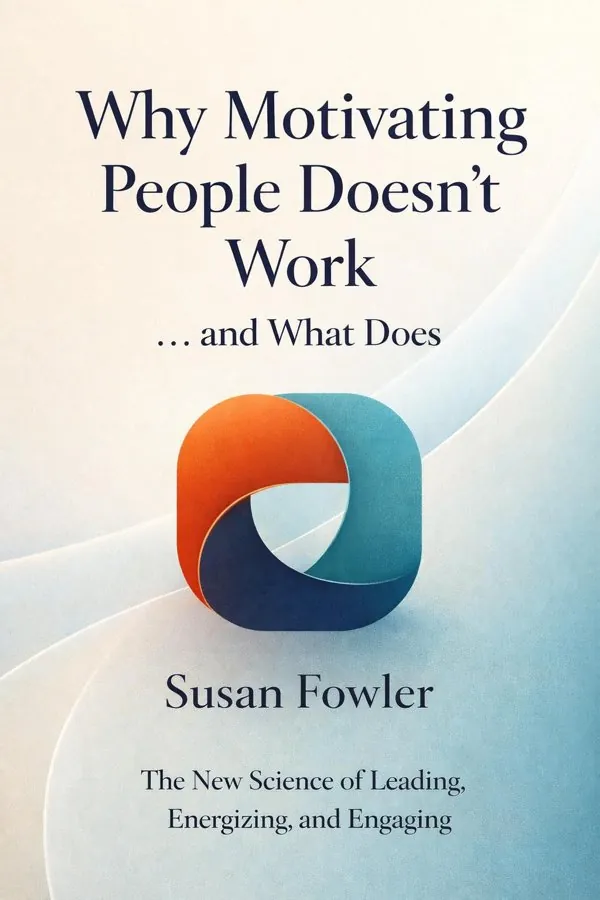
Why Motivating People Doesn't Work ... and What Does: The New Science of Leading, Energizing, and Engaging: Summary & Key Insights
by Susan Fowler
 10 min9 chaptersAudio available
What Is Why Motivating People Doesn't Work ... and What Does: The New Science of Leading, Energizing, and Engaging About?
Why Motivating People Doesn't Work ... and What Does: The New Science of Leading, Energizing, and Engaging by Susan Fowler is a leadership book spanning 9 pages. In this influential management book, Susan Fowler challenges traditional motivational practices and introduces a science-based approach to leadership. She explains why external rewards and pressure often fail to inspire sustainable performance and offers a framework for fostering autonomy, relatedness, and competence in the workplace. Drawing on self-determination theory, Fowler provides practical strategies for leaders to create environments where people thrive through internal motivation and meaningful engagement.
This FizzRead summary covers all 9 key chapters of Why Motivating People Doesn't Work ... and What Does: The New Science of Leading, Energizing, and Engaging in approximately 10 minutes, distilling the most important ideas, arguments, and takeaways from Susan Fowler's work. Also available as an audio summary and Key Quotes Podcast.
Why Motivating People Doesn't Work ... and What Does: The New Science of Leading, Energizing, and Engaging
In this influential management book, Susan Fowler challenges traditional motivational practices and introduces a science-based approach to leadership. She explains why external rewards and pressure often fail to inspire sustainable performance and offers a framework for fostering autonomy, relatedness, and competence in the workplace. Drawing on self-determination theory, Fowler provides practical strategies for leaders to create environments where people thrive through internal motivation and meaningful engagement.
Who Should Read Why Motivating People Doesn't Work ... and What Does: The New Science of Leading, Energizing, and Engaging?
This book is perfect for anyone interested in leadership and looking to gain actionable insights in a short read. Whether you're a student, professional, or lifelong learner, the key ideas from Why Motivating People Doesn't Work ... and What Does: The New Science of Leading, Energizing, and Engaging by Susan Fowler will help you think differently.
- ✓Readers who enjoy leadership and want practical takeaways
- ✓Professionals looking to apply new ideas to their work and life
- ✓Anyone who wants the core insights of Why Motivating People Doesn't Work ... and What Does: The New Science of Leading, Energizing, and Engaging in just 10 minutes
Want the full summary?
Get instant access to this book summary and 100K+ more with Fizz Moment.
Get Free SummaryAvailable on App Store • Free to download
Key Chapters
For decades, management thinking has been dominated by the belief that people need external stimulus to work hard—money, recognition, or fear of failure. Yet, science repeatedly shows that these external motivators only spark short-term compliance, not long-term commitment. When we dangle carrots, people may chase them for a while, but their internal drive weakens. Worse, when rewards fail to materialize or when pressure intensifies, motivation deteriorates entirely. I have seen this countless times: incentive systems that make people obsess about the bonus rather than the purpose, leaders who believe increased surveillance boosts productivity when it actually fuels resistance.
The deeper issue is misunderstanding human motivation. We assume people are empty vessels needing to be filled with incentives. But motivation is not a commodity; it’s a dynamic psychological experience. When we manipulate it externally, we undermine autonomy—the very foundation of inner drive. We produce compliant behavior rather than creative engagement. This is why so many organizations face burnout, disengagement, and turnover even while offering lucrative perks and recognition.
What I urge leaders to see is that control-based motivation traps us in a vicious cycle. It might deliver short bursts of performance, but it erodes well-being and innovation. True motivation arises when people feel ownership of their actions, understand their value, and connect meaningfully with others. The shift begins by acknowledging that traditional motivation—built on rewards and punishment—is broken not because people are broken but because our methods ignore their deeper psychological needs.
To move beyond outdated methods, we need to understand the science of motivation itself. Studies in psychology and neuroscience tell us that all human behavior is driven by the quest to satisfy three basic psychological needs: autonomy (the desire to act with a sense of choice), relatedness (the need to connect and feel that our actions contribute to others), and competence (the drive to grow and master our environment). When these needs are fulfilled, people experience vitality, creativity, and persistence. When they are thwarted, they fall into apathy or resentment.
Motivation is not just high or low—it’s **quality**, not quantity, that matters. Two people may work equally hard, but their internal experience can differ dramatically. One may feel energized by purpose; the other, drained by obligation. The difference lies in whether their motivation is autonomous or controlled. Controlled motivation—based on pressure, rewards, or fear—narrows focus and eventually backfires. Autonomous motivation—aligned with values, interest, and choice—expands awareness and sustains effort.
Understanding this distinction liberates leaders from the illusion of control. You can’t motivate others by imposing incentives; you can only create conditions where they motivate themselves. This requires empathy, curiosity, and genuine dialogue. When leaders begin to explore what truly inspires their people, they unlock energy that no bonus check could buy.
+ 7 more chapters — available in the FizzRead app
All Chapters in Why Motivating People Doesn't Work ... and What Does: The New Science of Leading, Energizing, and Engaging
About the Author
Susan Fowler is an American leadership consultant, researcher, and author known for her work on motivation and workplace engagement. She has served as a senior consulting partner with The Ken Blanchard Companies and has written extensively on self-leadership and motivation science.
Get This Summary in Your Preferred Format
Read or listen to the Why Motivating People Doesn't Work ... and What Does: The New Science of Leading, Energizing, and Engaging summary by Susan Fowler anytime, anywhere. FizzRead offers multiple formats so you can learn on your terms — all free.
Available formats: App · Audio · PDF · EPUB — All included free with FizzRead
Download Why Motivating People Doesn't Work ... and What Does: The New Science of Leading, Energizing, and Engaging PDF and EPUB Summary
Key Quotes from Why Motivating People Doesn't Work ... and What Does: The New Science of Leading, Energizing, and Engaging
“For decades, management thinking has been dominated by the belief that people need external stimulus to work hard—money, recognition, or fear of failure.”
“To move beyond outdated methods, we need to understand the science of motivation itself.”
Frequently Asked Questions about Why Motivating People Doesn't Work ... and What Does: The New Science of Leading, Energizing, and Engaging
Why Motivating People Doesn't Work ... and What Does: The New Science of Leading, Energizing, and Engaging by Susan Fowler is a leadership book that explores key ideas across 9 chapters. In this influential management book, Susan Fowler challenges traditional motivational practices and introduces a science-based approach to leadership. She explains why external rewards and pressure often fail to inspire sustainable performance and offers a framework for fostering autonomy, relatedness, and competence in the workplace. Drawing on self-determination theory, Fowler provides practical strategies for leaders to create environments where people thrive through internal motivation and meaningful engagement.
You Might Also Like

Extreme Ownership
Jocko Willink
10 min
Dare to Lead
Brene Brown
10 min
Leaders Eat Last
Simon Sinek
10 min
The 21 Irrefutable Laws of Leadership
John Maxwell
10 min
Start With Why
Simon Sinek
10 min
How to Lead When You're Not in Charge
Clay Scroggins
10 minBrowse by Category
Ready to read Why Motivating People Doesn't Work ... and What Does: The New Science of Leading, Energizing, and Engaging?
Get the full summary and 100K+ more books with Fizz Moment.