
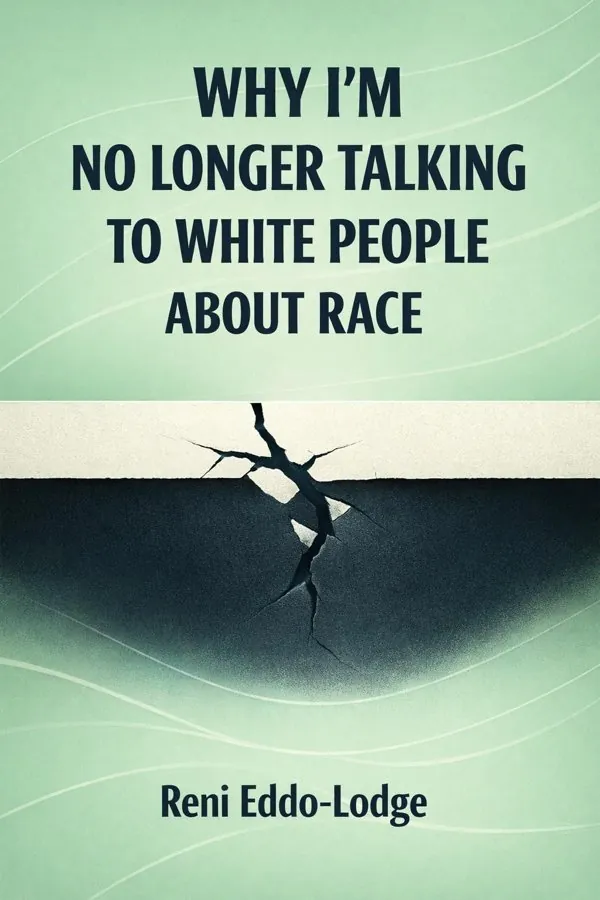
Why I'm No Longer Talking to White People About Race: Summary & Key Insights
 10 min7 chaptersAudio available
What Is Why I'm No Longer Talking to White People About Race About?
Why I'm No Longer Talking to White People About Race by Reni Eddo-Lodge is a sociology book spanning 7 pages. In this powerful and provocative book, Reni Eddo-Lodge explores the deep-rooted racial inequalities that persist in British society. Beginning with her viral blog post of the same name, she examines the structural racism embedded in institutions, history, and everyday life, and challenges readers to confront their own complicity. Through a blend of personal reflection, historical analysis, and social commentary, Eddo-Lodge offers a compelling call for awareness and change.
This FizzRead summary covers all 7 key chapters of Why I'm No Longer Talking to White People About Race in approximately 10 minutes, distilling the most important ideas, arguments, and takeaways from Reni Eddo-Lodge's work. Also available as an audio summary and Key Quotes Podcast.
Why I'm No Longer Talking to White People About Race
In this powerful and provocative book, Reni Eddo-Lodge explores the deep-rooted racial inequalities that persist in British society. Beginning with her viral blog post of the same name, she examines the structural racism embedded in institutions, history, and everyday life, and challenges readers to confront their own complicity. Through a blend of personal reflection, historical analysis, and social commentary, Eddo-Lodge offers a compelling call for awareness and change.
Who Should Read Why I'm No Longer Talking to White People About Race?
This book is perfect for anyone interested in sociology and looking to gain actionable insights in a short read. Whether you're a student, professional, or lifelong learner, the key ideas from Why I'm No Longer Talking to White People About Race by Reni Eddo-Lodge will help you think differently.
- ✓Readers who enjoy sociology and want practical takeaways
- ✓Professionals looking to apply new ideas to their work and life
- ✓Anyone who wants the core insights of Why I'm No Longer Talking to White People About Race in just 10 minutes
Want the full summary?
Get instant access to this book summary and 100K+ more with Fizz Moment.
Get Free SummaryAvailable on App Store • Free to download
Key Chapters
Before we can understand the racial dynamics of modern Britain, we must confront the history that built them. Too often, British education offers only fragments: a sanitized version of empire centered on exploration and progress, not domination and exploitation. I wanted to uncover the histories that never make it into the textbooks — the story of Britain’s involvement in the transatlantic slave trade, the wealth accumulated through forced labor, and the political decisions that have been quietly tucked away as national achievements.
Britain’s reluctance to face its own racial past is not accidental. It is a deliberate forgetting, one that allows the country to maintain a moral high ground while continuing to benefit from the legacies of empire. When statues of slave traders still stand and museums display colonial loot as 'treasure,' it tells a story about who Britain chooses to remember. My intention in revisiting this history is not to dwell in guilt, but to recognize that structural racism has a lineage. Britishness itself was defined in contrast to those it colonized — white supremacy institutionalized as national identity.
Until this history is taught honestly, until it is understood as a living force shaping the present, we cannot claim progress. Modern racism did not spring out of nowhere; it was built into the foundation.
Racism is not merely about rude comments or hateful acts; it is built into the structure of our institutions. In Britain, this systemic racism operates seamlessly — through education, employment, housing, media, and the criminal justice system. When Black children are disproportionately excluded from schools, when CVs with 'foreign-sounding' names are passed over for interviews, when police forces stop and search Black people far more often than their white peers, these are not isolated incidents. They are the symptoms of a system working exactly as designed.
The language of neutrality often hides bias. Policies that appear colorblind can reproduce inequality when they fail to acknowledge preexisting disparities. That is why I argue that racism must be understood as a system of power — not as a matter of individual intent. The challenge is to see that white people benefit from this system even if they never ask to.
The system’s persistence depends on denial. If society refuses to admit there is a problem, there can be no solution. That denial is more dangerous than overt aggression because it makes racism socially invisible. True change demands that we name the machinery of inequality and dismantle it, piece by piece.
+ 5 more chapters — available in the FizzRead app
All Chapters in Why I'm No Longer Talking to White People About Race
About the Author
Reni Eddo-Lodge is a British journalist, author, and podcaster known for her incisive commentary on race, feminism, and social justice. Her work has appeared in major publications such as The Guardian, The Independent, and The New York Times. Her debut book, 'Why I'm No Longer Talking to White People About Race,' became a bestseller and won multiple awards for its groundbreaking discussion of race in the UK.
Get This Summary in Your Preferred Format
Read or listen to the Why I'm No Longer Talking to White People About Race summary by Reni Eddo-Lodge anytime, anywhere. FizzRead offers multiple formats so you can learn on your terms — all free.
Available formats: App · Audio · PDF · EPUB — All included free with FizzRead
Download Why I'm No Longer Talking to White People About Race PDF and EPUB Summary
Key Quotes from Why I'm No Longer Talking to White People About Race
“Before we can understand the racial dynamics of modern Britain, we must confront the history that built them.”
“Racism is not merely about rude comments or hateful acts; it is built into the structure of our institutions.”
Frequently Asked Questions about Why I'm No Longer Talking to White People About Race
Why I'm No Longer Talking to White People About Race by Reni Eddo-Lodge is a sociology book that explores key ideas across 7 chapters. In this powerful and provocative book, Reni Eddo-Lodge explores the deep-rooted racial inequalities that persist in British society. Beginning with her viral blog post of the same name, she examines the structural racism embedded in institutions, history, and everyday life, and challenges readers to confront their own complicity. Through a blend of personal reflection, historical analysis, and social commentary, Eddo-Lodge offers a compelling call for awareness and change.
You Might Also Like
Between the World and Me
Ta-Nehisi Coates
10 min
Half the Sky
Nicholas D. Kristof, Sheryl WuDunn
10 min
Men Explain Things To Me
Rebecca Solnit
10 min
Rational Ritual
Michael Suk-Young Chwe
10 min
The New Jim Crow
Michelle Alexander
10 min
Beyond Culture
Edward T. Hall
10 minBrowse by Category
Ready to read Why I'm No Longer Talking to White People About Race?
Get the full summary and 100K+ more books with Fizz Moment.