
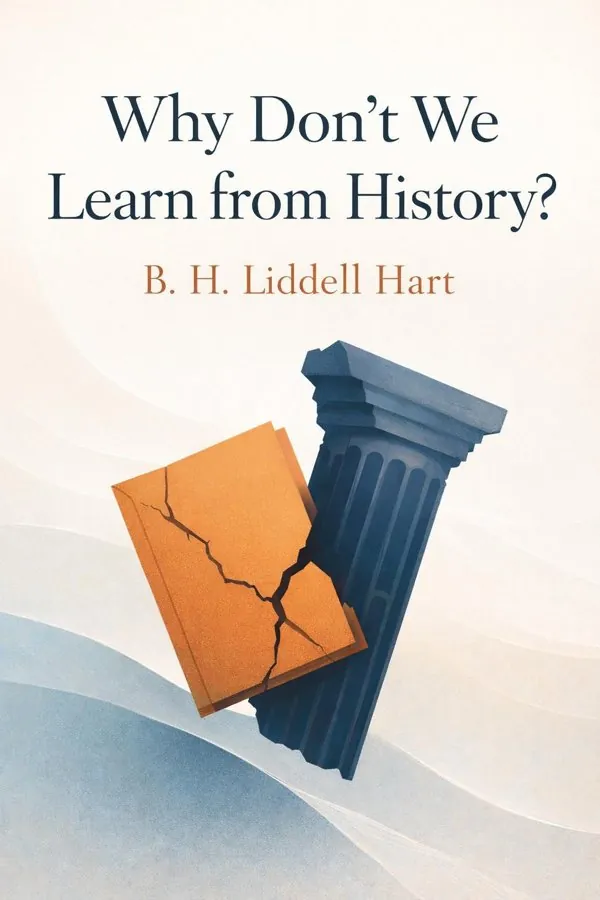
Why Don't We Learn from History?: Summary & Key Insights
 10 min10 chaptersAudio available
What Is Why Don't We Learn from History? About?
Why Don't We Learn from History? by B. H. Liddell Hart is a war_military book spanning 10 pages. This book by British military historian Basil Henry Liddell Hart explores the recurring patterns of human error in warfare and politics. Written after World War II, it reflects on how societies fail to learn from past mistakes, emphasizing the importance of historical understanding for future peace and strategic wisdom.
This FizzRead summary covers all 10 key chapters of Why Don't We Learn from History? in approximately 10 minutes, distilling the most important ideas, arguments, and takeaways from B. H. Liddell Hart's work. Also available as an audio summary and Key Quotes Podcast.
Why Don't We Learn from History?
This book by British military historian Basil Henry Liddell Hart explores the recurring patterns of human error in warfare and politics. Written after World War II, it reflects on how societies fail to learn from past mistakes, emphasizing the importance of historical understanding for future peace and strategic wisdom.
Who Should Read Why Don't We Learn from History??
This book is perfect for anyone interested in war_military and looking to gain actionable insights in a short read. Whether you're a student, professional, or lifelong learner, the key ideas from Why Don't We Learn from History? by B. H. Liddell Hart will help you think differently.
- ✓Readers who enjoy war_military and want practical takeaways
- ✓Professionals looking to apply new ideas to their work and life
- ✓Anyone who wants the core insights of Why Don't We Learn from History? in just 10 minutes
Want the full summary?
Get instant access to this book summary and 100K+ more with Fizz Moment.
Get Free SummaryAvailable on App Store • Free to download
Key Chapters
When I speak of history, I do not refer simply to dates or deeds inscribed in dusty volumes. History is the record of human behavior—the grand experiment of our instincts and intellect across generations. Its fundamental value lies in its ability to reveal patterns of cause and consequence. Yet, people often treat it as entertainment or justification, never as instruction. That is the tragedy.
In essence, history is the world’s memory. But memory is useless unless it is interpreted honestly. Too often, pride, prejudice, and the convenient forgetfulness of power distort its meaning. Nations remember their victories but ignore the wisdom of their losses. Politicians invoke historical precedents selectively, shaping memory into propaganda. Thus, the true nature of history—its capacity to educate through failure—is lost.
During my own study of war, from ancient conflicts to the catastrophes of the twentieth century, I found that the laws of behavior repeat themselves. When arrogance replaces prudence, when emotion outweighs reason, disaster follows. Those patterns endure not because history fails to teach, but because we fail to learn. To engage history properly is to treat it as a disciplined inquiry—a moral and intellectual exercise demanding humility before truth. If we read history merely to confirm our opinions, we remain trapped in illusion. But if we read it to understand how people act under pressure, we begin to see through the mirage of our own self-deception.
Thus, the nature of history is dual: it is mirror and teacher. It shows us what we have been and what we might become. Yet, it teaches only to those willing to be taught. The student of history must bear the discomfort of recognizing himself in the errors of the past.
The most lethal errors arise not from ignorance of history, but from its distortion. Leaders, analysts, and even historians commit the crime of interpretation—bending facts to suit the doctrine they wish to prove. Throughout my research I have encountered this repeatedly: generals justifying aggression through misread precedents, politicians invoking history to sanctify ambition.
History, when treated without honesty, becomes a weapon of ideology. Each epoch has seen its thinkers pervert truth for national comfort. Whether in the glorification of imperial conquest or the defense of revolutionary violence, interpretation has often served to excuse rather than enlighten. The historian’s duty is sacred precisely because it guards against such misuse. To preserve truth is not to provide moral approval, but to present the record in the cold light of reality. Yet too few accept this responsibility.
When we analyze past wars and policies, we must ask not what success someone claimed, but what price was paid—morally and materially. The interpretation that omits suffering is dishonest; the one that glorifies cunning at the expense of conscience is corrupt. History can only guide when stripped of flattery. My own experience in military affairs taught me that failure usually begins in false interpretation: generals who cling to outdated victories, rulers who mistake temporary advantage for enduring truth.
To learn from history, therefore, we must first learn how to interpret it rightly. The process demands critical detachment—a refusal to accept comforting myths. A society that loses its ability to judge its past truthfully cannot distinguish between courage and recklessness, between wisdom and pride. Such blindness is the seed of future tragedy.
+ 8 more chapters — available in the FizzRead app
All Chapters in Why Don't We Learn from History?
About the Author
Basil Henry Liddell Hart (1895–1970) was a British soldier, military theorist, and historian. He is known for his influential works on military strategy, including the concept of the 'indirect approach' and his analyses of both World Wars. His writings have shaped modern military thought and strategic studies.
Get This Summary in Your Preferred Format
Read or listen to the Why Don't We Learn from History? summary by B. H. Liddell Hart anytime, anywhere. FizzRead offers multiple formats so you can learn on your terms — all free.
Available formats: App · Audio · PDF · EPUB — All included free with FizzRead
Download Why Don't We Learn from History? PDF and EPUB Summary
Key Quotes from Why Don't We Learn from History?
“When I speak of history, I do not refer simply to dates or deeds inscribed in dusty volumes.”
“The most lethal errors arise not from ignorance of history, but from its distortion.”
Frequently Asked Questions about Why Don't We Learn from History?
Why Don't We Learn from History? by B. H. Liddell Hart is a war_military book that explores key ideas across 10 chapters. This book by British military historian Basil Henry Liddell Hart explores the recurring patterns of human error in warfare and politics. Written after World War II, it reflects on how societies fail to learn from past mistakes, emphasizing the importance of historical understanding for future peace and strategic wisdom.
You Might Also Like
Patriot
Andrew Britton
10 min
War
John Hersey
10 min
An Army at Dawn: The War in North Africa, 1942–1943
Rick Atkinson
10 min
Brave New War: The Next Stage of Terrorism and the End of Globalization
John Robb
10 min
Catch-22
Joseph Heller
10 min
Command and Control: Nuclear Weapons, the Damascus Accident, and the Illusion of Safety
Eric Schlosser
10 minBrowse by Category
Ready to read Why Don't We Learn from History??
Get the full summary and 100K+ more books with Fizz Moment.