
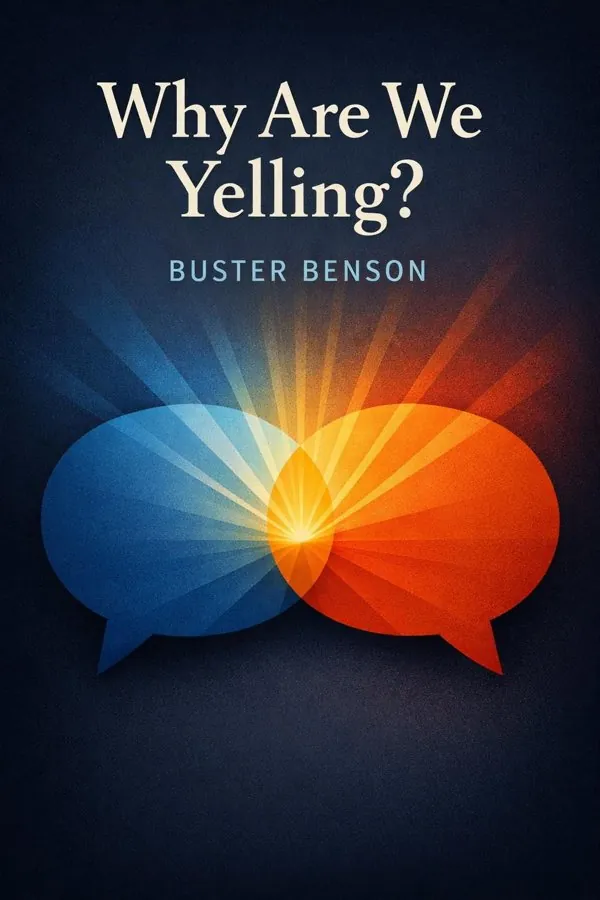
Why Are We Yelling?: The Art of Productive Disagreement: Summary & Key Insights
 10 min11 chaptersAudio available
What Is Why Are We Yelling?: The Art of Productive Disagreement About?
Why Are We Yelling?: The Art of Productive Disagreement by Buster Benson is a communication book spanning 11 pages. This book explores how to turn arguments and disagreements into constructive conversations. Buster Benson draws on cognitive psychology and communication research to show how people can better understand their biases, listen empathetically, and find common ground even in heated debates. It offers practical tools for improving relationships, teamwork, and decision-making through productive disagreement.
This FizzRead summary covers all 11 key chapters of Why Are We Yelling?: The Art of Productive Disagreement in approximately 10 minutes, distilling the most important ideas, arguments, and takeaways from Buster Benson's work. Also available as an audio summary and Key Quotes Podcast.
Why Are We Yelling?: The Art of Productive Disagreement
This book explores how to turn arguments and disagreements into constructive conversations. Buster Benson draws on cognitive psychology and communication research to show how people can better understand their biases, listen empathetically, and find common ground even in heated debates. It offers practical tools for improving relationships, teamwork, and decision-making through productive disagreement.
Who Should Read Why Are We Yelling?: The Art of Productive Disagreement?
This book is perfect for anyone interested in communication and looking to gain actionable insights in a short read. Whether you're a student, professional, or lifelong learner, the key ideas from Why Are We Yelling?: The Art of Productive Disagreement by Buster Benson will help you think differently.
- ✓Readers who enjoy communication and want practical takeaways
- ✓Professionals looking to apply new ideas to their work and life
- ✓Anyone who wants the core insights of Why Are We Yelling?: The Art of Productive Disagreement in just 10 minutes
Want the full summary?
Get instant access to this book summary and 100K+ more with Fizz Moment.
Get Free SummaryAvailable on App Store • Free to download
Key Chapters
Disagreement begins as something innocent: two people trying to make sense of the same world from different angles. But what makes it so emotionally charged is how our brains interpret it. From an evolutionary standpoint, disagreement used to signal danger. If your tribe disagreed with you, it could mean exclusion, even death. Our nervous systems have not evolved much since then. Today, when a colleague challenges our idea in a meeting, we experience the same physiological stress as if being chased by a predator.
The key insight is that disagreement is not about the content of the dispute alone—it's about what’s underneath it. Our arguments often mask needs for belonging, safety, and recognition. When we sense those bonds are threatened, we fight harder, not smarter. I’ve learned, both in personal relationships and during product debates in tech, that people rarely argue because they hate each other. They argue because they care about something deeply and feel unseen or misunderstood.
Recognizing this pattern allows us to pause. That pause is where the magic begins. Instead of defending, we can become curious. What if this disagreement isn’t an obstacle but a signal that something important is at stake? What if both of us are right from different vantage points? The truth is that most disagreements contain a hidden collaboration waiting to be uncovered. The art of productive disagreement begins with noticing this shift—from fear to curiosity, from opposition to exploration.
Our brains are miraculous yet flawed machines. To survive in a world overflowing with information, they rely on heuristics—mental shortcuts that help us decide quickly. But these same shortcuts distort our understanding in disagreement. We suffer from confirmation bias, seeking only what supports our existing beliefs. We fall prey to fundamental attribution error, assuming someone’s behavior reveals who they are instead of the situation they’re in. We engage in binary thinking, splitting the world into good or bad, right or wrong.
I’ve spent years studying and mapping these biases, which together form what I call the Cognitive Bias Codex. Once you start noticing them, it’s astonishing how often they hijack argument. A partner forgets to do a chore, and instead of noticing our own stress or assumptions, we make a sweeping judgment about their character. A colleague rejects our idea, and we assume hostility rather than a different perspective.
The way out isn’t to eliminate bias—it’s to become aware of it. When we learn to slow down and ask what our brains might be filtering out, we move from reactive to reflective. It’s like turning on the lights in a dark room; you can finally see the furniture you’ve been bumping into. In productive disagreement, awareness of bias acts as humility’s best friend. It lets us say, “Maybe I don’t see the whole picture, but I want to.” That willingness opens space for genuine dialogue.
+ 9 more chapters — available in the FizzRead app
All Chapters in Why Are We Yelling?: The Art of Productive Disagreement
About the Author
Buster Benson is an entrepreneur and writer known for his work on cognitive biases and communication. He has worked at companies such as Amazon, Twitter, and Slack, and is the creator of the Cognitive Bias Codex. His writing focuses on how people think, argue, and collaborate more effectively.
Get This Summary in Your Preferred Format
Read or listen to the Why Are We Yelling?: The Art of Productive Disagreement summary by Buster Benson anytime, anywhere. FizzRead offers multiple formats so you can learn on your terms — all free.
Available formats: App · Audio · PDF · EPUB — All included free with FizzRead
Download Why Are We Yelling?: The Art of Productive Disagreement PDF and EPUB Summary
Key Quotes from Why Are We Yelling?: The Art of Productive Disagreement
“Disagreement begins as something innocent: two people trying to make sense of the same world from different angles.”
“Our brains are miraculous yet flawed machines.”
Frequently Asked Questions about Why Are We Yelling?: The Art of Productive Disagreement
Why Are We Yelling?: The Art of Productive Disagreement by Buster Benson is a communication book that explores key ideas across 11 chapters. This book explores how to turn arguments and disagreements into constructive conversations. Buster Benson draws on cognitive psychology and communication research to show how people can better understand their biases, listen empathetically, and find common ground even in heated debates. It offers practical tools for improving relationships, teamwork, and decision-making through productive disagreement.
You Might Also Like
Magic Words: The Science and Secrets Behind Seven Words That Motivate, Engage, and Influence
Tim David
10 min
Talking Across The Divide: How to Communicate with People You Disagree with and Maybe Even Change the World
Justin Lee
10 min
The Exceptional Presenter: A Proven Formula to Open Up! and Own the Room
Timothy J. Koegel
10 min
4 Essential Keys to Effective Communication in Love, Life, Work--Anywhere!: Including the 12-Day Communication Challenge!
Bento C. Leal III
10 min
Active Listening Techniques: 30 Practical Tools to Hone Your Communication Skills
Nisha Gupta
10 min
Bargaining for Advantage: Negotiation Strategies for Reasonable People
G. Richard Shell
10 minBrowse by Category
Ready to read Why Are We Yelling?: The Art of Productive Disagreement?
Get the full summary and 100K+ more books with Fizz Moment.