
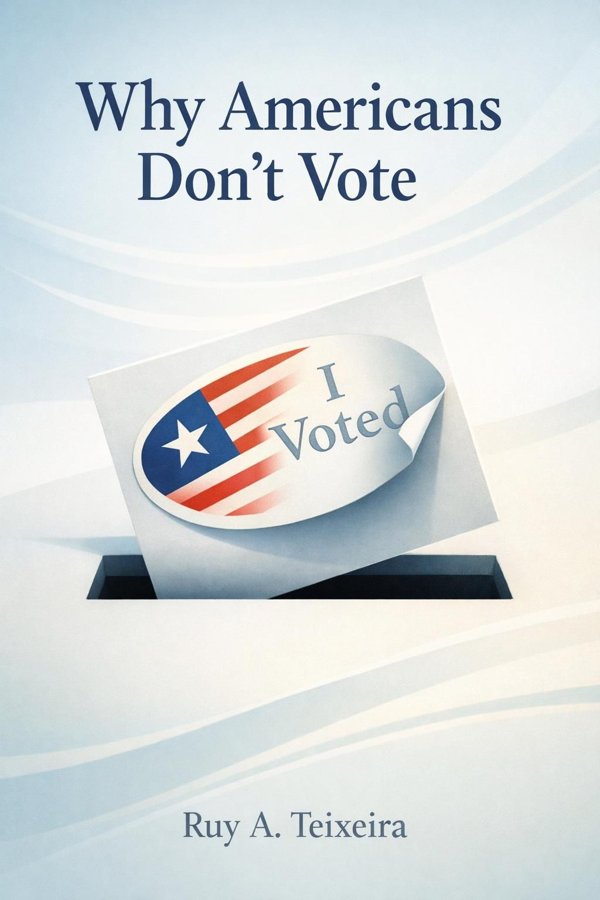
Why Americans Don't Vote: Summary & Key Insights
 10 min9 chaptersAudio available
Key Takeaways from Why Americans Don't Vote
A democracy does not become less participatory overnight; it drifts there through decades of accumulated change.
The people least likely to vote are often the people with the least margin for error in everyday life.
When a nation’s population changes, its voting patterns change too.
Many Americans do not fail to vote because they reject democracy; they fail because democracy asks too much of them.
People are far more likely to vote when someone asks them to.
What Is Why Americans Don't Vote About?
Why Americans Don't Vote by Ruy A. Teixeira is a politics book spanning 8 pages. Voting is often described as the simplest act of citizenship, yet millions of Americans routinely choose not to do it. In Why Americans Don't Vote, political scientist Ruy A. Teixeira investigates this puzzle with unusual depth and discipline. Rather than blaming nonvoters on laziness, ignorance, or moral decline, he shows that falling turnout is the result of larger social, economic, political, and institutional forces that have reshaped American life. His analysis connects changes in education, class structure, family patterns, party organization, electoral rules, and public trust to explain why participation has weakened over time. What makes this book matter is that it treats low turnout not as a side issue, but as a warning sign about the health of democracy itself. If some groups vote consistently while others stay home, political power becomes unevenly distributed and public policy follows suit. Teixeira writes with the authority of a careful political analyst, grounding his claims in data and comparative perspective rather than slogans. The result is a serious, accessible explanation of why voter participation declined in the United States and what that trend reveals about inequality, representation, and the future of democratic engagement.
This FizzRead summary covers all 9 key chapters of Why Americans Don't Vote in approximately 10 minutes, distilling the most important ideas, arguments, and takeaways from Ruy A. Teixeira's work. Also available as an audio summary and Key Quotes Podcast.
Why Americans Don't Vote
Voting is often described as the simplest act of citizenship, yet millions of Americans routinely choose not to do it. In Why Americans Don't Vote, political scientist Ruy A. Teixeira investigates this puzzle with unusual depth and discipline. Rather than blaming nonvoters on laziness, ignorance, or moral decline, he shows that falling turnout is the result of larger social, economic, political, and institutional forces that have reshaped American life. His analysis connects changes in education, class structure, family patterns, party organization, electoral rules, and public trust to explain why participation has weakened over time.
What makes this book matter is that it treats low turnout not as a side issue, but as a warning sign about the health of democracy itself. If some groups vote consistently while others stay home, political power becomes unevenly distributed and public policy follows suit. Teixeira writes with the authority of a careful political analyst, grounding his claims in data and comparative perspective rather than slogans. The result is a serious, accessible explanation of why voter participation declined in the United States and what that trend reveals about inequality, representation, and the future of democratic engagement.
Who Should Read Why Americans Don't Vote?
This book is perfect for anyone interested in politics and looking to gain actionable insights in a short read. Whether you're a student, professional, or lifelong learner, the key ideas from Why Americans Don't Vote by Ruy A. Teixeira will help you think differently.
- ✓Readers who enjoy politics and want practical takeaways
- ✓Professionals looking to apply new ideas to their work and life
- ✓Anyone who wants the core insights of Why Americans Don't Vote in just 10 minutes
Want the full summary?
Get instant access to this book summary and 100K+ more with Fizz Moment.
Get Free SummaryAvailable on App Store • Free to download
Key Chapters
A democracy does not become less participatory overnight; it drifts there through decades of accumulated change. Teixeira begins by showing that low voter turnout in the United States is not a sudden anomaly but the endpoint of a long historical decline. In the late nineteenth and early twentieth centuries, turnout in presidential elections was much higher, helped by intense party loyalty, strong local political organizations, and a culture in which elections were major social events. Over time, however, those conditions weakened. Political parties became less rooted in neighborhoods, civic life became less communal, and elections lost some of their ritual intensity.
This historical view matters because it challenges simplistic explanations. Americans did not suddenly become more apathetic. Instead, the institutions and social environments that once drew people into politics gradually changed. Reforms designed to make politics cleaner and more rational, such as weakening machine politics or professionalizing administration, sometimes had the unintended effect of reducing the personal contact and social pressure that once brought ordinary citizens to the polls. At the same time, growing mobility and social fragmentation made politics feel less embedded in everyday life.
A practical example is the contrast between an earlier era in which ward leaders, union networks, and party clubs actively reminded and escorted people to vote, and the modern era in which citizens often must independently track deadlines, registration rules, and election schedules. One system may have been messier, but it was also more mobilizing.
The actionable takeaway: if we want to raise turnout, we should stop treating nonvoting as a purely individual failure and start rebuilding the social and institutional structures that make participation feel normal, easy, and expected.
The people least likely to vote are often the people with the least margin for error in everyday life. One of Teixeira’s core arguments is that turnout is strongly tied to socioeconomic status. Education, income, job stability, and social integration all increase the likelihood that someone will vote. Citizens with more education are generally better equipped to understand political information, navigate registration procedures, and feel confident that their participation matters. Higher-income voters often have more stable routines, more flexible schedules, and stronger ties to organizations that encourage engagement.
By contrast, those facing economic insecurity encounter hidden barriers everywhere. A person working irregular hours, moving frequently, juggling childcare, or dealing with transportation problems may care about politics deeply yet still miss registration deadlines or Election Day itself. Teixeira’s insight is powerful because it shifts attention away from abstract civic virtue and toward the lived realities of inequality. Low turnout is not just a political problem; it is partly a social and economic one.
This has major consequences for representation. If wealthier and more educated citizens vote more consistently, elected officials have stronger incentives to prioritize their concerns. That can produce a feedback loop: underrepresented groups feel ignored, become less trusting of government, and are then even less likely to participate in future elections.
In practical terms, think of two citizens: one with a salaried job, reliable internet, and a college degree; the other working hourly shifts, moving apartments often, and lacking paid time off. Even if both care equally, the first faces a much easier path to the ballot.
The actionable takeaway: increasing turnout requires reducing the practical burdens that fall hardest on lower-income citizens through simpler registration, flexible voting options, and stronger civic outreach in underserved communities.
When a nation’s population changes, its voting patterns change too. Teixeira argues that demographic shifts are central to understanding turnout decline. The American electorate is not a fixed body; it is shaped by generational replacement, migration, urbanization, changing family structures, and the growth of groups that have historically participated at lower rates. Younger voters, for example, generally turn out less than older voters, not necessarily because they are less idealistic but because they are less settled, less attached to parties, and less habituated to voting.
Similarly, newer entrants into the electorate, including some immigrant communities or socially marginal populations, may face weaker political incorporation. If institutions fail to effectively welcome these groups into the democratic process, national turnout can fall even as the eligible population expands. Teixeira’s point is subtle: demographic change itself is not the problem. The problem is that political institutions and parties often fail to adapt their mobilization strategies to changing populations.
Consider a city with rapid population growth among young renters and first-generation Americans. If voter outreach is still built around older homeowners and long-established neighborhoods, many eligible voters will remain disconnected. The issue is not disinterest alone; it is a mismatch between who the electorate is becoming and how the system still expects voters to behave.
This idea also warns against reading turnout numbers too superficially. Aggregate decline may partly reflect the growing share of groups with historically lower participation rates. That means improving turnout requires targeted inclusion rather than generic appeals about civic duty.
The actionable takeaway: parties, campaigns, and civic institutions must design outreach around emerging demographics, especially younger, more mobile, and less institutionally connected citizens, instead of assuming traditional voting habits will reproduce themselves.
Many Americans do not fail to vote because they reject democracy; they fail because democracy asks too much of them. Teixeira highlights the importance of institutional barriers, especially the unusually burdensome structure of American elections. Compared with many democracies, the United States makes participation more complicated through voter registration requirements, decentralized election administration, weekday voting, and a fragmented electoral calendar filled with primaries, local races, and off-cycle contests.
These obstacles may appear minor to highly engaged citizens, but they have large cumulative effects. Registering in advance, updating an address after moving, locating a polling place, understanding separate primary rules, and carving out time on a workday all impose costs. Each step filters out some portion of the electorate. The burden falls most heavily on citizens who are younger, poorer, less educated, or more geographically mobile.
Teixeira’s analysis is especially useful because it shows that institutions are not neutral containers. Rules shape behavior. A country can express support for democratic participation while still maintaining procedures that make turnout harder than it needs to be. This helps explain why the United States often lags behind other democracies in participation despite strong rhetorical commitment to popular government.
A clear practical example is automatic registration. In systems where the state takes responsibility for registering eligible citizens, turnout tends to be less dependent on individual administrative competence. In the U.S. model, citizens often bear that responsibility themselves, and many fall through the cracks.
The actionable takeaway: if participation is the goal, election systems should be designed for convenience rather than endurance, using reforms such as automatic registration, same-day registration, early voting, and clearer ballot access rules.
People are far more likely to vote when someone asks them to. One of Teixeira’s most important themes is the declining mobilizing power of political parties. Historically, parties did more than nominate candidates and run television ads. They built local networks, maintained neighborhood ties, and provided citizens with regular cues about why elections mattered. As party organizations weakened and campaigning became more candidate-centered and media-driven, many citizens lost the direct contact that often turns passive interest into actual turnout.
This matters because participation is not simply a personal decision made in isolation. Voting is socially encouraged. When parties are rooted in workplaces, churches, unions, community groups, and local associations, they create pathways into politics. When they rely instead on broad television messaging and consultant-driven strategies, they often reach habitual voters while missing irregular voters who need personal contact and repeated encouragement.
Teixeira’s argument also helps explain why turnout is uneven. Strong mobilization tends to flow toward groups already seen as politically valuable. Campaigns invest in reliable voters because they are easier to activate and more likely to determine outcomes. Citizens with weak partisan attachment or little history of voting are often ignored, which further reduces their likelihood of participating. Over time, political inequality becomes self-reinforcing.
A practical example is the difference between receiving a generic campaign ad and getting a call from a local volunteer who explains where, when, and why to vote. The second method is far more likely to move a marginal voter.
The actionable takeaway: rebuilding turnout requires stronger grassroots party and civic mobilization, especially face-to-face and community-based outreach aimed at people who are rarely contacted, not just those already likely to vote.
Citizens participate when they believe politics can hear them. Teixeira explores the role of political efficacy and alienation in turnout decline, arguing that many Americans abstain not because they are indifferent to public issues but because they doubt their voice matters. Internal efficacy refers to feeling competent enough to understand politics; external efficacy refers to believing institutions are responsive. When either form weakens, voting becomes less likely.
This helps explain why turnout can decline even during periods of intense political conflict. People may be angry, worried, or opinionated yet still conclude that elections are distant spectacles controlled by elites, money, and insider interests. In that environment, abstention can become a form of resignation rather than apathy. Teixeira’s analysis points to the connection between trust, representation, and participation: when citizens feel unseen, they disengage; when they disengage, elites become even less responsive to them.
Alienation is often strongest among groups that experience economic precarity or cultural exclusion. If campaigns only appear during election season, use abstract language, and fail to produce visible change, people reasonably begin to question the value of participating. This is particularly true when elections are followed by policymaking that seems disconnected from everyday concerns such as wages, healthcare, schools, or neighborhood safety.
A practical application is in civic education and public communication. It is not enough to tell citizens that voting matters; institutions must show concretely how political participation leads to outcomes. Transparent local government, participatory forums, and visible policy feedback can strengthen efficacy.
The actionable takeaway: to increase turnout, democratic institutions must do more than remove procedural barriers; they must also restore the belief that ordinary citizens can understand politics and influence what government does.
Not every reform that sounds democratic actually increases participation. Teixeira treats reform efforts seriously but skeptically, emphasizing that turnout problems are multidimensional. Measures such as easing registration, expanding absentee voting, or changing election administration can help, but they are unlikely to solve the problem alone. Administrative reforms remove friction; they do not automatically create motivation, trust, or mobilization.
This is a crucial distinction. Public debate often oscillates between two weak positions: one side blames individuals for not voting, while the other assumes a single procedural reform will unlock mass participation. Teixeira argues that both views underestimate the complexity of turnout decline. Effective reform must combine easier access with stronger party contact, better civic incorporation, and policies that reduce the underlying inequalities associated with nonparticipation.
For example, early voting can help workers with rigid schedules, but its benefits may be limited if citizens remain unregistered, uninformed, or unconvinced that candidates represent them. Likewise, mail voting may increase convenience, yet it does little for someone who has never been personally mobilized or who distrusts politics altogether. Reform works best when administrative changes are paired with civic investment.
Teixeira’s broader lesson is that democratic participation is an ecosystem. Rules matter, but so do social structures, political organizations, and public confidence. A healthy democracy cannot be engineered by paperwork alone.
The actionable takeaway: evaluate voting reforms by asking two questions at once—does this make participation easier, and does it also help connect underrepresented citizens to meaningful political engagement?
Sometimes the best way to understand a country is to compare it with others. Teixeira places American turnout in comparative perspective and shows that the United States is distinctive among advanced democracies in maintaining relatively low electoral participation. This comparison matters because it undermines the idea that low turnout is simply the inevitable result of modernization, television, or voter complacency. Other democratic nations have also experienced social change, mass media, and political distrust, yet many still produce higher turnout.
What differs is often institutional design and political integration. Many democracies have simpler registration systems, national election administration, fewer elections, stronger party identities, proportional representation, or even compulsory voting. These arrangements reduce the logistical burden on citizens and often make people feel that more votes can influence representation. By contrast, the American system combines multiple barriers with a winner-take-all structure that can make many voters feel their ballot has little impact, especially in safe districts or predictable states.
The comparative lens also reveals how deeply American political culture prizes decentralized, individual responsibility in electoral participation. Citizens are often expected to navigate the system on their own. That expectation may sound civic-minded, but in practice it privileges the already advantaged.
A practical example is registration: in many democracies, government records are used to enroll voters automatically. In the United States, citizens frequently must complete separate steps and monitor their own status, especially after moving.
The actionable takeaway: when thinking about turnout, Americans should treat higher-participation democracies not as irrelevant exceptions but as evidence that election systems can be organized in more inclusive and effective ways.
When fewer people vote, the problem is not just numerical; it is political. Teixeira shows that low turnout changes who gets represented and what issues receive attention. Nonvoters are not a random slice of the population. They are disproportionately younger, poorer, less educated, more mobile, and often less connected to civic organizations. That means turnout decline produces a skewed electorate whose preferences may differ meaningfully from the broader public.
This distortion affects policy. If active voters are older, wealthier, and more socially stable, elected officials will naturally focus more on their priorities, whether in taxation, retirement policy, homeownership incentives, or education funding. The result is not necessarily malicious exclusion. It is a rational response to the incentives of electoral politics. But the effect is serious: those who most need public responsiveness may receive the least of it.
Teixeira’s contribution here is to frame turnout as a problem of democratic equality, not merely democratic participation. A system can hold regular elections and still fail to represent the full citizenry if major segments systematically stay home. In that sense, turnout is a measure of inclusion. It tells us whose voices count in practice, not just in theory.
A practical way to apply this idea is in evaluating political claims about public opinion. Analysts and leaders should ask whether the people speaking through elections reflect the full population or a more privileged subset. That question matters for everything from welfare policy to criminal justice to urban planning.
The actionable takeaway: treat voter turnout as a core representation issue, and support reforms and outreach strategies that bring underrepresented groups into the electorate so policy reflects the whole public more accurately.
All Chapters in Why Americans Don't Vote
About the Author
Ruy A. Teixeira is an American political scientist, commentator, and author known for his work on electoral behavior, demographic change, and the evolution of American political coalitions. His research has focused on how class, race, education, and social change shape voting patterns and party competition in the United States. Over the course of his career, he has written widely on turnout, realignment, and the social foundations of political participation, earning a reputation for combining data-driven analysis with clear, accessible argument. In Why Americans Don't Vote, Teixeira brings that strength to the study of democratic participation, showing how institutional rules and broader inequalities affect who enters the electorate. His work remains influential among scholars, journalists, strategists, and readers interested in the future of American democracy.
Get This Summary in Your Preferred Format
Read or listen to the Why Americans Don't Vote summary by Ruy A. Teixeira anytime, anywhere. FizzRead offers multiple formats so you can learn on your terms — all free.
Available formats: App · Audio · PDF · EPUB — All included free with FizzRead
Download Why Americans Don't Vote PDF and EPUB Summary
Key Quotes from Why Americans Don't Vote
“A democracy does not become less participatory overnight; it drifts there through decades of accumulated change.”
“The people least likely to vote are often the people with the least margin for error in everyday life.”
“When a nation’s population changes, its voting patterns change too.”
“Many Americans do not fail to vote because they reject democracy; they fail because democracy asks too much of them.”
“People are far more likely to vote when someone asks them to.”
Frequently Asked Questions about Why Americans Don't Vote
Why Americans Don't Vote by Ruy A. Teixeira is a politics book that explores key ideas across 9 chapters. Voting is often described as the simplest act of citizenship, yet millions of Americans routinely choose not to do it. In Why Americans Don't Vote, political scientist Ruy A. Teixeira investigates this puzzle with unusual depth and discipline. Rather than blaming nonvoters on laziness, ignorance, or moral decline, he shows that falling turnout is the result of larger social, economic, political, and institutional forces that have reshaped American life. His analysis connects changes in education, class structure, family patterns, party organization, electoral rules, and public trust to explain why participation has weakened over time. What makes this book matter is that it treats low turnout not as a side issue, but as a warning sign about the health of democracy itself. If some groups vote consistently while others stay home, political power becomes unevenly distributed and public policy follows suit. Teixeira writes with the authority of a careful political analyst, grounding his claims in data and comparative perspective rather than slogans. The result is a serious, accessible explanation of why voter participation declined in the United States and what that trend reveals about inequality, representation, and the future of democratic engagement.
You Might Also Like

Antifa: The Anti-Fascist Handbook
Mark Bray
10 min
Attack from Within: How Disinformation Is Sabotaging America
Barbara McQuade
10 min
Coercion, Capital, and European States, AD 990–1992
Charles Tilly
10 min
Digital Democracy: Concepts, Methodologies, Tools, and Applications
Various Authors
10 min
Fascism
Stanley G. Payne
10 min
Fire And Fury: Inside The Trump White House
Michael Wolff
10 minBrowse by Category
Ready to read Why Americans Don't Vote?
Get the full summary and 100K+ more books with Fizz Moment.