
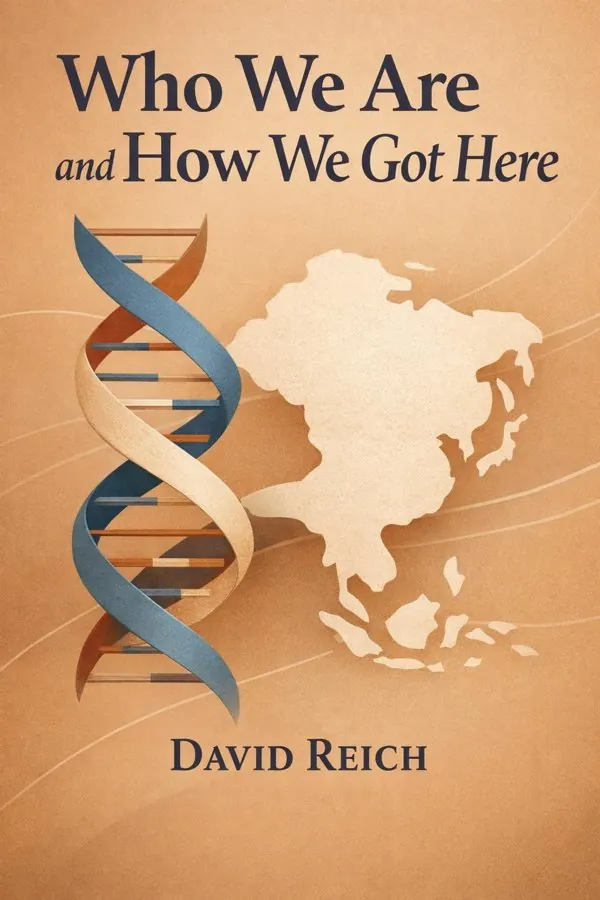
Who We Are and How We Got Here: Ancient DNA and the New Science of the Human Past: Summary & Key Insights
by David Reich
 10 min10 chaptersAudio available
What Is Who We Are and How We Got Here: Ancient DNA and the New Science of the Human Past About?
Who We Are and How We Got Here: Ancient DNA and the New Science of the Human Past by David Reich is a life_science book spanning 10 pages. This book explores how advances in ancient DNA analysis have transformed our understanding of human history. David Reich, a leading geneticist, explains how genetic data reveals the migrations, mixtures, and evolutionary changes that shaped modern populations. The work combines genetics, archaeology, and anthropology to reconstruct the deep history of humanity and challenge traditional narratives about race and ancestry.
This FizzRead summary covers all 10 key chapters of Who We Are and How We Got Here: Ancient DNA and the New Science of the Human Past in approximately 10 minutes, distilling the most important ideas, arguments, and takeaways from David Reich's work. Also available as an audio summary and Key Quotes Podcast.
Who We Are and How We Got Here: Ancient DNA and the New Science of the Human Past
This book explores how advances in ancient DNA analysis have transformed our understanding of human history. David Reich, a leading geneticist, explains how genetic data reveals the migrations, mixtures, and evolutionary changes that shaped modern populations. The work combines genetics, archaeology, and anthropology to reconstruct the deep history of humanity and challenge traditional narratives about race and ancestry.
Who Should Read Who We Are and How We Got Here: Ancient DNA and the New Science of the Human Past?
This book is perfect for anyone interested in life_science and looking to gain actionable insights in a short read. Whether you're a student, professional, or lifelong learner, the key ideas from Who We Are and How We Got Here: Ancient DNA and the New Science of the Human Past by David Reich will help you think differently.
- ✓Readers who enjoy life_science and want practical takeaways
- ✓Professionals looking to apply new ideas to their work and life
- ✓Anyone who wants the core insights of Who We Are and How We Got Here: Ancient DNA and the New Science of the Human Past in just 10 minutes
Want the full summary?
Get instant access to this book summary and 100K+ more with Fizz Moment.
Get Free SummaryAvailable on App Store • Free to download
Key Chapters
When my colleagues and I began working in the field now known as ancient DNA research, the challenges seemed almost insurmountable. DNA is fragile. Time, temperature, and microbial decay reduce it to fragments nearly impossible to read. Yet advances in molecular biology—especially next-generation sequencing and rigorous contamination controls—changed everything. For the first time, we could recover genetic material from bones tens of thousands of years old.
The initial breakthroughs were modest: mitochondrial DNA from a Neanderthal, then partial genomes from ancient humans. But with each improvement, the picture sharpened. DNA sequencing began to show how populations were related across time and geography, providing direct evidence of migrations and replacements that the archaeological record only hinted at. In the early 2010s, the pace accelerated dramatically. Laboratories across Europe, the U.S., and Asia began to process hundreds of samples, revealing that population turnover—one group replacing or mixing with another—was the rule rather than the exception in our past.
This revolution has redefined what we mean by 'ancestry.' Today, we can watch, almost in real time, as populations fracture, migrate, and reunite. Each set of bones becomes not just an artifact but a node in a global network of human history. For me, the most exhilarating moment came when ancient DNA allowed us to see the fingerprints of historical events—such as the spread of agriculture or the migration of horsemen from the Eurasian steppe—not in pottery or tools, but in our genes. That is the power of genetics: it can reveal the hidden pulses of history invisible to the eye.
Europe’s ancient population history is one of continuous transformation. When I first began analyzing genetic data from prehistoric Europeans, the assumption had been that modern Europeans descended largely from hunter-gatherers who populated the continent after the Ice Age. But ancient DNA told a much more complex story.
The first major revelation was that early European farmers, who introduced agriculture from the Near East around 8,000 years ago, were genetically distinct from the hunter-gatherers they encountered. Their arrival represented a true migration, not merely a diffusion of ideas. These early farmers, originally from Anatolia, moved westward, replaced much of the local gene pool, and brought with them new ways of life. Yet over time, the boundaries softened; genetic mixing between hunter-gatherers and farmers became widespread.
Then came a second seismic demographic event about 5,000 years ago: the arrival of steppe pastoralists from the Yamnaya culture north of the Black and Caspian Seas. Their genetic signature spread rapidly across Europe and became a major contributor to modern European ancestry. The Yamnaya people likely carried with them technologies such as horse domestication and perhaps early Indo-European languages. By around 3,000 BCE, Europe had become a new mosaic, shaped by at least three ancestral groups—hunter-gatherers, farmers, and steppe herders—all blending in varying proportions. This insight demonstrated that European identity was never static; it was reinvented again and again through migration and mixture. Ancient DNA taught us that the Europeans of 10,000 years ago would have looked, and been, profoundly different from those of today.
+ 8 more chapters — available in the FizzRead app
All Chapters in Who We Are and How We Got Here: Ancient DNA and the New Science of the Human Past
About the Author
David Reich is a professor of genetics at Harvard Medical School and a pioneer in the field of ancient DNA research. His work has significantly advanced the study of human evolution and population genetics, earning him recognition as one of the foremost scientists in genomics.
Get This Summary in Your Preferred Format
Read or listen to the Who We Are and How We Got Here: Ancient DNA and the New Science of the Human Past summary by David Reich anytime, anywhere. FizzRead offers multiple formats so you can learn on your terms — all free.
Available formats: App · Audio · PDF · EPUB — All included free with FizzRead
Download Who We Are and How We Got Here: Ancient DNA and the New Science of the Human Past PDF and EPUB Summary
Key Quotes from Who We Are and How We Got Here: Ancient DNA and the New Science of the Human Past
“When my colleagues and I began working in the field now known as ancient DNA research, the challenges seemed almost insurmountable.”
“Europe’s ancient population history is one of continuous transformation.”
Frequently Asked Questions about Who We Are and How We Got Here: Ancient DNA and the New Science of the Human Past
Who We Are and How We Got Here: Ancient DNA and the New Science of the Human Past by David Reich is a life_science book that explores key ideas across 10 chapters. This book explores how advances in ancient DNA analysis have transformed our understanding of human history. David Reich, a leading geneticist, explains how genetic data reveals the migrations, mixtures, and evolutionary changes that shaped modern populations. The work combines genetics, archaeology, and anthropology to reconstruct the deep history of humanity and challenge traditional narratives about race and ancestry.
You Might Also Like
The Selfish Gene
Richard Dawkins
10 min
Awakenings
Oliver Sacks
10 min
Parasite Rex: Inside the Bizarre World of Nature's Most Dangerous Creatures
Carl Zimmer
10 min
The Atlas of Life on Earth
Various
10 min
The Book of Humans: The Story of How We Became Us
Adam Rutherford
10 min
The Horse
Wendy Williams
10 minBrowse by Category
Ready to read Who We Are and How We Got Here: Ancient DNA and the New Science of the Human Past?
Get the full summary and 100K+ more books with Fizz Moment.