
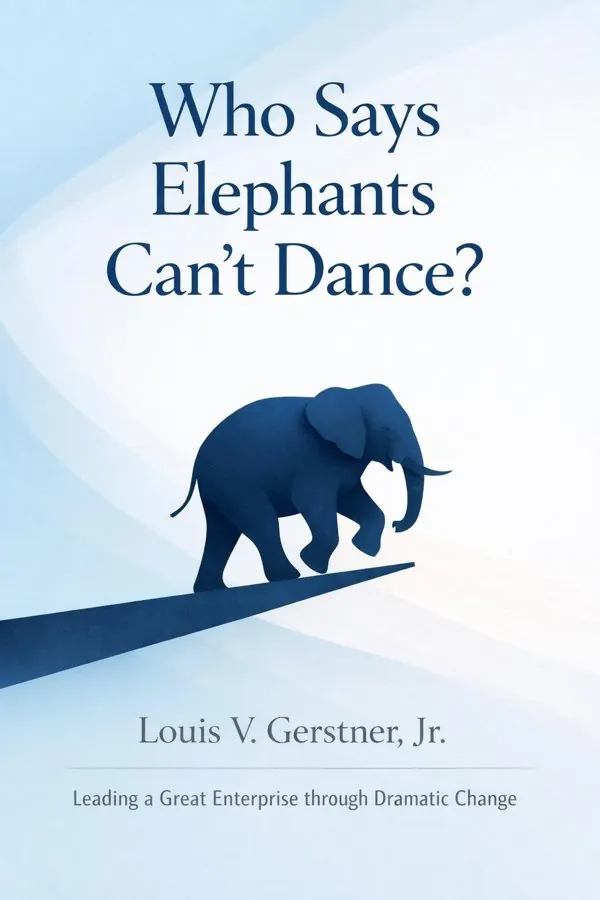
Who Says Elephants Can't Dance?: Leading a Great Enterprise through Dramatic Change: Summary & Key Insights
 10 min7 chaptersAudio available
What Is Who Says Elephants Can't Dance?: Leading a Great Enterprise through Dramatic Change About?
Who Says Elephants Can't Dance?: Leading a Great Enterprise through Dramatic Change by Louis V. Gerstner Jr. is a leadership book spanning 7 pages. This book is the memoir of Louis V. Gerstner Jr., chronicling his tenure as CEO of IBM during the 1990s. It details how he led the company through a major transformation, shifting its focus from hardware to services and software, and revitalizing its culture and strategy. Gerstner shares insights into leadership, corporate turnaround, and organizational change, offering lessons on managing large-scale transformation in a global enterprise.
This FizzRead summary covers all 7 key chapters of Who Says Elephants Can't Dance?: Leading a Great Enterprise through Dramatic Change in approximately 10 minutes, distilling the most important ideas, arguments, and takeaways from Louis V. Gerstner Jr.'s work. Also available as an audio summary and Key Quotes Podcast.
Who Says Elephants Can't Dance?: Leading a Great Enterprise through Dramatic Change
This book is the memoir of Louis V. Gerstner Jr., chronicling his tenure as CEO of IBM during the 1990s. It details how he led the company through a major transformation, shifting its focus from hardware to services and software, and revitalizing its culture and strategy. Gerstner shares insights into leadership, corporate turnaround, and organizational change, offering lessons on managing large-scale transformation in a global enterprise.
Who Should Read Who Says Elephants Can't Dance?: Leading a Great Enterprise through Dramatic Change?
This book is perfect for anyone interested in leadership and looking to gain actionable insights in a short read. Whether you're a student, professional, or lifelong learner, the key ideas from Who Says Elephants Can't Dance?: Leading a Great Enterprise through Dramatic Change by Louis V. Gerstner Jr. will help you think differently.
- ✓Readers who enjoy leadership and want practical takeaways
- ✓Professionals looking to apply new ideas to their work and life
- ✓Anyone who wants the core insights of Who Says Elephants Can't Dance?: Leading a Great Enterprise through Dramatic Change in just 10 minutes
Want the full summary?
Get instant access to this book summary and 100K+ more with Fizz Moment.
Get Free SummaryAvailable on App Store • Free to download
Key Chapters
When I walked into IBM’s Armonk headquarters in April 1993, the sense of paralysis was palpable. Once the undisputed leader of the computing world, IBM had become a relic of its own glory. Revenues were shrinking, morale was demoralizingly low, and factions within the company were preparing for dismemberment. For decades, IBM had thrived on its hardware dominance, but the world had moved on. The personal computer revolution and emerging client-server models had splintered traditional computing, and IBM was stuck defending its fortress of mainframes.
But the deeper problem lay inside—the culture. IBM had become consumed by process over purpose. Meetings about meetings, reports about reports—decisions lost in layers of bureaucracy. People spent more time protecting turf than serving customers. Financially, the numbers told the story: billions in losses, bloated costs, and product lines competing against one another. The planned breakup reflected the prevailing sentiment that the company was too big to manage.
I was warned repeatedly: no one could save it. Yet, as I studied the company, I realized IBM didn’t just make hardware. It had something priceless—deep relationships with the world’s largest corporations and unmatched technical expertise across systems, software, and services. The issue was not technology; it was a lack of direction. IBM was like a symphony with talented musicians but no conductor keeping tempo. That was the crisis I inherited—not just financial, but spiritual. And the only cure would be leadership that fused realism with optimism.
Within weeks of my arrival, I faced the decision that would define IBM’s future: should we follow the Wall Street blueprint and divide the company into autonomous units? To many insiders, this seemed inevitable. Investors argued that breaking IBM apart would unlock value. But as I studied the pieces, I saw the fatal flaw in that logic. The future of computing was moving toward integration—networks, software, and hardware all converging to solve real customer problems. To separate IBM would destroy the one thing that made it unique.
So, I made what many called a contrarian choice: I killed the breakup plan. My reasoning was rooted not in sentimentality but in strategic conviction. Customers didn’t want a fragmented vendor; they wanted a partner who could bring it all together. The irony was that IBM’s size—always portrayed as its weakness—would become its greatest strength if we could operate as one.
This decision sent shockwaves through the organization. It told employees: we’re staying together, and we’re going to fight. It required an entirely different leadership mindset. Instead of surrendering to market pressure, we focused on execution—restoring performance one business at a time, simplifying operations, and holding people accountable. That moment, rejecting the breakup, wasn’t just about structure; it was IBM rediscovering its self-belief.
+ 5 more chapters — available in the FizzRead app
All Chapters in Who Says Elephants Can't Dance?: Leading a Great Enterprise through Dramatic Change
About the Author
Louis V. Gerstner Jr. is an American businessman best known for his role as CEO of IBM from 1993 to 2002. Before joining IBM, he held senior positions at American Express and RJR Nabisco. His leadership at IBM is widely credited with saving the company from decline and repositioning it as a leader in technology services.
Get This Summary in Your Preferred Format
Read or listen to the Who Says Elephants Can't Dance?: Leading a Great Enterprise through Dramatic Change summary by Louis V. Gerstner Jr. anytime, anywhere. FizzRead offers multiple formats so you can learn on your terms — all free.
Available formats: App · Audio · PDF · EPUB — All included free with FizzRead
Download Who Says Elephants Can't Dance?: Leading a Great Enterprise through Dramatic Change PDF and EPUB Summary
Key Quotes from Who Says Elephants Can't Dance?: Leading a Great Enterprise through Dramatic Change
“When I walked into IBM’s Armonk headquarters in April 1993, the sense of paralysis was palpable.”
“Within weeks of my arrival, I faced the decision that would define IBM’s future: should we follow the Wall Street blueprint and divide the company into autonomous units?”
Frequently Asked Questions about Who Says Elephants Can't Dance?: Leading a Great Enterprise through Dramatic Change
Who Says Elephants Can't Dance?: Leading a Great Enterprise through Dramatic Change by Louis V. Gerstner Jr. is a leadership book that explores key ideas across 7 chapters. This book is the memoir of Louis V. Gerstner Jr., chronicling his tenure as CEO of IBM during the 1990s. It details how he led the company through a major transformation, shifting its focus from hardware to services and software, and revitalizing its culture and strategy. Gerstner shares insights into leadership, corporate turnaround, and organizational change, offering lessons on managing large-scale transformation in a global enterprise.
You Might Also Like

Extreme Ownership
Jocko Willink
10 min
Dare to Lead
Brene Brown
10 min
Leaders Eat Last
Simon Sinek
10 min
The 21 Irrefutable Laws of Leadership
John Maxwell
10 min
Start With Why
Simon Sinek
10 min
How to Lead When You're Not in Charge
Clay Scroggins
10 minBrowse by Category
Ready to read Who Says Elephants Can't Dance?: Leading a Great Enterprise through Dramatic Change?
Get the full summary and 100K+ more books with Fizz Moment.