
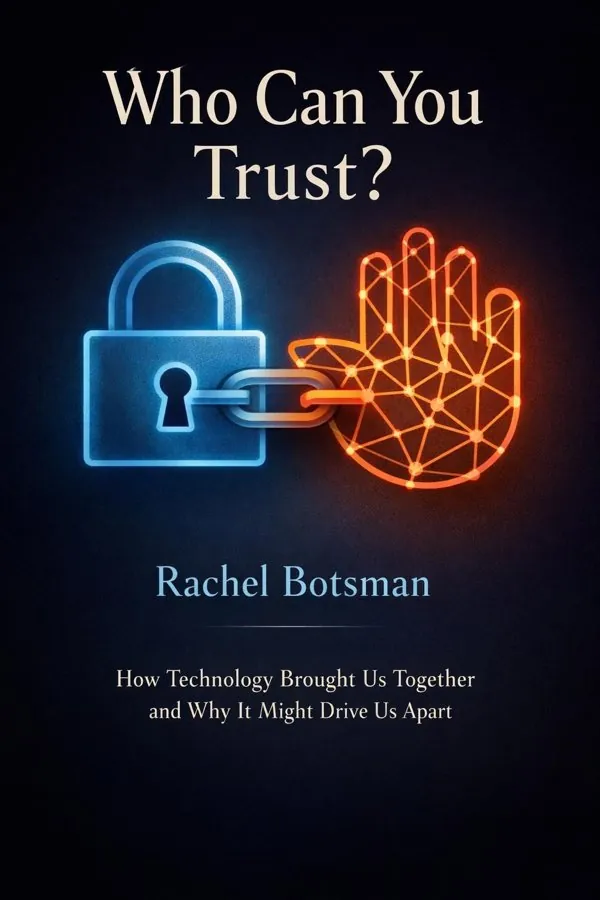
Who Can You Trust?: How Technology Brought Us Together and Why It Might Drive Us Apart: Summary & Key Insights
 10 min6 chaptersAudio available
What Is Who Can You Trust?: How Technology Brought Us Together and Why It Might Drive Us Apart About?
Who Can You Trust?: How Technology Brought Us Together and Why It Might Drive Us Apart by Rachel Botsman is a digital_culture book spanning 6 pages. In this influential work, Rachel Botsman explores how trust is being transformed in the digital age. She examines the shift from institutional trust—governments, banks, and corporations—to distributed trust enabled by technology platforms. Through case studies of companies like Airbnb, Uber, and blockchain systems, Botsman analyzes how trust is built, lost, and regained in a connected world, and what this means for society, business, and personal relationships.
This FizzRead summary covers all 6 key chapters of Who Can You Trust?: How Technology Brought Us Together and Why It Might Drive Us Apart in approximately 10 minutes, distilling the most important ideas, arguments, and takeaways from Rachel Botsman's work. Also available as an audio summary and Key Quotes Podcast.
Who Can You Trust?: How Technology Brought Us Together and Why It Might Drive Us Apart
In this influential work, Rachel Botsman explores how trust is being transformed in the digital age. She examines the shift from institutional trust—governments, banks, and corporations—to distributed trust enabled by technology platforms. Through case studies of companies like Airbnb, Uber, and blockchain systems, Botsman analyzes how trust is built, lost, and regained in a connected world, and what this means for society, business, and personal relationships.
Who Should Read Who Can You Trust?: How Technology Brought Us Together and Why It Might Drive Us Apart?
This book is perfect for anyone interested in digital_culture and looking to gain actionable insights in a short read. Whether you're a student, professional, or lifelong learner, the key ideas from Who Can You Trust?: How Technology Brought Us Together and Why It Might Drive Us Apart by Rachel Botsman will help you think differently.
- ✓Readers who enjoy digital_culture and want practical takeaways
- ✓Professionals looking to apply new ideas to their work and life
- ✓Anyone who wants the core insights of Who Can You Trust?: How Technology Brought Us Together and Why It Might Drive Us Apart in just 10 minutes
Want the full summary?
Get instant access to this book summary and 100K+ more with Fizz Moment.
Get Free SummaryAvailable on App Store • Free to download
Key Chapters
To understand where trust is heading, we have to understand where it came from. For millennia, trust emerged from local, personal relationships. You bought bread from the baker you knew, borrowed money from your neighbor, and learned news at the marketplace. These interactions required reputation to be built face-to-face. But as societies expanded and urbanized, our need to trade and cooperate beyond our immediate circles forced trust to scale. Thus entered institutions — social machines designed to manage relationships once rooted in locality.
With the rise of the industrial age came banks, governments, legal systems, and media outlets — the pillars of institutional trust. We learned to believe that the bank’s certification or the newspaper’s report could substitute for direct personal knowledge. Symbols of reliability — stamps, seals, signatures — became trust mechanisms themselves. For decades, this institutional model seemed stable and powerful. It held citizens together through shared confidence in centralized systems.
Yet institutions, by their nature, depend on authority, hierarchy, and opacity. They work best when people accept that others — experts, leaders, regulators — know better. This worked in an era where information was scarce and slow to move. But the internet changed that. Suddenly, individuals had tools to verify, communicate, and publish at scale. When everyone can be a broadcaster or entrepreneur, the foundation of institutional authority begins to shake. The emergence of distributed networks did more than democratize information; it reconfigured the very flow of trust. The shift away from the local and institutional toward the networked is, I believe, one of the most profound transitions in human history.
We live in a time when faith in institutions — governments, banks, media, even universities — is at an all-time low. People feel disenfranchised by opaque systems that serve themselves more than their societies. Scandals involving political corruption, corporate irresponsibility, and data misuse have eroded the implicit contract between citizens and institutions. Once, individuals assumed that social structures acted in their best interest; now, the dominant sentiment is skepticism. We question motives. We seek transparency. And we turn away when trust is broken.
The decline of institutional trust is not purely emotional — it is structural. Centralized institutions were built for an analog world, one that prized stability and control. They were slow-moving, bound by bureaucracy, and defined by distance between those who governed and those who were governed. In contrast, technology has accelerated every dimension of human interaction. Speed, personalization, and peer networks have created new expectations of responsiveness and accountability. Institutions are struggling to adapt because they were never designed to operate with real-time transparency.
This loss of faith sets the stage for alternatives to emerge. When people lose confidence in centralized power, they begin building decentralized systems where trust is distributed — shared, verified, and maintained collectively. We no longer ask whether the expert or company is trustworthy; we look at ratings, reviews, peer recommendations, and shared data trails. Technology has effectively remapped the geography of trust.
+ 4 more chapters — available in the FizzRead app
All Chapters in Who Can You Trust?: How Technology Brought Us Together and Why It Might Drive Us Apart
About the Author
Rachel Botsman is a British author and lecturer known for her research on trust and collaborative consumption. She has taught at Oxford University’s Saïd Business School and is recognized as a leading thinker on the changing nature of trust in the digital economy.
Get This Summary in Your Preferred Format
Read or listen to the Who Can You Trust?: How Technology Brought Us Together and Why It Might Drive Us Apart summary by Rachel Botsman anytime, anywhere. FizzRead offers multiple formats so you can learn on your terms — all free.
Available formats: App · Audio · PDF · EPUB — All included free with FizzRead
Download Who Can You Trust?: How Technology Brought Us Together and Why It Might Drive Us Apart PDF and EPUB Summary
Key Quotes from Who Can You Trust?: How Technology Brought Us Together and Why It Might Drive Us Apart
“To understand where trust is heading, we have to understand where it came from.”
“We live in a time when faith in institutions — governments, banks, media, even universities — is at an all-time low.”
Frequently Asked Questions about Who Can You Trust?: How Technology Brought Us Together and Why It Might Drive Us Apart
Who Can You Trust?: How Technology Brought Us Together and Why It Might Drive Us Apart by Rachel Botsman is a digital_culture book that explores key ideas across 6 chapters. In this influential work, Rachel Botsman explores how trust is being transformed in the digital age. She examines the shift from institutional trust—governments, banks, and corporations—to distributed trust enabled by technology platforms. Through case studies of companies like Airbnb, Uber, and blockchain systems, Botsman analyzes how trust is built, lost, and regained in a connected world, and what this means for society, business, and personal relationships.
You Might Also Like
An Ugly Truth: Inside Facebook’s Battle for Domination
Sheera Frenkel, Cecilia Kang
10 min
Cyber Citizens
Ian Goodfellow
10 min
Digital Minimalism: Choosing a Focused Life in a Noisy World
Cal Newport
10 min
E‑Books & Beyond
Various Authors
10 min
The Future of Media
Various Authors
10 min
This Is Why We Can't Have Nice Things
Whitney Phillips
10 minBrowse by Category
Ready to read Who Can You Trust?: How Technology Brought Us Together and Why It Might Drive Us Apart?
Get the full summary and 100K+ more books with Fizz Moment.