
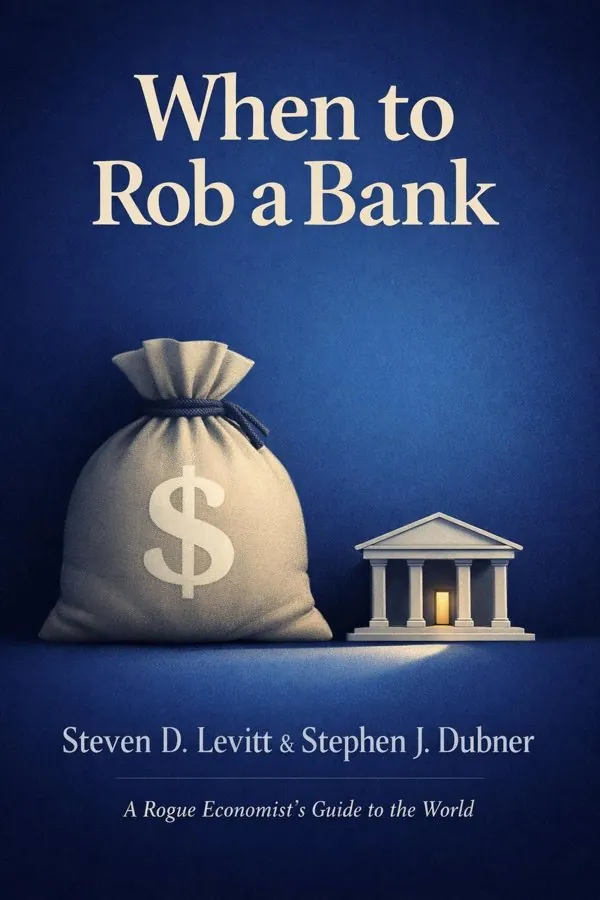
When to Rob a Bank: A Rogue Economist's Guide to the World: Summary & Key Insights
by Steven D. Levitt, Stephen J. Dubner
 10 min10 chaptersAudio available
What Is When to Rob a Bank: A Rogue Economist's Guide to the World About?
When to Rob a Bank: A Rogue Economist's Guide to the World by Steven D. Levitt, Stephen J. Dubner is a economics book spanning 10 pages. A collection of essays and blog posts by the authors of Freakonomics, exploring quirky and unconventional economic insights into everyday life, from the economics of bank robbery to the hidden side of human behavior.
This FizzRead summary covers all 10 key chapters of When to Rob a Bank: A Rogue Economist's Guide to the World in approximately 10 minutes, distilling the most important ideas, arguments, and takeaways from Steven D. Levitt, Stephen J. Dubner's work. Also available as an audio summary and Key Quotes Podcast.
When to Rob a Bank: A Rogue Economist's Guide to the World
A collection of essays and blog posts by the authors of Freakonomics, exploring quirky and unconventional economic insights into everyday life, from the economics of bank robbery to the hidden side of human behavior.
Who Should Read When to Rob a Bank: A Rogue Economist's Guide to the World?
This book is perfect for anyone interested in economics and looking to gain actionable insights in a short read. Whether you're a student, professional, or lifelong learner, the key ideas from When to Rob a Bank: A Rogue Economist's Guide to the World by Steven D. Levitt, Stephen J. Dubner will help you think differently.
- ✓Readers who enjoy economics and want practical takeaways
- ✓Professionals looking to apply new ideas to their work and life
- ✓Anyone who wants the core insights of When to Rob a Bank: A Rogue Economist's Guide to the World in just 10 minutes
Want the full summary?
Get instant access to this book summary and 100K+ more with Fizz Moment.
Get Free SummaryAvailable on App Store • Free to download
Key Chapters
Our curiosity has always been our best compass. In the Freakonomics world, questions are never too silly or too sacred to explore. We’ve asked whether names can affect a child’s future income, whether prostitution pays better than honest work, and even what the economic logic behind drunk walking might be. Each of these begins not with a tidy hypothesis, but with a nagging sense that something about our daily assumptions deserves a double take.
When we began writing blog posts, we wanted not just to share data but to invite people into the joy of wondering. Why does everyone think real estate agents have your best interests at heart? Why do we tip some service workers and not others? When we press into these questions, we find the hidden incentives shaping behavior, often in ways that contradict what people claim to believe. The goal is not cynicism, but clarity. Because the moment we uncover the invisible levers of motivation, we understand the subtler ways our world really turns.
Readers often ask if we deliberately choose provocative questions. The truth is, the world provides them freely. We only need to notice them. The blog became a running conversation about curiosity itself—a playground for anyone who wanted to examine life’s odd patterns with data, humor, and a dash of irreverence. In that sense, this book is both a celebration and invitation: a proof that asking strange questions isn’t foolish; it’s the first step toward genuine understanding.
Our title essay, “When to Rob a Bank,” began as a joke. A reader once asked if we, as economists, could calculate the perfect time to rob a bank. We laughed, then wondered—why not? When we investigated, the data showed what our gut already suspected: bank robbery is a terrible business. The average haul barely covers a few months’ rent, the risk of being caught is sky-high, and the rewards, compared to even low-income jobs, are dismal. The timing, location, and method matter less than the reality that incentives make crime rarely worth the cost.
Crime, after all, is just another market, shaped by incentives and constraints. Decades of economic analysis, including Levitt’s own work on crime rates and policing, reveal how people weigh potential gains against probabilities of punishment. When we see crime rates fall, it may not be because people have become more virtuous—it’s often because the math has changed. The expected payoff no longer exceeds the expected cost.
Take the example of the U.S. crime drop in the 1990s. Our earlier work proposed factors that went beyond standard explanations like policing or the economy. Everything from legalized abortion to the rise of incarceration changed the composition and behavior of potential offenders. Whether or not you agree with that interpretation, the underlying message remains: every social trend has economic roots. By examining them honestly, we uncover human motivations that moral lectures alone cannot explain.
The beauty of this perspective lies in stripping away moral noise to reveal incentive logic. When we see crime as a response to economic conditions, we can design better interventions. The question isn’t “why are people bad?” but “why is this choice, however irrational it seems, worth the risk to them?” Once you ask that, policy—and empathy—has a fighting chance.
+ 8 more chapters — available in the FizzRead app
All Chapters in When to Rob a Bank: A Rogue Economist's Guide to the World
About the Authors
Steven D. Levitt is an American economist known for his work on crime, incentives, and rational choice theory. Stephen J. Dubner is an American journalist and author who co-wrote the Freakonomics series with Levitt.
Get This Summary in Your Preferred Format
Read or listen to the When to Rob a Bank: A Rogue Economist's Guide to the World summary by Steven D. Levitt, Stephen J. Dubner anytime, anywhere. FizzRead offers multiple formats so you can learn on your terms — all free.
Available formats: App · Audio · PDF · EPUB — All included free with FizzRead
Download When to Rob a Bank: A Rogue Economist's Guide to the World PDF and EPUB Summary
Key Quotes from When to Rob a Bank: A Rogue Economist's Guide to the World
“Our curiosity has always been our best compass.”
“Our title essay, “When to Rob a Bank,” began as a joke.”
Frequently Asked Questions about When to Rob a Bank: A Rogue Economist's Guide to the World
When to Rob a Bank: A Rogue Economist's Guide to the World by Steven D. Levitt, Stephen J. Dubner is a economics book that explores key ideas across 10 chapters. A collection of essays and blog posts by the authors of Freakonomics, exploring quirky and unconventional economic insights into everyday life, from the economics of bank robbery to the hidden side of human behavior.
More by Steven D. Levitt, Stephen J. Dubner
You Might Also Like
Business Adventures
John Brooks
10 min
Nudge
Richard H. Thaler, Cass R. Sunstein
10 min
The Hitchhiker"s Guide to the Galaxy
Douglas Adams
10 minThe Muqaddimah
Ibn Khaldun
10 minThe Outsiders
William N. Thorndike
10 min
A Little History of Economics
Niall Kishtainy
10 minBrowse by Category
Ready to read When to Rob a Bank: A Rogue Economist's Guide to the World?
Get the full summary and 100K+ more books with Fizz Moment.