
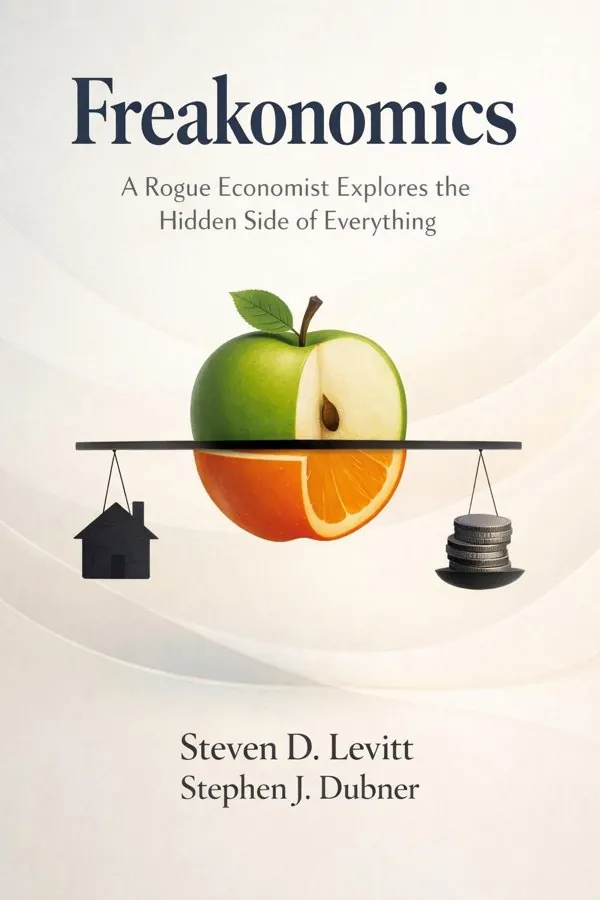
Freakonomics: A Rogue Economist Explores the Hidden Side of Everything: Summary & Key Insights
by Steven D. Levitt, Stephen J. Dubner
 10 min6 chaptersAudio available
What Is Freakonomics: A Rogue Economist Explores the Hidden Side of Everything About?
Freakonomics: A Rogue Economist Explores the Hidden Side of Everything by Steven D. Levitt, Stephen J. Dubner is a economics book spanning 6 pages. Freakonomics es un libro que aplica la teoría económica a una amplia gama de fenómenos sociales y culturales aparentemente no relacionados. A través de ejemplos provocativos y análisis empíricos, los autores exploran cómo los incentivos, la información y los intereses ocultos moldean el comportamiento humano en contextos tan diversos como el crimen, la educación y la paternidad.
This FizzRead summary covers all 6 key chapters of Freakonomics: A Rogue Economist Explores the Hidden Side of Everything in approximately 10 minutes, distilling the most important ideas, arguments, and takeaways from Steven D. Levitt, Stephen J. Dubner's work. Also available as an audio summary and Key Quotes Podcast.
Freakonomics: A Rogue Economist Explores the Hidden Side of Everything
Freakonomics es un libro que aplica la teoría económica a una amplia gama de fenómenos sociales y culturales aparentemente no relacionados. A través de ejemplos provocativos y análisis empíricos, los autores exploran cómo los incentivos, la información y los intereses ocultos moldean el comportamiento humano en contextos tan diversos como el crimen, la educación y la paternidad.
Who Should Read Freakonomics: A Rogue Economist Explores the Hidden Side of Everything?
This book is perfect for anyone interested in economics and looking to gain actionable insights in a short read. Whether you're a student, professional, or lifelong learner, the key ideas from Freakonomics: A Rogue Economist Explores the Hidden Side of Everything by Steven D. Levitt, Stephen J. Dubner will help you think differently.
- ✓Readers who enjoy economics and want practical takeaways
- ✓Professionals looking to apply new ideas to their work and life
- ✓Anyone who wants the core insights of Freakonomics: A Rogue Economist Explores the Hidden Side of Everything in just 10 minutes
Want the full summary?
Get instant access to this book summary and 100K+ more with Fizz Moment.
Get Free SummaryAvailable on App Store • Free to download
Key Chapters
Incentives are the cornerstone of human behavior, yet they can also be the engine of corruption. When I began studying cheating among Chicago schoolteachers, the revelation was startling: teachers whose pay and reputation depended on student test scores occasionally changed those scores. The statistical patterns—identical wrong answers erased and replaced, improbable jumps in scores from one year to the next—made the truth undeniable. When incentives tempt the morally weak or desperate, cheating becomes rational.
The same pattern appeared in the world of sumo wrestling. Sumo wrestlers, bound by tradition and honor, were thought to be immune to manipulation. But data told another story: wrestlers on the verge of maintaining their rank tended to win suspiciously often, especially against peers who could afford to lose. Once incentives were aligned—to preserve mutual status—honor yielded to pragmatism.
Exploring these parallels reveals the economic logic beneath moral facades. Cheating isn’t rooted in cultural deficiency or personal wickedness; it’s an outcome of incentive design. When the rewards for success and the penalties for failure become extreme, even good people rationalize dishonest actions. The economist’s job, then, isn’t to moralize but to measure—to use data to unmask behavior that defies appearance. By understanding incentives, we learn not only how systems fail but also how they might be restructured to foster honesty instead of deceit.
Information is power—a truth so pervasive that it dictates social hierarchies, business negotiations, and historical oppression. The Ku Klux Klan, for all its terror and secrecy, maintained its influence through control of information. When a journalist infiltrated and exposed their rituals and internal communications to the public, their mystique evaporated. Deprived of the informational monopoly that sustained fear, the Klan lost its grip on communities.
Real-estate agents, though far removed from such notorious history, operate on a similar principle. They possess insider information about market value, pricing strategies, and buyer psychology. Their clients rely on them blindly, believing their interests are aligned. But data shows otherwise: agents tend to keep homes on the market longer and negotiate harder only when selling their own properties. It’s an example of how asymmetry of information quietly shifts incentives.
This chapter pushes us to confront the uncomfortable truth that transparency reshapes power. When both sides of a transaction possess equal information, manipulation declines, trust increases, and outcomes improve. Economically speaking, reducing information asymmetry is a democratizing act—it reduces exploitation, enhances efficiency, and reveals how much of our power structure rests on ignorance.
+ 4 more chapters — available in the FizzRead app
All Chapters in Freakonomics: A Rogue Economist Explores the Hidden Side of Everything
About the Authors
Steven D. Levitt es un economista estadounidense y profesor en la Universidad de Chicago, conocido por su trabajo en microeconomía aplicada. Stephen J. Dubner es periodista y escritor, reconocido por su capacidad para traducir ideas complejas en narrativas accesibles. Juntos, han popularizado la economía conductual a través de la serie Freakonomics.
Get This Summary in Your Preferred Format
Read or listen to the Freakonomics: A Rogue Economist Explores the Hidden Side of Everything summary by Steven D. Levitt, Stephen J. Dubner anytime, anywhere. FizzRead offers multiple formats so you can learn on your terms — all free.
Available formats: App · Audio · PDF · EPUB — All included free with FizzRead
Download Freakonomics: A Rogue Economist Explores the Hidden Side of Everything PDF and EPUB Summary
Key Quotes from Freakonomics: A Rogue Economist Explores the Hidden Side of Everything
“Incentives are the cornerstone of human behavior, yet they can also be the engine of corruption.”
“Information is power—a truth so pervasive that it dictates social hierarchies, business negotiations, and historical oppression.”
Frequently Asked Questions about Freakonomics: A Rogue Economist Explores the Hidden Side of Everything
Freakonomics: A Rogue Economist Explores the Hidden Side of Everything by Steven D. Levitt, Stephen J. Dubner is a economics book that explores key ideas across 6 chapters. Freakonomics es un libro que aplica la teoría económica a una amplia gama de fenómenos sociales y culturales aparentemente no relacionados. A través de ejemplos provocativos y análisis empíricos, los autores exploran cómo los incentivos, la información y los intereses ocultos moldean el comportamiento humano en contextos tan diversos como el crimen, la educación y la paternidad.
More by Steven D. Levitt, Stephen J. Dubner
You Might Also Like
Business Adventures
John Brooks
10 min
Nudge
Richard H. Thaler, Cass R. Sunstein
10 min
The Hitchhiker"s Guide to the Galaxy
Douglas Adams
10 minThe Muqaddimah
Ibn Khaldun
10 minThe Outsiders
William N. Thorndike
10 min
A Little History of Economics
Niall Kishtainy
10 minBrowse by Category
Ready to read Freakonomics: A Rogue Economist Explores the Hidden Side of Everything?
Get the full summary and 100K+ more books with Fizz Moment.