
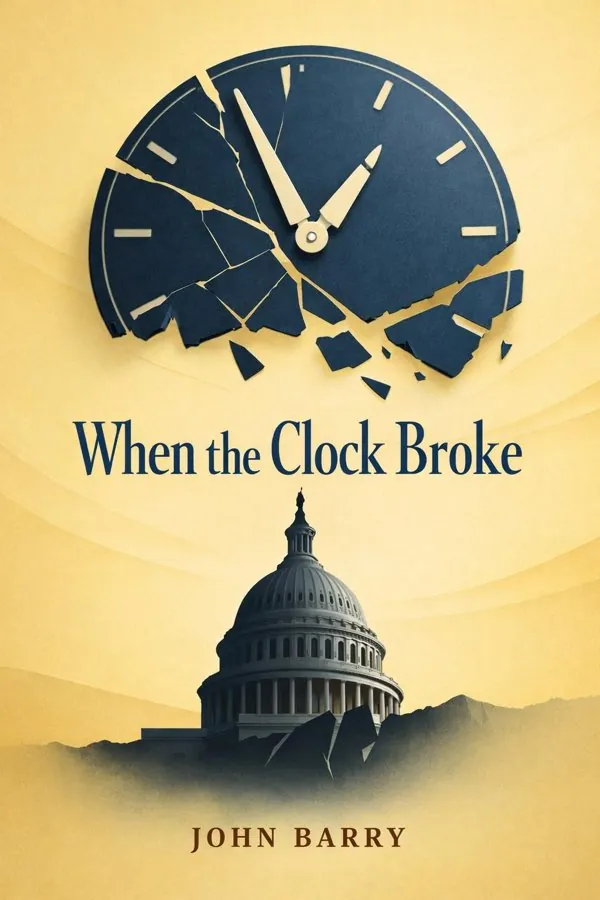
When the Clock Broke: The Republicans in Congress and the Plan to Destroy Government: Summary & Key Insights
by John Barry
 10 min11 chaptersAudio available
What Is When the Clock Broke: The Republicans in Congress and the Plan to Destroy Government About?
When the Clock Broke: The Republicans in Congress and the Plan to Destroy Government by John Barry is a politics book spanning 11 pages. This book by John M. Barry examines the political transformation of the Republican Party in the United States during the 1990s, focusing on the rise of Newt Gingrich and the radical shift in congressional politics. Barry explores how ideological polarization and strategic obstructionism reshaped American governance, leading to a breakdown in bipartisan cooperation and a new era of political warfare.
This FizzRead summary covers all 11 key chapters of When the Clock Broke: The Republicans in Congress and the Plan to Destroy Government in approximately 10 minutes, distilling the most important ideas, arguments, and takeaways from John Barry's work. Also available as an audio summary and Key Quotes Podcast.
When the Clock Broke: The Republicans in Congress and the Plan to Destroy Government
This book by John M. Barry examines the political transformation of the Republican Party in the United States during the 1990s, focusing on the rise of Newt Gingrich and the radical shift in congressional politics. Barry explores how ideological polarization and strategic obstructionism reshaped American governance, leading to a breakdown in bipartisan cooperation and a new era of political warfare.
Who Should Read When the Clock Broke: The Republicans in Congress and the Plan to Destroy Government?
This book is perfect for anyone interested in politics and looking to gain actionable insights in a short read. Whether you're a student, professional, or lifelong learner, the key ideas from When the Clock Broke: The Republicans in Congress and the Plan to Destroy Government by John Barry will help you think differently.
- ✓Readers who enjoy politics and want practical takeaways
- ✓Professionals looking to apply new ideas to their work and life
- ✓Anyone who wants the core insights of When the Clock Broke: The Republicans in Congress and the Plan to Destroy Government in just 10 minutes
Want the full summary?
Get instant access to this book summary and 100K+ more with Fizz Moment.
Get Free SummaryAvailable on App Store • Free to download
Key Chapters
In the years after World War II, Congress operated on informal codes that encouraged cooperation and civility. Senior members mentored newcomers, committee chairs wielded power responsibly, and bipartisan coalitions frequently shaped legislation. The system was imperfect—racial segregation, entrenched committee hierarchies, and limited transparency all constrained progress—but the culture of mutual respect allowed the legislative process to function.
Through the 1960s and 1970s, however, profound social changes tested these unwritten rules. Vietnam, Watergate, and the civil rights revolution exposed deep fissures of mistrust. The Democratic majority grew vulnerable as public confidence declined. In this era, procedural reforms intended to democratize Congress inadvertently weakened its institutional coherence, opening space for individual ambition over collective responsibility.
By the 1980s, political television and the rise of ideological advocacy changed how politicians spoke to their constituencies. Partisanship became a form of identity. The era of consensual governance—where members sought shared solutions—was giving way to one defined by confrontation and spectacle. This was the world into which Newt Gingrich stepped, determined not just to play by the old rules but to destroy them.
When Gingrich entered Congress in 1979, he was a marginal figure from Georgia with a crusader’s mindset. He was not interested in committee practice or the slow mastery of legislative craft; he viewed the institution itself as the problem. His formative belief was that Democrats dominated Congress not because of superior ideas but because Republicans had accepted minority status as permanent. To end that defeatism, he decided to redefine how Republicans fought.
Gingrich’s theory of politics was rooted in confrontation. He cultivated young conservatives willing to use emotion, accusation, and television as weapons. Through media staging and floor speeches delivered to an empty chamber—yet broadcast by C-SPAN—he framed Democrats as corrupt, elitist, and anti-American. It was a rhetorical innovation that blurred the line between opposition and insurgency.
What distinguished Gingrich was his ability to merge ideology with performance. He was both tactician and propagandist, understanding that the real battlefield was perception. Inside the party, he built alliances with fellow malcontents—to him, compromise equaled surrender. In the pages of this book, I trace his strategic growth: how he learned to manipulate procedures, exploit ethics investigations, and shame opponents to gain attention. This was not politics as debate but politics as permanent campaign—a style that would come to define the Republican Revolution.
+ 9 more chapters — available in the FizzRead app
All Chapters in When the Clock Broke: The Republicans in Congress and the Plan to Destroy Government
About the Author
John M. Barry is an American author and historian known for his works on politics, history, and science. He is best known for 'The Great Influenza' and 'Rising Tide: The Great Mississippi Flood of 1927 and How It Changed America.' His writing combines deep research with accessible narrative style.
Get This Summary in Your Preferred Format
Read or listen to the When the Clock Broke: The Republicans in Congress and the Plan to Destroy Government summary by John Barry anytime, anywhere. FizzRead offers multiple formats so you can learn on your terms — all free.
Available formats: App · Audio · PDF · EPUB — All included free with FizzRead
Download When the Clock Broke: The Republicans in Congress and the Plan to Destroy Government PDF and EPUB Summary
Key Quotes from When the Clock Broke: The Republicans in Congress and the Plan to Destroy Government
“In the years after World War II, Congress operated on informal codes that encouraged cooperation and civility.”
“When Gingrich entered Congress in 1979, he was a marginal figure from Georgia with a crusader’s mindset.”
Frequently Asked Questions about When the Clock Broke: The Republicans in Congress and the Plan to Destroy Government
When the Clock Broke: The Republicans in Congress and the Plan to Destroy Government by John Barry is a politics book that explores key ideas across 11 chapters. This book by John M. Barry examines the political transformation of the Republican Party in the United States during the 1990s, focusing on the rise of Newt Gingrich and the radical shift in congressional politics. Barry explores how ideological polarization and strategic obstructionism reshaped American governance, leading to a breakdown in bipartisan cooperation and a new era of political warfare.
You Might Also Like
Antifa: The Anti-Fascist Handbook
Mark Bray
10 min
Attack from Within: How Disinformation Is Sabotaging America
Barbara McQuade
10 min
Coercion, Capital, and European States, AD 990–1992
Charles Tilly
10 min
Digital Democracy: Concepts, Methodologies, Tools, and Applications
Various Authors
10 min
Fascism
Stanley G. Payne
10 min
Fire And Fury: Inside The Trump White House
Michael Wolff
10 minBrowse by Category
Ready to read When the Clock Broke: The Republicans in Congress and the Plan to Destroy Government?
Get the full summary and 100K+ more books with Fizz Moment.