
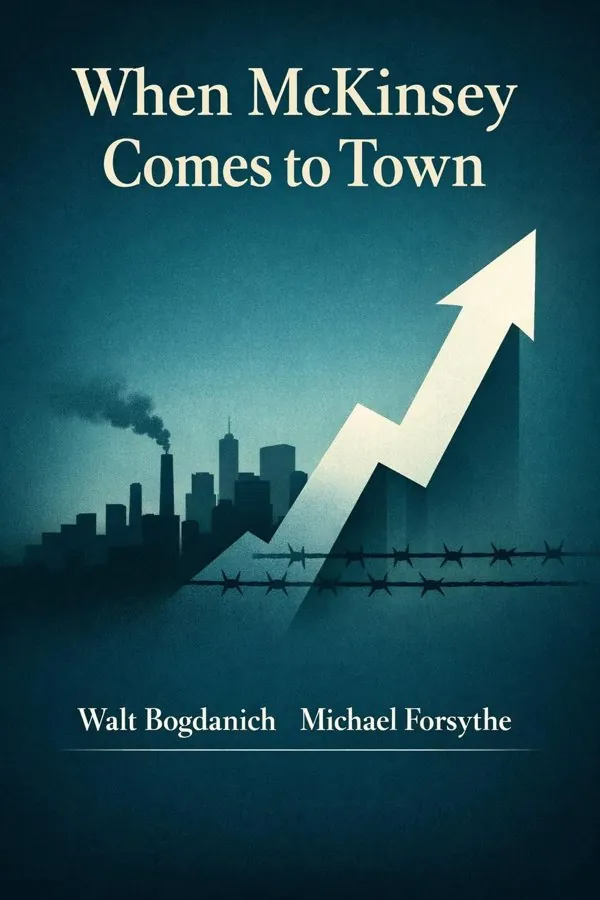
When McKinsey Comes to Town: The Hidden Influence of the World's Most Powerful Consulting Firm: Summary & Key Insights
by Walt Bogdanich, Michael Forsythe
 10 min10 chaptersAudio available
Key Takeaways from When McKinsey Comes to Town: The Hidden Influence of the World's Most Powerful Consulting Firm
Power is often strongest when it is least visible.
A consultant’s slide deck can change more lives than a politician’s speech.
Democracy weakens when public decisions are made by private advisers.
Some of the most damaging decisions in modern business were not made in ignorance, but with expert assistance.
Neutrality can become a moral fiction when expertise serves repression.
What Is When McKinsey Comes to Town: The Hidden Influence of the World's Most Powerful Consulting Firm About?
When McKinsey Comes to Town: The Hidden Influence of the World's Most Powerful Consulting Firm by Walt Bogdanich, Michael Forsythe is a politics book spanning 10 pages. What happens when a company that almost no ordinary citizen can name helps shape the decisions that govern hospitals, drugmakers, prisons, banks, tech firms, and even national governments? In When McKinsey Comes to Town, investigative journalists Walt Bogdanich and Michael Forsythe pull back the curtain on McKinsey & Company, the elite consulting firm whose advice has quietly influenced some of the most consequential choices in modern public and corporate life. The book is not merely a history of management consulting. It is an exposé of how prestige, secrecy, and analytical authority can combine to affect millions of lives while evading public scrutiny. Through deeply reported case studies, the authors trace McKinsey’s role in the opioid crisis, its work for authoritarian regimes, its influence inside government bureaucracies, and its involvement with companies facing major ethical failures. Bogdanich and Forsythe bring unusual authority to the subject: both are veteran New York Times investigative reporters with long records of uncovering hidden systems of power. The result is a sharp, timely examination of how expertise can be used not only to solve problems, but also to legitimize harmful decisions.
This FizzRead summary covers all 10 key chapters of When McKinsey Comes to Town: The Hidden Influence of the World's Most Powerful Consulting Firm in approximately 10 minutes, distilling the most important ideas, arguments, and takeaways from Walt Bogdanich, Michael Forsythe's work. Also available as an audio summary and Key Quotes Podcast.
When McKinsey Comes to Town: The Hidden Influence of the World's Most Powerful Consulting Firm
What happens when a company that almost no ordinary citizen can name helps shape the decisions that govern hospitals, drugmakers, prisons, banks, tech firms, and even national governments? In When McKinsey Comes to Town, investigative journalists Walt Bogdanich and Michael Forsythe pull back the curtain on McKinsey & Company, the elite consulting firm whose advice has quietly influenced some of the most consequential choices in modern public and corporate life. The book is not merely a history of management consulting. It is an exposé of how prestige, secrecy, and analytical authority can combine to affect millions of lives while evading public scrutiny. Through deeply reported case studies, the authors trace McKinsey’s role in the opioid crisis, its work for authoritarian regimes, its influence inside government bureaucracies, and its involvement with companies facing major ethical failures. Bogdanich and Forsythe bring unusual authority to the subject: both are veteran New York Times investigative reporters with long records of uncovering hidden systems of power. The result is a sharp, timely examination of how expertise can be used not only to solve problems, but also to legitimize harmful decisions.
Who Should Read When McKinsey Comes to Town: The Hidden Influence of the World's Most Powerful Consulting Firm?
This book is perfect for anyone interested in politics and looking to gain actionable insights in a short read. Whether you're a student, professional, or lifelong learner, the key ideas from When McKinsey Comes to Town: The Hidden Influence of the World's Most Powerful Consulting Firm by Walt Bogdanich, Michael Forsythe will help you think differently.
- ✓Readers who enjoy politics and want practical takeaways
- ✓Professionals looking to apply new ideas to their work and life
- ✓Anyone who wants the core insights of When McKinsey Comes to Town: The Hidden Influence of the World's Most Powerful Consulting Firm in just 10 minutes
Want the full summary?
Get instant access to this book summary and 100K+ more with Fizz Moment.
Get Free SummaryAvailable on App Store • Free to download
Key Chapters
Power is often strongest when it is least visible. One of the book’s central insights is that McKinsey did not become influential by courting public attention; it became influential by positioning itself behind the scenes, advising the people who already held economic and political power. Founded in the 1920s by James O. McKinsey, the firm began with the idea that business decisions could be made more rational through accounting, measurement, and systematic analysis. That premise sounds benign, even useful. Over time, however, it evolved into something much larger: a global institution whose recommendations could shape entire industries.
The authors show how McKinsey’s growth came from mastering elite trust. It sold not products but confidence. Executives, cabinet officials, and boards hired the firm because McKinsey projected rigor, objectivity, and discretion. Its consultants were trained to speak the language of efficiency, transformation, and strategic clarity. Because clients believed they were buying world-class insight, McKinsey often gained access to highly sensitive decisions, from layoffs to mergers to public-sector reforms.
This rise mattered because the firm’s influence expanded faster than public understanding of what it actually did. McKinsey rarely put its name on policies, but its fingerprints appeared everywhere. Its recommendations could reshape staffing, pricing, incentives, and public services without democratic debate or transparent accountability. The firm’s authority rested not on election, regulation, or public consent, but on reputation.
A practical way to apply this idea is to become more skeptical of "neutral experts" who claim to offer purely technical solutions. Expertise always operates within values and incentives. When an adviser promises efficiency, ask: efficient for whom, at what cost, and with what oversight? Actionable takeaway: whenever an institution claims to be just an objective problem-solver, examine who hired it, what interests it serves, and who bears the consequences of its advice.
A consultant’s slide deck can change more lives than a politician’s speech. The book demonstrates that McKinsey’s corporate work was not limited to harmless productivity improvements; it often helped define how major companies pursued growth, cost reduction, and market dominance. In industry after industry, McKinsey became the trusted adviser brought in when leaders wanted to restructure, expand, or defend profits under pressure.
Bogdanich and Forsythe explain how this influence worked. McKinsey typically entered organizations as the outsider capable of asking hard questions and recommending bold moves. Its advice often centered on measurable performance gains: streamline operations, cut labor costs, optimize pricing, reorganize management, or identify profitable customer segments. These moves could make firms leaner and more competitive, but they also frequently shifted pain onto workers, consumers, and weaker communities.
Examples throughout the book show a pattern: firms hired McKinsey to accelerate transformation, and the firm delivered frameworks that made controversial decisions appear rational and inevitable. Layoffs could be renamed efficiency. Aggressive sales tactics could be framed as market capture. Cost-cutting in health, logistics, or retail could be presented as shareholder discipline. The consulting process gave leaders analytical cover for decisions they already wanted to make or lacked the political courage to own directly.
This matters because consulting can alter accountability. When difficult outcomes follow, executives can point to expert recommendations instead of moral judgment. The lesson extends beyond McKinsey. Whenever organizations invoke external advisers, they are often seeking not just ideas but legitimacy.
For readers, the practical application is simple: learn to read business transformation claims critically. Ask what metrics are being optimized and what realities those metrics ignore. A company may boast of improved margins while quietly reducing safety, service quality, or workforce stability. Actionable takeaway: whenever you hear leaders justify painful decisions with consultant language like efficiency, optimization, or transformation, look for the human trade-offs hidden behind the numbers.
Democracy weakens when public decisions are made by private advisers. A major theme of the book is that McKinsey’s reach extended far beyond corporations into the machinery of government. Agencies and ministries turned to the firm for help on modernization, budgeting, operations, and strategic reform, often assuming that private-sector expertise could fix public-sector complexity. But the authors show that this outsourcing of judgment came with serious risks.
Government is not a business, even when it uses budgets, metrics, and management tools. Public institutions are accountable to citizens, constrained by law, and obligated to weigh fairness, access, and public trust alongside efficiency. McKinsey’s style, shaped by corporate priorities, could be poorly suited to those broader obligations. Yet officials often embraced the firm because its recommendations carried elite credibility and the promise of rapid reform.
The book describes how McKinsey embedded itself in sensitive areas of public administration, where decisions affected vulnerable populations and national priorities. The danger was not only bad advice. It was the quiet displacement of democratic deliberation by consultant logic. Policies that should have been debated in public were sometimes designed in private meetings, justified by technical jargon, and implemented with limited transparency.
There is a practical lesson here for citizens, public servants, and nonprofit leaders. Outsourcing can be useful for specialized tasks, but it becomes problematic when external firms begin defining goals rather than merely supporting execution. Public institutions should be especially cautious about handing strategic authority to organizations that are accountable primarily to paying clients.
In everyday life, the same principle applies to schools, hospitals, universities, and charities. Not every problem is best solved by importing corporate management methods. Actionable takeaway: when a public institution hires outside consultants, ask not only whether they are competent, but whether their framework aligns with the institution’s public mission, transparency duties, and moral responsibilities.
Some of the most damaging decisions in modern business were not made in ignorance, but with expert assistance. One of the book’s most disturbing sections examines McKinsey’s work for opioid manufacturers, especially Purdue Pharma, maker of OxyContin. The authors detail how the firm advised clients on ways to boost opioid sales even as evidence of addiction, overdose, and social devastation mounted across the United States.
What makes this episode so powerful is not simply that a consulting firm worked for a controversial client. It is that McKinsey’s recommendations were deeply entangled with commercial strategies that prolonged harm. According to the reporting, consultants explored how to accelerate sales, target high-prescribing doctors, and counteract barriers to opioid expansion. In one especially chilling illustration, McKinsey discussed strategies related to overdose concerns not primarily as a public health emergency, but as a business problem affecting market performance.
The broader point is that analytical brilliance without ethical boundaries can become dangerous. McKinsey’s methods were designed to identify growth levers, incentives, and market opportunities. In most contexts, that may look like strategy. In a crisis involving addiction and death, the same skills can intensify catastrophe. The book forces readers to confront how professional detachment can sanitize morally unacceptable choices.
This idea has clear practical relevance. In any field, people may become so focused on solving the assigned problem that they stop questioning whether the problem itself is legitimate. Sales can be optimized, engagement can be increased, and costs can be lowered in ways that are technically impressive but socially ruinous.
Actionable takeaway: before admiring any successful strategy, ask what outcome it is maximizing and whether that outcome deserves to be maximized at all. Ethical judgment must come before optimization, not after the damage is done.
What organizations choose not to measure often reveals what they do not value. The book shows that McKinsey’s problem-solving approach, while data-heavy and intellectually polished, could contain major ethical blind spots, especially in areas like environmental damage and long-term social cost. Consulting frameworks tend to privilege what can be quantified quickly: revenue growth, cost savings, productivity gains, shareholder value, operational targets. But many of the most important consequences of corporate decisions unfold slowly and fall outside the spreadsheet.
Bogdanich and Forsythe argue that this creates a dangerous imbalance. If a consulting project helps a client cut expenses or expand production while increasing pollution, climate risk, or public health burdens, the immediate business result may look successful even as the societal outcome worsens. The firm’s methods are not inherently malicious, but they can narrow attention toward the client’s measurable advantage and away from diffuse public harm.
This is one reason the book matters politically as well as economically. It invites readers to see ethics not as an afterthought or compliance box, but as part of how problems are defined in the first place. If environmental costs, labor disruption, or civic damage are excluded from the project scope, then the analysis will predictably recommend actions that externalize those costs onto others.
The practical implication is broad. Whether you work in business, policy, or nonprofit leadership, the metrics you choose determine the behaviors you reward. Short-term dashboards often hide long-term damage. If you evaluate success only through profits or efficiency, you should expect ethically incomplete decisions.
Actionable takeaway: whenever a strategy appears compelling, ask what costs have been excluded from the model. Build decisions around full consequences, not just the variables that are easiest to quantify.
Elite institutions often protect themselves not just with rules, but with culture. The book portrays McKinsey as a firm defined by intense internal discipline, extraordinary prestige, and a deep commitment to secrecy. Its consultants were selected from top schools, trained to project confidence, and socialized into a worldview where analytical sophistication and client service became near-sacred values. This culture helped McKinsey maintain quality and mystique, but it also insulated the firm from outside scrutiny.
Confidentiality was central to the business model. Clients wanted discretion, and McKinsey delivered it. But secrecy does more than protect information; it can protect patterns. When outsiders cannot see who is being advised, what recommendations are given, and what conflicts may exist across clients, accountability becomes difficult. The book suggests that this opacity allowed McKinsey to work across ethically conflicting domains while preserving an image of principled professionalism.
Internally, prestige reinforced compliance. People who have spent their careers being told they are among the smartest in the room may become especially vulnerable to believing their methods are inherently justified. Strong cultures can suppress dissent by making criticism feel like disloyalty or naivete. In such environments, ethical concerns are often reframed as secondary to client needs, legal risk, or implementation challenges.
This is not unique to consulting. Law firms, investment banks, elite universities, and technology companies can all become self-sealing systems in which reputation substitutes for moral reflection. For individuals, the lesson is to watch how institutional pride shapes judgment. If everyone around you is brilliant, ambitious, and highly rewarded, that is precisely when you need independent standards.
Actionable takeaway: never assume that prestige equals integrity. In any elite organization, create habits of ethical questioning that do not depend on the institution’s self-image or internal consensus.
Financial disasters are often preceded by elegant justifications. The book highlights McKinsey’s presence in the financial sector, where banks and other institutions sought advice on growth, strategy, restructuring, and risk. Consulting firms in this environment do more than provide technical analysis. They can help normalize aggressive behavior by wrapping it in the language of strategy, resilience, and market competitiveness.
Bogdanich and Forsythe show that in finance, as elsewhere, McKinsey’s value often lay in giving major institutions a sense of disciplined confidence. If executives wanted to expand into new products, push performance targets, or reorganize operations under pressure, McKinsey could translate those ambitions into polished plans backed by data and frameworks. That does not mean the firm caused every risky decision. But it frequently operated in ecosystems where short-term gains were rewarded while systemic dangers were underestimated.
This matters because legitimacy is itself a powerful asset. When boards, regulators, or investors see that a famous consulting firm has reviewed a strategy, they may assume the strategy has been responsibly stress-tested. In reality, expert endorsement can conceal uncertainty rather than remove it. The book invites skepticism toward the idea that formal analysis automatically reduces risk. Sometimes it merely redistributes responsibility.
The same phenomenon appears in personal and organizational life. People often feel safer making questionable choices when those choices have been approved by consultants, lawyers, or other specialists. Yet external validation does not transform a fragile plan into a sound one.
Actionable takeaway: treat expert endorsement as one input, not proof of wisdom. When evaluating a high-stakes decision, ask what assumptions underpin the analysis, what incentives shaped the recommendation, and what worst-case scenarios remain unaddressed despite the polished presentation.
An institution’s reputation can become a shield against the very scrutiny it deserves. One of the book’s strongest contributions is its contrast between McKinsey’s public image and the reality uncovered through reporting. The firm cultivated an aura of seriousness, excellence, and public-minded professionalism. It was seen as the place brilliant people went to solve difficult problems. That image made clients eager to hire McKinsey and made outsiders slower to question it.
But the authors argue that reputation is not accountability. In fact, the more trusted an institution becomes, the easier it may be for people to overlook warning signs. McKinsey’s discretion, elite recruiting, and association with powerful leaders gave it a kind of moral credit in the public imagination. Yet many of the book’s case studies suggest a gap between the firm’s rhetoric and the consequences of its work.
This gap is important because modern institutions increasingly manage criticism through communications strategy rather than structural reform. Organizations under pressure often emphasize values statements, internal reviews, and selective apologies. These may reduce reputational damage without changing the underlying incentive system. The book asks readers to look past polished messaging and ask whether accountability mechanisms are real, independent, and durable.
In practical terms, this insight helps readers assess not just consulting firms but universities, nonprofits, media companies, and corporations of all kinds. Public statements about ethics matter less than evidence of changed behavior, transparent reporting, and meaningful consequences for misconduct.
Actionable takeaway: judge institutions by incentives, disclosures, and demonstrated reforms, not by prestige or eloquent claims of principle. If an organization says it has learned from failure, ask what changed, who now has oversight, and how outsiders can verify the improvement.
The hardest question in the book is not whether McKinsey has done harm, but whether firms like it can be governed responsibly. The final lesson is less about one company than about a larger system in which private advisers wield enormous influence over public and corporate outcomes with limited transparency. If the demand for strategic expertise is not going away, then what forms of accountability are possible?
Bogdanich and Forsythe do not suggest that consulting is inherently illegitimate. Organizations do need outside expertise at times. The problem arises when advisers operate across conflicting clients, enter sensitive public domains, and shape high-impact decisions while remaining insulated from public oversight. Reform, then, would require more than better messaging. It would mean stricter conflict rules, clearer disclosure requirements, stronger public procurement standards, and internal cultures that empower employees to challenge ethically dubious work.
For clients, reform means refusing to outsource moral responsibility. Executives and officials should not treat consultants as a mechanism for laundering difficult choices through expert authority. For employees inside firms, reform means recognizing that legality is not enough. A project can comply with rules and still be deeply harmful. For the public, reform means paying attention to the intermediaries who shape decisions without appearing on ballots or product labels.
This is a highly practical idea. In any organization, outside advisers should supplement judgment, not replace it. Leaders must remain accountable for both the outcomes and the values built into their strategies.
Actionable takeaway: if you hire, work with, or are affected by powerful experts, insist on transparency, conflict checks, ethical review, and clear ownership of decisions. Advice can inform power, but it should never hide who is responsible.
All Chapters in When McKinsey Comes to Town: The Hidden Influence of the World's Most Powerful Consulting Firm
About the Authors
Walt Bogdanich and Michael Forsythe are acclaimed investigative journalists known for exposing powerful institutions and hidden systems of influence. Bogdanich, a longtime reporter for The New York Times, is a three-time Pulitzer Prize winner whose work has examined corporate misconduct, regulatory failure, and public harm with exceptional depth and precision. Forsythe, also a reporter for The New York Times, has built a strong reputation covering corporate power, political networks, and global business controversies, drawing on earlier reporting experience at Bloomberg News. Together, they combine rigorous document-based investigation with clear narrative storytelling. Their reporting on McKinsey reflects their shared strength as journalists: tracing how decisions made behind closed doors can shape public life on a massive scale while often escaping meaningful scrutiny.
Get This Summary in Your Preferred Format
Read or listen to the When McKinsey Comes to Town: The Hidden Influence of the World's Most Powerful Consulting Firm summary by Walt Bogdanich, Michael Forsythe anytime, anywhere. FizzRead offers multiple formats so you can learn on your terms — all free.
Available formats: App · Audio · PDF · EPUB — All included free with FizzRead
Download When McKinsey Comes to Town: The Hidden Influence of the World's Most Powerful Consulting Firm PDF and EPUB Summary
Key Quotes from When McKinsey Comes to Town: The Hidden Influence of the World's Most Powerful Consulting Firm
“Power is often strongest when it is least visible.”
“A consultant’s slide deck can change more lives than a politician’s speech.”
“Democracy weakens when public decisions are made by private advisers.”
“Some of the most damaging decisions in modern business were not made in ignorance, but with expert assistance.”
“Neutrality can become a moral fiction when expertise serves repression.”
Frequently Asked Questions about When McKinsey Comes to Town: The Hidden Influence of the World's Most Powerful Consulting Firm
When McKinsey Comes to Town: The Hidden Influence of the World's Most Powerful Consulting Firm by Walt Bogdanich, Michael Forsythe is a politics book that explores key ideas across 10 chapters. What happens when a company that almost no ordinary citizen can name helps shape the decisions that govern hospitals, drugmakers, prisons, banks, tech firms, and even national governments? In When McKinsey Comes to Town, investigative journalists Walt Bogdanich and Michael Forsythe pull back the curtain on McKinsey & Company, the elite consulting firm whose advice has quietly influenced some of the most consequential choices in modern public and corporate life. The book is not merely a history of management consulting. It is an exposé of how prestige, secrecy, and analytical authority can combine to affect millions of lives while evading public scrutiny. Through deeply reported case studies, the authors trace McKinsey’s role in the opioid crisis, its work for authoritarian regimes, its influence inside government bureaucracies, and its involvement with companies facing major ethical failures. Bogdanich and Forsythe bring unusual authority to the subject: both are veteran New York Times investigative reporters with long records of uncovering hidden systems of power. The result is a sharp, timely examination of how expertise can be used not only to solve problems, but also to legitimize harmful decisions.
You Might Also Like
Antifa: The Anti-Fascist Handbook
Mark Bray
10 min
Attack from Within: How Disinformation Is Sabotaging America
Barbara McQuade
10 min
Coercion, Capital, and European States, AD 990–1992
Charles Tilly
10 min
Digital Democracy: Concepts, Methodologies, Tools, and Applications
Various Authors
10 min
Fascism
Stanley G. Payne
10 min
Fire And Fury: Inside The Trump White House
Michael Wolff
10 minBrowse by Category
Ready to read When McKinsey Comes to Town: The Hidden Influence of the World's Most Powerful Consulting Firm?
Get the full summary and 100K+ more books with Fizz Moment.