
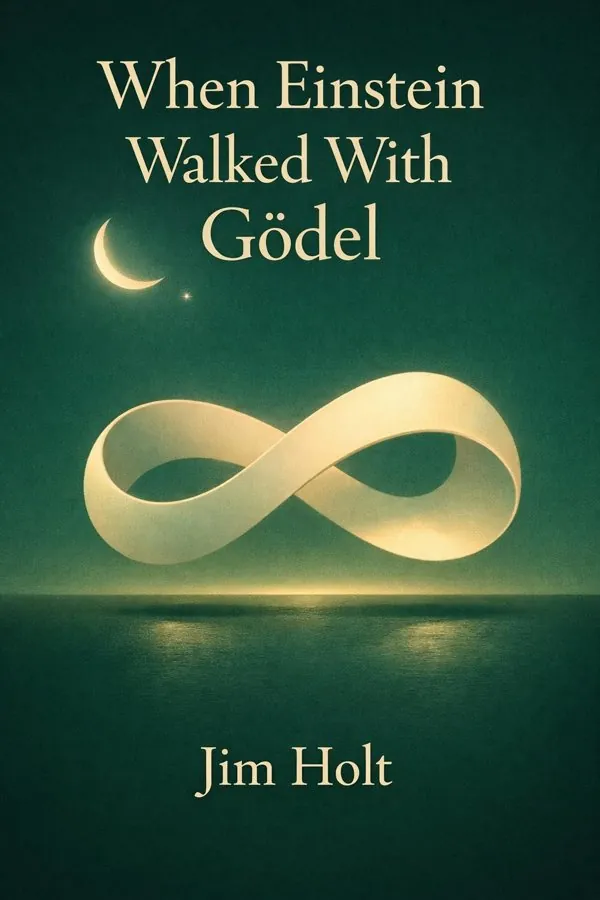
When Einstein Walked With Gödel: Excursions to the Edge of Thought: Summary & Key Insights
by Jim Holt
 10 min9 chaptersAudio available
What Is When Einstein Walked With Gödel: Excursions to the Edge of Thought About?
When Einstein Walked With Gödel: Excursions to the Edge of Thought by Jim Holt is a popular_sci book spanning 9 pages. A collection of essays exploring profound questions at the intersection of science, mathematics, and philosophy. Jim Holt examines topics such as the nature of time, consciousness, infinity, and the limits of human understanding, weaving together stories of great thinkers like Einstein, Gödel, and others to illuminate the mysteries of existence.
This FizzRead summary covers all 9 key chapters of When Einstein Walked With Gödel: Excursions to the Edge of Thought in approximately 10 minutes, distilling the most important ideas, arguments, and takeaways from Jim Holt's work. Also available as an audio summary and Key Quotes Podcast.
When Einstein Walked With Gödel: Excursions to the Edge of Thought
A collection of essays exploring profound questions at the intersection of science, mathematics, and philosophy. Jim Holt examines topics such as the nature of time, consciousness, infinity, and the limits of human understanding, weaving together stories of great thinkers like Einstein, Gödel, and others to illuminate the mysteries of existence.
Who Should Read When Einstein Walked With Gödel: Excursions to the Edge of Thought?
This book is perfect for anyone interested in popular_sci and looking to gain actionable insights in a short read. Whether you're a student, professional, or lifelong learner, the key ideas from When Einstein Walked With Gödel: Excursions to the Edge of Thought by Jim Holt will help you think differently.
- ✓Readers who enjoy popular_sci and want practical takeaways
- ✓Professionals looking to apply new ideas to their work and life
- ✓Anyone who wants the core insights of When Einstein Walked With Gödel: Excursions to the Edge of Thought in just 10 minutes
Want the full summary?
Get instant access to this book summary and 100K+ more with Fizz Moment.
Get Free SummaryAvailable on App Store • Free to download
Key Chapters
When I think of Einstein and Gödel walking together through the autumn streets of Princeton, I imagine two minds orbiting a shared fascination: time. Both men, in their own ways, had dismantled the ordinary flow of it. Einstein’s theory of relativity dissolved the universal ticking of clocks into a fluid network where time and space intertwined. Gödel, meanwhile, used logic to pierce mathematics itself, revealing that even the most rigorous systems are haunted by truths they cannot contain.
Their friendship was not merely social—it was metaphysical. As I explored their story, I found something poetic about how Einstein, nearing the end of his life, took solace in walking with Gödel, whose own work proved that reason is incomplete. When Gödel discovered a solution to Einstein’s equations—a rotating universe in which time loops back upon itself—he showed that relativity permits worlds where time has no true flow, where you could, in theory, visit your own past. Einstein found Gödel’s interpretation uncanny, yet resonant: both men seemed to intuit that time’s reality might be far thinner than our experience suggests.
To me, their conversation represents the limit of human thought pressed against the veil of the unknowable. Einstein had reduced time to geometry; Gödel had revealed that logical systems, like time, contain holes that logic cannot fill. Together, they embodied the tension that drives this book—the yearning to know, and the humility that follows when knowledge itself becomes suspect.
What, then, is time? The more one studies it, the more its solidity liquefies. In physics, we learn that time is relative: it slows near the speed of light, stretches near massive bodies, and refuses to keep the same tempo everywhere. Yet our inner sense of time—our memory, anticipation, regret—is vividly absolute. I wanted to explore this divide between the physical time of Einstein’s equations and the lived time of human consciousness.
The idea of the 'block universe' fascinates me most. In this view, the past, present, and future coexist equally, like different pages of a book all written and fixed. Our feeling of a 'now' sliding across that book is an illusion, a trick of perception. Physically, everything is already there; psychologically, we experience the unfolding as motion. The block universe forces us to confront a cosmological irony: if everything that happens is already laid out, where does our freedom, our novelty, our becoming reside?
When I talk with physicists, they often shrug at such questions. The equations work. But as a philosopher, I cannot shrug. The human meaning of time—our sense of growth, loss, and purpose—seems to depend on its passage. And yet, if Einstein and Gödel are right, we may live inside a vast stillness, a four-dimensional eternity masquerading as motion. To grasp this is unsettling, but also liberating. It teaches us that even our most intimate intuitions of temporality are local phenomena, fragile as consciousness itself.
+ 7 more chapters — available in the FizzRead app
All Chapters in When Einstein Walked With Gödel: Excursions to the Edge of Thought
About the Author
Get This Summary in Your Preferred Format
Read or listen to the When Einstein Walked With Gödel: Excursions to the Edge of Thought summary by Jim Holt anytime, anywhere. FizzRead offers multiple formats so you can learn on your terms — all free.
Available formats: App · Audio · PDF · EPUB — All included free with FizzRead
Download When Einstein Walked With Gödel: Excursions to the Edge of Thought PDF and EPUB Summary
Key Quotes from When Einstein Walked With Gödel: Excursions to the Edge of Thought
“When I think of Einstein and Gödel walking together through the autumn streets of Princeton, I imagine two minds orbiting a shared fascination: time.”
“The more one studies it, the more its solidity liquefies.”
Frequently Asked Questions about When Einstein Walked With Gödel: Excursions to the Edge of Thought
When Einstein Walked With Gödel: Excursions to the Edge of Thought by Jim Holt is a popular_sci book that explores key ideas across 9 chapters. A collection of essays exploring profound questions at the intersection of science, mathematics, and philosophy. Jim Holt examines topics such as the nature of time, consciousness, infinity, and the limits of human understanding, weaving together stories of great thinkers like Einstein, Gödel, and others to illuminate the mysteries of existence.
You Might Also Like

Structures: Or Why Things Don"t Fall Down
J.E. Gordon
10 min
The Road to Wigan Pier
George Orwell
10 min
Bonk: The Curious Coupling of Science and Sex
Mary Roach
10 min
First Bite: How We Learn to Eat
Bee Wilson
10 min
In Pursuit Of The Unknown: 17 Equations That Changed The World
Ian Stewart
10 min
Napoleon's Buttons: 17 Molecules That Changed History
Penny Le Couteur and Jay Burreson
10 minBrowse by Category
Ready to read When Einstein Walked With Gödel: Excursions to the Edge of Thought?
Get the full summary and 100K+ more books with Fizz Moment.