
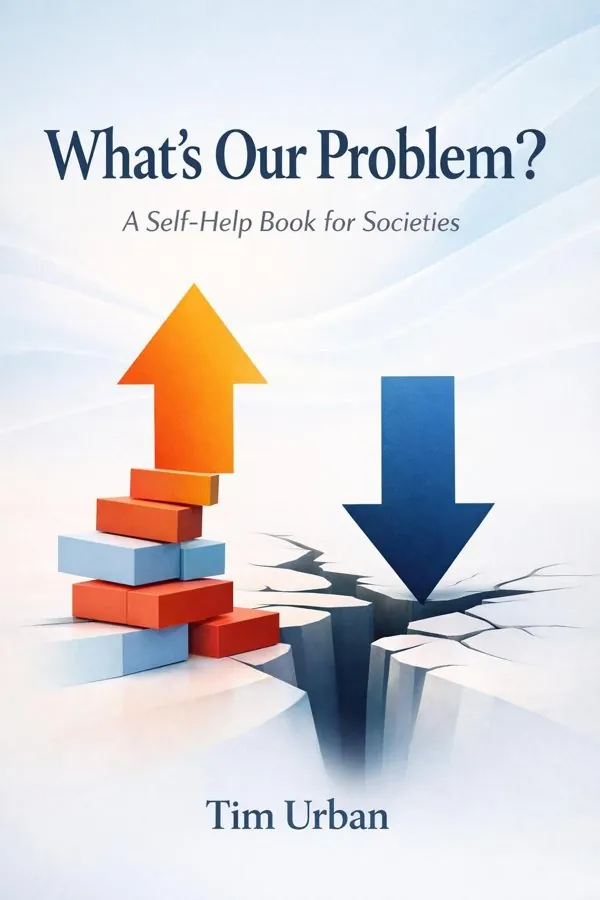
What’s Our Problem?: A Self-Help Book for Societies: Summary & Key Insights
by Tim Urban
 10 min4 chaptersAudio available
What Is What’s Our Problem?: A Self-Help Book for Societies About?
What’s Our Problem?: A Self-Help Book for Societies by Tim Urban is a sociology book spanning 4 pages. In this book, Tim Urban explores the modern social and political landscape through the lens of human psychology and group behavior. Using humor, illustrations, and accessible explanations, he examines why societies become polarized, how thinking can go wrong at scale, and what individuals can do to foster clearer, more rational discourse. The work blends social science, philosophy, and storytelling to encourage readers to think more deeply about collective progress and the challenges of modern democracy.
This FizzRead summary covers all 4 key chapters of What’s Our Problem?: A Self-Help Book for Societies in approximately 10 minutes, distilling the most important ideas, arguments, and takeaways from Tim Urban's work. Also available as an audio summary and Key Quotes Podcast.
What’s Our Problem?: A Self-Help Book for Societies
In this book, Tim Urban explores the modern social and political landscape through the lens of human psychology and group behavior. Using humor, illustrations, and accessible explanations, he examines why societies become polarized, how thinking can go wrong at scale, and what individuals can do to foster clearer, more rational discourse. The work blends social science, philosophy, and storytelling to encourage readers to think more deeply about collective progress and the challenges of modern democracy.
Who Should Read What’s Our Problem?: A Self-Help Book for Societies?
This book is perfect for anyone interested in sociology and looking to gain actionable insights in a short read. Whether you're a student, professional, or lifelong learner, the key ideas from What’s Our Problem?: A Self-Help Book for Societies by Tim Urban will help you think differently.
- ✓Readers who enjoy sociology and want practical takeaways
- ✓Professionals looking to apply new ideas to their work and life
- ✓Anyone who wants the core insights of What’s Our Problem?: A Self-Help Book for Societies in just 10 minutes
Want the full summary?
Get instant access to this book summary and 100K+ more with Fizz Moment.
Get Free SummaryAvailable on App Store • Free to download
Key Chapters
Modern technology isn’t neutral—it’s designed as a system of influence. In interviews with former Silicon Valley engineers, I learned that social media platforms function as hunters of attention. Their algorithms evolve constantly, drawing on our behavior data to maximize engagement. Every scroll, every tap, is measured, optimized, and exploited.
One designer told me their goal wasn’t to make users happy—it was to make them unable to leave. These platforms rely on the principle of intermittent reinforcement—the same mechanism that keeps gamblers glued to slot machines. Every like, comment, or push notification serves as a tiny reward, triggering a dopamine rush and a fleeting sense of pleasure. But that pleasure quickly fades, compelling us to chase it again.
Without realizing it, we become trapped in an endless stream of information. Our attention is sliced into fragments and sold as a commodity. The more addicted we become to fragments, the harder deep thought becomes. Algorithms build cognitive cages that masquerade as freedom.
Yet this chapter isn’t just an exposé—it’s a reminder. Technology itself isn’t the enemy; the intentions behind its design are. Once we understand those mechanisms, we can reclaim control over our devices instead of letting them control us. True freedom lies in understanding the system and setting boundaries by choice.
We live in an era that worships efficiency, urging everyone to become superhuman multitaskers. The truth, however, is that our brains cannot handle multiple complex tasks simultaneously. Neuroscience shows that so-called multitasking actually forces the brain to rapidly switch focus, draining cognitive resources each time.
As one researcher explained, bouncing between emails and social feeds repeatedly resets the prefrontal cortex—the part responsible for deep thinking—leading to weaker memory and comprehension. This constant state of partial attention keeps us alert but never truly focused. Over time, our baseline capacity for concentration declines.
The flood of information makes matters worse. Notifications, reminders, and alerts bombard us, leaving us mentally exhausted and unable to distinguish what truly matters. We think we’re absorbing knowledge, but often we’re merely consuming fragments, too scattered to form understanding.
Real productivity doesn’t come from doing more—it comes from doing one thing deeply. When we train ourselves to focus on a single task and mute unnecessary inputs, the brain’s deep-thinking circuits begin to recover. The illusion of multitasking must be broken. Only by reclaiming the power to choose what we attend to can we return to genuine thought and calm.
+ 2 more chapters — available in the FizzRead app
All Chapters in What’s Our Problem?: A Self-Help Book for Societies
About the Author
Tim Urban is an American writer, illustrator, and co-founder of the blog Wait But Why. Known for his long-form essays on topics ranging from procrastination to artificial intelligence, Urban combines humor and deep analysis to make complex ideas accessible to a broad audience. 'What’s Our Problem?' is his first full-length book.
Get This Summary in Your Preferred Format
Read or listen to the What’s Our Problem?: A Self-Help Book for Societies summary by Tim Urban anytime, anywhere. FizzRead offers multiple formats so you can learn on your terms — all free.
Available formats: App · Audio · PDF · EPUB — All included free with FizzRead
Download What’s Our Problem?: A Self-Help Book for Societies PDF and EPUB Summary
Key Quotes from What’s Our Problem?: A Self-Help Book for Societies
“Modern technology isn’t neutral—it’s designed as a system of influence.”
“We live in an era that worships efficiency, urging everyone to become superhuman multitaskers.”
Frequently Asked Questions about What’s Our Problem?: A Self-Help Book for Societies
What’s Our Problem?: A Self-Help Book for Societies by Tim Urban is a sociology book that explores key ideas across 4 chapters. In this book, Tim Urban explores the modern social and political landscape through the lens of human psychology and group behavior. Using humor, illustrations, and accessible explanations, he examines why societies become polarized, how thinking can go wrong at scale, and what individuals can do to foster clearer, more rational discourse. The work blends social science, philosophy, and storytelling to encourage readers to think more deeply about collective progress and the challenges of modern democracy.
You Might Also Like

Between the World and Me
Ta-Nehisi Coates
10 min
Half the Sky
Nicholas D. Kristof, Sheryl WuDunn
10 min
Men Explain Things To Me
Rebecca Solnit
10 min
Rational Ritual
Michael Suk-Young Chwe
10 min
The New Jim Crow
Michelle Alexander
10 min
Beyond Culture
Edward T. Hall
10 minBrowse by Category
Ready to read What’s Our Problem?: A Self-Help Book for Societies?
Get the full summary and 100K+ more books with Fizz Moment.