
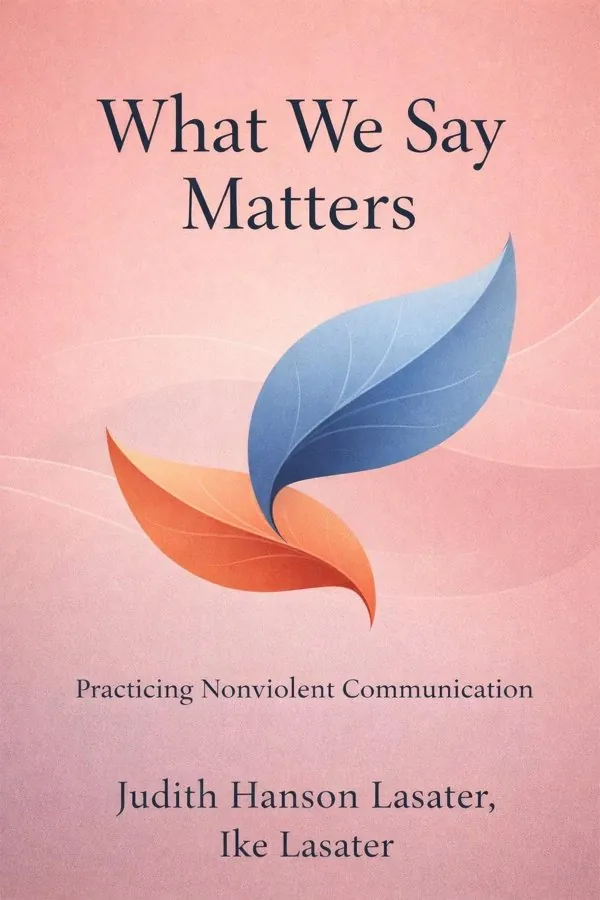
What We Say Matters: Practicing Nonviolent Communication: Summary & Key Insights
by Judith Hanson Lasater, Ike Lasater
 10 min7 chaptersAudio available
What Is What We Say Matters: Practicing Nonviolent Communication About?
What We Say Matters: Practicing Nonviolent Communication by Judith Hanson Lasater, Ike Lasater is a communication book spanning 7 pages. This book explores how the words we choose shape our relationships and our inner lives. Drawing on the principles of Nonviolent Communication (NVC), the authors offer practical guidance for speaking and listening with compassion, awareness, and authenticity. Through real-life examples and exercises, readers learn to transform habitual patterns of speech into mindful communication that fosters understanding and connection.
This FizzRead summary covers all 7 key chapters of What We Say Matters: Practicing Nonviolent Communication in approximately 10 minutes, distilling the most important ideas, arguments, and takeaways from Judith Hanson Lasater, Ike Lasater's work. Also available as an audio summary and Key Quotes Podcast.
What We Say Matters: Practicing Nonviolent Communication
This book explores how the words we choose shape our relationships and our inner lives. Drawing on the principles of Nonviolent Communication (NVC), the authors offer practical guidance for speaking and listening with compassion, awareness, and authenticity. Through real-life examples and exercises, readers learn to transform habitual patterns of speech into mindful communication that fosters understanding and connection.
Who Should Read What We Say Matters: Practicing Nonviolent Communication?
This book is perfect for anyone interested in communication and looking to gain actionable insights in a short read. Whether you're a student, professional, or lifelong learner, the key ideas from What We Say Matters: Practicing Nonviolent Communication by Judith Hanson Lasater, Ike Lasater will help you think differently.
- ✓Readers who enjoy communication and want practical takeaways
- ✓Professionals looking to apply new ideas to their work and life
- ✓Anyone who wants the core insights of What We Say Matters: Practicing Nonviolent Communication in just 10 minutes
Want the full summary?
Get instant access to this book summary and 100K+ more with Fizz Moment.
Get Free SummaryAvailable on App Store • Free to download
Key Chapters
Most of us speak automatically, without noticing the emotional residue that our words leave behind. We grew up hearing expressions that judged, blamed, or compared, and those phrases quietly became our inner soundtrack. In this section, I guide you through the subtle ways our habitual patterns of speech create disconnection, even when our intentions are good. For instance, when we tell someone they are 'wrong' or 'should' behave differently, we implicitly place ourselves above them, as if communication were a battlefield rather than a meeting of two human beings seeking understanding.
Habitual language obscures our true experience. Instead of saying, 'I’m frustrated because nobody listens to me,' we might say, 'You never pay attention!' The first statement reveals feeling and need; the second hides them beneath blame. Once we start listening for the underlying need — maybe the desire to be heard and valued — we discover an opening for empathy. This exploration is not theoretical. It involves catching ourselves mid-sentence and softening into mindfulness. Ike often describes it as learning a new language that reveals what is alive in us rather than who is at fault. This section teaches you how awareness transforms speech from habit into choice.
Imagine a tense workplace meeting. Instead of countering criticism with defensiveness, you pause, breathe, and notice the tension rising in your chest. That pause is power. You can then respond from curiosity rather than anger: 'I hear that you’re worried about deadlines. Can we explore what would help you feel more confident about our progress?' By choosing consciousness over reaction, you shape a space where collaboration can flourish. Habits lose their grip when awareness holds them gently. This is the essence of mindful communication — noticing before reacting and speaking from a place of genuine intention.
At the core of Nonviolent Communication are four distinctions that illuminate how to express authenticity and receive others with compassion: observation, feeling, need, and request. Each component is like a facet of a crystal — transparent, distinct, and refracting truth when held to light. Observation means seeing what is actually happening without evaluation. Feelings reveal the emotional resonance of those observations. Needs uncover the universal forces motivating those feelings. Requests bring the awareness into action through clear, compassionate dialogue.
In daily life, these components act as a bridge between self-awareness and interpersonal understanding. For instance, instead of saying, 'You’re inconsiderate,' we might practice, 'When I see the dishes left in the sink, I feel overwhelmed because I value order and cooperation. Would you be willing to help me wash them this evening?' In this transformation, judgment dissolves into transparency, and defensiveness softens into cooperation.
What makes this practice powerful is its simplicity. Observation trains us to separate fact from interpretation — a discipline as rigorous as mindfulness itself. Feelings remind us we are living beings, not machines; we move through experiences that need acknowledgment. Needs connect us to every other human, revealing that behind conflict lies shared humanity. And requests invite collaboration, honoring autonomy rather than control.
Throughout this chapter, Ike shares stories from mediation and professional training, showing how these four components turn adversaries into allies. Whether between colleagues or couples, the shift from 'you’re wrong' to 'I’m longing for understanding' redefines the atmosphere entirely. The four components are not steps to follow mechanically but windows into consciousness — tools for uncovering what truly matters beneath every word we speak.
+ 5 more chapters — available in the FizzRead app
All Chapters in What We Say Matters: Practicing Nonviolent Communication
About the Authors
Judith Hanson Lasater, Ph.D., is a physical therapist and yoga teacher known for her work in restorative yoga and mindful living. Ike Lasater, J.D., is a co-founder of Mediate Your Life and a trainer in Nonviolent Communication, focusing on conflict resolution and personal growth.
Get This Summary in Your Preferred Format
Read or listen to the What We Say Matters: Practicing Nonviolent Communication summary by Judith Hanson Lasater, Ike Lasater anytime, anywhere. FizzRead offers multiple formats so you can learn on your terms — all free.
Available formats: App · Audio · PDF · EPUB — All included free with FizzRead
Download What We Say Matters: Practicing Nonviolent Communication PDF and EPUB Summary
Key Quotes from What We Say Matters: Practicing Nonviolent Communication
“Most of us speak automatically, without noticing the emotional residue that our words leave behind.”
“At the core of Nonviolent Communication are four distinctions that illuminate how to express authenticity and receive others with compassion: observation, feeling, need, and request.”
Frequently Asked Questions about What We Say Matters: Practicing Nonviolent Communication
What We Say Matters: Practicing Nonviolent Communication by Judith Hanson Lasater, Ike Lasater is a communication book that explores key ideas across 7 chapters. This book explores how the words we choose shape our relationships and our inner lives. Drawing on the principles of Nonviolent Communication (NVC), the authors offer practical guidance for speaking and listening with compassion, awareness, and authenticity. Through real-life examples and exercises, readers learn to transform habitual patterns of speech into mindful communication that fosters understanding and connection.
You Might Also Like

Magic Words: The Science and Secrets Behind Seven Words That Motivate, Engage, and Influence
Tim David
10 min
Talking Across The Divide: How to Communicate with People You Disagree with and Maybe Even Change the World
Justin Lee
10 min
The Exceptional Presenter: A Proven Formula to Open Up! and Own the Room
Timothy J. Koegel
10 min
4 Essential Keys to Effective Communication in Love, Life, Work--Anywhere!: Including the 12-Day Communication Challenge!
Bento C. Leal III
10 min
Active Listening Techniques: 30 Practical Tools to Hone Your Communication Skills
Nisha Gupta
10 min
Bargaining for Advantage: Negotiation Strategies for Reasonable People
G. Richard Shell
10 minBrowse by Category
Ready to read What We Say Matters: Practicing Nonviolent Communication?
Get the full summary and 100K+ more books with Fizz Moment.