
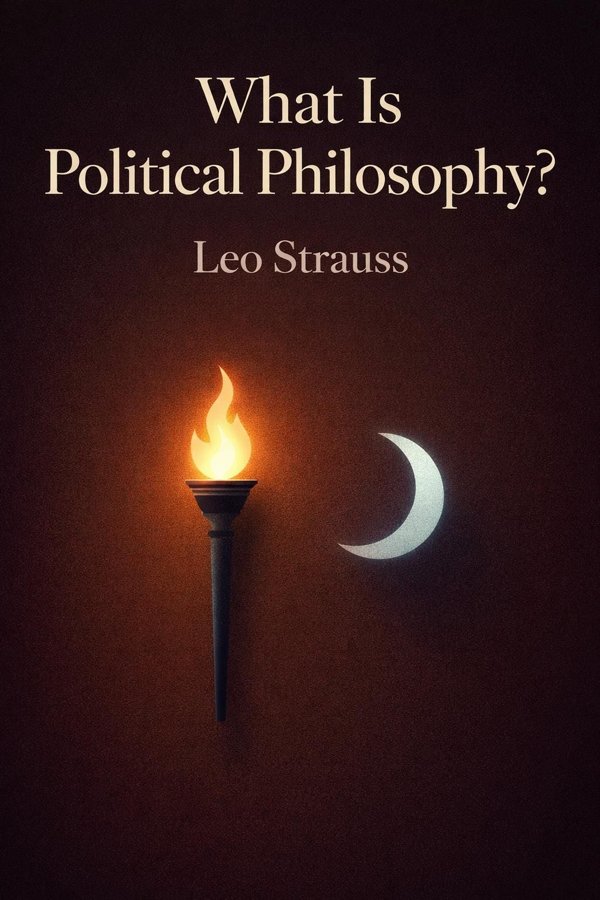
What Is Political Philosophy?: Summary & Key Insights
by Leo Strauss
 10 min8 chaptersAudio available
What Is What Is Political Philosophy? About?
What Is Political Philosophy? by Leo Strauss is a politics book spanning 8 pages. In this influential collection of essays, Leo Strauss explores the fundamental questions of political philosophy, examining the relationship between philosophy and politics, the nature of political knowledge, and the tension between reason and revelation. The book includes the seminal essay 'What Is Political Philosophy?' and other works that shaped twentieth-century political thought.
This FizzRead summary covers all 8 key chapters of What Is Political Philosophy? in approximately 10 minutes, distilling the most important ideas, arguments, and takeaways from Leo Strauss's work. Also available as an audio summary and Key Quotes Podcast.
What Is Political Philosophy?
In this influential collection of essays, Leo Strauss explores the fundamental questions of political philosophy, examining the relationship between philosophy and politics, the nature of political knowledge, and the tension between reason and revelation. The book includes the seminal essay 'What Is Political Philosophy?' and other works that shaped twentieth-century political thought.
Who Should Read What Is Political Philosophy??
This book is perfect for anyone interested in politics and looking to gain actionable insights in a short read. Whether you're a student, professional, or lifelong learner, the key ideas from What Is Political Philosophy? by Leo Strauss will help you think differently.
- ✓Readers who enjoy politics and want practical takeaways
- ✓Professionals looking to apply new ideas to their work and life
- ✓Anyone who wants the core insights of What Is Political Philosophy? in just 10 minutes
Want the full summary?
Get instant access to this book summary and 100K+ more with Fizz Moment.
Get Free SummaryAvailable on App Store • Free to download
Key Chapters
When I reflect upon the problem of political philosophy, I do not see merely an academic tension between two disciplines. I see a conflict rooted in the nature of the philosopher’s life. Philosophy, by its essence, seeks truth, while politics, by its essence, seeks order and cohesion. The city demands loyalty and consensus; the philosopher demands freedom and inquiry. Thus, political philosophy must continually attempt the reconciliation of truth and opinion, of nature and convention.
The philosopher lives among citizens who hold beliefs about the gods, justice, and virtue. Yet these beliefs are maintained so that the city may survive, not because they have been proven true. The philosopher, in seeking knowledge, examines these opinions and uncovers their contradictions. In the classical sense, this act of questioning is the beginning of wisdom, but it can be dangerous, because it subverts the opinions upon which civic unity rests. Socrates is the symbol of this danger: he was put to death because his questioning appeared to threaten the city’s moral foundations.
This tension defines the permanent problem of political philosophy. Can truth and politics be reconciled? Can the philosopher live with the city without betraying philosophy’s principles? Political philosophy must recognize both the necessity of political order and its imperfection. The best city will always be guided by opinion more than truth, yet without the philosopher’s questioning, political life degenerates into mere power-seeking or myth-making. The task, then, is not to destroy the city in pursuit of truth, but to illuminate its opinions so that they come closer to what is truly just.
When I turn to the ancients—to Socrates, Plato, Aristotle—I find a form of political thought superior in clarity and moral depth to our own. Classical political philosophy began as the Socratic search for nature’s guidance. Socrates discovered that human beings possess reason, and through reason, they can discern what is just by nature, not by convention. The classical thinkers held that there exists a natural order of ends: human flourishing depends on the cultivation of virtue, and virtue is knowledge of what is good.
In this tradition, political philosophy was not separated from moral philosophy. The question of the best regime was inseparable from the question of the best life. The polis was understood as the arena in which human excellence could be realized—it provided the conditions for the practice of virtue. Justice, therefore, was not a mere system of legality or contract; it was the right ordering of souls and communities according to nature. Political philosophy, in its classical form, sought to discover this natural right, to articulate the standards of justice independent of opinion.
The Socratic legacy taught that all political ideals must be examined through dialectic—the rational exchange of arguments aimed at discovering truth. This method recognized that human beings are capable of knowing the good, yet never cease to debate its meaning. Through this questioning, philosophy nourishes the city with moral insight, while the city nourishes philosophy with the experience of real human affairs. Such was the harmony envisioned by classical rationalism: a partnership between mind and polis grounded in the reality of human nature.
+ 6 more chapters — available in the FizzRead app
All Chapters in What Is Political Philosophy?
About the Author
Leo Strauss (1899–1973) was a German-American political philosopher known for his studies of classical political theory and his critique of modernity. He taught at the University of Chicago and influenced generations of scholars in political philosophy and political science.
Get This Summary in Your Preferred Format
Read or listen to the What Is Political Philosophy? summary by Leo Strauss anytime, anywhere. FizzRead offers multiple formats so you can learn on your terms — all free.
Available formats: App · Audio · PDF · EPUB — All included free with FizzRead
Download What Is Political Philosophy? PDF and EPUB Summary
Key Quotes from What Is Political Philosophy?
“When I reflect upon the problem of political philosophy, I do not see merely an academic tension between two disciplines.”
“When I turn to the ancients—to Socrates, Plato, Aristotle—I find a form of political thought superior in clarity and moral depth to our own.”
Frequently Asked Questions about What Is Political Philosophy?
What Is Political Philosophy? by Leo Strauss is a politics book that explores key ideas across 8 chapters. In this influential collection of essays, Leo Strauss explores the fundamental questions of political philosophy, examining the relationship between philosophy and politics, the nature of political knowledge, and the tension between reason and revelation. The book includes the seminal essay 'What Is Political Philosophy?' and other works that shaped twentieth-century political thought.
You Might Also Like
Antifa: The Anti-Fascist Handbook
Mark Bray
10 min
Attack from Within: How Disinformation Is Sabotaging America
Barbara McQuade
10 min
Coercion, Capital, and European States, AD 990–1992
Charles Tilly
10 min
Digital Democracy: Concepts, Methodologies, Tools, and Applications
Various Authors
10 min
Fascism
Stanley G. Payne
10 min
Fire And Fury: Inside The Trump White House
Michael Wolff
10 minBrowse by Category
Ready to read What Is Political Philosophy??
Get the full summary and 100K+ more books with Fizz Moment.